Monday, April 18, 2016

EarthBound

Note: Minor spoilers included. EarthBound Beginnings is referred to its original name, Mother, for context.


What is the video game, Earthbound?
Even today, it’s so hard to answer that question.

It was like a group of children taking dolls from a toy chest.
Old dishes no longer used in the kitchen.
Nuts and bolts found inside a toolbox.
Little flowers and leaves from the backyard.
And they were all laid down on the carpet with everybody singing made-up songs.
Ready to talk all day about that world they just made.
That, I think was how Earthbound was made.

Well, I’m a grown-up too,
so I didn’t hold back in adding things here and there,
like putting more angles here,
hiding a secret there,
and sometimes slipping in little mean things.

Then a whole lot of friends came over to play.
And they helped it grow as they were having fun as they pleased.
They gave it branches, leaves and flowers,
to what was once a simple story of just root and trunk.
For every person that played, there are that many iterations of Earthbound.

As I met different people on unrelated occasions,
they told me “I found out about you by playing Earthbound.”
This was not only right after the game was out.
People were telling me this after it’s been out for quite some time.

All sorts of people tell me about their memories,
about all the things I left in the playground called Earthbound.
From the tiny safety pins, broken pieces of colored glass to the withering leaves.
When I ask them, “how do you remember so much?”
With their eyes gleaming, they say,
“I love that world so much I remember everything about it.”
I reply right away saying “me too.”

Ah hah! That may be it.
Maybe I wanted to make a playground.
A playground filled with things no matter how small or unwanted,
they would all be kept dear in people’s hearts.
It looks like all my friends from around the world have discovered the theme to the game as they were playing – even though I didn’t think I gave it one.
That’s right, that’s something I also wanted to do all along.

I was already a grown-up at the time I was making Earthbound,
but now that thirty years have been added to my life, I’ve grown up even more.
I think about things that I didn’t back then.

Things like, “what kind of a person do I want to be when I die?”
I already know the answer to this one.
It’s “someone with a lively wake.”

The person who passed away has to be in all sorts of different people’s memories.
What they’ve done, how stupid they were, what kind of things they did for fun,
and how kind that person was sometimes.
All the people who are still alive are laughing,
wanting to be the first one to bring up those things to everyone around them.
The life I want to live is something that can be concluded with that kind of a party-like wake.
Fame and fortune, setting records and accomplishments are all meaningless.
That person is inside those stories that are told,
where people talk about their episodes, casually and sincerely.

Well, it’s not dead, and it’s not even human,
but to me Earthbound is a game that’s kind of like that guy.

Now that you’ll be able to play Earthbound to your heart’s content,
I hope you’ll play it with someone and create all kinds of great, happy memories.
I’m glad that this day has come.
And I think everyone who had a part in making this game is very excited too.

Thank you for everything. 


~EarthBound creator Shigesato Itoi, on the digital release of the game for Wii U.

----

When I first read Mr. Itoi's write-up, I was stunned at how much it mirrored my own feelings on EarthBound, which holds the distinction of being my favorite video game ever made. Only very recently had I realized my feelings on the game had come full circle, and the tears I shed upon its Virtual Console announcement just a few months before affirmed that EarthBound was as close to me as ever.

But despite my undying love for it, it's a title that's hardly penetrated public consciousness, so an introduction is necessary. Despite the singular name, EarthBound is actually the second of a JRPG trilogy known in Japan as Mother. Why did Mr. Itoi grant the series such an unusual name? There's his personal connection with the John Lennon song of the same name, for starters, but the name betrayed typical JRPG conventions of the time. There were no dragons or fantasies or legends implied, but a word associated with feelings of warmth and love.


That, and there are a whole lotta Motherships flying around. Choosing to instead take place in a tongue-in-cheek parody of America, protagonists in the form of children take on aliens, robots and brainwashed hippies as they gather melodies, battle with psychic powers and baseball bats and pop guns while learning the values of love. It wasn't uncommon for JRPGs to use avatars as proxies for the player, but Mother was unprecedented: for all the imagination it took to imagine yourself in Ye Olden times, here was an adventure you could forge in your very own backyard.

One that North America never gave a chance. While beloved cult classics in their native country of Japan, Mother had its own set of troubles settling into the very country that inspired it. The original Mother for the Famicom had been fully translated and localized for American NES release, but was quietly canceled in the face of the upcoming SNES. Mother 2, or what we know as EarthBound, was released in 1995, but what was perhaps the worst advertisement concept in video game history prevented any sort of mainstream success.

There were two factors that prevented EarthBound from falling into the ether. One was that the audience it did grab and speak to grew into some of the most passionate fans the industry has ever seen. Indeed, the folks at Starmen.net have created much noise for roughly two decades now, what with it hosting annual summer playthroughs for EarthBound, petitions begging for Mother 3's revival from cancellation and translation patches for titles that never made it over to America (Mother 3 and the GBA port Mother 1+2). Believe it or not, there's actually a Wikipedia article on how passionate we Mother fans are.


We'll get into the other one later, but what makes EarthBound so special? Honestly, I cannot bear to begin with any one detail without immediately seguing into another. There's the colorful, minimalist graphic style that leaves just enough detail for the players to fill in the gaps; the script, handwritten by Itoi himself and manages a wonderful balance of being rip-roaringly funny and achingly sincere; the music, an absurdly unique blend of genres, sampling and dissonance by Hirokazu Tanaka and Keiichi Suzuki; the New Age Retro Hippie, one of the brainwashed denizens you meet in Twoson who fights by brushing his teeth and whose theme music is obviously (amazingly?) inspired by Johnny B. Goode.

In case you hadn't caught on, EarthBound is something of a part-comic, part-thought-provoking deconstruction of JRPGs. But it's never a cynical one; actually, it's a progressive one. Where Itoi stumbled in the very same traps he wanted to avoid for the original Mother, none of the large, confusing maps or frustrating random battles are present here. Take the latter: not only does everything from aliens to possessed road signs traverse on the very same maps you do, but enemies you've long since outstripped will flee at first sight. If you chase them down, you'll beat them in, literally, a flash. (So long, Worthless Protoplasms!) Yes, it may throw monkey wrenches like randomly blocking players with iron pencil statues, but it's largely all for the sake of comedy. (After all, why do you think they can only be dismantled through a device known as the "Pencil Eraser"?)

It's a game that invites you in not just because of how weird and funny it is, but because it makes you the star, and it's dead-set on making you feel like one. The naming screen asks what your favorite thing is, which subsequently becomes the name of Ness's personalized PSI attack. Your favorite food isn't just whipped up by your Mom, but is the topic of conversation among several NPCs ("Bread"? Please...we do not have such trash on our menu"). Kids who play it are often tempted to name Ness and the gang after themselves and their friends. The game actually speaks to you at certain points--no, not Ness, but you, the player holding the controller.

In a way, it becomes a game that transcends "play". You don't spend your time grinding for levels or meticulously planning battle strategies like other JRPGs, but instead are actually invested in what NPCs have to say and find yourself exploring every crook and nanny of every town just to make sure you've talked to everyone. After all, why wouldn't you want to talk to Ruffini, the drugstore dog who's possessed by Itoi? And you better make it a habit to pick up every phone you see, because if Ness hasn't called his mother for a while, he'll be stricken by homesickness and rendered useless in battle.

It's a living, breathing, organic world where you can call Mach Pizza and wait at the bus stop. Concerts are attended (actually, they're woven into the storyline!) and you can experiment with what condiments go on what foods. You can ride a bike and ring its bell if only for the shortest of times (or can you?). Is that a treehouse hidden in the forests of Onett? What are those two conspicuous dots lying in the Dusty Dunes Desert, and what happens if I interact with them? Who is Nico, the little girl who sings and dances in Magicant, Ness's realm of memories? What's the deal with that tiny, inaccessible house outside the stretches of Twoson?


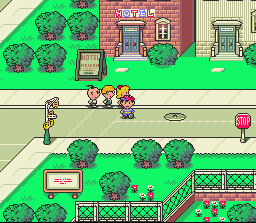
Itoi's toy chest comparison hits the mark; indeed, EarthBound may very well be an electronic toy chest. Not in the "build-your-world" context of Minecraft and Little Big Planet, mind, but a metaphorical one; alongside its bright colors, the game's oblique projection tilts the perspective just enough to present it as a diorama, with the characters as dolls and figures you want to pick up and play with. EarthBound's character sprites are hardly as detailed as, say, Chrono Trigger, but as mentioned before, they stay just minimalized enough for players to come up with their own personalized details. (Think about it: how many different interpretations of Ness have you seen in the game's countless troves of fan art?)


One of my favorite examples involves the lone NPC you see above. You see that guy with the blond hair? Try reading his shirt. Okay, you can't, but note how it's just legible enough to make out the famous "I Heart" brand of shirts. What does he love? We don't know, but boy can we have fun filling in the blanks. (apparently Itoi loved the character as much as we did, as the NPC reappears in Mother 3) There are other favorite designs, namely how the members of Tessie Watching Club always have binoculars glued to their faces and conspicuous Mr. T lookalikes (the best possibly being a resident of Twoson, who, after a kidnapping incident is resolved, claims he'll be "careful" not to kidnap anyone. It's not nearly as suspect as it sounds, but that it's said so straight-laced always has me howling).


So while EarthBound's graphics are hardly a looker by SNES standards, they remain timeless via the player's own projection. Just take how it treats the game's sole visual stunner: the psychedelic battle backgrounds. Pulsing and fluttering around like a music visualizer, these fluctuating abstractions steal the show of the admittedly simple battle encounters. EarthBound's battle system isn't the deepest you'll come across, and you can't even see your party, but that's okay. After all, you're the star; how the kids fend off aliens with baseball bats and frying pans and bazookas and the hexagonal chaos that are PSI attacks is entirely up to your imagination.

Take an old perception of mine as some food for thought: are you fighting in the streets of Onett, or are you zapped into dimensions host to those zany 3D backgrounds? Back when I was a kid, I perceived it as the latter, and mentally framed all the battles as such. Was I taking the presentation literally as-is, or did I take inspiration from the whole "crime-fighting kids who keep their occupation secret" cartoon trope? Regardless, even now I occasionally get caught up in that little theory, and now maybe you can, too.

But if we must praise the battle system from a "game" perspective, there is no other nominee but the rolling HP meter. Whereas enemy damage is immediately applied to your characters' HP in other RPGs, any attacks here slowly dwindle down number-by-number as according to how much was inflicted. Even if you're dealt mortal damage, a serving of Hamburgers or casting a PSI LifeUp will save yourself before the ticker reaches zero. EarthBound keeps its battle just interesting enough to keep the player invested, but it doesn't go for flashiness lest it overrides its purpose of immersion.


Needless to say, EarthBound was far ahead of its time for a 1994 video game, and so much of this has to do with the excellent, excellent writing. That Mr. Itoi is, first and foremost, a copywriter/essayist should speak for itself on how different it's going to be, but consider how he's considered to be one of Japan's most eccentric. Hardcore Gaming 101's review elaborates on how the Japanese kana for the original Mother 2 projects what can be best described as a free-flowing script that, despite the childish inclinations from that sector of the Japanese language, never comes across as patronizing.

All woefully difficult to conserve in translation, you understand, and yet Mother 2's transition into EarthBound results in what's NOA's first legitimately great localization. I'm not exaggerating here: just read up on Clyde Mandelin's super comprehensive Mother 2 vs. EarthBound comparison, and you'll realize how any mistranslations that slipped by are a drop in the bucket to how perfectly it captures Itoi's tone. Bear in mind this is from the mid-90's; granted, we'd just started to figure out this "localization" business (no more "Dodongo dislike smoke!" for us Nintendo fans), but that the localizers felt the words "crap" and "sexy" were needed to flesh out Itoi's world just proves EarthBound's localization is a real gift. (Bear in mind not only had NOA been enforcing a strict "kid's only" set of depiction guidelines at the time, but the former word only just recently became standard for Fire Emblem games, while the latter remains exclusive to good ol' EB)


And what a gift the writing itself is. It's a masterful blend of wit, parody, casual speak, and occasional sincerity. Helpful one moment and sudden (but clever!) Beatles reference the next. It'll break the fourth wall, but only in ways that'll serve the game's world and the player's connection. There are two entire dungeons dedicated to gloriously parodying RPG tropes. It's not outright manic, but it's the logic behind an earlier point: you want to explore everything the game has to offer. For example, you discover early on that while not every building is accessible, you'll still receive an answer should you knock on the door. How many houses can I enter, you might wonder, and so you're encouraged to find out what lies in them. If you can't, you're at least rewarded with funny dialogue.


The NPC dialogues are really the winner here. I could elaborate on any number of them, but I particularly enjoy the ones who betray conventions. The first woman you meet in Twoson who introduces the town, for one; I dare not spoil the punchline, but I can confirm the conversation will induce more philosophical ponderings on NPCs you never thought possible. Anyone invoking wordplay (namely the Happy-Happyist Cult, who desire to paint the world blue) is a riot, and I also appreciate the wordplay behind the towns ("Twoson--we got this name because we weren't first").


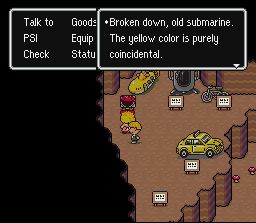
Of course, the best of the best are everyone's favorite part of the game: the Mr. Saturns, a race of tiny aliens fond of ribbons, help Ness engage in introspective coffee trips, and are, at one point, held captive by sentient piles of barf. Oh, and they speak in broken English, with their font as a mess of foreign-styled scribbles (apparently inspired by the handwriting of Itoi's daughter). This results in beautiful dialogue like in screenshot above. Basically, if they don't make you at least crack a grin, you don't have a soul.

Anyone could make a case for EarthBound's quirky, innovative writing being the best part of the game, but you could just as easily do the same for its quirky, innovative score. For the sake of context, I consider the Super Nintendo to be home to the greatest soundtracks in gaming history, be it the orchestral flair of Kirby Super Star and Chrono Trigger, the rock of Star Fox, the chill ambiance of the Donkey Kong Country games, and Super Mario RPG's repertoire of xylophones, pianos and whistles remaining the very best of Yoko Shimomura. As opposed to the limited channels of NES chiptunes and the N64's weak MIDI instrumentation, the balance of synth in SNES music is almost magic in how there's no compromises in producing truly rich scores. There's a homely, warming nostalgia to it all, and you could swear early examples like Super Mario World and SimCity were scored around this very purpose.


Maybe it's how the composers built upon Itoi's love of Lennon and based the soundtrack around how much he sang about love. Maybe it's Keiichi Suzuki's non-game music background or Hirokazu Tanaka's unique approach to producing music (perhaps he took inspiration from the "living creature" sound of Metroid?). Whatever it is, it expertly plays into the game's themes. Take the concept of Ness's home: no matter how far you've gone in your journey, no matter how many countries you've travelled, you're always welcomed home with a serving of your favorite homemade food, courtesy of Mom. Even with the fate of the world on his shoulders, Ness is still, after all, a young boy.


And all the while, a slow arrangement of the Pollyanna overworld theme from the first Mother plays. If I'm forced to choose a favorite song, it would be this. It is a Lazy Sunday and a tearful homecoming all in one, topped off with what can only be described as a heavenly choir. It always, without fail, makes me feel safe and loved, makes me reflect whether I'm playing the game or simply looking it up on YouTube.


We could spot similar themes in Eight Melodies, which plays throughout the game in various forms. It echoes in toy-box form whenever a new melody is gathered at a "Your Sanctuary", and again as a whole in the game's most heartwarming scene: Ness visiting his baby-self in monochrome. It's echoed again in the Sound Stone item; a deeper introspective that gradually morphs with the more melodies you gather. But up until all are collected, it stops after your last melody and thumps with perhaps the most unique sampling: an instrumental take on Lennon's Give Peace a Chance.


Of course, EarthBound doesn't always get all mushy. Let's not forget it is a weird, weird beast, and we learn that the moment we reach the naming screen. We're greeted with the game's first instance of ear-catching dissonance, consisting of a Monty Python's Flying Circus sampling before diving into a pop beat. It's a beat so infectious that I tend to stick around far longer than I should, staring at each character's animations as I file through their lists of default names.


Actually, EarthBound doesn't just stick to samplings; at times, it pays full-blown tributes, including one of my favorite pieces above. The theme of the Sky Runner machine is undoubtedly derived from The Who's Won't Get Fooled Again, (or, at the very least, its intro) and fans had long since speculated EarthBound took so long to reach the Virtual Console due to music licensing/infringement issues, with this song at the top of the list. If that's the case, then I dub it a necessary evil that we had to wait so long, because I cannot imagine anything more perfect than the technopop launch buildup and the steady, pronounced percussion of the actual flight.


Obviously, EarthBound's music has its roots (and rightfully so!) in the Western sphere. Its parody of American culture comes alive best in Twoson, a laid-back tune I actually once wrote about. All the numbered-town tunes with their own brand of American nostalgia, but I particularly enjoy this one in how it's the sort of the tune that'd accompany a country drive. I'm also fond of the theme for the town's Chaos Theater, undoubtedly one of the game's top atmospheric tracks (just listen to all the little clinks!).

There are so, so many more I could elaborate upon---the snowy nostalgia of Winters and the Snow Wood Boarding School, the latter of which is another atmospheric winner through its borrowing of of Mother's Snowman theme. The tribal, jubilant walk of The Lost Underworld. My favorite of the psychedelic battle themes, which is reserved for mini-boss fights. The climatic fusion of 8-bit marches, rock guitars and haunting ambience for the masterpiece that is the final boss battle. The heartwrenching duo of Because I Love You and Smiles And Tears for their respective ending setpieces. There are many others.

But I fear I've shared too much already, and I haven't even discussed what I love most about the game.


The reason why EarthBound resonated so much with its fans is because while it's a fantastical sci-fi experience following the tale of four children, it's all framed within very human circumstances.Just ask the guy who grew up without a father and was comforted by how Ness communicated with his absent father through telephone (which is the game's method of saving). *Or the gay man who had anti-gay rallies take place on his street, and could only find solace in Jeff's friend: Tony, a homosexual child who dreams of taking walks with his bespectacled roommate.

*This story was shared on a Starmen.net forum post nearly a decade ago. I've since been unable to find it, but the tale's stuck with me as a prime example of EarthBound's immersion.

And take me. The other factor that prevented EarthBound from falling into the American abyss--the one hooked me into the game--was that Ness was included in the roster for the Nintendo 64's crossover fighter Super Smash Bros. The character fascinated me all the way up through the GameCube's Melee: here was a young boy who sauntered into a Nintendo all-star fray as if he was on the same level as Mario or Donkey Kong, and all he had to show for it was his brand of psionic powers. That was rad.

What was even radder was how his source game ticked off every box that 4th Grade me identified with. It was weird not just for the sake of being weird, but was entirely self-aware (NPCs commonly mention the game's title) and ripped on RPG tropes (the aforementioned Pencil Statue). I was out-of-touch and awkward and the game's "neglected" status became an identifiable symbol, a treasure hidden within the flood of "I rented Enter the Matrix over the weekend" during Circle Time.

Oh, and I also liked random humor. The likes of Invader Zim and Ed, Edd n' Eddy warped my young mind with their mall security zombies and buttered toast, and soon a new outlet of humor was born and eventually expressed through the likes of Games in the Basement and writings/drawings revolving around Kung Fu Animal Forces and Zombie Men. And now for the first in my favorite medium, I had a refuge in a game that hosted Mr. Saturns, peanut-cheese bars, and trout-flavored yogurt. Even if others didn't accept me, I was vindicated through this one game alone.

Of course, I've grown to further appreciate the game's satire as I've gotten older, but the way it's transformed the mundane into the hysterical is just phenomenal. Here's an example I've grown to recognize as one of my favorites: after collecting the first of the Eight Melodies, Ness is accosted by Onett's police (who, just so you know, are going for the world record in road-blocking) for trespassing in a restricted area, and is told to report the station. There, the chief explains that while he's aware Ness wishes to travel to Twoson, the roads shall remain blocked unless he completes a certain test. Leading him down to an isolated room, he turns to Ness and asks if he can "get past five of my best men..."

At the time, I took this at face-value. So Ness had to take on some policemen now, okay. I'd already put a stop to the biggest, baddest gang in town and took down a giant ant, and it's not like I wasn't already running over police in Grand Theft Auto: Vice City. How was fighting cops any different than stomping on Goombas? It wasn't until I was replaying it in college when I realized this guy legitimately pitted a little boy against trained policemen. Cops that chose to battle with karate chops rather than firearms, mind, but it was enough to send me into hysterics (that it was already home to some of the game's best quotes was icing on the cake).

And even still, the best examples of EarthBound's humor are those rare moments when it blends weird with the genuinely heartfelt; case in point, the Camera Man. Every so often, stepping on an unassuming spot will trigger a trumpeting fanfare as a bearded man spirals down the sky and, after announcing his profession, will snap a picture of Ness's party. He'll claim the picture will bring back the greatest of memories and, just as quickly as he came, spins back into the heavens.

That this seemingly pointless event occurs again and again throughout the game tricks you into thinking it's just one of EarthBound's gleeful methods of screwing with the player. And maybe it kind of is; I'll admit I actually hated him as a kid for interrupting my game. But right after the character roll call at the end, you realize his purpose when he pulls up a camera stand: as the credits roll, those very same photographs scroll by as Smiles and Tears instills the warmest of smiles or renders you a sobbing mess.

The very fondest of my video game memories lie within EarthBound. I was only ten and was just discovering internet forums and sprite comics and the history of a company I'd been busy worshiping for the past four years. The passion surrounding EarthBound struck me the hardest, what with the achievements of Starmen.net and their forums of teens and young adults endlessly discussing their love for the game. Naturally, a ten year old can't quite mingle with a size gap that big; my topics were frequently locked and my entries for the Apple of Enlightenment contests were nothing sort of embarrassing (I'll leave to you to guess which one is mine). But it was how I was part of a beloved secret--a masterpiece forgotten by society--that mattered most.

That, and how I learned the word "nostalgia". Imagine it: a ten year old knowing the word nostalgia! It's true. The Starmen.net hippies I idolized used the word to describe their memories of EarthBound and how Super Smash Bros. Melee glorified Nintendo history and I wanted in on whatever they were talking about. Was it the way the towns of Onett and Twoson recalled memories of a youth I didn't have, or how I imagined kids back in 1995 waking up in the languid hours of the morning and rushing downstairs to play EarthBound, or how I felt when I listened to Melee's arrangement of Pollyanna?

Whatever it was, it was the greatest feeling in the world; my most cherished secret of all. And now it's fourteen years later and I'm still playing EarthBound. It's a game that has grown up with me, gradually building upon what I adored about it as a child alongside all the trials and tribulations of being a young adult. It's a game all about nostalgia and making memories, and now I can mine that very same nostalgia I once sought to discover. The irony continues to blow my mind; I can't think of anything else like it.

EarthBound is not a game of excitement or thrills, the most common reasons people play games. In that sense, I often don't recommend as a game game. But for games that require any sort of investment, or introduce any sort of theme or message, or push the boundaries of what exactly is defined as a video game, it is, with the very possible exception of its own sequel, the very best video game not just under Nintendo's banner, but the best video game you can play, on any console. EarthBound is a game that will grow the more you play it, and I eagerly anticipate to see what I'll discover next time I visit its world: where I can be a kid and an adult all in one. Say fuzzy pickles!

Wednesday, April 13, 2016

Biweekly Music Wednesday! No. 34 ~Tallon Overworld~ (Metroid Prime)


Origin: Metroid Prime
Plays In: Tallon Overworld for the game's first half.
Status: Arrangement
Arranged by: Kenji Yamamoto

I don't think anyone can disagree that Metroid Prime has one of the greatest opening sequences in gaming history, no? Samus's infiltration of the Frigate Orpheon is heart-pounding, thrilling, and haunting all-in-one, concluding with a true-to-Metroid-form escape from the exploding facility as she chases down her (now mechanized!) archenemy, Ridley. Cue her landing on the mysterious planet Tallon IV, where you soak in the view of the raining jungle as the above song plays.

I can only imagine the euphoria long-time Metroid fans found themselves in, as a masterful combination of synth, choir, percussion and a lone trumpet conjured up an atmosphere so powerful that I suspect many just stood there taking everything in. I know I have, but how many stood knowing this adventure would live up to every expectation they'd been building for eight years?

That it works so beautifully is no coincidence. Kenji Yamamoto may not have composed the original Brinstar theme (that would be Hirokazu Tanaka) but his experience with Super Metroid bears fruit. With how Frigate Orpheon came out guns blazing, Yamamoto takes the opportunity to provide a nostalgic cooldown for the player as they slowly absorb their surroundings. It segues perfectly into the ambience that paves the way to the Chozo Ruins, and continues to do so until it's replaced by the equally amazing Tallon Overworld 2.

Together with Metroid Fusion, this GameCube masterpiece kicked off an era of Metroid that lasted well throughout the 00's. None managed to top Retro Studios' part revival, part 3D transition, but that Metroid was once again a starring member of the Nintendo family was enough fans to ask for...that is, until the disastrous reception of 2010's Metroid: Other M brought the series to a screeching halt.

The protracted silence on Metroid since then drove fans to unease, and last year's equally-disastrous reveal of Metroid Prime: Federation Forces has, once again, made those very fans to label the series as "dead". Bear in mind said game hasn't even come out. Ouch.

Putting aside the possibility that Federation Forces could end up a quality title (it's by Next Level Games, after all), where does Metroid go from here? Yoshio Sakamoto, undoubtedly burnt by Other M's reception, already expressed he's moved on to less-ambitious projects like Tomodachi Life. Do we hope that Miyamoto's interest in a Wii U Metroid title has somehow manifested into a NX project? And what if Federation Forces ends up bombing and Nintendo takes that a sign the series is no longer profitable? It's a scary time.

The wait from Super Metroid to Metroid Prime was a masterpiece being topped by another masterpiece, but here we have a dud transitioning to an unknown quantity fans won't even give the time of day. You have those wishing for Metroid Prime 4, and while Retro Studios has expressed interest in taking on the series again, you have an equal number of fans begging for them to take on something new. There's just no easy answer.

Even what I personally wish is certainly no easy feat. Metroid may not rank in my Top 5 Nintendo franchises, but what I desire is a game that has an opening reflecting that Tallon Overworld moment. It doesn't have to be as good as Metroid Prime or Super Metroid, but something that tells fans "you're home" and guarantees another sci-fi spelunking epic would be enough.

Samus Aran has been through a lifetime of horrors. I'm sure she can survive a character assassination and a spin-off misfire. Maybe she can pull it off.

Final Thoughts: Man, now I want to play Metroid Prime again. So good.

Wednesday, April 6, 2016

Evaluating Localization: In Defense of NOA Treehouse (Nintendojo)


This is, by far and away, my biggest article for Nintendojo. This has become a real hot topic over the past year and after a certain dust-up on my Twitter not too long ago, I knew I had to write about it. I think what amazes me the most about this whole controversy is that for years and years you had gamers praising NOA Treehouse as one of the best game localization groups in the business, and all it took for them to get vilified was for them to take out some butts. I imagine the presence of a certain hate group (which I won't dignify by name) made it far louder than it should be, but I digress.

Regardless, I'm incredibly proud of what I pulled off here, especially with how I managed to get an actual game translator to pitch in some comments! My friend Masked Man from NeoGAF works in Japan, and although he still won't tell me what he works on (pesky NDAs and all), he's absolutely the real deal. If you're reading this, just know you are the man.

This is a special article, so I'd like it to hog the spotlight instead of being bumped off by a Biweekly Music Wednesday! installment. I have a real penchant for delaying that column, I know, but I already have the next song planned and it'll actually tie into a subject I also recently discussed on Nintendojo! My only hint will be that the column written hasn't included the related series in some time. Definitely look forward to it.

Friday, April 1, 2016

Checking in for April

Hey, all! Sorry for the dry spell last month; not only was my computer under siege from the Locky virus (yikes!), but there were some work-related issues I had to make priority. Regardless, I'm hoping I made it up with the Kirby's Epic Yarn rereview! I don't think we'll be seeing much of those, but I do have four other games in mind for that, so keep a look out for those.


At any rate, I wanted check in to say April's going to be quite the busy month. As we're (finally!) approaching the end of Ten Years of Kirby, some exciting Nintendo-related events are coming our way. First off, Star Fox Zero is releasing in mid-April! Needless to say, I'm super pumped for it, and I can't think of a better way to celebrate its launch than reviewing one of my favorite games: the N64 masterpiece Star Fox 64! I'm hoping to align the review somewhere around Zero's launch date (April 22nd), so please stay tuned!


And that's not all for non-Kirby reviews, as just two days before Zero's release is the 10th anniversary of another favorite title of mine: Mother 3! Of all of Nintendo's wonderful franchises, Mother is the one dearest to my heart and I've wanted to discuss both EarthBound and Mother 3 since forever. As I've recently played through both games, I feel the time is ripe to discuss my two favorite video games ever made. You can certainly expect both games to be covered before the 20th, and I aim to make them the best they can be. EarthBound Beginnings, the original Mother, is also scheduled to be reviewed but I feel the game requires another playthrough on my part before I can grant it the review it deserves, so expect it later this year (in the meantime, don't forget I wrote a Retro Scope on it for Nintendojo!)

Finally, as for Ten Years of Kirby, I'm aiming for a monthly review for the remaining games, so you can expect Kirby Mass Attack later this month. The bonus anime review as well as Triple Deluxe and Rainbow Curse will also follow this template. After three years, we've finally reached the end, so look forward to them!
April's set to introduce the content output I've been meaning to maintain for quite some time, so I hope you're as excited as I am. I know I can't wait to finally talk EarthBound!

Ah, yes, and one more thing...that big news I've been talking about? Progress is being made on it, and I can definitely confirm it WILL arrive this month. I can't wait to share it!

Edit (4/4): This is probably something I should've elaborated on earlier, but while progress is being made on the "big news", I cannot 100% guarantee it will become a reality. Various parties are working for it to be so, but if it doesn't happen, well, it doesn't happen. Whether or not it does, you WILL know by the end of the month. That I can assure you. Let's hope for the best!

Thursday, March 31, 2016

Ten Years of Kirby ~Reverie 14~ Kirby's Epic Yarn


Since the barren wasteland of 2008, everyone that hadn't jumped ship more or less came to terms with Nintendo's new direction. As 2009 would entail, new releases for Punch-Out!! and New Super Mario Bros. were accompanied by Wii Sports and Wii Fit. Despite the release of the DSi handheld upgrade and an ever-growing trove of third-party gems, this juxtaposition of "casual" and "core" offerings continued to incite controversy. "Nintendo's too kiddy" may've been a thing of the past, but "Nintendo has no games" echoed everywhere from message boards to comment sections. Of course, that wasn't quite true, but this stigma continued well into the next year.

Up until the buzz of next year, anyway. Springtime of 2010 brought with it an unexpected announcement: the 3DS. Heads were scratched at the prospect of yet another DS, especially since it was just days before the DSi XL model was set for American release. However, Nintendo made it abundantly clear this was not a new iteration, but a successor. After six years, the time seemed ripe for a handheld newcomer to enter the stage, but not even the euphoria of Super Mario Galaxy 2 kept analysts and players alike from wondering how it could top the cultural penetration of DS.


The explosion of news at that year's E3 put those thoughts on hold. Storming right out the gate with a new Zelda, Nintendo's conference tore all heads away from rivals Microsoft and Sony's takes on motion control. Retro Studios was reviving Donkey Kong Country. The first 3DS game revealed was a Kid Icarus sequel courtesy of Masahiro Sakurai. Animal Crossing was set for a big overhaul on the system, and remakes of beloved N64 titles were on the way.

At one moment, NOA president Reggie Fils-Aime sauntered onto the stage and briefly reflected on the past collaborations of Sakurai and Nintendo president Satoru Iwata; in particular, the cuddly softness of Kirby. "Somehow, he's managed to work his way into the hearts of a lot of hardened games," he said as he pointed to his chest, "they know Kirby's got game."

After seven years, Kirby would be returning to home consoles! But what would it be? Thoughts immediately turned to that of the long-lost GameCube title, but as Reggie launched into a tirade of fabric-themed metaphors, hope seemed to slip away...


Entitled Kirby's Epic Yarn, the game would be the first Kirby title not to be developed by series developer HAL Laboratory. Good Feel, the folks behind Wario Land: Shake It!--a 2D platformer released for Wii just two years before--were to helm the title independently of Kirby's creators. With the drastic new changes to gameplay involving yarn whips, bead collecting, and the inability to die, many Kirby fans couldn't help but doubt the title's potential to live up to series standards. Could a Kirby game devoid of Copy Abilities feel like a Kirby game?


My friends, you already know the answer.

----

Soon after Kirby's Epic Yarn released, I described the game as something of a "relaxation simulator". Kirby's yarn immortality was the key factor -- everything from the backgrounds to the music to the Meta-Mortex transformations installed a languid calm into the player, and while the game was framed within your typical 2D-sidescroller progression (alongside the bead collection), the game's variety in apartment design, furniture/wallpaper collection, and tenant mini-games introduced a new style of play for the series. A younger, more ambitious Anthony Pelone claimed Kirby's Epic Yarn forged a new road for sidescrollers as we knew them, and looked forward to where the series would take this leisurely direction.

Obviously, that didn't happen. We mustn't forget Kirby's Epic Yarn was handled by a different developer, and while they were certainly given HAL's blessing, Good-Feel's philosophies in gameplay weren't going to overrun those of the original (particularly when Kirby's Return to Dream Land was soon to see the light of day). And yet while I was wrong, I've found it's actually made Epic Yarn's niche even stronger.

Make no mistake: this is easily the biggest Kirby departure barring Mass Attack, with level design and attack mechanics completely different from the works of HAL Laboratory. No longer does Kirby rampage through levels in a sugar rush frenzy, as the game aims to be softer and cuddlier than Dream Land 3. It wishes to be more inspired, however, and as it deviated from the series formula just as Canvas Curse before it, it remains one of the very few Kirby games to capture the gaming public's attention.

There are Kirby fans out there who do not like this game, and they'll likely tell you it's because Epic Yarn is not really a Kirby game. This is a valid opinion; indeed, there's no denying the game is firmly stitched to outlandish outskirts. You're still in control of Kirby and will meet familiar characters, but there's no Copy Abilities or lives or health-restoring food lying around. An argument can certainly be made that the game achieves the "easy to play, tough to 100%" mantra of Kirby games (more on that later), but how it ultimately played was enough to turn those fans off.


The key, then, is to approach it on its own terms. Maybe some couldn't do that, but if I have to raise any voice of objection, it's that I don't know how it's possible your heart cannot melt by the very first level. I daresay Epic Yarn is in possession of one of the best opening levels in 2D sidescrolling history: Fountain Gardens. Okay, maybe that's a little bold, but gosh, I can't express enough how happy it makes me! Be it watching your first enemy encounter (a Yarn Waddle Dee) stumble and fall in his tackle attempt, the bead-propelling waterspouts that have Kirby cheering in ecstasy, latching onto a tree button and having Kirby sway back and forth as a pendulum as he shakes off the tree's beads...


Because we've already done away with the cozy tutorial level, we're left to experiment with Kirby's new Yarn Whip and transformations in a level bursting with life, all accompanied by a wonderful, wonderful music piece courtesy of Tomoya Tomita. Good-Feel's composer helms most of the soundtrack and is a perfect fit for capturing the mellow side of Kirby, and as seen above he can fluctuate the score to a more active mood. It is as grand and joyous as you'd expect a yarn wonderland to be, and the effect it has on the level cannot be stated enough. Without fail, all of the level's set pieces immediately reduce the player into a childlike state of catharsis, and everything from stitching and stretching the landscape to watching Kirby weave his way into the background fabric all grant a genuine sense of wonder.

The tree shaking is the perfect example. Catching all the falling beads may be the only purpose, yet I'm always compelled to keep swinging long after the tree's run dry. Maybe it's the innocent smile Kirby holds all the while, or the feel of the swing being so satisfying all the while distorting his bell shape (look at how fat he gets!). Kirby turning into a giant yarn tank at the end is the level's showstopper, but this one moment captivates me above all else.

(Speaking of the irresistible, we cannot gloss over the game's one instance of openly embracing Kirby's dark side: Yarn Waddle Dees sleeping underneath a red bead-shaped heart, who are just begging to be squished under Kirby's weight pound. Rest assured, their romance always ends in tragedy under my watch)


Such moments keep building and building. Flower Fields' take on the gentle piano of the main theme sends me into nostalgic contemplation as I'm swinging on dandelions, swimming in the soft rain and abducting helpless yarn baddies as UFO Kirby. Rainbow Falls etches the biggest smile on my face with the most delightfully adorable music and having Kirby playing in rapids as a surfin' penguin. Big Bean Vine has me going up, up, and up as Yarn Waddle Dees sail on balloons to the chillest of songs.

So much of why Epic Yarn works isn't just because of the wonderful relationship between concept and music, but in that it's purely a joy to play. It wouldn't be as stretch to say the game has the best level design in Kirby history, as the absence of Copy Abilities means they have to flex their imaginative muscles; imagination, you understand, that has to prove these new mechanics have value. And they certainly do. There's the matter of beads, for instance. Since you can't die, the game has to rely on making this whole collection thing fun. Like how any good action platformer handle collectibles, beads are tantalizingly placed above pitfalls and near enemies and the like. By adhering to a medal system, Epic Yarn's difficulty lies in conserving your beads by the end of the level. It's not terribly hard, but it's a painful affront to our dignities when beads are dropped all over the place (especially the large star-shaped crystal beads, ouch!).


Yet it's hard to stay mad when the game's bursting with such imagination, with the Melody Town level being a perfect example in the relation between beads and level design. As the name implies, the level is strewn with instruments of all sorts, all of which reward beads through interactivity. Jumping on drums and cymbals unleashes beads in music notes, swinging on harp strings will nab the beads strewn across, and traveling through music staffs (played by trumpets!) requires careful precision to collect note beads.

It feels natural and organic; not once does the level feel forced in its gimmicks or unearned in its rewarding of beads, and it takes enough advantage of Kirby's yarn transformations (check out how the ground-embedded pianos react to Kirby's car dash). That and it's impossible not to smile with everything going on: Melody Town brims to life with Yarn Waddle Dees bouncing on cymbals, drums functioning as elevators, and the above music instilling nothing but joy.


Really, I can't express enough how much I love the Yarn Whip. The lasso doesn't reach the destructive thrills of the Copy Ability, but it doesn't try to be; it instead chooses to innovate and wow us. With the Yarn Whip controlling the very fabric of Patch Land, Kirby can do anything from fixing up crying teddy bears (who, in return, kindly let the pink ball use their outlines as platforms) to quell raging bead-spewing volcanoes.


And for those seeking Kirby's destructive prowess and aren't satisfied with untangling yarn enemies and throwing yarn drills (although I find much sick pleasure in doing so), you may find your wish in the Metamortex transformations. But while I do rather love the Tankbot and the UFO, my personal favorite lies in the Dolphin. Any concerns regarding swimming controls should be dispelled, for it swims like a dream and twirls with a surging force that rips through enemies (and hoops!) like butter.

This is all just a long way of saying by golly, how much do I love the overall presentation? Saying the yarn aesthetic is beautiful goes without saying, but the real triumph is how it weaves itself into the actual template of gameplay. Take the winter stretches of the Snow Land world: Snowy Fields, the opening level, portrays snowballs big and small as overstuffed balls of wool, and we cannot help but delight in not just how Kirby can ride on top of them, but at his misfortune at getting swallowed up in their paths (particularly at his already-minimalist shape is reduced to his facial features struggling to remove himself).


I am also quite fond of the hidden Evergreen Lift, which revolves around a Christmas tree elevator of sorts that Kirby has to constantly spin and maintain while dashing for Christmas-themed beads and collectibles and is under attack from wintry foes. It is not at all easy, yet we are too under the spell of the accompanying track to notice. Shared by the aforementioned Snowy Fields level, it is absolutely the most heartfelt song in the entire soundtrack and will prod at every one of your pleasant Christmas memories into a swirling vertigo of warm sentimentality. (Let us dismiss any similarities to the dismal Yoshi's Island DS theme as an uncanny coincidence).

In that sense, Epic Yarn's other area of success is how it siphons the number one creed of Kirby games: that they make you so goddamn happy just by playing them. That the fuzzy graphics recall just as much gooey nostalgia as Kirby's HAL best is merely a bonus; it's a game that wants to bend the rules of Kirby all the while recalling that creed for the purpose of relaxing the player (and with how a certain world (correctly!) takes inspiration from Kirby Super Star's godly aesthetic, you know Good-Feel had the series's best interests in mind).


And by "bend the rules", I'm especially referring to how this is a Kirby game with honest-to-god voiced cutscenes. No, none of the grating 4Kids accents from the anime dub are present, for the story is presented as a gentle storybook tale told by a warm grandfatherly voice. I'm told the Japanese version is performed by a young woman, but I cannot imagine it any other way, what with the English narrator performing deliberate intonations for all the characters involved (his take on King Dedede being a particular highlight). Regardless, even when the story focused on the idyllic mischief of Kirby and Prince Yarn, I enjoyed the sweet tale all the way to the end.


By the way, Kirby lives in an apartment in this game, one you can decorate with furniture and wallpaper and carpets and the like that you can purchase with beads. Upon first glance, it's a wholly pointless feature until you realize the game grants free reign over object placement and you can have Kirby snooze on any bed of your choosing. Oh, and there's pancakes. Needless to say, anyone who's sunk time into Animal Crossing will undoubtedly unleash their inner Feng Shui here. Be it guitars or rock gardens or dinosaur slides or sci-fi walls, anything and everything goes here alongside a bare minimum of interactivity (my room always features some sort of strumming guitar). I often find myself leaning towards cloud-based motifs, but in my last playthrough I attempted a sky pirate ship of sorts. What about you?

I may or may not have publicly expressed my desire for a similar feature in future Kirby title, a wish that did not come true. Kirby games have always been meaty in their accompanying sub-games and whatnot, but here we have a fun distraction that runs parallel to the main game. You could dismiss it as a worthless distraction, yet there's the presence of Kirby's flatmates, who require the presence of specific furniture for them to move in; that, and they visit Kirby's apartment and challenge him to various mini-games. All of these games are great, and I was surprised at not just how many there were, but how brutal they could get.

I found that in both instances of my post-game play, much of my time surrounded around the apartment building. You could say that's to be expected in achieving 100% completion, and yet both times I found myself completely absorbed in this trivial feature. Not that I didn't have fun revisiting and fully completing the game's levels, mind, but it became something of a pattern: start up the game, spend time rearranging my apartment, go earn beads in levels and whatever collectibles I missed, splurge on my earnings and then rearrange some more. (Actually, thanks to Kirby's dash animation turning him into a Yarn Car, I always pretend he's going off to work to earn beads.)

When analyzing the fruits of my fabric-inspired labor, it's hard for me to handwave the apartment business as a simple distraction. It's an organic component of a game I can already lose myself in by itself, and I find it an adorable fit for the series. I'm not exactly sure how it could work within the main Copy Ability template, but my goodness, there is potential here for HAL to mine. 

Much as I've sung the game's praises, I cannot label Epic Yarn as a complete masterpiece. As inventive as the boss battles are, they're the one instance where the inability to die comes across as rather jarring. Yes, the "don't get hit" objective has its challenge, yet that Kirby is placed in direct conflict with oversized enemies undermines his immortal status (barring the magician Squashini, whose clever magic tricks are enough to distract me). There are other missteps, like how the Train Metamortex attempts to channel Canvas Curse's draw direction, but ends up being a frustrating chore to control.


But such niggles hardly weigh down Epic Yarn's direction. To me, the game's crowning achievement lies in how much it channels and even celebrates the beating heart of what makes Kirby "Kirby" while trying not to be Kirby, and somehow we ended up with the best Kirby game that doesn't have the words "Adventure" or "Super Star" in its name. That this was accomplished by an outside developer that wasn't HAL only renders Epic Yarn even more magical in its status as one of the best Wii games.


On the title screen, I still see my childhood hero waving to me. Just as it was back in 2010, I'm transported without fail into another era; one far more innocent and defined by self-aware nostalgia. But now, there's another time mixed in, where I had to face one of the hardest tragedies imaginable, and didn't know where life would take me from then on. He was there ready to pick me back up soon after, and he's since never let go.

And he will always do so forevermore.

Wednesday, March 16, 2016

Biweekly Music Wednesday! No. 33 ~Pallet Town~ (Pokemon Red and Blue)


Origin: Pokemon Red and Blue
Plays In: Pallet Town
Status: Original Composition
Composed by: Junichi Masuda

Where it all began.

Pokemon was an overnight success in America, and I was certainly no exception to its clutches. I followed its Nintendo Power previews with some mild interest, watched as it absorbed the lives of my cousins, and eventually received my own copy of Pokemon Red not too long after it initially came out.

As someone with a strong memory, it's spotty in certain places for this game. I was naturally inclined towards Charmander, but Brock''s Rock-types were a harsh counter, so I found myself drifting towards Squirtle. Other than those two, I can't tell you who else I used in my party. I had one of my cousins play through the game for me after getting stuck at Lt. Surge's puzzle, but I vaguely recall playing through it myself more than once; in fact, I remember one time being shocked I skipped a route after completing the game, full of trainers waiting to fight me. I captured a Golduck in Seafoam Islands. I abused the hell out of the Rare Candy trick, among other glitches (fishing in statues!). I taught my Blastoise Earthquake, which always felled Gary's Venasaur. I always named the main character after my best friend in 1st Grade. There are many other scattered memories...but hardly any connect to a single thread.

Childhood memories are chock-full of gaping holes like that, but I've found that's part of the appeal. They're puzzles that'll never be solved, but each has their own involved story. The Golduck one, for instance; my Mom and I were just driving into an OT session, and I pumped my fist at the thrill of obtaining a Golduck for the first time. The big mystery, of course, is why I hadn't bothered raising a Psyduck into evolving one beforehand, but that aforementioned thrill is the only memory I have of capturing a rare Pokemon. You don't need logic to understand that.

Now that I think about it, I realize the Pokemon phenomenon was bigger to me than the game. I still loved playing it, of course, but my life was practically captivated by everything Pokemon. I watched the cartoon religiously every morning and after school. I rocked out to the full version of the opening theme on CD. I had a behemoth collection of Pokemon cards, courtesy of my mother buying them for me as a reward for being good at school. I obtained practically every Pokemon book and magazine out there--the first issues of Pojo and Beckett, various manga published by Viz, the excellent Versus Book guides, and both editions of the Official Pokemon Handbook. I ate the cereal. I counted down the days to the movie, which was originally scheduled to come out on my birthday. I fell for that fake secret in Expert Gamer about capturing a Yoshi. I had the plushies, the Burger King toys, the pinball game, the Pokedex replicas, everything.

I'm not particularly into any of that anymore (barring my shrine of ancient Pokemon cards), but I remember what was most important of all: there was a time when Pokemon ruled the world. And at the beating heart of that nostalgia is where it all began for every Pokemon fan: the theme of Pallet Town. It's that rare beginning theme that etches every moment of context into a young gamer's heart: the protagonist's SNES console, the Stand by Me reference on his TV, the fat guy marveling at technology in front of Prof. Oak's laboratory., being stopped by the professor himself and receiving your very first Pokemon. The first of many fated battles with your rival, who you've known since you were babies.

It's a mirror of tear-inducing nostalgia in and out of itself, and many cannot listen to it without crying. I still haven't yet, but listening to the orchestrated version at Symphonic Evolutions made me come close. Actually, writing this now is almost pushing me off the edge.

But nostalgia is nostalgia, and memories are memories. What's most important of all is that twenty years later, Pokemon is still around. New fans are still cropping up everywhere, and have their own Pallet Towns in Littleroot and Vaniville. And now, thanks to Red, Blue, and Yellow finally releasing on the 3DS Virtual Console, they can finally experience what defined our lives eighteen, perhaps twenty years ago. That the monochrome corners of Pallet Town will give birth to new childhoods excites me more than anything else

Here's to twenty, forty, and an eternity of more Pokemon. It truly deserves it.

Final Thoughts: Man, does anyone else hate those official "echo" versions of the R/B/Y soundtrack? Totally ruins the feel for me.

Sunday, March 13, 2016

Worldly Weekend: Tales of Zestiria (PS3)


The gradual decline of Tales over the past decade has been heavily disputed, with its journey into HD at the heart of the matter. Any potential brought forward by Vesperia was quickly snuffed in favor of rushed products and randomly adapting to AAA-standards. Namco clearly didn't have the budget to elevate Tales to Final Fantasy production values, and it showed in the mediocrity that were the Xillia games, what with the banal fields that stretched on forever and various cut corners (not the least of which were the limitless assets reuse; how many identical, music-less port towns were in the game, again?). Aimless stories and Motoi Sakuraba's homogenized score only cemented the notion that Tales games had grown creatively bankrupt.

When I reviewed Tales of Xillia 2, I dismissed the game as being the latest in a series of JRPG junk food because, really, that's what the series had become: an assembly line of fast food that barely scratch that RPG itch. That analogy is inapplicable as of Tales of Zestiria, a complete failure in everything from level design, pacing and progression, modern graphical standards and proper storytelling. I can't claim to have played every Tales game of the past nine years, but I remain confident in stating it's the absolute worst since the abominable Tales of Symphonia: Dawn of the New World (and what a coincidence that they're from the same series; I can't think of any game I've hated as much since).

I mean, Jesus Christ. I knew during pre-release the game was likely to continue the series stagnation, as the previews showed little evidence of Namco learning from Xillia's missteps. It's not that I believed such a tone-deaf game would reinvigorate the series (not to mention the controversy surrounding the Alisha character, which signaled alarm bells rivaling that of Xillia 2's debt system), so I walked into Zestiria thinking it'd be the latest batch of sub-par takeout that I'd maybe write about.

Boy, oh boy, was I not ready. I wish I could say the game's return to swords and sorcery was as base as its overall presentation; in particular, the latter is just a stunning display of laziness and inadequacy. I mean, where do I even begin? The inconsistent character framerate? The empty dungeon design? The terrible facial animation? The pathetic pop-in and draw distance? The pixelated tree shadows? The sound glitches that plagued the PC release? That one scene where two characters not only talked over each other when they were clearly not supposed to, but the dialogue didn't even match the subtitles? How some of the anime cutscenes output sound with all the glory of a 240p stream video, including the very first one you see?


Needless to say, I'm beyond shocked production values have fallen below even that of the Xillia games. The framerate particularly caught my attention; it's not like Zestiria looks even that different from those games, but apparently Namco spent a couple years developing a new graphics engine that can't produce 60 FPS for an overworld monster unless you're standing less than five feet away from it. With how ghastly their movements carry even into battle, I wonder if 30 FPS would be pushing it.


Not even the in-game cutscenes are exempt from this, as it's not rare for characters to fluctuate in frame animation and slowdown from the most minor of movement. On top of how the rocky character animation itself, you can hardly take them seriously regardless of context. Above is an example of the blank facial animation: here, the character is supposed to be shellshocked at a betrayal, but the way her mouth morphs into a near-smile renders the scene almost comical. Oh, and just to clarify, that GIF is from the Playstation 4 version. Let that sink in for a moment.


To top it off even further, Xillia's dry color scheme and static field designs are alive and well. I mean, the former was at least kinda acceptable before considering the new setting, but there's just no excuse for the latter anymore. The Tales team is clearly ill-equipped in adapting the series to an "open-world" environment and it shows in everything from the needlessly broad overworld maps to the boring mazes. It's gotten to the point where I have to ask what's the point in suddenly pretending Tales an AAA effort when all the obvious cut corners immediately dispel such fantasy.

The dungeons are the perfect example here. No matter how bombastic Go Shiina's music may be, the level design never lives up to any such standard no matter how much the context wills it to be. Rooms are designed with bare minimum effort, devoid of any aesthetic value or interesting features besides enemy/treasure chest placement and whatever half-baked gimmick each respective dungeon decides to throw at you (the most torturous of all being the water dungeon, a convoluted maze which zaps you back to the entrance whenever you come across a sentry's line of sight.)

So how on earth did Zestiria end up being this cheap? With the Tales Studio being laid-off/absorbed into Namco and other huge internal projects developed within the same timeframe (notably Super Smash Bros. for 3DS and Wii U, which borrowed a portion of Tales staff), Namco had no choice but to rely on heavy outsourcing; more than any Tales game before, in fact. While it's unfair to say outsourcing is solely for conserving money, that the game required such a ridiculous extent and still looked this terrible proves just how limited the game's budget was (the convoluted web of external assets likely contributed to the mess).

And what was it all for, really? It only serves as a detriment to the actual gameplay, as already seen in the worthless dungeon and field design, but what about the combat? For the first time in Tales, Zestiria opts for seguing battles into the overworld rather than transitioning to specialized battlefields. See, there's a neat idea for evolving the series...had the overworld been competently designed and the characters/battle camera didn't get stuck behind walls and pillars (seriously, just watch this).


It's actually pretty funny how much it falls into the pitfalls as Xillia 2. Just like Xillia 2, the impact of attacking monsters feels as dull as pounding on a wet paper bag. And just like Xillia 2, it's only worth using the characters gifted with super cool awesome Plot Powers (in this case, Sorey and Rose's Armatization, where they combine with one of their element-coded Seraph friends). And hey, just like Xillia 2, they try to make you work for those via combos, but unlike Xillia 2, there's no limit or penalty to how long you can use Armatization. Consequently, battles just boil down to pounding down on enemy weaknesses, and the inclusion of Graces' CC combo system does little to ease the tedium.

The second point is particularly interesting, considering how just like Xillia 2, the whole game is a vehicle for a plot not worth a damn. Of course, that's how JRPGs work, but everything from the overworld to the combat just renders Zestiria a slow, terrible slog to wade through, one that not even the fast travel option can fix (something you actually have to pay Gald for!). That, and...well, JUST LIKE XILLIA 2, it decides to piss me off with horrible, horrible padding. I was not at all happy to discover I was being gated off from continuing at one point until I gathered all the Iris Gems, which magically project the disposable backstory of the generic villain.

Rare is the Tales game that actually has a well-rounded story (that would be Tales of the Abyss), but it's especially bad here since in recent years, Tales has fallen into a bad rut with goody two-shoes protagonists and characters who join your party just because. Not once am I given a reason to care about Sorey (who falls squarely into the "Chosen One" trope right down to pulling the generic sword from the generic stone) and his band of Seraphs and squires, as Zestiria frequently screws around with natural foreshadowing and player expectations.


Just take the character Edna. The diminutive, snarky Seraph only joins Sorey's gang in the faint hopes of reverting her brother back from being a dragon, yet apparently the developers had the bright idea of relegating that subplot to a sidequest. As far as the main plot is concerned, not once do Sorey's idealistic dreams of curing dragons from malevolence ever become important, and not once does Edna ever embark on a character arc, remaining static in her snarky ways of harassing party members. Other party members fall in similar traps, but she's the most striking example.

On top of out-of-whack story beats and base "twists", there is no reason for investment in anything that goes on. A character turns into a monster? That other one betrays me? Someone dies? I don't care because the game won't let me care, because it refuses to properly foreshadow, engage in proper pacing or, y'know, develop its characters. As to why, a good chunk of this can be chalked up to the elephant in the room: a shift in party members so nonsensical in concept I'm beyond baffled it was actually executed.

I'm talking, of course, about the Alisha bait-and-switch. Yes, we can bring up her gradual absence in pre-release material or producer Hideo Baba claiming they never said she was the heroine despite her being the very first female character they introduced, but how it happens in-game is ultimately what's important. There's just no getting around how jarring it is, as the character is the catalyst for Sorey leaving his village of Seraphim and fulfilling his destiny of becoming The Shepard. While there's nothing particularly nuanced about her character, her role as Sorey's squire sets one of the game's few fathomable themes in stone: two people with entirely separate backgrounds helping the world in ways the other cannot (in this case, an idealistic country orphan and a troubled princess knight).


That is, until said role randomly causes Sorey to temporarily grow blind and she decides to up and leave six, maybe seven hours in. It's as random as it sounds, and what makes it even worse is that her replacement (Rose) is later thrust into the role despite being casually introduced as a NPC (some have defended this saying it plays into the revelation of her spoiler-related job, but, well, she's right on the box. Every other Tales party member has had an elaborate introduction).

I'll refrain from citing any of the vague *conspiracy theories regarding the situation, but regardless, it's just so easy to frame the contextual reason as "well, Alisha wasn't working out for whatever reason, so here's another character that works better just because!" It's not even as if Rose brings anything to the party that Alisha couldn't aside from having a foul mouth and her relationship with Dezel, a Seraph whose endearing traits are being reclusive and getting pissed off at everybody. (This isn't even getting into how poorly Rose takes over Alisha's role; heck, her fellow guildmates don't even acknowledge her absence!)

In attempting to have Alisha take care of Zestiria's events by holding the fort back at her kingdom, all it does is invalidate her character. Rather than sharing a dual role, any appearances from then on are fleeting, and she possesses absolutely zero involvement with the climax. As it is, it's the biggest screw-up in an indecisive tale right down to the context of the "surprised" GIF: a delayed reaction to a twist we already knew and don't care about since she's become superfluous; at that point, we've gotten so used to Rose cementing over her role that Alisha may as well have been that background character.

Can I say anything positive about Zestiria? It has a solid localization with solid voice acting (despite that aforementioned "speaking over each other" goof-up), and there's some sidequest meat to chew on. Sidequests I chose not to partake, but they exist in case you enjoy the contemptible thing. Oh, and being able to customize flair and costumes for characters. Having Sorey wearing giant sunglasses and Mikleo being stalked by a floating Yuri Lowell doll was the only thing that dulled my pain (aside from South Park episodes playing on my tablet. "Suck my b-b-balls, PC Principal!").

Is that it? I don't know, and honestly, I don't care anymore. Between this, the fiasco that was the Tales of Symphonia Steam port (and to a lesser extent, its PS3 "remaster"), a separate Namco development team being unable to tell who Zestiria's main heroine is (look up the controversy surrounding the Tales of Asteria mobile game), and the upcoming Tales of Berseria being a prequel to this game, I've given up hope Namco and the Tales team can provide a quality experience for the series in this age. They're clearly unable to manage quality control across the board, and so any aspirations for evolving a niche RPG series remain futile.


The days of relatable characters and fun battle systems are over. Tales is dead.

*Which reminds me, there's nothing in the main plot that even remotely hints at a homosexual relationship between Sorey and his BFF Mikleo. Sorry, Fanfiction.net!

Friday, March 11, 2016

Evaluating "Tone Deafness": Metroid Prime: Federation Forces and Paper Mario: Color Splash (Nintendojo)


Funny how quickly I wrote this despite being a tough subject. Did my point come across clearly here? While I certainly agree there's some qualities of tone-deafness in these games, I think the worst part is how they were ultimately announced. Did you notice how there was no fanfare for their respective revelations?  

Anyway, sorry things have been a bit slow here. To make up for it, we'll have some fun content this weekend and the coming week. By the way, rumor has it that exciting news I mentioned a few months ago might finally be announced within the coming weeks...