This was a pleasant surprise.
Showing posts with label great. Show all posts
Tuesday, December 24, 2019
Monday, December 2, 2019
Monday, November 25, 2019
8-Bit Chronicles: Mario Bros. (Hey Poor Player)
I'll reiterate this when I finish playing catch up, but for reasons previously elaborated, I had to step away from the blog for the sake of my health. A clearer vision awaits me now, so look forward to our discussion.
Labels:
8-bit chronicles,
arcade,
great,
hey poor player,
mario bros
Friday, May 17, 2019
8-Bit Chronicles: Twinbee (Hey Poor Player)
As noted in the article, Twinbee's already the first game in this column to stonewall me. I wonder how many will follow suit?
Labels:
1985,
arcade,
great,
konami,
nes,
shoot-'em-up,
twinbee,
twinbee arcade
Monday, December 31, 2018
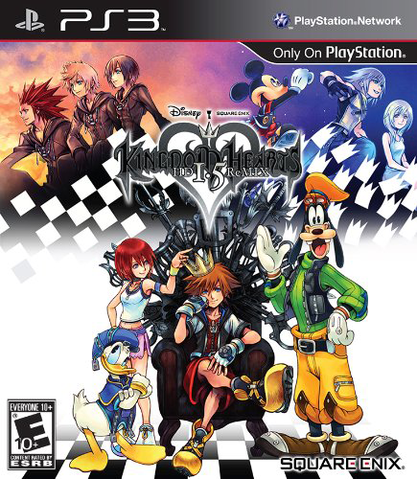
Worldly Weekend: Kingdom Hearts HD 1.5 ReMIX
Full Disclosure: This article will serve as the "main" review for
Kingdom Hearts: Final Mix, as I have no interest in importing the
original version.
And so begins our journey into the world of Kingdom Hearts remasters. For the uninformed, the three we'll be reviewing are three-course meal packages -- two upgraded ports and a cinematic feature "retelling" the story behind one of the handheld spinoffs -- designed for the purpose of uniting the series onto one console in PlayStation 3 (barring Kingdom Hearts HD 2.8 Final Chapter Prologue, which exclusively released for PlayStation 4 and would later be repackaged in Kingdom Hearts - The Story So Far on the same console). Given my peculiar relationship with this bizarre franchise, I simply cannot ignore reiterations that've hooked new fans, and so here we are.
In this case, we are reviewing Kingdom Hearts HD 1.5 ReMIX. Putting aside the series' latest in bizarre names, this first collection contains the "Final Mix" upgrade of the original Kingdom Hearts, PlayStation 2's Kingdom Hearts: Re:Chain of Memories remake of the Game Boy Advance game, and a movie version of Kingdom Hearts: 358/2 Days. As you may recall, I have conflicting feelings on all three: the first one's an aged, wannabe masterpiece that's more of a bizarrely enchanting freshman project, Re:Chain of Memories is an inferior remake worth only for 3D novelty, and 358/2 Days' pretentious presentation can't mask its identity as mediocre product. For the weathered Kingdom Hearts fan as myself, barring the first-ever release of Kingdom Hearts: Final Mix in the West, this is not an especially enticing purchase, particularly when considering 1.5 ReMIX has been repackaged into two further collections: Kingdom Hearts HD 1.5 + 2.5 ReMIX and Kingdom Hearts -The Story So Far-.
And so begins our journey into the world of Kingdom Hearts remasters. For the uninformed, the three we'll be reviewing are three-course meal packages -- two upgraded ports and a cinematic feature "retelling" the story behind one of the handheld spinoffs -- designed for the purpose of uniting the series onto one console in PlayStation 3 (barring Kingdom Hearts HD 2.8 Final Chapter Prologue, which exclusively released for PlayStation 4 and would later be repackaged in Kingdom Hearts - The Story So Far on the same console). Given my peculiar relationship with this bizarre franchise, I simply cannot ignore reiterations that've hooked new fans, and so here we are.
In this case, we are reviewing Kingdom Hearts HD 1.5 ReMIX. Putting aside the series' latest in bizarre names, this first collection contains the "Final Mix" upgrade of the original Kingdom Hearts, PlayStation 2's Kingdom Hearts: Re:Chain of Memories remake of the Game Boy Advance game, and a movie version of Kingdom Hearts: 358/2 Days. As you may recall, I have conflicting feelings on all three: the first one's an aged, wannabe masterpiece that's more of a bizarrely enchanting freshman project, Re:Chain of Memories is an inferior remake worth only for 3D novelty, and 358/2 Days' pretentious presentation can't mask its identity as mediocre product. For the weathered Kingdom Hearts fan as myself, barring the first-ever release of Kingdom Hearts: Final Mix in the West, this is not an especially enticing purchase, particularly when considering 1.5 ReMIX has been repackaged into two further collections: Kingdom Hearts HD 1.5 + 2.5 ReMIX and Kingdom Hearts -The Story So Far-.
Sunday, August 19, 2018
Worldly Weekend: Kingdom Hearts: Birth by Sleep (PSP)
And so along comes the second title in Kingdom Hearts' never-ending flood of side-games, this time on a console I have absolutely no interest in owning. As mentioned in an earlier review, I was only able to play Kingdom Hearts: Birth by Sleep on a PSP lent by a buddy at college, and have since purchased the remaster contained within PS3's Kingdom Hearts HD 2.5 ReMIX. There are, I am certain, other good games on the system. Great games. Amazing games. But for the life of me, I cannot bring myself to care about it, and so I suspect this will be the one and only PSP review we'll see on here for some time. Perhaps my other Worldly Weekend retrospectives will eventually lead me to cross paths with Sony's handheld once more, but for now, I'm afraid you'll have to make do with this one article.
Regardless, I dub Birth by Sleep as a side-game with some mighty hesitation there, and that's for two reasons: a) Birth by Sleep is absolutely essential in comprehending the Kingdom Hearts story from here on out, and b) it's easily the series' best since Chain of Memories; actually, that probably remains the case. Not that it doesn't fumble in that typical Kingdom Hearts manner -- that, and while I hate to keep dragging the PSP, I heavily question its existence on the platform -- but we'll get to those problems when they come. For now, let's get into the good stuff.
Labels:
2010,
action jrpg,
great,
kingdom hearts,
kingdom hearts birth by sleep,
psp,
square enix
Monday, July 16, 2018
Super Mario Bros. 2
And now, to reiterate gaming's most famous switcheroo: what we know as Super Mario Bros. 2 in Western territories is not the actual Super Mario Bros. 2, which was deemed too difficult and too similar for foreign audiences. The solution: take an unrelated platformer (Yume Kōjō: Doki Doki Panic, a Fuji TV collaboration that originally featured an Arabian cast), repackage it with Mario characters, get Shigeru Miyamoto and co. to polish up the gameplay, and voila -- you have gaming's greatest magic trick. It wouldn't be until five years later with the remake collection that was Super Mario All-Stars that rumors and urban legends whispered about Western audiences, with internet inertia finally dawning what would place among Nintendo's most historic fun facts.
In other words, this is why Mario and the gang are suddenly throwing vegetables at bad guys rather than stomping them. Without this knowledge, it becomes all too easy to label Super Mario Bros. 2 as one of the many infamous "black sheep sequel" so dreaded on NES -- sequels in the vein of Zelda II: Adventure of Link, Castlevania II: Simon's Quest or even the Japan-only Final Fantasy II, all which were being divisive experiments that messed with their predecessor's formulas a tad too much -- but even knowing that, is it really the game's fault it doesn't live up to the Super Mario name? Adding to the confusion is how despite the Japanese version being called "Super Mario USA," Nintendo has been all too quick to brush Super Mario Bros. 2 under the rug and not only inducting this localized version into series canon, but has since referred to this game as the real Super Mario Bros. 2 (as recently as being heavily referenced in Super Mario 3D World, in fact).
Labels:
1988,
2d platformer,
doki doki panic,
great,
koji kondo,
mario,
nes,
nintendo,
super mario,
super mario bros 2
Wednesday, April 25, 2018
Kirby Fighters Deluxe
In retrospect, the absence of Kirby spin-offs following Kirby Air Ride is quite odd when considering how much of them populated the series' early life: nothing in the vein of Kirby's Dream Course, Kirby's Pinball Land or Kirby's Block Ball ever arrived in the DS era or even GBA. Perhaps HAL felt the sub-games found in Amazing Mirror and Super Star Ultra were enough, the mainline games being a priority as opposed to rebuilding a franchise empire. Whatever the reason may be, the eleven-year absence is evident, and so we must ask ourselves: what compelled HAL Laboratory to develop downloadable expansions on Kirby: Triple Deluxe's own brand of sub-games?
Thankfully, that's an easy one: because they're probably the best sub-games in series history. At the very least, Kirby Fighters Deluxe is a common-sense idea: the original Kirby Fighters was a slightly-altered tweak on Triple Deluxe's engine framed within Super Smash Bros. mechanics, complete with multiple Copy Abilities, stages, items and even its own little campaign. As opposed to the previous design rhetoric of Kirby sub-games -- little time wasters deviating our attention from the main game for just a teensy-bit -- it was the closest any mini-game had reached "game within a game" status within the series hitherto, and its addictive nature repeatedly kept fans coming back for more.
Labels:
2014,
3DS,
eshop,
fighter,
great,
hal laboratory,
kirby,
kirby fighters deluxe,
kirby triple deluxe,
nintendo,
spin-off
Sunday, February 18, 2018
Worldly Weekend: Dragon Quest II (Dragon Warrior II) (NES)
It's really hard for me to look at the above cover. While hardly problematic in itself, something about this localized box art for Dragon Quest II -- Dragon Warrior II in the States -- irks me more than the one for the first, which is mighty odd considering they both subscribe to the 80's style of realistic medieval fantasy. Could it be the exaggerated chest for the Princess of Moonbrooke, or that at this point I'm far, far too accustomed to Akira Toriyama's signature artwork for the series?
Ah, yes, that's more like it. And the answer is apparent as well: as much as the NES Dragon Warrior covers attempt to present the games as no-nonsense affairs, the goofy enemies obviously suggest a more tongue-in-cheek affair, and thus it's insanely difficult imagining the American art having any agency in our imaginations. Naturally, Toriyama's art is the way to go, so let us not tarry upon such incongruities.
Labels:
1987,
1990,
aged game,
dragon quest,
dragon quest 2,
dragon warrior,
great,
jrpg,
nes,
square enix,
why sugiyama why
Thursday, February 8, 2018
Donkey Kong Country
I don't typically touch upon my Asperger's in these reviews, but there's a certain memory regarding Donkey Kong Country that must be shared. By far the most prominent of my preschooler-age quirks were made-up words: nonsense given purpose only to the mind of a self-absorbed child. Often taking the form of onomatopoeia, one such term -- "BWAH BWAH!" -- was born from the powerful opening visual of Donkey Kong barreling through his tree house's front door and slamming into the ground below. A ritual was born every time I replayed that level, that guttural cry erupting from my throat in very same shrill ferocity of Baby Animal from Muppet Babies.
The point being, the visual prominence of Donkey Kong Country inspired people to the point of babbling nonsense at the sight of its pre-rendered 3D visuals, myself included. And why shouldn't they, when it was not only the Super Nintendo's greatest technical marvel but groundbreaking enough to ensure the 16-bit market wasn't done just yet? Of course, there are those who believe Donkey Kong Country's only claim to fame was its graphics and not its actual gameplay, which is often perceived as inferior to the likes of Super Mario World and Yoshi's Island.
Labels:
1994,
2d platformer,
donkey kong,
donkey kong country,
great,
nintendo,
rare,
super nintendo
Sunday, December 3, 2017
Kirby and the Rainbow Curse
Ah, now there's the smile we know and love! As expected, Kirby's preciousness shines especially well through clay, and there is perhaps no better representative to bear it than Kirby and the Rainbow Curse: a claymation-based title matched only by Kirby's Epic Yarn in sheer cuteness. Even now, we must continue cherishing this pure countenance, for it is the last time Kirby bared this visage for an international audience.
Anywho, Kirby and the Rainbow Curse is not only the one Wii U Kirby game, but is a sequel to 2005's Kirby: Canvas Curse, the one series entry notable for captivating non-fans. Hailed as Nintendo's first truly original concept for Nintendo DS, Canvas Curse remains the handheld's hallmark for touchscreen play: drawing rainbow strokes for Kirby to coast along played unlike anything else in the market, and combined with a techno soundtrack and mish-mash of abstract aesthetics so alien to Kirby, it's little wonder it succeeded as it did.
Labels:
2015,
action platformer,
great,
hal laboratory,
kirby,
kirby and the rainbow curse,
nintendo,
wii u
Sunday, August 27, 2017
Wordly Weekend: Sonic the Hedgehog (Genesis)
Imagine, if you will, blast processing. Not that any sane individual would be able to define what exactly it meant -- for the uninformed, it was a tacky marketing buzzword to describe the speedy processing of Sega Genesis -- but doesn't it just sound cool as all hell? To the young consumers of the 16-bit era, it was a nebulous term that exuded an impressionable coolness, undoubtedly due to how it rolled off the tongue and was an easy referral to why the Genesis' graphics were so good. Or how its games were so fast. Or whatever.
Naturally, the poster boy for this gimmick would also match said coolness; hence Sonic the Hedgehog, featuring a cocky animal mascot of the same name, an acidic blend of colors and backgrounds and, most of all, an emphasis on speed. Billed as the fastest thing alive, Sonic the Hedgehog was designed to surpass Super Mario through lightning-fast running, setting the portly plumber's meticulous platforming to shame via eye-catching movement. On a surface level, the concept is, in retrospect, something only designed to impress a 90's audience through the 90's philosophy of "too cool for school" appeal to kids through eye-bleeding use of 90's aesthetics and character design.
Labels:
1991,
2d platformer,
great,
sega,
sega genesis,
sonic 1,
sonic team,
sonic the hedgehog,
worldly weekend
Sunday, June 11, 2017
Worldly Weekend: Kingdom Hearts (PS2)
Note: Please excuse the imbalance of quality for screenshots here; for whatever reason, viable screenshots of earlier PS2 game are especially hard to find.
Dear readers not familiar with Kingdom Hearts, I implore you to look, just look, at the cover above. Yes, that is Goofy and Donald Duck of Disney fame chilling in the moody, moonlit sky alongside three anime teenagers. Their normally-cheery faces are now solemn, decorated with such wistful melancholy that does away with their kid-friendly personas, evoking an aura of maturity never before displayed to the public eye.
Needless to say, Kingdom Hearts was one of the most bizarre debuts of the PS2/GC/Xbox era, and yet somehow it ended up being one of the most beloved. A collaboration between Disney and famed RPG developer Squaresoft (now Square-Enix), the 2002 action-RPG's outlandish concept of pitting Disney icons and zipper-laden, key-wielding adolescents against Disney villains in command of heart-harvesting shadows--a tale bookended by Hikaru Utada pop songs, mind--is so uniquely ludicrous that it demands your attention. But why?
My theory? By framing itself as a "darker" take on Disney, Kingdom Hearts ropes in the nostalgic RPG player who once associated with their films in early youth. I am no exception to this: the game was responsible for restarting my fervent following in Disney animation, the soundtrack never left my CD player and I clocked out the "Hours Played" stat in the course of a year. Since then, my association with Kingdom Hearts has floundered over the years: it birthed as an obsession that required a near-intervention, followed by a burning hate that wanted nothing more to do with the series, and am now settled as a casual fan who partakes in it like the finest of junk food.
Dear readers not familiar with Kingdom Hearts, I implore you to look, just look, at the cover above. Yes, that is Goofy and Donald Duck of Disney fame chilling in the moody, moonlit sky alongside three anime teenagers. Their normally-cheery faces are now solemn, decorated with such wistful melancholy that does away with their kid-friendly personas, evoking an aura of maturity never before displayed to the public eye.
Needless to say, Kingdom Hearts was one of the most bizarre debuts of the PS2/GC/Xbox era, and yet somehow it ended up being one of the most beloved. A collaboration between Disney and famed RPG developer Squaresoft (now Square-Enix), the 2002 action-RPG's outlandish concept of pitting Disney icons and zipper-laden, key-wielding adolescents against Disney villains in command of heart-harvesting shadows--a tale bookended by Hikaru Utada pop songs, mind--is so uniquely ludicrous that it demands your attention. But why?
My theory? By framing itself as a "darker" take on Disney, Kingdom Hearts ropes in the nostalgic RPG player who once associated with their films in early youth. I am no exception to this: the game was responsible for restarting my fervent following in Disney animation, the soundtrack never left my CD player and I clocked out the "Hours Played" stat in the course of a year. Since then, my association with Kingdom Hearts has floundered over the years: it birthed as an obsession that required a near-intervention, followed by a burning hate that wanted nothing more to do with the series, and am now settled as a casual fan who partakes in it like the finest of junk food.
Labels:
2002,
action rpg,
disney,
great,
kingdom hearts,
kingdom hearts (ps2),
ps2,
square enix,
yoko shimomura
Sunday, July 31, 2016
Ten Years of Kirby ~Reverie 15~ Kirby Mass Attack
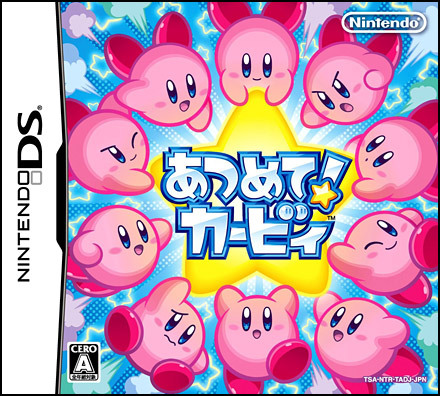
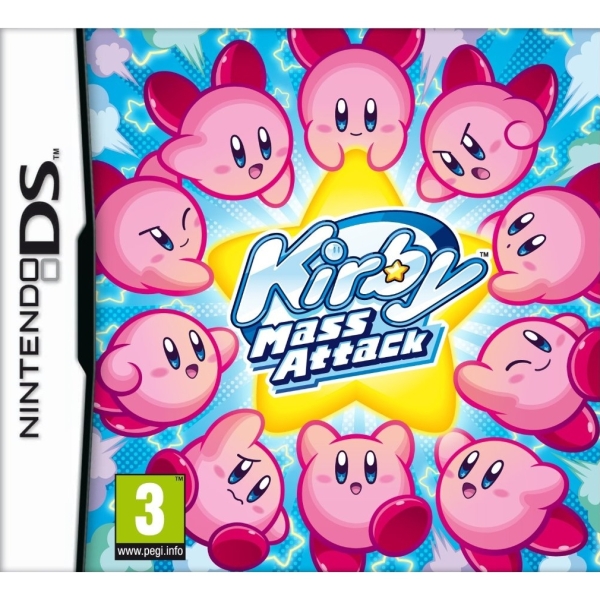
2011, where--No. NO. NOOOOOOOO. Oh, real funny NOA; way to build me up and knock me down with a dreadful one-two Angry Kirby combo. I mean, good god, this is easily the worst offender yet; just look at Kirby's uncharacteristic expression. I'd say this is one of this rare instances where the Japanese cover probably wouldn't gel with Western shelves, yet Europe seemed to deal just fine with it. Granted, they also got Freshly Picked Tingle's Rosy Rupeeland, so I suppose us Yanks have to deal with our violence-appealing culture and Kirby's attempts at the DreamWorks eyebrow.
But I digress. Anyway, 2011 brought the first of many problems that would plague Nintendo over the next half-decade: how to properly promote their new hardware. In this instance, the 3DS's March release was diluted by the annual iterations of the DS and DSi; unfortunately, this meant consumers couldn't tell it was actually a brand new console (that, and why would parents buy a new handheld when their kids received a DSi XL the previous Christmas?). Combined with how it was clearly rushed for launch--mainly with the weak launch line-up alongside the unavailability of the eShop--and the impending threat of mobile gaming, it was a rough start for the successor of the world's greatest-selling handheld.
Cue the following summer, which brought more confusing announcements in the form of Wii U and what is perhaps the quickest turnaround apology in video game history. Apologizing profusely for the 3DS's slow sales, president Satoru Iwata announced a price-cut that would not only halve his salary, but would offer twenty free downloadable games from NES and GBA libraries for those who had already bought the handheld. Alas, it would prove not to be the last of Iwata's miscalculations, and one thing was coming clear: Nintendo's dominance over the casual market was starting to wane.
Let it be known that while 3DS is undoubtedly yours truly's favorite handheld console of all time, the DS was in no rush to be replaced in early 2011. Pokémon Black and White was released just before the successor's release in all territories, and our favorite pink puffball wasn't ready to make the jump, either. The DS had served him quite well, and while HAL suggested otherwise, perhaps he felt it owed the handheld one last hurrah.
The ensuing title, Kirby Mass Attack, is something of an anomaly. It was the first mainline Kirby game to completely abandon the series' trademark Copy Ability in favor of an entirely new mechanic, one that transforms the game into something hardly resembling Kirby at all. We can trace elements of more offbeat entries like Epic Yarn and Canvas Curse back to the source material, but Mass Attack operates on a completely different scale barring its 2D gameplay. This, along with how more eyes were on Wii's Kirby's Return to Dream Land--which would release only a month later in most territories--led to Mass Attack having a muted launch...or did it?
As we'll learn in the next Reverie, fall 2011 was a jam-packed season for games, with The Legend of Zelda Skyward Sword and The Elder Scrolls V: Skyrim leading the pack. However, just like 2002's miraculous one-two Metroid revival, two back-to-back Kirby games somehow survived unscathed with a million copies under their respective belts. The new era of Kirby kickstarted by Super Star Ultra was about to transform again, and it would take one final push from this experimental title to launch it.
---
If you're not familiar with Kirby Mass Attack, you've probably guessed that the related horde of Kirbys running around is why the game functions so differently. After being split into ten bodies by the nefarious Necrodeus, only one escapes his wrath to stumble upon the star-shaped embodiment of the original Kirby's heart. The heart is what the player controls via stylus, as the Kirbys--who grow in number by collecting food--follow wherever it goes.
Needless to say, it's an innately adorable concept that gels perfectly with the cuddly-cute image of Kirby. The enigma of Kirby's sweetness cancelling out its basely horrifying concept--a pink blob swallowing everything in sight--is channeled properly here, as the ten Kirbys rampage about in their efforts to put themselves back together. Its execution brims with ideas, hardly any of them having much to do with Kirby's original concepts. Mechanics like the Copy Ability and Kirby's infinite floatiness were designed primarily to help anyone reach the goal, and with those stripped away, there's no crutch for beginners to rely on. It takes raw skill to overcome its trials.
The implications are clear in that Kirby Mass Attack is the hardest game in series history. We've had rough patches in outliers like Kirby's Dream Land 2, but none have demanded such constant focus and demand as managing up to ten separate Kirbys at once. Even the generous compensations it makes for the series' intended audience aren't easy hurdles; for instance, take the way it handles damage/revival. Each Kirby can take two hits before it floats up to the afterlife, but a carefully-aimed Kirby fling via touch screen will send the soul crashing down to earth fully revived.
A fair enough trade, but not one that's guaranteed. As the game progresses, the Kirbys will be inundated with projectiles, enemy hordes and moving screens of death to the extent where it's nearly impossible to multitask. That's not a mark on the game; after all, it's the only way the game can raise the stakes. Mass Attack is not overtly difficult by itself, but I can certainly imagine a child struggling with the concept far more than the likes of Kirby's Adventure or Kirby's Epic Yarn, and it's in an entirely different league should you aim for 100% completion. This should go against the very grain of the series--and as explained with the difficulty, it does--but it's actually quite fascinating to witness how far HAL's willing to stretch the series' goals and conventions via such an oddball concept.
Let us not mince words: much like the days of Shinichi Shimomura, Mass Attack is a B-Team effort made by HAL's B-Team. Unlike Mr. Shimomura's works, however, I struggle in pinpointing any specific design flaws in Mass Attack. I mean, I guess I could, but most of its drawbacks result from the more overt shortcomings of its producers than anything else. I say this with no offense whatsoever; I'm more than willing to be lenient with an experimental Kirby (I mean, it's hardly the first), and that I cannot pick apart specific flaws as a functioning game speaks to Mass Attack's quality.
Really, I guess what I'm trying to say is...well, let's just start with the gameplay. Naturally, the first question that arises from such a concept is that "Is it hard to control?". Not at all, and considering the disorderly Kirby horde I'm actually surprised the touch controls register so smoothly. Most, if not all, of the Kirbys were felled due to my error as a player, not from any misguided controls or slacking AI. They quickly react to the stylus and loyally follow the star wherever it goes.
That, and it's great fun. Copy Abilities may be sitting out again, but who cares when you have an army of Kirbys ready to swarm and piledrive everything in sight? Be it meticulously aiming for airborne enemies or simply swarming helpless Beanbons, Mass Attack operates with such vigorous, calculated chaos that could very well be the side-scrolling lovechild of Kirby and Pikmin. (In fact, I'd even say for fans of the latter like me, it leaves us wondering how a 2D Pikmin would operate...)
Adjectives like "meticulous" are interesting here since they provide such an intriguing contrast to Kirby's core. Make no mistake: this is just as much of a sugar-rush as the rest of the series, but that it's underscored by constant micromanagement provides not just a gripping challenge, but a different level of engagement we've never seen before from Kirby. For instance, levels are gated according to the number of Kirbys you possess, so letting KO'd Kirbys go or passing by food is not an option.
Furthermore, the concept demands objective-based level design, and Mass Attack delivers. As mentioned previously, where Mass Attack does succeed is its progressive ascension. Simply observe how the game is bookended: the opening levels have the Kirbys working together to pull out giant radishes to scrambling around an alien spaceship for blueprints of their extraterrestrial vehicle by the game's end. The latter concept is particularly inspired by how open-ended it is: you don't have to get all the blueprints if you don't want to, but you'll hardly have enough manpower for the inspired shoot-em'-up section at the end (not to mention your chances for earning medals).
It's not that the instances of semi-regular sidescrolling greatly pale in comparison or anything, but the problem is that there's an awful lot of it. Levels tend to go on far longer than they should, and unless they break convention like the aforementioned UFO level, the game gets a little long in the tooth. This is especially troubling considering Mass Attack's abnormally large level-to-world ratio: each typically features 11 stages, and with only four worlds to venture--with a final one that's essentially a boss rush--the presentation of a confined, yet bloated context paves the way for some troubling flaws.
As already mentioned, the game does succeed in building upon ideas as it goes: Dedede Resort is a boon of mini-games and some great ice-related levels, and I dare not spoil the rest of Volcano Valley's surprises. No, Mass Attack's issues lie in how they're all framed. The "B-team" qualities are never stronger than they are in the accompanying visuals and sound, which rank among the lowest in the Kirby canon. They're hardly enough to cripple the game on its own terms, mind, but that they're this forgettable is a betrayal to the game's wondrous concept.
Case in point: the backgrounds. It's worth reminding 2D Kirby games have blended sprites and CGI in their backgrounds for a decade prior to Mass Attack. Here, the entirety of Mass Attack is sprite-based, with not a speck of pre-rendered models to be found. I can only imagine this was done in regards to the game's overabundance of sprites, hence the relative lack of detail.
About the only inspired setpieces lie in the Dedede Resort, home to fun imagery consisting of pineapple islands and puzzle-piece domes. Not pictured are the Dedede-shaped funhouses, which always delight in their signalling of an upcoming mini-game (and further displaying the narcissistic ego of everyone's favorite royal penguin).
I must also call attention to the world map, which has never made an ounce of sense to me. For the uninitiated, Pop Star is supposed to be yellow, as stars typically are in children's properties; here, it's blue. I can only assume they're emphasizing the ocean surrounding the Popopo Islands, but it's rendered all the more bizarre since you witness Pop Star in all its yellow brightness during the ending.
For the record, I can't say I attribute Mass Attack's aesthetic issues entirely within its sprite-based confines; after all, the sprite animation works just fine (just watch the idle Kirbys!) with plush characters that easily fit within the world of Kirby. It's really more the art style that disappoints, as its limited detail cannot pick up the slack of the low world count. The game tries to subvert this by cramming numerous environmental tropes within each one, but even the likes of haunted graveyards and icy caverns beg the question if they didn't deserve worlds of their own.
Then there's the matter of music, which does break my heat a little. Look, let's be absolutely reasonable here: Shogo Sakai is not, in any way, a B-level composer, as attested by his work on Mother 3 (his masterpiece), Kirby Air Ride and the Smash Bros. series. Unfortunately, his first solitary Kirby work in Mass Attack is up there with his Squeak Squad collaboration as the weakest of his Nintendo output. While thankfully there's not a trace of GBA recycling to be found, the soundtrack's something of a mystifying mixed bag.
Which is all the more disappointing when considering how the game's main themes initially promise great things. Kirby Collecting is a joyously bombastic mix of percussion and vocals that greets the player at the title screen, instantly guaranteeing earworm hell over the ensuing week. The in-game variation, Meadow Breeze, carries the title's momentum with a lighter tone, as banjos and accordions come together to encapsulate the game's active energy.
An energy that, sadly, isn't consistently carried throughout the soundtrack. It's not so much terrible as it is forgettable; so forgettable, in fact, I struggle in highlighting any one weak track over the rest (and I have the game's Sound Player right in front of me!). It comes across as Sakai recognizing the concept calls for overtly-peppy, vigorous tracks that rouse the player into action, but fears of treading too much on that line in the event of carbo-loaded burnout.
This isn't to say there aren't such tracks in Mass Attack's repertoire, and as expected, they're the soundtrack's standouts. There are excellent Kirby Air Ride cameos, for one, but we must not lose focus of what's actually new. Snowy Zone and Ruins Ahead, the former as featured above, are genuinely spirited representations of their respective environments, and Fetching Fruit is undeniably the driving force of what makes its respective sections so fun.
The problem here lies in balance. Such fun bombast is far too few and between, and when that a) directly correlates with the theme behind the game and b) is drowned by tracks that don't stir much emotion at all (let alone evocative of Kirby), that's something of a shame.
But let us not be too harsh on Mass Attack. Any failures in visuals or sound cannot override its solid foundation in gameplay, and I ultimately forgive its missteps thanks to its one upholding of a certain Kirby creed: it remembers that Kirby games must be stuffed full of content; specifically, the mini-games. Mass Attack presents no less than six of the little buggers, and even then I pause at labeling them all as "little".
To the point, the volume of function and eye candy found in the likes of Kirby Brawlball (Kirby's second take at a pinball venture), Strato Patrol EOS (a multi-pronged shoot-em'-up) and Kirby Quest (a pseudo-RPG filled to the brim with fanservice) are particularly impressive. Much like how Kirby Triple Deluxe's sub-games would go on to be eShop purchases, it's very easy to see these three games polished up for digital release, and that's not even getting into how the latter two expertly weave the main game's ten Kirbys mechanic into their own domain.
This is not to sweep the other three mini-games under the rug; as a matter of fact, I appreciate Kirby Curtain Call's hilarious efforts to screw over the player (think about it: why does it have peaches mingling with the crowd?) as well as Field Frenzy's difficulty options offering a compelling crutch for its simple concept. It's an incredibly well-rounded selection of extras, enough to possibly render it the strongest mini-game collection in Kirby history.
Labels:
2011,
2d platformer,
angry kirby,
ds,
great,
hal laboratory,
kirby mass attack,
platformer,
reverie,
ten years of kirby
Monday, February 29, 2016
Pikmin
It goes without saying that Shigeru Miyamoto is a genius. After all, he's the creator of Super Mario Bros. and The Legend of Zelda, two video games that revolutionized the game industry. They grew into multi-million selling series that forged countless childhoods over the course of three decades; in particular, Super Mario has sold more than any other video game franchise in the world at over 300 million (and that's not including the dozens of spin-offs). The names "Mario" and "Zelda" are practically synonymous with the term "video game", proving how successfully they've penetrated into culture and the public at large.
Pikmin, Miyamoto's pet project for Nintendo GameCube, never achieved those same accolades. But I'll be damned if it's not his most inspired concept. This isn't to say it's his best, yet that one could make compelling cases for its masterpiece sequels shows the series can stand proudly with his most famous titles. And yet that they were both born from this experimental little oddball fascinates me to no end. After all, Miyamoto himself said Pikmin 3, undoubtedly the finest game you can play on Wii U, was the finalization of what he set out to accomplish with this title.
The game is the little survival tale of a diminutive astronaut, who crash-lands onto an alien world. His beloved Dolphin a mess, Captain Olimar must recover the spaceship parts with the help of plant-endowed critters, who share the game's title. Divided into three separate colors for their respective strengths (reds are immune to fire, yellows are light and can be tossed high, and blues can wade through water), the Pikmin are inquisitive, adorable lifeforms who require a capable leader for their own survival. Through commanding and propagating the Pikmin, Olimar must brave the dangers of the planet within thirty days before his life support system runs out. But the team can only brave the planet's surface during daytime, as the nightlife is far too dangerous for expeditions.
Needless to say, it's a game that requires a different sort of dedicated commitment than Zelda; a far cry from the pick-up-and-play familiarity of Mario. There were those who couldn't handle the pressure of completing the game under the 30-day time limit; others didn't "get" the premise's replayability and thought it was too short. And that's fine; while we could cite shortcomings on behalf of the developers, not every good idea will penetrate the mainstream market.
Personally, I suspect another reason, which relates to the "pressure" factor, is probably what I love so much about it; mainly, there's a stark sense of humanity present, more so than its two sequels. There's as much whimsy as any other Miyamoto title, but it hits home. There's the impending threat of Olimar's demise, for one: we learn from his nocturnal logbook that as excited as he is to learn about the Pikmin and their strange world, he always reverts to thoughts of his family back home.
That's right: Pikmin decides to punish you for your failures by killing off your new pets. To further rub it in, they emit one last mournful cry before they dissipate into ghostly silhouettes, rising up to the great beyond.
I'll be honest in admitting I've since enjoyed a dark humor in that as I've grown older (particularly in the sequels, as they lean more towards comedy), but that you constantly have to manage and weigh the lives of adorable little critters under a ticking clock was probably too much for some. I know it was for me as a kid, no matter how much I enjoyed it.
I cannot claim this is entirely a matter of "git gud", either. Just the year before Pikmin, there were players who couldn't accustom to the three-day apocalypse of Zelda: Majora's Mask, which coincidentally also featured oddball humor and poignant themes. However, there's a rather big difference between the two: not only would the player have to purposefully encounter Majora's Mask's hour of doomsday given how the game incorporates time travel, but the player can actually work around the game's rules through slowing time. In Pikmin, either you play ball with the rules given, or you don't. In that sense, I understand Miyamoto's regret.
But why was I so captivated by it then? Why did I try to succeed over and over? Because of the very same reason it may've turned people off: its presentation of "stark reality." The sunbaked forests and desolate springs bear eerily Earthen roots, yet are framed in a style so alien we cannot help but discover its depths. There's all the indigenous life-forms, for starters: you have the bird-serpent hybrids, mind-controlling toadstools, fire-breathing warthogs, and, my personal favorite, a bread loaf-shaped scavenger that frequently engages in tug-of-war with Pikmin for goodies.
That these creatures sound just as cartoony as the Pikmin themselves would imply the game's world is just as cartoonish, but we're instead left to traverse one of the most beautiful worlds the GameCube has to offer. A cartoonish setting would entirely defeat the game's purpose; in the end, the Pikmin's world is that of survival, and Olimar's plight is no different. The realistic setting ensures the dangers of carnivorous beasts and environmental hazards come alive.
What really drives this point home is the great music provided by Hajime Wakai. Listen how the above example, the lullaby that is Forest of Hope, fluctuates according to time and tension. The way it initially captures a languid sunny morning is a perfect complement to how the area starts off. With the landing site block off by a dirt wall, Pikmin are divided into groups of either breaking it down or securing Pellets to grow more Pikmin. The ensuing work is long and hard, but it's ultimately an eye-opener into the game's circle of life: newborn Pikmin who remain planted in the ground gradually grow from leaf, to bud, and finally flower.
On the opposite side of the spectrum lies The Distant Spring. It's a flooded marsh host to both infinite beauty and certain death, as the aquatic grounds are home to most of Pikmin's deadliest creatures. As echoed by the song, it represents the number one creed of nature: survival of the fittest, and so the cries of dead Pikmin naturally blend in. Despite being succeeded by one more area, visiting The Distant Spring truly feels like reaching the ends of the world.
It's here the player realizes Olimar is our link to the world. For as much as he's in wonder of the alien world, his fight for survival is a lonely one the Pikmin can't entirely cure. We are just as in the dark as he is, and so we share his feelings of discovery, his confusion, his loneliness. By the time The Distant Spring rolls around, enough days have certainly passed for the explorer to feel more than a little homesick. But the harsh environment cares little for his plight, and so like Olimar, we must shoulder the burden of survival and sacrifice.
The roots for this process takes place from the very beginning, although with how the game starts at The Impact Site, you'd hardly think things would take such a dark turn. The song frames Olimar's plight as an adorable intrigue; a playroom mess rather than a struggle for survival, and given the oversized flora and cardboard boxes, you wouldn't be at fault for mistaking it as such.
But given the size chart in the game's manual (Olimar is only the size of a quarter), perhaps that's the point. It's a game designed for all ages, and so the game's darkness has to be balanced out by the whimsy of the Pikmin. Like the song and Olimar themselves, we delight in discovering what they're capable of.
Which brings us to the joy of the game's greatest song. No matter what point you're at in the game--be it having just met the Pikmin or have emerged from the depressing throes of The Distant Spring---the World Map theme will be there waiting for you. Opening with a light-hearted sunrise, the World Map theme is as adventurous as it is encouraging. It'll play even when time is running out, or if Olimar's army of Pikmin has been mercilessly slaughtered.
And that's because its job is in telling you to keep trying. It implores you to explore, to persevere. You may've had one bad day, but why not persevere and come up with new strategies for next time? Time run out and you still haven't found all the necessary ship pieces? Hey, life goes on, so why not try again? The song matches Nintendo's objective in always looking out for the player, and even if Pikmin doesn't hit all the bases for that, this one moment holds that one creed above all else.
But suppose you do succeed, and are thusly rewarded with the heartfelt ending...do you play again? After all, this sort of game is supposed to reward creativity. To achieve one goal in different ways and discover new shortcuts and tricks. Such a game begs for replayability, yet as mentioned before, Miyamoto and co. observed not many chose to do so.
Does the reason go beyond the stressful time limit? We can offer the argument that Pikmin and fellow GameCube launch title Luigi's Mansion offered a style of gameplay that flew over the mainstream's heads, yet I can't help but shake the feeling both games stuck too closely to their experimental roots. Of course, not every inspired concept will come barreling out the gate with heaps upon heaps of polish and content, but their respective setpieces never "wow" us as the N64 and SNES launch efforts did prior. We're drawn into their creativity, but leave considering them appetizers to the main course (in this specific context, Super Smash Bros. Melee).
It's why I label the game as experimental, but that doesn't mean I don't think the game's a beautiful rough draft. Just because the general public may've been done with it after one go doesn't mean I wasn't, and the aforementioned nuance is enough to keep me coming back on lazy afternoons. What propels Pikmin from "good" to "great" mainly boils down to two things: a) the character and presentation involved and b) the presence of an addictive Challenge Mode. The latter has been undeniably outstripped in the sequels, but the former possesses a unique niche even those masterpieces may have yet to surpass.
In the end, while Pikmin doesn't reach the awesome heights of Miyamoto's more famous works, it nurtured enough love and passion to blossom into one of Nintendo's finest franchises. In that respect, such humble beginnings are rendered just as stunning. Hmm, I wonder what that reminds me of?
Labels:
first entry,
gamecube,
great,
hajime wakai,
pikmin,
real time strategy,
shigeru miyamoto
Thursday, June 19, 2014
Ten Years of Kirby ~Reverie 7~ Kirby 64: The Crystal Shards
NOTICE: Due to the jaw-dropping amount of shitty emulator/watermarked/black bordered/pixellated screenshots provided for this particular game, quality between the images presented in this article will vary. Until I purchase a viable screencapturing device of my own, please bear with this minor issue for now.
The new millennium, 2000. As opposed to the Pokemon-propped Game Boy, the Nintendo 64 was in no shortage of troubles: its game release schedule still remained barren outside of Nintendo's own releases, customers continued flocking to the Sony Playstation and pre-ordered its upcoming successor in droves, and the Nintendo 64 Disk Drive peripheral was cancelled as quickly as it arrived in Japan. Preparations were well underway for shifting to the Nintendo Gamecube, as eventually evidenced by the N64's paltry 2001 lineup (a distressing transition that would send off every Nintendo console henceforth), and so the media ate up the console's final heavy-hitters: Rare's Perfect Dark and Banjo Tooie, as well as the Zelda installment Majora's Mask.
No one seemed to have the time for the latest Kirby game's debut on the system, least of all creator Masahiro Sakurai himself. Having recently completed a little all-star crossover called Super Smash Bros., Sakurai seemed to show meager interest in his puffball's debut in 3D (despite his inclusion in the aforementioned fighting game) and, aside from a minor voice credit as King Dedede, had absolutely no involvement in Kirby 64's development. It would be hasty to state he had lost all interest in the world of Dream Land, as he'd go on to two develop two more Kirby games and created guidelines for the creative staff involved in the Kirby of the Stars anime adaption (his abnormally long dialogue for the character's page on the Japanese Super Smash Bros. Melee Dojo website, of which was being updated as the show was about to air in Japan, evidences his then-nostalgic reflection on the series). Rumors, however, not only persisted he never laid eyes upon the N64 installment until its release, but his dissatisfaction of the troubled development history for Kirby Air Ride. His citation of tired sequelization following his eventual resignation from HAL Laboratory remains the only proof regarding his series fatigue, and with six Kirby titles under his belt, perhaps the man felt his creativity was being stifled.
Despite the indifferent shrugs from the gaming media and the series' own creator, HAL Laboratory continued to truck on with the game. Details on Kirby 64's development remains sparse; aside from apparent plans to launch the game on the ill-fated N64DD add-on and screenshots that initially indicated playable roles from Waddle Dee, King Dedede, and the painter girl Adeline, only one particular design choice remains evident even within its beta screenshots: the decision to retain the linear 2D gameplay of old. We perhaps have our answer to the muted reception from, at the very least, the world of gaming: with every other classic gaming icon jumping into free-roaming 3D, why didn't Kirby make the same jump? A look into Nintendo's list of cancelled N64 projects holds a likely answer, with longtime franchises such as Metroid and Fire Emblem struggling to properly gestate into the polygonal realm. In particular, HAL Laboratory faced a troubling transition to 3D development, as numerous projects--including Kirby Air Ride and Mother 3--were being cancelled left and right. Only Super Smash Bros.--of which featured 3D graphics but was confined to 2D space--was released without a hitch, and perhaps Kirby 64 followed its example to avoid any similar issues that doomed its HAL brothers.
Did it pay off? Criticism from the gaming media did not bear much love for Kirby 64; it was considered adequate, yes, but was rated as only a trivial venture in the grand scheme of ambitious cartoony platformers. Much like Kirby's Dream Land 3, the game was welcomed by the Kirby fanbase with a division; some loved it for its new spin on the Copy Ability formula, some hated it for the slower gameplay. From a personal perspective, this split was lost upon my naïve 2nd Grade graduate self, as I too busy anticipating the season finale of Digimon and regularly munching on CatDog Cheese Nips. Regardless, the impending release of Kirby 64 did catch my eye: I was only familiar with the titular character's appearance in Super Smash Bros., and was eager to finally try out his source material for myself. It wasn't the game that kickstarted my fascination with the series (that would be Kirby's Adventure), but I still hold it dear for introducing me to another avenue of the company that was taking over my childhood life.
As a young adult diving into the Dream Collection anniversary pack, however, a familiar figure potentially stood in the way of my revisiting the game: the director, Shinichi Shimomura. While he still had some good games under his belt (Kirby's Dream Land 2/Kirby's Dream Land 3), it was these very games that possessed level design flaws so severe that I was nearly turned off them altogether. Dream Land 2's introductory mishaps were still fresh in my memory, and with Dream Land 3 falling into similar traps, I feared Shimomura's final attempt in the director's chair would only mirror his past mistakes.
As I engrossed myself into Kirby's galaxy-trotting adventure, I let out a sigh of relief when I reached the teardrop-shaped Aqua Star, realizing I nothing to fear. He finally got it right.
-----
Kirby 64: The Crystal Shards is an unusual Kirby game. I say this while knowing Kirby games are an oddity in themselves: almost all of them are designed for anyone (mainly children) to complete, and they typically center around the objective of eating cherubic critters. However, I cannot help but notice its many incongruities: the roaming camera angles that circle the levels evidence an ambitious undertaking from HAL's part, yet the game is still confined to two-dimensional space. Many Nintendo 64 games ignored the controller's directional pad, yet Kirby 64 functions primarily on its input. It even does away with traditional series canon: it is the only Kirby game where the titular character cannot float indefinitely (barring some of his more experimental titles), it is the sole Kirby where mini-bosses are just larger versions of regular enemies--providing for rather uninspired sequences--and the only one with an exclusive theme for obtaining the Invincibility Candy item.
It's different, perhaps too different. I imagine most who were turned off by Dream Land 3 echoed the same complaints here, as it wouldn't be a stretch to say Kirby 64 is within the same vein as the SNES title. Aside from sharing the same director and in-game antagonist (Dark Matter, the cluster of sentient, evil smog spawned by the fallen angel-inspired Zero/02), both of the games are among the slowest of the Kirby pantheon and rely heavily on gimmicky applications of the Copy Ability as opposed to branching out on Kirby Super Star's in-depth extensions for Kirby's entire arsenal.
And yet, it works. Kirby 64 genuinely works. It's not perfect by any stretch of the imagination; at the very least, I'd never dream of placing it on the same pedestal as Kirby Super Star or Kirby's Adventure, as it's host to a numerable amount of flaws. But I hold Kirby 64 in high regard for what it means, in that I can finally play through the entirety of a Shimomura-directed game without being bogged down by shitty level design. I can play through Kirby 64 and not be induced into boredom. I am constantly intrigued every time by how I can shift through its unique take the Copy Ability on a dime. Like Dream Land 3, I am drawn to Kirby 64 in how it represents an abnormality, only this time it is successful across the board.
For this game, Shimomura and the gang ditch the animal partners--a charming mechanic on its own, but not substantial enough to provide fully compelling gameplay---for something completely new: combining Copy Abilities. While Kirby can get by with his normal array of powers (including Fire, Cutter, Spark, Stone, Bomb, Ice, and Needle), why bother when you can mix-and-match to craft exciting combinations? These aren't just souped-up versions of his old powers, either: there are genuinely creative inventions from these mergers, ranging from wonderfully badass (the GIGANTIC FLAMING SWORD resulting from Fire+Cutter) to hilarious (probably the most cited examples is where Spark and Ice turns Kirby into a food-spawning refrigerator).
Critics of this system write it off as a collection of one-trick ponies, as they lack the depth found in earlier titles. To be fair, this is a reasonable criticism: nothing really tops the beat-em-'up action of Super Star, as its success can be attributed to being featured in 65-70% of all Kirby games following 2004's Kirby and the Amazing Mirror. I am also quick to secede that it's the superior system, as the quick succession of inputs not only feels more intuitive but grants a greater sense of control and power to the player. While the shallowness of the animal partner mechanic was a partial detriment to my experiences with Dream Land 2 and 3, I don't mind its spiritual successor here.
Kirby 64 works not because of constantly engaging level design or fast movement; in fact, it suffers from the same problems as Shimomura's previous works. This isn't to say there aren't moments of creativity found in the areas Kirby traverses--I'm quite fond of how it tackles stage hazards--but his molasses-like movement is quite a downgrade from Super Star's sugar-rush. It's instantly a turn-off for anyone who desires to master speed and precision in their 2D action/platformer games, and while I can certainly respect, it's certainly a shame since they'll be missing out on a creative gameplay element.
Kirby 64 works because the player genuinely wants to see what they'll create out of this exciting system. It'd be one thing if the Copy Ability combinations were actually half-baked, but they're not. With such combo highlights including the GIGANTIC FLAMING SWORD and exploding shuriken and successive strings of fireworks being available in the very first level, the player is instantly driven to find out what other kooky ideas the game is ready to toss at them. Any disappointment regarding the low number of singular, unique Copy Abilities is quickly ebbed away by the growing fascination of perpetually combining them. What will happen if I combine Ice and Bomb? Stone and Fire? Favorites are quickly found as the system becomes ingrained within the player and are actively sought out.
Even better is how these mixtures aren't as stiff as detractors would have you think. Yes, a fair number of them are restricted to a singular action, but who cares when they possess such visual, destructive impact? Take the dual-Needle ability for example: in the manner of a swiss army knife, an artillery of random sharp objects--from a pencil to a cactus to a bee stinger--violently protrude from Kirby in a circular formation. The collection of buzzing sharp objects is dazzling enough, but that's not even getting into its actual execution: due to its arc-like movement, any enemies swept up in the maelstrom are swung around for its duration, dying in a satisfying pop as the attack ends. The satisfaction of pulling this off against a swarm of enemies goes without saying (the same goes for a similar mechanic involving the dual-Ice ability, where Kirby rolls up into a giant snowball and mows over anyone in his path. Fun explosion times await!). The gradual realization that this is the only game in the world where--thanks to Spark+Cutter--you can have an underwater lightsaber duel with a killer whale is just icing on the cake.
So, yes, the Copy Abilities here are mainly designed to blaze through crowds of enemies as opposed to quick-fire versatility. In this way, it's akin to Kirby's Adventure in that some abilities can safely accommodate for any situation (the aforementioned dual-Needle ability, for instance), whereas others can be a tad unwieldy for certain situations (typically anything slow/stationary when dashing away from screen-scrolling hazards). It is a slower game than Adventure, but the Copy Ability mixtures here remain involved and compelling due to both the player's intrigue and their interaction with the environment; in particular, their role in unearthing the titular Crystal Shards (some of which end up being real headscratchers to locate).
I could go on about other gameplay features---Waddle Dee's fun vehicular rides and the mounted King Dedede escapades, for starters--but I'd like to move on to what I suspect differentiates Kirby 64 from the rest of its brethren: the camera. Consider how previous Kirby titles (or any ol' 2D sidescroller, really) were constructed with a camera fixed solely on the movement of the player avatar. Wherever Kirby hops around, it'll always follows him from the side, regardless of whether he's heading backwards, upwards, or straight on. Here, the camera fluctuates depending on the level's own progression--it'll still operate from the side to properly follow Kirby's movement, but the angle will always slowly shift to present the next big obstacle coming his way. It'll gradually loom behind him, for instance, whenever he's about to enter a gigantic structure, or scroll around him when he's ascending an oversized staircase.
Despite remaining confined within sidescrolling gameplay, Kirby 64 is still clearly a product of its time. Unlike the fixed-camera movement of Kirby's Epic Yarn and Kirby's Return to Dream Land, this dynamic focus is a telltale sign of Kirby 64's intent to impress with it's pseudo-transition into 3D. Does it work? By itself, there's certainly some effective moments--in particular, being swallowed up by the massive drawbridge/entrance of King Dedede's castle. However, it's another one of the game's innate quirks that I imagine will require some adjusting to; it is, after all, the only Kirby game that does anything like this, and it can occasionally serve to only highlight Kirby's slow movement. I mean, I don't particularly mind it since you can actually run unlike Dream Land 2 (that, and I've found traversing with powers such as the Light bulb bomb, and, of course, charging straight ahead with a GIGANTIC FLAMING SWORD eases the tedium of movement); yet, I again imagine my opinion isn't shared across the fanbase, and there are undoubtedly times where the camera takes forever to pan around Kirby's movement as he's about to enter a grand abandoned mall or something. It functions well enough, but the age is telling.
Speaking of age, there's the matter of discussing graphics. If Kirby 64 accomplishes one thing here, it's being bright. Poppy. The game is adorned with an abundance of solid primary colors that could make even Yoshi's Story blush. Okay, maybe not, but there's no denying how undeniably bright the game is. As opposed to many sidescrolling platformers of the time, Kirby 64 makes no use of prerendered graphics and instead guns for full-on polygons. As a later N64 title, any presentational issues with with low-poly models are skirted around in favor of surprisingly smooth characters (Waddle Dee!). Regardless, HAL's awkward transition into 3D is still visibly apparent in ways that go beyond the camera.
Take a gander at the game's Whispy Woods boss battle. The "checkerboard" aesthetic pattern that constantly populate Kirby are at full effect here. It's everywhere from the trees to the stumps to the grass texture to even Whispy Woods himself, which all combines to form a weird "quilted" motif that's offset by the blinding colors. Despite the creativity taken with the traditional Whispy Woods sequence, it's a bit too much for the eyes to process.
HAL's inexperience with 3D is also evident in certain areas, most notably clumsy "stitching" of the foreground planes. If you check out this video link, note how the seams of the sand texture rapidly fluctuate between the texture mapping and immensely detracting black space spawning from the skybox. While brief and fortunately not that common, it's an obvious visual detriment whenever it pops up and renders the game's graphical age more awkwardly than it should.
It would be all too easy to dock points off in visuals, but there's also points in its favor. For one thing, the animation and design of Kirby himself is spectacular. Of course, he'd have to look great given the ambitious undertaking of mixing copy abilities and the imagination required for the payoff, but it must be commended regardless. Some of his facial animations alone heighten the fun of his new abilities--the obvious highlight being his dreamy-like rave when performing the dual-spark ability, closing his eyes as enemies are singed by his three-ringed electric shield. This was probably already the case, but if there was any evidence Kirby did not give a shit about slaughtering innocents, it is found in this very move.
There's also this rare display of surprise--usually reserved for the story cutscenes--that has me laughing my ass off everytime I see it. The above is just CGI artwork of the Waddle Dee boat ride sequence, but trust me, it's funny**. Actually, as I was fruitlessly looking for screenshots, I happened to come across pictures of a very rare Japanese keychain depicting the above artwork.
I must claim it for my own. It's calling to me...
Anyway, inexperience and blinding poppiness aside, Kirby 64 does look good overall. Much of the game's backgrounds take inspiration from the simple pastel of Dream Land 3, albeit in more of the aforementioned quilted/paper cutout style (considering how boxed/cubed game environments tended to look in those days, the latter fits in quite well). This, however, varies: this look is typically reserved for areas such as the above forest level, where a pinch of parallax scrolling helps the sprite-based 2D backgrounds appear more immersive. It being the first 3D Kirby game, however, paves the way for fully-polygonal backgrounds, as seen below.
I generally find myself more drawn to these sorts of backgrounds. While the aforementioned paper cut-out backgrounds do a good job of masking any boxed corners and whatnot, they make the same mistake as Dream Land 3 in gunning for uninspired designs. HAL clearly put their imaginative priorities into these fully rendered backgrounds, regardless of whether or not it fits the franchise. Backgrounds such as the floating cubes inside the desert spaceship are perfectly serviceable elements of a children's fantasy, while the factory level is a serious case of nightmare fuel. This isn't to say the 2D backgrounds are bad in themselves, but one can only wonder if HAL put in equal effort into both styles.
Regardless, any minor disappointments regarding visuals are quickly forgotten in the face of the game's biggest accomplishment: the soundtrack. Jun Ishikawa and Hirokazu Ando return to score possibly one of the greatest soundtracks to grace the Kirby series, and this is saying a lot given the weak instrumentation of the Nintendo 64's sound processor. Kirby 64 avoids the relatively tinny sounds of Star Fox 64 and Ocarina of Time, free from any weak percussion or trumpets that would no doubt hamper any great composition. It already impresses straight from the beginning, with the above file select theme inducing a mysterious air of nostalgia through an alluring repetition of chimes. The music of Kirby often impresses with its variances into other musical territories, yet this one track alone promises a grand feast of genres.
This is quickly proven by the segue into the above larger-than-life theme for the world (galaxy?) map. It's every bit as grand as the actual expanses of space, yet gentle as the twinkling stars of a child's fantasy. While not nearly as haunting as the deafening roar of Dream Land 3's Pop Star map, the way this songs prods at wonder and discovery trumps it in my mind. It's great for soothing the nerves.
Another highlight is the Factory Inspection theme, which has served as a recurring theme since its inception. Harsh clanks throughout the dark piece are eventually silenced by the unsettling mashing of piano keys, a chill-inducing accompaniment to the sights and sounds of the factory level. Seriously, what's up with those test tubes? They're too cute to be nightmare-inducing, but they're still unsettling regardless.
A couple of familiar arrangements pop up here and there as well, including the above take on Adventure's Butter Building. While it retains the upbeat pop of the original, it's largely a feel-good rendition that perfectly compliments the sky area it accompanies. This is possibly my favorite level theme just for, well, the feel-good quality alone. It is the distillation of Kirby into aural form--a poppy, smile-inducing piece that reaches into the purity of your childhood memories--and I couldn't be happier listening to it.
I'd also like to grant kudos to the boss music. While the mini-boss theme is as uninspired as the battles it accompanies (a repetitive tune alongside regular versions of baddies), the regular theme is a heart-pumping piece frantic danger that is the perfect sort of boss music: one that's aimed at involving the player through its own animated vigor. Perhaps I am not normally invested in routine fights with Whispy Woods and a troublesome trio of beam-spewing diamonds, yet I find myself taking them seriously through the song's moxie. The wonders game music can perform!
Yet it is, however, but a prelude to the ultimate piece of the game: the final boss theme. It is every bit as nightmarish and dark as Marx's Theme before it; perhaps even more so, in fact. From the way it opens with an indescribable black hole of a noise to an ominous series of bells and wind chimes, it is powerfully haunting throughout and will no doubt leave a strong impression on anyone who completes the game. For a boss whose best-known trait is shedding a single tear of blood (well, in an illustration for the credits sequence, anyway), I can think of no better theme for--by Kirby standards--such a chilling figure.
So we have well-rounded gameplay, a beautiful well-rounded soundtrack, and a well-rounded sense of curiosity. But what about content? If there's one lesson Kirby 64 puts into practice from its Sakurai seniors, it's that offering players a wealth of content will keep them coming back again and again. The new Copy Ability system, the Crystal Shard hunt, and the collectible Enemy Info cards do a great job of prolonging the single-player mode, whether it be for the sake of 100% completion or for the sake of curiosity.
The game also comes with a four-player multiplayer mode involving three mini-games: 100-Yard Dash, a cute race-to-the-finish over puddles (complete with an arrangement of the Gourmet Race theme!); Bumper Crop Bump, where the gang violently scrambles for falling fruit, and Checker Board Chase, in where...you know what, let's just talk about that one.
I actually don't even know where to begin in describing Checker Board Chase. I want to say it's like checkers albeit with sentient pieces that fall victim to the Smash Bros. "ring-out" philosophy, but then I think of the color-coded beams the individual players decorate the board with and suddenly I'm at a loss. Just watch the video and it'll make sense. In any case, it's by far the most compelling of Kirby 64's multiplayer offerings, as it continuously wracks the mind as the board gradually shrinks and collapses with each fallen player.
This isn't to say I don't like the other two games. They're enjoyable and serve as fun timewasters, but I've always chugged through them as preludes to Checker Board Chase. There's a prevalent sense of cutthroat competition present that's not found in the other two, and that's why I'm drawn to it more. It's constantly involved, requires quick-thinking and precise precision, it's just great.
Is it enough, though? Some Kirby fans just aren't interested in that. The overall game is still too slow for some, still too deviant, too weird. And I respect that. But for me, the game succeeds on capturing the most vital element of Kirby: fulfilling childhood's sense of achievement while a) not pandering to babyish levels and b) feature enough flexible content to hook in experienced gamers. Dream Land 2 and 3 had issues with this, Kirby 64 doesn't. It's consistently satisfying to play throughout and its core gimmick doesn't grow old.
Still too slow, you say? Maybe, but I'm sure children won't mind, and I can prove it, too. Check out the above screenshot. Kirby has just inhaled an enemy, but the player can choose to not swallow it. The player can dispose of any enemy he wishes through a toss, but what happens if Kirby leaps off a platform while carrying a Bronto Burt? Suddenly, the player lifts off from the ground, soaring off to the Burt's whims. If Kirby's carrying Sawyer, the circular saw's blades will cut through anything from above. If Kirby tosses away the stacking-ring shaped Cairn, the rock creature falls apart with the signature clumsy nature of a toddler.
I experimented with this endlessly back in the day, and I know that I'm not the only one. It's a whole hidden layer of the game hidden beneath the surface, and it tugs and pulls at the curious mind akin to that of combining abilities. It's not a Sakurai trademark in itself, yet his desire for beginners to further acqauint themselves into gaming's idiosyncrasies is plastered all over it. Even if the man never touched the game, Kirby 64 is infused with his spirit. Maybe not all of it, but some. And boy, am I ever thankful for that.
*Ha, I was just kidding! Stare at the glory of his expression to your leisure.
----
So how about that there E3?!? I'll have my own impressions up soon!
Subscribe to:
Posts (Atom)