To discuss these Nintendo progenitors is something of a difficult task: much as I adore the likes of Super Mario Bros. and The Legend of Zelda, for instance, they've certainly been outstripped not merely by modern standards but in their own successors. While Super Mario Bros.' immaculate design renders it just timeless enough to be accessible even to modern audiences, however, the same can't be said for The Legend of Zelda -- it certainly remains a masterpiece for those wishing to invest time into it, but barring one's possession of an NES Classic and its instant save states, its cycles of punishment and foraging fare quite poorly against the conveniences of today.
Much like The Legend of Zelda, Metroid is also often cited as an impenetrable classic -- the game is hard-as-nails difficult, thinking little to nothing of the player's morale. The overall "maze" design, while taking care to distinguish Planet Zebes's underground sectors from one another, does not establish the same philosophy with its room design and we're left with a homogeneous, indistinguishable look that's prone for disorientation. There are various reasons for this -- Metroid had a particularly
troubled development, for starters, and the game as we know it today
only came together in the final three months of development -- but let's be honest: it's not as if Metroid was the only 80's game that employed similar tactics, and I'd like to think the game still holds up regardless. Being a Nintendo historian, it's easier for fanboys like myself to overlook such flaws for the sake of research and personal amusement, and Samus Aran's first adventure is hardly an exception.
Koei-Tecmo’s brand of Warriors games – hack-and-slash spectacles wherein one character
takes on entire armies – are, to my mind, excellent stress-relievers. They are
not the most polished or ambitious on the market, but their elaborate power
fantasies are instant addictions, the thrill of smashing through endless
platoons and capturing bases instilling a bountiful catharsis. This isn’t to
say the games are doormats – the various missions and down-to-the-wire missions
engage us to the point of anxiety, but overcoming such odds is what makes them
constantly satisfying to play.
I confess my experience with Warriors is limited – while I’ve played the entire One Piece: Pirate Warriors trilogy and
extensively played both Nintendo-themed offerings (Hyrule Warriors, the game we’re reviewing today, and Fire Emblem Warriors), my experience
with series progenitor Dynasty Warriors is
limited only to the aged Dynasty Warriors
2. A mistake I aim to rectify in the future, but the point is, it is not
uncommon at all for fans to claim Hyrule
Warriors – a Nintendo and Koei-Tecmo collaboration based on The Legend of Zelda – is the best of
them all. Even putting aside the celebrated mechanical improvements, the Wii U
game is an insane labor of love and passion from developers clearly enamored
with Nintendo’s famous fantasy series, with two years’ worth of DLC culminating
with a boatload of content, a 3DS version with exclusive features (Hyrule Warriors Legends), and a Switch
version collectively including all aforementioned content (Hyrule Warriors: Definitive Edition).
With Donkey Kong Country and its pre-rendered 3D taking the world by storm during 1994's holiday season, it was only natural developer Rare would get to work on a sequel, this time starring Donkey Kong's breakout sidekick: Diddy Kong. Fittingly, the game was dubbed Donkey Kong Country 2: Diddy's Kong Quest, a notorious pun that slipped by young gamers and resulted in shock and awe upon sudden realization years later. Having been one of these unfortunate children, it's never ceased in irking the hell out of me, so perhaps we should not call attention to it at all? Yes, that's what we'll do.
Anyway, Donkey Kong Country 2 is often lauded as the apex of not just the Donkey Kong name but of 16-bit platforming and the Super Nintendo console, cited alongside the likes of Super Mario World and Sonic 3 & Knuckles as being the very finest the genre and/or console has to offer. This claim is not without merit: the level design is no longer basic and constructs itself around depth rather than just cheap thrills, the setting breaks free of ordinary tropes and plunges headfirst into full-on creativity, and David Wise's music is as delicious as ever, if not more so. No longer was Rare's re-imagining of Nintendo's first true gaming star a freshman effort, but a full-fledged video game that vindicated the British game developer's rise into stardom.
In retrospect, it's hard to believe we've gone fifteen years without a single new take on the Mario RPG formula. Mario & Luigi: Superstar Saga, developed by Super Mario RPG alumni at AlphaDream and the game we are reviewing today, was the last new concept introduced and that was way back in 2003's GameCube/Game Boy Advance era. Since then, Mario & Luigi has ballooned with five consecutive sequels (including Superstar Saga's 3DS remake just last fall), Paper Mario only had one more RPG (2004's The Thousand-Year Door) before bumbling into a hitherto unfinished run of tone-deaf platforming/action hybrids, and despite what dubious rumors may tell you, Nintendo, Square-Enix and AlphaDream's aforementioned alumni remain uninterested in a Super Mario RPG sequel.
In other words, for maybe the past decade we've been offered Mario RPGs/non-RPGs people are either sick of or don't want, and whereas Nintendo may strangely be complacent with this state, I can only imagine a reboot of some sort would ease our depressed fatigue. My current adoration of Mario & Luigi: Superstar Saga + Bowser's Minions aside, Mario & Luigi's over-saturation is mostly imposed by the series' mixed quality: Superstar Saga and DS's Bowser's Inside Story are generally regarded as the best, with the rest either considered mediocre (Partners in Time), well-meaning but tutorial/content-bloated (Dream Team) or just wasted potential (Paper Jam). When the series works, its offerings are among the most delightful Mario spin-offs around; when it doesn't, it feels draining and monotonous.
Not even one game later, and we arrive at the embryonic stage of Kingdom Hearts'
ultimate folly: "bridge" games released across multiple platforms. The
Disney/Square-Enix saga was not to continue just through numbered
mainline entries, but through what series director Tetsuya Nomura
described as games that would "bridge" -- or rather, set the stage for
-- said numbered entries together. Kooky executive antics and Nomura's
own over-ambition would eventually drive this direction out of control,
as evidenced by the fact it's been twelve years since Kingdom Hearts II first launched in Japan and we've only just recently received a tentative date for the long-awaited third entry.
But we'll get to that mess when it comes. Really, what I want to talk about is how undeserving Kingdom Hearts: Chain of Memories
-- the first of these bridge games, which arrived on Game Boy Advance
in 2004 -- is of this blame, for I daresay it is perhaps the very finest
title under the Kingdom Hearts banner. Not because it possesses
the very highest highs of the series -- although quite a few are present
here -- but rather in how it is the most consistent: what we
have here is a game that not only recognizes its purpose, but is aware
of its limitations and tries its damnedest to work around them to
provide one of the most compelling JRPGs on the platform.
Question: was 4/5 too low? I come across as quite positive throughout the review, and I kept going back and forth on that and 4.5. I felt 4/5 was appropriate for a game of this caliber, but it just does so much right; actually, I'd say it's easily the best indie I've played all year.
Let me put it this way: if Zelda: A Link to the Past was your childhood jam, you'll love Blossom Tales. And you'll like it regardless. Play it!
This week just about killed me, so I wasn't able to go too in-depth in this review. Perhaps you can view this and The Beginner's Guide as two parts of a whole?
My friends, as you all certainly learned back in 2014, we lost the Angry Kirby war. What you see above is not just the cover for American audiences, but for worldwide consumers; sadly, this includes Kirby's native homeland of Japan. Whether it be HAL's belief that this was the best way to show off the new Hypernova power or them being sick of adjusting the cover nearly every time Kirby leaves his Eastern shores, it proves he's not safe even in his home country. While the above cover is hardly among the worst Angry Kirby offenders -- that it's at least designed from the ground up renders it not nearly as awkward-- what it represents proves it won't be going away anytime soon.
Let it be reminded that Angry Kirby is an aesthetic paradox at odds with the presentation and spirit of Kirby, yet I can't think of any case more true than Kirby: Triple Deluxe, which is such a downright pleasant game that very nearly reaches the heights of Epic Yarn, Dream Land 3 and Rainbow Curse. This is not an exaggeration; every time we start the game, the main menu greets us with an assortment of blue skies, vines hosting collectible keychains of old Kirby sprites dangling accordingly to the 3DS's gyroscope, and a mandolin-accompanied arrangement of the gentle Save Hut theme from Kirby Super Star. Coaxing us into that warm, heart-gooey nostalgia that traps us into reverie, we're immediately at home.
In retrospect, that the initial reception to The Legend of Zelda: The Wind Waker -- once branded as "Celda" by embittered fans -- has all but evaporated is rather stunning. Witnessing the shift from the realistic Spaceworld 2000 demo into this brought upon much hellfire; I still remember several of my Zelda-loving friends hating the crap out of it and refusing to do anything with it (a promise that was eventually rescinded; personally, while I loved Majora's Mask and casually enjoyed Link's Awakening, I wasn't invested enough in Zelda to really care). While we could certainly chalk up the switch to poor foresight and communication on Nintendo's part, the shift into cartoonish cel-shaded graphics highlighted the number one complaint of the GameCube days: Nintendo was too childish, too alienating in their kid-oriented direction of Toon Links and the latest Mario game being dubbed Super Mario Sunshine.
Those days are now behind us, yet somehow in the fourteen-plus years since The Wind Waker's release, criticism remains intertwined with the game's identity. This isn't to say the game's not surrounded by a sizeable, adoring fanbase -- you'll find it commonly cited as a series favorite, in fact -- but it remained so dogged by harsh critique that would continue to split the fanbase not just in itself, but pave the road for future titles' division. It's too easy, perhaps too short, and the game's central mechanic of sailing took too long for many.
Most damnably of all, however, was the obvious evidence of it being rushed out to market: there are cut dungeons, abrupt sequences, and an infamous endgame fetch quest that amounts to nothing more than padding. One could even say said padding was the genesis for its plaguing future mainline entries, yet for as much as Twilight Princess and Skyward Sword would be inundated with handholding and bloat, neither possess this glaring, crippling flaw.
One that somehow flew over me when I first played it; it is a video game I have much reverence for, as The Wind Waker was the entry responsible for finally captivating me into the world of Zelda. It's one of my childhood favorites, in fact, taking the No. 4 spot in my "Holy Nintendo Five" alongside the likes of EarthBound, Super Smash Bros. Melee, Super Mario 64 and Kirby Super Star. For a child awakened to nostalgia, it was everything I looked for in a game: a vibrant world possessing that ever-so-rare euphoric warmth in its beauty, setting the imagination aflame of universes beyond our own. So gripping was its atmosphere that I envisioned myself as an explorer who seeped through dimensions, canvassing the musty depths of temples and seas alike.
These days, it's a little different. The Wind Waker is still something I'm very fond of, but time has rendered its flaws unavoidable; being such an ambitious project, those black marks of clumsy, shore-horned segments and stripped elements are only all the more apparent. And yet as I had once done on Nintendojo, even now I'm compelled to defend most of those same flaws. Yes, it is a game that misses opportunities and doesn't build upon them, but I adore so much of what it tries to do that I cannot help but raise an objection to those, well, objections.
Take the game's central context and mechanic: sailing on the wide open sea. The Wind Waker takes place in The Great Sea, divided into island-dotted sectors with all sorts of treasures, secrets and locals waiting for you. Grand as that may seem, many claim it to be a tedious exercise: even with the later aid of warping, sailing from one island to another takes an awful lot of time, and it's been accused of exploiting that for padding purposes via fetch quests. I, for one, cannot get enough of it; you could point to certain stretches of emptiness, but witnessing the game's various weather patterns and hearing The King of Red Lions' soft rocking within silent nights provides a soothing catharsis not found anywhere else in Zelda; as a matter of fact, I've yet to spot any other vehicular transport emulate this level of calm anywhere else.
Much of this has to do with how it perfectly fits into the exploratory heart of Zelda. The gradual process of a distant speck morphing into an island isn't just met with anticipation; it's perhaps the first moment Zelda had an open world-esque inkling of "you can go there." Indeed, The Wind Waker was perhaps the most "open" 3D Zelda in this closing pre-Breath of the Wild era: you won't be choosing dungeons in any which order, but it's not too long until The Great Sea is yours to explore. And perhaps it's not so empty after all: the careful
player will notice, for instance, that the treasure-filled Light Circles only appear
in certain sectors at night.
Not that The Great Sea doesn't forget to include some thrills; even when you're being chased by carnivorous Gyorgs and the helicopter-sounding Peahats, haven't you ever decided to just climb up that watchtower and knock over some Bokoblins? For all its aforementioned catharsis, the adrenaline of combating maritime monsters and bombing enemy battleships within the confines of your tiny boat is just as satisfying (not the least of which are the Big Octos, one of my many water-based phobias in youth).
Which reminds me: the combat has also been derided for undeveloped concepts (you can pick up enemy weapons like spears and longswords, but there's not much to do with them) or overtly-lenient shortcuts (A-button parries against Darknuts, otherwise known as "press A-to-win!"). While there's certainly a case for the former, it's enough for me that I've always found hilarity in the juxtaposition between Toon Link and the oversized weapons, while the latter looks especially cool and has great feedback in control/weight. That they don't detract from the combat in itself is a blessing.
Not exactly the best defense, I know, but to this day, The Wind Waker still possesses my favorite sense of Zelda sword-slicing: a punchy, rhythmical force of impact that conveys not the distinct sword slices of the past two 3D Zeldas, but whaling an enemy in a manner not entirely unlike boxing. It feels wonderful to execute, heightened by "strike" beats in the accompanying music. This isn't even factoring in the other weapons: I can't be the only one who's unable to resist constantly bashing in Moblin heads with a boomerang, right?
I ask that because it's one one of the many, many reasons why the visuals remain The Wind Waker's finest achievement. As mentioned earlier, you'll barely find a trace of graphics complaints to be found, and that's because The Wind Waker's cel-shaded aestheticis the definition of timeless: fourteen years later, you can hardly spot any limitations found in the animation, texture-work and graphics involved. It is a cartoon truly come to life, with the obvious Asian influences granting it a foreign mystique and enchantment not completely unlike Capcom's Okami.
It goes without saying it still has the most beautiful setpieces in all of Zelda, and while Breath of the Wild seems poised to dethrone it in this area, I can't imagine my breath ever ceasing to stop at some of The Wind Waker's best cases of art direction. Is there anything more beautiful on the GameCube than the Fairy Fountains, with their azure colors, nautical-based formations and luminescent walls providing the game's most soothing, jaw-dropping locale? Even the Great Fairies themselves are a mystifying visual treat; no longer are we treated to screeching, scantily-clad nymphs, but graceful multi-limbed deities comprised of petals and spiral cut paper.
When compounded upon by the chorus-filled heaven that is the Fairy Fountain theme -- said chorus being enough to render it the very best version of that classic theme -- they amount to nothing less than spellbinding scenery with an irresistible pull. Not one visit comes to mind where I hadn't just sat there and watched the crowd of ever-rising sprites ascend into the ether, and they're certainly not the only location with such a hypnosis.
So great are The Wind Waker's visuals that I'd even claim they come to aid anytime the gameplay may be lacking;
some rag on the dungeons, for instance, for being too linear. The best
Zelda dungeons provide an organic flavor of continually traversing
across their depths, so perhaps there's a point there. But why should I
care when the setpieces involved express the other very best factor of
dungeons: making me feel like I'm really there? All five of the game's dungeons excel at this: even now, I cannot help but be pulled in by the chilling, shadowy haze of the Earth Temple or the crowds of spores and writhing, squirming plants in the Forbidden Woods.
The last three -- Tower of the Gods, Earth Temple and Wind Temple -- are probably the best in how appropriately huge they feel: intertwined with the plot, the trio must invoke a grand, majestic aura to convey themselves as appropriately sacred. The Tower of the Gods is my particular favorite, its holographic rainbow bridges and rising water levels expressing a prestigious air echoed by its placement in the game's plot: its ascendance from the ocean after centuries' worth of sleep provokes a musty, ancient feel.
Again, the music is imperative: Tower of the Gods with its powerful chorus is easily the best dungeon theme, but the Wind Temple evokes the more common usage of atmospheric sound: Pikmin-esque instruments introduce the temple (perhaps the biggest hint that Hajime Wakai, one of the game's four composers, was behind this song?) as they segue into a lone, melancholic guitar, perhaps reflecting the solitary slumber of the moss-filled temple itself.
Naturally, The Wind Waker wants to show all this off with clever manipulations of the camera. Bosses have never been this huge before in Zelda,
for example, which gives ample excuse to draw the camera out during
each and every battle. Every instance is meant to emphasize Toon Link's
relative tininess to everything around him, be it the massive jaws of
the sand serpent Molgera or the vast ocean surrounding each of the three
Triangle Isles. It's a powerful effect adjusted to one's liking via
C-stick, and even now, I can't help but be absorbed by how huge
everything is.
And as expected for a game passing itself as a cartoon, the animation is wonderful; the dynamic expressions of Toon Link are commonly cited, but I'm especially taken with the game's horde of enemies. Watching the Moblin's antics (light their arses on fire!) or the armorless, weaponless Darknuts make do with their fists or stray Moblin spear lying around is greatly entertaining, and I've made it a hobby of mine to experiment with Toon Link's various weapons to gauge their reactions. Case in point: smacking Miniblins off the Forsaken Fortress's upper reaches with the Skull Hammer, as watching their puny little bodies launch into a watery grave is not unlike the awe of a soaring golf ball.
It's a good thing the character animation succeeds in its goals, as the story -- perhaps tied with Majora's Mask as being the strongest within Zelda's history -- wouldn't nearly be as good without them. Taking place as something of an alternate sequel to Ocarina of Time, its setting up of a mystery within an entirely new setting --- The Great Sea -- provides a fascinating juxtaposition: we desire to learn the fate of familiar kingdom we learn about in the intro -- a gripping sequence depicted in hieroglyph-esque woodblock prints -- but we're having too much fun with the new world's pirates and bird people and wood spirits for our curiosity to linger too long.
The Wind Waker is different from the previous two games in that strikes a mid-road: the themes and character moments involved aren't nearly as raw, but they ain't exactly subtle. The aforementioned "mystery" introduces a wealth of gravity and import to this new realm, yet even moments like Prince Komali's one-sided affection for Medli echo its biting themes of loss and moving on; in that respect, watching series villain Ganondorf earn his first touch of
character is a thing of beauty, and remains the most tantalizing moment of humanization in Zelda history. As a grown man who's watched his cherished
childhood slip away, it identifies with me more with each passing year.
So much of what makes this new setting so foreign is in the score: helmed by a four-man team (Kenta Negata, Hajime Wakai, Toru Minegishi and Koji Kondo in his first supervisory role), The Wind Waker brims with Celtic-influences and instruments, namely in the very first song we hear. Best described as the game's main theme, the playful Irish arrangement that is the Title Theme is reverberated throughout The Wind Waker as not just a clever recurring motif, but in tone: we find its whimsy shared in other compelling themes as well (namely the castanet-filled Dragon Roost Island). Personaly, I've always thought of it as a fairy-tale opening.
But it's not Zelda without the adventurous backdrops, which we find in the wonderful ocean theme. Both intrepid and marvelous, The Great Sea encapsulates the very essence of "adventure" in its entire duration, never failing to inspire the swelling need for discovery and the unknown. Everything from climbing Bokoblin watchtowers to watching seagulls fly alongside The King of Red Lions is heightened by this one song.
The Wind Waker is notable for being the first Zelda to establish unique theme for each boss, and while they are spectacular (Molgera and Helmaroc King being the standouts), the recurring mini-boss theme remains my favorite. Making a triumphant first impression through its chiming of bells, the way this valor is carried through the light-hearted whimsy of whistles is nothing less than infectious.
I should highlight one more positive while we're on the subject of sound: the conduction of the Wind Waker itself. I could elaborate on how much I cherish the game's sound effects, but it is one of the most ethereal moments of sound in Zelda, as even simply standing there graces our ears with a celestial air. This isn't even getting into the ascending chimes of the three conduction times, all accompanied by stunning choirs. The baton may not be as functionally deep as the Ocarina, but the sound reverie is enough to render it my favorite Zelda instrument.
All this and more is enough to propel The Wind Waker into the upper echelons of Zelda...but alas, for all its ambitions, it misses the very top. Everything to do with this relates to its rushed status: this is something not immediately apparent, but by end of the game's first act (roughly by the third dungeon), it becomes undeniably evident this ambitious title did not fully achieve its vision. Such a failure is not uncommon in the industry, but when it sinks to levels of wasting the player's time, it becomes a major detriment.
Case in point: the cut dungeons. After the game's opening stages, the story makes a point of collecting three magical pearls after completing the early dungeons. The first two are acquired in this matter without a hitch, but after a protracted dash to nab Nayru's Pearl, it's suddenly handed to you by the water spirit Jabun. The aforementioned Nintendojo article does have a defense for this -- that the "water" dungeon role may've been filled by the Tower of the Gods, which immediately follows -- but there's just no getting around how abrupt the Jabun sequence is.
One can't also help but wonder if the "mini-dungeons" -- Fire Mountain and Ice-Ring Isle, used to obtain certain equipment -- were the two cut dungeons, and yet they're so short even the term "mini-dungeon" does them a disservice (aside from a cool secret in the latter). This isn't to say they're terrible in themselves -- they actually fit relatively seamlessly into the progression -- but one also cannot help but imagine if these dungeons were tied into the game's mid-game twist: one I shall not spoil for those who have yet to plunder The Wind Waker's depths, but it's a gripping possibility that would've opened up the game's already massive world two-fold.
Of course, the elephant in the room is the Triforce Hunt: a blatant case of padding that would set the example for bloated, uneventful events that would later plague the series. This is the one area my article faltered in defending, as it not only abruptly shoehorns itself into the narrative but its repetitive lazy cycle speaks for itself: you sail all over The Great Sea to find a Triforce Chart, hand it over to Tingle to translate for hundreds of rupees, and then go off to recover the Triforce piece.
This is a process repeated seven times, and to make matters worse, it gets thoroughly openly lazy. Practically every one of them jams in enemy brawls, homogenizing even its rare inspirations into an endless, tiring cascade of swordplay. Take the chart involving the Ghost Ship: it's a perfect concept for a game set on the high seas, with the set-up involving an elaborate quest to obtain an ocean villa, discover a zombie-infested basement within and acquire the bewitched Ghost Ship Chart. All riveting stuff, especially when the ship itself greets itself in the night, its demonic chanting alerting us to its presence...only to end up being yet another enemy horde.
While The Wind Waker is not as shockingly amateurish as its Mario GameCube contemporary (Super Mario Sunshine) in compensating for rushed development, its failure stings a bit more in that it's this close to achieving masterwork status...only to slip up in Nintendo's drive to meet the Japanese holiday season. It is a game I still fervently defend and regard as superior to the mediocre 3D efforts over the next decade, but that simple fact undermines not just any arguments I push forward, but a rare betrayal to Nintendo's values and work ethic regarding development.
To my mind, I can imagine a Wind Waker that stands up with the very best of Zelda. It is absolutely a visual masterpiece, one that will certainly be held up as one of the finest applications of aesthetics found in a Nintendo game. But I cannot claim the same as an actual game; visuals will only get you so far, after all, and between the likes of its lack of unique mini-bosses and the undeveloped enemy weapon system and once again doing the "Ganon's Tower is a hodgepodge of previous dungeon concepts" endgame shtick, there's the sense it's just not trying hard enough. By itself, it's a betrayal to its graphical ambitions; as a Zelda game, it's perhaps the most disappointing thing of all.
And yet to me, it doesn't really matter. Do I still lament The Wind Waker doesn't achieve its dreams? On some days. Do I lament we never got the planned sequel? Definitely, and that's because I love so much of what it earnestly tries to accomplish that it still sets a reputable bar. It's an even rarer example of a game where I don't care it has flaws, I don't care it makes missteps; above all, its infatuating sense of catharsis is enough to lull me into sweet, sweet rapture, one where another world is active and awake.
Even now, that is still everything I'm looking for. The Wind Waker is not the best Zelda, but it is the Zelda that still speaks to me the most as an adult with its brilliant themes and meaty exploration; to my inner child with whimsy nostalgia and a warm, beating heart. For that alone, it remains my favorite Zelda.
I'm sorry, I know the hilarious travesty of Mega Man's American box art is probably the most infamous example of packaging in video game history, but Leave Luck to Heaven represents games with NA covers whenever possible, right down to the "Angry Kirby" nonsense. Even so, just look at the contemptible thing: the indistinguishable geography, the structural disaster that is the building on the left (what's with the stairs? The random stone well?), and last but certainly not least, the mess of proportions, colors and physicality that is Mega Man himself. It's the prime example of 80's game boxarts attempting to make their respective games look way more badass than they actually were, and with how Mega Man underperformed in sales, it backfired miserably here. For shame, Capcom!
Not that Japan wasn't guilty of the same practice, you understand, but its respective cover for Mega Man--I'm sorry, Rock Man--was far more in-line with the game's aesthetic: the plush, wide-eyed animation style commonly found in 80's anime. It's clear from the very moment one lays eyes on the select screen line-up of Robot Masters that this isn't a game meant to channel any sort of realism, but the more light-hearted antics of Super Mario Bros. and Pac-Man.
Could it also be said that Mega Man matches the quality of those classics? Capcom's Mega Man games are only challenged by Konami's Castlevania in how they are the most celebrated NES action titles not associated with the Nintendo name, and that's being fairly generous considering Mega Man himself is a more recognizable 8-bit icon than Simon Belmont, what with his blinking doe eyes and squat one-inch stature. Yes, they are classics, although to what extent is debatable considering how much Capcom unabashedly milked the games (of the original series' ten entries, six are on NES).
Many agree the first three are the cream of the NES crop, and I'm included in their ranks. It's funny how all six games are homogenized around the same gameplay and aesthetics, yet it's those first three games that stick in everyone's memory. In this sense, the original we're reviewing today is a curious delight -- to my mind, it doesn't reach the heights of Mega Man 2 (the series masterpiece) or Mega Man 3 (the runner-up), yet it's such a genuinely strong first effort that I consider it a near-crime the former overshadowed its place in gaming history.
Forging the design that would soldier on in countless sequels and spin-offs, Mega Man revolves around six levels that culminate into their respective "Robot Master" bosses. Each is defined by a singular trait (Fire Man, for example, wielding the power of, well, fire) that also houses a weakness. as defeating any one Robot Master absorbs their power into Mega Man's own (which lets player experiment with Robot Master weaknesses). Each Robot Master can be tackled in any order, and once all are defeated, you head to the castle of dastardly Dr. Wily to halt his evil schemes.
Needless to say, it's a non-linear action take on rock-paper-scissors. As opposed to the physics-bound goofiness of Super Mario Bros., Mega Man relies on a level of strategy and planning not commonly found in action platformers. While thankfully this doesn't seep into the actual gameplay, it allows for nearly every run as divergent as you want it to be; for instance, do you proceed in the order of Robot Master weaknesses, or just go about any which route you wish?
As mentioned earlier, this level progression system hardly renders the original unique in retrospect, but its superiority lies in that very same retrospection. Yes, it lacks the fanciful features including Rush the robot dog and the Mega Buster and the like, but that it's forged only around three mechanics --Mega Man's arm cannon, the Robot Master abilities and good ol' fashioned jumping--ensures it's not bloated with unnecessarily flashy features, instead relying on pure grit to overcome its trials.
Which means that as fun as it is shoot things, it's also undeniably difficult. Like any other 8-bit action game, Mega Man is actively punishing in its damage-sponge robots, leaps of faith, touch of death hazards (watch out for spikes!) and grueling boss patterns. The Robot Masters in particular give Super Mario Bros. games a run for their money in that their toughness matches the rest of the level, and even memorizing their attack patterns and weaknesses won't ensure you'll make it out alive (as seen with the countless close shaves endured with Ice Man).
Could it perhaps be too difficult? Some Robot Master weaknesses aren't very apparent, so the game has to rely on certain context clues within the levels; for example, Cut Man is weak to Guts Man's Super Arm, used to pick up heavy blocks littered across the former's stage and boss room. There is some decent balance across the board, my favorite example being how anyone can memorize Ice Man's disappearing rock platforms with some careful observation.
It falls apart in other places; the game's non-linearity comes to a halt with Elec Man, who hides the vital Magnet Beam necessary for Wily's Castle. This tool can only be uncovered with the aforementioned Super Arm, and this only becomes apparent more than halfway through the level. Mega Man simply isn't the game for this kind of foreshadowing, and with the Magnet Beam being the only way to fully circumvent certain obstacles (such as Ice Man's flying Foot Holders, which by themselves are a tad too random in their placement and tend to frustrate with their mid-air laser blasting), it's a problem.
By and large though, there's hardly any missteps in foe placement and the like; in fact, the game takes steps for the player to navigate around the stage's intricacies. Take the spiky Gabyoalls (try saying that three times fast!), which patrol about on platforms and attempt to shove off Mega Man when he intrudes upon their territory. They rank among the game's most annoying enemies, but they're momentarily paralyzed by a single shot, so they're easily neutralized.
And if you have the Rolling Cutter, all the better: they're destroyed immediately. The fun of Mega Man lies in its replayability and figuring out how the game works. While the Elec Man/Magnet Beam thing limits the potential for experimentation, it's impressive how many quirks and enemy weaknesses can be perceived and utilized through the Robot Master powers. This is further perfected in Mega Man 2 and 3, but that the first title can be this experimental in spite of its flaws is worth noting.
All the better that it's so pleasing to look at. As mentioned previously, the graphics are overtly clean with a bright aesthetic. It's as much of a sci-fi adventure as it is the home of a Saturday Morning Cartoon; not too goofy, but with enough light-heartedness to win anyone over with the likes of beady-eyed blue robots and flying robot penguins.
Hammering this balance down is the wondrous music by Manami Matsumae, which is the perfect complement for such a world. Level themes dip into either motif in accordance to not merely the Robot Masters involved, but the overall motif for their respective stages. With the Cut Man Stage often being the first stage players tackle, it's only natural its theme would thrust us into action. Like the majority of the soundtrack, it's 8-bit catchiness at its finest.
On the other side of the spectrum lies the Elec Man Stage music. Apparently designed with electricity in mind, it's another song that accompanies not the character, but of the level itself. The stage is constructed vertically, with tricky ladders, vigilant Gabyoalls and electric currents seeking to knock you down. The ensuing frustration is only natural, so an upbeat theme is necessary for encouragement.
None of which we find in Wily's Castle. For the record, this is not the beloved action masterpiece found in Mega Man 2, and yet I consider this a distinctive runner-up. Ominous and foreboding, it compels us further down Wily's lair and overcome his traps one by one. Only the Guts Man Stage rivals this theme in their apprehension, which are executed not with darkness but a building degree of menace.
Any and all praising of Mega Man's sound design typically revolves around the music--and deservedly so!--but there is one sound effect I must elaborate upon. Every time Mega Man lands after jumping, a distinguished "plink!" noise always greets his impact. It is absolutely, unabashedly sci-fi; the one detail that defines Mega Man's character as a robot. That we, as the players, are the ones initiating the sound further links us into the game, and furthermore its world. Being a recurring theme throughout the series, I can't help but imagine it as the primary source of Mega Man nostalgia.
Mega Man is not a clumsy, forgotten progenitor, but is instead the treasured 8-bit example of how to initiate a long-running series. It stumbles into traps common of the era, but they're never anything fatal; not anything to the extent of how Capcom dragged the series into tedium, anyway. It's an overtly-solid action game that entertains with its creative non-linearity and thrills with its engaging Wily Castle set pieces/big boss sequences, all foreshadowing what was to come with its famous sequel.
When Ico begins, we're treated to a long cinematic of tribesmen escorting a peculiar young boy with horns protruding from his head. Emerging from a forest, they approach an ancient castle first on horseback, then enter its watery underside with a small boat. Stairs are climbed, elevators are ridden and magic swords cast aside door-blocking golems until they reach their destination: a hall of sarcophaguses. As if sentient, one of the stone coffins has already foreseen their arrival, brimming to life with an ominous blue light. It opens its maw, ready to participate in the ritual.
"Do not be angry with us," says one of the guardsmen to the horned boy in a foreign tongue, "this is for the good of the village."
The boy's lack of resistance implies he's already resigned to his fate, but when a mysterious quake shakes the castle, inspiration strikes. He tugs at his restraints just as the stone flooring beneath him crumbles, breaking the sarcophagus and tumbling him out. He rises to his feet and absorbs his surroundings.
Then the player assumes control, and that's it. No control tutorial, no HUD, no signs blaring "THIS IS THE WAY OUT!". We're simply left to figure out what to do with this horned boy in the enigmatic castle.
Having first played Ico's spiritual successor (the masterpiece Shadow of the Colossus) many years before, this came as something of a shock. For all the similarities in tone and visuals, Shadow of the Colossus gives you a purpose, a destination and a couple weapons by the end of the first cinematic. In Ico, we have nothing, and so we are left as confused and aimless as the horned boy we control.
All in part to designer Fumito Ueda, perhaps gaming's most humble auteur. In subscribing to "subtracted game design", Ueda's sense of granting immersion remains unchallenged in this industry. The elements of story, color and sound are tantalizingly minimized, beating just beneath the surface of a deceptively simple game. The world of Ico is outwardly defined by simple puzzles and a simple story, yet it's howthe game is constructed around that captivates us.
Take what happens after the aforementioned beginning, when Ico, the horned boy, rescues another child in captivity: an older girl with otherworldly snow-white skin wearing wispy clothes. The girl, Yorda, also speaks a foreign language, but as shown by subtitles, it's one entirely different from Ico's. It's only by linking hands do they recognize a mutual goal: to escape.
So sets the contextual stage for Ico. In navigating the castle, Ico and Yorda are in consistent physical contact, as they cannot escape without the other despite their respective weaknesses. Note how this very fact allows Ico to subvert typical gaming tropes; for instance, take how the game handles combat. There's no elaborate combo system or leveling-up, for despite having horns, Ico is no different from any other boy. The only means he has in fending off the shadow men that chase the pair around is picking up the nearest torch or sword and swinging away. What would be shallow and repetitive in any other game complements the world Ico builds.
But the game's vision never obstructs the actual gameplay, as seen in the case of Yorda. As only she can magically open the idol gates strewn about the castle, her frailty doesn't override her importance. But she's still left vulnerable most times, and as escort missions are often frowned upon in games (typically in their being slow and how often your partners get lost), it can be easy to dismiss Ico as being basically just one big fat embodiment of that unpopular trope. Yet Yorda never feels like a burden: the essential call button pans the camera over to her in times of progression or in frantic attempts to spot her when the shadow men attack. But as she's still too weak to swim and climb ropes, you can't rely on that button forever.
Guided by meticulous design, such subtle clues beg the player further into Ico's embrace. Growing so accustomed to its spare color palette--gray, black, white, and brown--we gasp when we see the first traces of green grass. The foreboding nightmare that is the shadow men theme makes us shiver at how subdued it is. We wonder if we've seen Yorda's powers somewhere before.
It goes without saying that Ico is an acquired taste. We could say the game gives as much as the player wants, but wouldn't the game's presentation be more active if that were the case? It's because Ico is so sparse in detail that we're given no choice but to analyze everything going on around the pair. If Shadow of the Colossus balanced thrill, immersion and pathos, then Ico juggles only the last two while honing in on something resembling critical thinking.
Shadow of the Colossus evokes such thoughts too, mind, but consider how that game largely consists of tragedy while Ico follows all the beats of a fairy tale. There's an evil queen, acts of love and companionship that save the day, and a nebulous happy ending. What's amazing about Ico is the density packed into these wafer-thin concepts; the queen's plot, for instance, isn't so uncommon in the realm of fiction. Instead, it's how this ill-fated goal is nearly achieved that reveals such a poignant darkness. It's something not explicitly told, but instead shown in a chilling pre-final battle sequence. All I'll say is that a second playthrough will require much pity unto the shadow "men".
But can a game like this have replay value? Seeing as how much extensive analysis has been performed onto the game, I can only conclude that what I've discovered in Ico will continue to branch off and grow in ways I never imagined. Much as it saddened me at times, such a thought excites me to return to the castle at some point and further scrutinize.
And to listen, too. The use of music in Ico is sparse too, but shown above is the game's single point of solace: Heal, which plays whenever Ico and Yorda rest upon the save benches. True to its purpose, it is the faintest of lullabies, free from the darkness and utter isolation the rest of the game's chilling soundtrack provides.
I bring the subject of replay up considering I get the feeling my opinion on Ico is not wholly complete. At the moment, I don't think it's quite the masterpiece Shadow of the Colossus is. That Ico compels me to dig beneath its simple surface is a wonderful feat of game design, yet its successor is such a leap in not just gameplay and sound, but in areas Ico never dared to cross (exploration, for one thing). Yet that I'm compelled to dig even further begs the question if that leap is so big after all.
Ico remains one of the most celebrated examples of art in gaming for a reason, one that I'm glad to have enjoyed on its PS3 remaster (as opposed to allowing the dreary NA PS2 boxart to grace my household, which just...well, just look at the contemptible thing). In an age where gritty games have already lost their luster, how amazing it is that Ueda's vision still strikes home fourteen years later. Here's to hoping The Last Guardian finally comes out next year.
Since the passing of 2002, the already-troublesome situation for the Nintendo Gamecube had not improved. While Metroid Prime received universal acclaim and Animal Crossing was an unexpected success in the West, other long-awaited sequels weren't so lucky. Super Mario Sunshine's unorthodox F.L.U.D.D. mechanic and brutal difficulty turned off many longtime fans, while the ground-focused combat of Star Fox Adventures--not to mention the surreal, tonally unfitting shift of setting for the series--initiated a stigma that haunted the series ever since. With the aforementioned Game Boy Advance "port breeding ground" initiating cries of laziness, things weren't looking up for the Big N.
2003 wasn't promising. The already-controversial The Legend of Zelda: The Wind Waker launched that spring to American audiences and continued to split the community, with the most negatively-cited examples including its easy difficulty, padding, and obvious evidence of rushed development. Fans were still scratching their heads at the announcement of the bongo-equipped Donkey Konga, and wondered if Nintendo had any idea of what to do with the Kong family following the recent sale of Rare. As sequels to Mario Kart, Pikmin and Paper Mario were still taking their sweet time, Nintendo began throwing whatever gimmicks they could at their consoles --be they the Game Boy Advance/Gamecube Link Cable, the card-swiping E-Reader, and the Game Boy Player peripheral for the GameCube. None of them caught the public eye, and so it was all the more embarrassing when the GBA/GC cable was front and center at Nintendo's E3 conference accompanying a yawn-inducing reveal: a multiplayer version of the original Pac-Man.
In the midst of it all was an unexpected announcement: the revival of the cancelled Nintendo 64 project, Kirby Air Ride, only this time retooled for the Gamecube. The game's troubled development still remains a mystery: we still don't quite know why the original version--originally named Kirby Bowl 64--was cancelled, much less why it was risen from the grave (our only insight into the game's development rests in a 2003 Nintendo Power interview with the game's producers, which didn't yield any answers). Air Ride's unintuitive control scheme confused journalists attending trade shows, and so the game failed to drum up hype in the face of the highly-anticipated Mario Kart: Double Dash!!. Could the fact that Kirby creator Masahiro Sakurai was at the game's helm as director turn public perception around? Having been behind the mega-hit Super Smash Bros. Melee, it seemed the young developer had nowhere to go up but up within the Nintendo echelon...
...unfortunately, it wasn't meant to be. Shortly after Kirby Air Ride's summer Japanese launch, Sakurai resigned from HAL Laboratories, dealing yet another huge blow to Nintendo. Rumors persisted he not only wasn't satisfied with Kirby Air Ride's development but of structural changes at the company, and his confirmation of being exhausted with sequels in a post-resignation interview is the only shred of evidence for those claims.
Is Wikipedia's uncited claim of his being disappointed with Air Ride development woes correct? Despite the evident use of Kirby Super Star graphical assets in the cancelled version's screenshots, it remains unknown if Sakurai was involved with the N64 game at all. if he truly held a grudge against the game, it's unlikely he would've included overt references to it in Smash Bros. games from Brawl onward. Yet if we disregard its troubled gestation, perhaps the real clue to Air Ride's sloppy, unfocused development lied within the gaming press.
In what remains the most inconsistent review amalgamation I have ever witnessed for a single title, Kirby Air Ride's scores ranged from praise to claims of boredom and dismissal. GameNow and GamePro magazines found themselves surprised at how fun the game's multiplayer turned out, but only after digesting the game's "quirks." Meanwhile, reputable sites including IGN and Gamespot led the charge with shocking 5.0 scores (out of ten), bemoaning the game's emphasis on simplicity and unintuitive controls. Electronic Gaming Monthly even took jabs at the dubious grammatical status of the title, and so Kirby Air Ride appeared destined for the forgotten halls of Nintendo mediocrity...
But that didn't happen. What rendered this inconsistency all the more divisive was the consumer reaction, which consisted of nearly unanimous praise. Despite the infamous control scheme, players found themselves endlessly amused with the flight mechanics and the gorgeous soundtrack. The City Trial mode was a particular anomaly; Nintendo World Report may have found it a missed opportunity, yet it was by far and away the most popular mode of the entire game, some say to the extent where it constituted the entirety of some players' playtime with the game.
In retrospect, I'm not that surprised at this division. Certain Sakurai titles--specifically, Kirby Air Ride and Super Smash Bros. Brawl--are blasted to hell and back for their attempts at deeper mechanics, yet most still sink countless hours into them on a surface level. The basic functions of Sakurai titles click with enough people, and I imagine the supplemented evidence of passion (be it art direction, sound quality or just plain charm) help override any perceived flaws. I also find it rather suspect that several outlets' complaints could've been solved with a quick trip to the options menu.
But what exactly divided critics and players alike on Kirby Air Ride in the first place, and furthermore, is it a good game? Perhaps a conversation with the current CEO of Nintendo can enlighten us...
---
In the Iwata Asks column for Kid Icarus: Uprising, Sakurai elaborated to Satoru Iwata on his peculiar game philosophy: disassembly and reassembly. He takes what he perceives to be the "fun" core of a genre, disassembles anything unnecessary, and then rebuilds it from the ground up. For example, beating up someone in a fighting game is fun, right? Yet are the elongated combo maneuvers necessary? Furthermore, what if we could extend that beat-em 'up fun to something of a four-player party game? The end result: Super Smash Bros.
As Kirby Air Ride's a racing game, let's say Sakurai took a look at fellow racer Mario Kart, for example. You maneuver and steer via a control pad/stick, hold down the A button to accelerate, and use the shoulder buttons to drift and break. There are several other buttons dedicated to series mechanics (such as the staple weaponry), but for all intents and purposes, it's intuitive, accurate to driving an actual car, and--most importantly--it works. It's not the world's most popular racing series for nothing.
Kirby Air Ride is...well, saying it's a tad different would be a vast understatement. See, the floating vehicles operated by Kirby and his color-coded doppelgangers--dubbed "stars"--accelerate all on their own without any input from the player. This is entirely due to the game's simplified control scheme: you use the control stick to steer and the A button for everything else. In other words, Kirby Air Ride is a one-button racer where breaking, boosting, swallowing, and utilizing Copy Abilities are shared via the same input.
It goes without saying this is not intuitive in the least, and though I probably couldn't have provided the definition of "acceleration" back at age eleven, it was obvious something was still completely off. My first memory of the game is vital: my friends and I went straight to the City Trial mode for an initial dry run only to be met with confusion. We were thrown into the middle of a city with absolutely zero context (least of all as to why there was a volcano right down the street), fumbling with the controls as we were crashing through trees, pelted by giant meteors, and discovering random underground mazes. We picked up various power-ups and weapons, yet had absolutely no clue how to use them. Then after five minutes, a bell rang, and we're suddenly in a race! One of my friends wins, and suddenly a checklist pops up saying we unlocked a vehicle or something.
Now, we could have just watched the handy tutorial videos, but you know how kids are. In any case, despite the "simplified" controls it's clear how downright relentless Kirby Air Ride is in playing by its rules. But these are rules we've never quite seen before, and I figure most everyone who's played the game went through a similar bout of confusion to the point where Air Ride was dismissed as broken, throwaway nonsense. With game critics having places to be and gamers being a fickle lot, it's little wonder Air Ride was subject to such divisive reception.
...and yet, call it Stockholm Syndrome, but much like the rising damage counter of Smash Bros. or Kid Icarus: Uprising's globe-spinning camera, I have unabashed love for Kirby Air Ride's unorthodox control scheme and cannot imagine it being played any other way. Make no mistake: it is by far the most unintuitive of Sakurai's titles, and to not label it as one of the weirdest Nintendo games ever developed would be doing it a disservice. Yet that it actually works despite its few flub-ups regarding execution deserves genuine praise, for Kirby Air Ride is very much an organic experience.
And what a coincidence: the namesake Air Ride mode is perfect in describing how this quirky racer works. The core racing mode of the game, Air Ride features nine courses and fourteen selectable stars for each Kirby to ride (King Dedede and Meta Knight also attend as unlockables, and respectively race via a Wheelie and wing-powered flight). No matter what vehicle or course you pick, Air Ride's emphasis on charging and boosting--a process Sakurai defines as "Push"--is key. Steering via control stick can only provide so much maneuvering, and so every time your Kirby avatar makes a turn, a well-executed boost is necessary for consistent movement and staying ahead of the competition.
As stated before, opinions will differ on this. Anyone can quickly pick up on Mario Kart's turns and handling, but Air Ride players must consistently depend on muscle memory and on-the-ball thinking in judging when to execute a well-timed turn via charging and boosting. Compounding on this are Air Ride's take on Copy Abilities: familiar enemies litter the courses and possess their typical powers for Kirby to utilize (Fire, Freeze, Bomb, Needle, Wheel, Wing, Tornado, Plasma, Mike, and, of course, Sleep), but their being tied to the brake/boost button can be extraordinarily awkward to adjust to. Say you're charging the Plasma ability via twirling the control stick, but have to make a turn. Regardless of how much plasma you've stocked, you have to release it in order to move on, even if you're not in a prime position to attack. A few others are inputted via spinning (Tornado) or activate automatically in the presence of rivals or enemies (Sword), but most do not, and to repeatedly brake for attacking tends to kill momentum.
It's awkward, it's unintuitive for the sake of being unintuitive, and yet through the same black magic that undoubtedly contributed to Sakurai's eternal youth, Kirby Air Ride's sense of drifting is top-notch. Despite the Copy Ability issue, drifting and boosting on their own works because the Stars are constantly sliding even as you're turning corners. There's no manual acceleration, yet there's a perpetual sense of tight control since navigating the courses requires utmost precision.
Boosting in particular grants a satisfaction unlike any other racing game; of course, the amount of boost power vary from star to star. The Rocket Star sacrifices speed over explosive, while the Swerve Star--my personal favorite--ditches handling for high top speed and precise brakes (that, and the "advanced ancient ruin" design is rad as all hell). I particularly enjoy the boost meter's presentation: it gurgles and replenishes with all the fervor of chugging down your favorite drink, the tasty fluids supercharging your energy. One could be correct in saying that playing Kirby Air Ride is much like ingesting the modern-day ambrosia known as Welch's White Grape Juice.
Beyond boosting, Kirby Air Ride emphasizes, well, the air. Much like recent Mario Karts, the game focuses on gliding rather than full-on flying. The course design reflects this via ramps and cannons and such, and while the design quality might not match Mario Kart's best, but a variety of fun gimmicks render racing a blast. Magical rail grinds and branching paths pepper each course (sometimes even being combined!), and I've always found great joy in the latter by the game encouraging me to repeatedly slam my vehicle into fragile walls.
Obstacle destruction aside, it all melds together to form a racer imbued with fantasy-stylized spectacles within gorgeous locales--and by the way, detailing Kirby Air Ride as "gorgeous" is really underselling its inspired art direction. The full-blown imagination of Kirby Air Ride's aesthetics deserve an in-depth article of their own, but their impact on gameplay is palpable. Storms of aerial grinds into active volcanoes and shortcuts in the form of airborne ferris wheels instill a laid-back catharsis of sorts into the player, and it's why the unlockable course--Nebula Belt--remains the weakest due to reverting to a more standardized, flat course. We can guess this was to emphasize the climatic "skills only" trope found in certain Sakurai titles (ala Super Smash Bros.'s Final Destination stage), but it's a real shame considering its sound (that theme!) and the potential from setting.
The genre-standard Time Trials are available, but of peculiar note are the Free Runs. Instead of being confined to a solitary three-lap for practice, this mode allows you to stick around as long as you please. If I either choose to aim for a best time or lose myself in grind rail surfing, I'm free to do so, but I find myself drifting towards the latter (in a mistake carried on from Smash Bros. Melee, the timer keeps ticking whenever you pause). Regardless, the fact remains that Kirby Air Ride is a satisfying solo racer like no other.
Emphasis on the word "solo". Multiplayer in this mode can provide some entertainment, but it possesses fatal flaws. As a racer first and foremost, Air Ride succeeds in introducing a variety of interesting vehicles for the player to operate, but "interesting" doesn't always translate into "being actually viable." Air Ride becomes so fascinated with emphasizing the gimmicky nature of certain Stars it neglects to properly balance them amid the natural, more well-rounded rounded Stars (such as Warp Star, Wing Star, and Shadow Star).
Take the Rocket Star, for instance. Its function primarily depends on charging for a good while, then unleashing a massive boost. There is an unbridled joy in mastering this vehicle for solo time trials, but it's simply too slow for a genuine race. The Slick Star is too caught up in loose turning, the Turbo Star inexplicably takes forever to charge up at the beginning of race, and the less said about the mess that is the Bulk Star, the happier I'll be.
I obviously don't mean to dismiss the Air Ride mode entirely. As stated before, mastering the world's most unconventional racer via Time Trial and Free Run provides a special--if not depressingly isolated--sort of satisfaction, but the actual races can come across as, well, unfocused, and there's no denying the Copy Abilities can feel at odds with the control scheme. These can be overlooked, but the sad truth remains that only about half--if even that--of the stars are reasonable choices for an actual race.
What is usable can be immensely enjoyable and fulfilling, even taking that in regard and for all my gushing within such confines, it all hinges on whether or not it clicks. For game journalists and a good chunk of the gaming public, it did not. I'm something of a lenient Sakurai fan--I frequently enjoy walk-offs and scrolling stages in Smash Bros. despite their infamous reputation (the former of which continues to confound me) and have no issue with Kid Icarus: Uprising's stylus controls, but even I struggle in defending what's supposed to be designed as the game's core appeal. In that respect, Kirby Air Ride's brand of mediocrity destines it to Nintendo's hallowed abyss of the forgotten...
And therein lies the true genius of Kirby Air Ride's organic constitution.
At first glance, City Trial is something entirely alien to the Kirby realm. It's the closest the series has ever teetered towards such a human-exclusive setting, and yet its entire presentation is fully immersed in surreal abstraction: a city square surrounded by biomes and man-made constructs of all sorts--a forest, a construction yard, a pair of volcanos, beaches, underground mazes, and even a miniature golf course. Absolutely zero context is given to its presentation: we don't know why a bizarrely condensed biosphere has developed on some island in the middle of a valley, let alone why Kirby and his band of doppelgangers flock to it despite the never-ending barrage of natural disasters.
It could be said that its sheer introduction is even more unintuitive than the core Air Mode, and that's why it continues to astound me it's the breakout--and just simply the best--feature of the entire game. What's even more of a miracle is that City Trial is Kirby Air Ride's ticket into the realm of legitimacy--not only in being something incredible, but actually legitimizing it's mistakes.
The mode functions as something of a time-limited massive playground. Players zoom around the city for five minutes (or up to seven, if you fiddle around in the settings), scavenging for randomly spawning Stars of their choice and busting open boxes. These boxes contain your typical multiplayer offerings in weapons and power-ups, but the main goal of gathering "Patches" take priority. By upgrading vehicles through emblems that increase top speed, boost power, offense capabilities and such on, players take their new and improved rides to compete in a random stadium event (or, if adjusted in the options, to a mini-game of the players' choice).
What makes City Trial so successful is that it's a mode that doesn't just emphasize competition; it encourages empowerment. Remember the Rocket Star? When considering its default status, it's not so hot, but now you can improve it to levels beyond viable status. By the end of your duration in City Trial, it's zipping along in the sky, crashing through trees and rock formations at top speed, and charges up into massive, prolonged boosts in no time at all. In other words, City Trial legitimizes what are, quite frankly, terrible stars in the game's core racing mode.
I cannot, for the life of me, think of another game that does this--a game that encourages me to take something fundamentally useless in its starring mode and beef it up. It's now possible for the Rocket Star to win actual races, and not only does it feel wonderful, but it feels earned. I'm not just slapping on a new part in some shoddy customization menu; I'm meticulously scavenging across the city, gradually revamping the vehicle to my liking.
And it's not alone: no longer is the Slick Star impossible to control, nor does Turbo Star have to deal with inane charging times. As much as I typically go for the Swerve and Shadow Stars, sometimes I lead myself astray into that special joy of upgrading those two stars into legitimate status. Oh, sure, it's a challenge taking hold of the reigns, but it's a fun challenge. Even the Bulk Star...well, nothing can save the Bulk Star, but I guess they can't all be winners.
Even outside of this game-changing revelation, City Trial isa wonderful enigma in itself. The concept of gradually empowerment through smashing the shit out of boxes lends itself a fulfilling multiplayer addiction (and one that clearly held merit, as Sakurai revisited the idea in Super Smash Bros. for 3DS), but the process is so inspired, begs every ounce of the player's curiosity that their acting on it is rewarded in spades. It's all thanks to the aforementioned bizarre setting, which demands immediate attention in exploring every nook and cranny. Underground mazes and shortcut grind rails permeate the entire city, numerous ramps serving as springboards for gliding and as entryways into aforementioned mazes, and plenty of stuff--trees, giant coral, and junkyard structures--to wreck and crash into. Don't feel too bad about that; in fact, the game encourages and rewards you for clearing the forest and bullying Whispy Woods.
Implemented within the context of multiplayer, it's amazing how City Trial emphasizes isolation from other players and still succeeds as a shared interactive experience. Granted, the mode provides more than enough deadly toys to ruin someone's upgraded star (my personal favorite being the hilariously massive Gordos), but it's not uncommon for players to just disperse across the city and be left to their own devices. In that sense, it could be said City Trial's main appeal is akin the quote "the adventure being the reward", yet I still find joy in proving my vehicle's worth in the Stadium Events ...and occasionally switching gears by beaning someone with a Gordo.
My gosh, I can't stop gushing about this city. Did I mention the events? The events of which involve giant meteors plowing into the city and Dynablade wrecking shit? The easter eggs and pointless interactions just for the sake of easter eggs and pointless interactions (how many pink flowers can you find?). That it's the first and only time Kirby is running around in a full 3D environment? It's nothing more than a necessary novelty (to switch between vehicles, Kirby has to hop off), but did the gravity of that trip anyone else up? HAL Laboratory remains content dwelling within the confines of 2D space, yet for the sole purpose of a two second process, the world's expanses are suddenly open to the pink puffball. Even if he's just limited to a neutered float jump (ala Smash Bros.), many an hour was spent in the mode's Free Run exploring the city sans vehicle.
I wonder if that'd hold the same appeal as an adult.
Ah, forgive me, I haven't even discussed the game's music yet! And what perfect timing: City Trial's score is just as lopsided as the game itself. Not necessarily in song execution, mind you, but rather it's method of selection.
This is not to dismiss the mode's main theme, mind. The perfect combination of inspired mystery and urgency, it correctly functions as a grand panorama for this offbeat city (whatever instrument's playing at 1:02 always takes my breath away). But it and the alternate Backside track are unique, for there's something else at work for the mode's Events and Stadium Matches.
Ah, just listen to how the radio show-inspired beginning transitions into a Disney-esque expression of flight. But...wait a minute, this wasn't composed by the game's sound team! In fact, most of the tracks for City Trial aren't. Indeed, the mode's songs are ripped straight from from the Japanese Kirby of the Stars anime adaption. Composed by one Akira Miyagawa, a total of at least fourteen tracks play not just throughout the mode, but occasionally pop up in other facets of Air Ride as well.
This begs the question: do these serve as a loving nod to the show's incoming conclusion, or just come across as phoned-in laziness? Well, that might depend on where you live. Us foreign players are placed in a peculiar situation with these songs, as 4Kids Entertainment's English dub of the show happened to erase the original Japanese score in favor for in-house works.
Now, I could elaborate on the particular fuck-ups behind that decision, but that's not important. What is important is that holy crap, these songs fit like a glove. I'm serious, just listen to the above selection for the Falling Meteor event and tell me that doesn't perfectly convey tongue-in-cheek pandemonium. Much like the Gordos, the flaming meteors themselves are inflated to the point of absurdity, yet this theme is what truly drives the hilarity levels home. It's truly something that has to be witnessed.
Here's a example better suited for written context, in which the above Castle Lololo arrangement plays for whenever Dyna Blade flies in to wreak havoc. The song's always held an antagonistic tone, but it's cranked up to the max here as the sky turns blood red for the arrival of the rainbow-colored beast. It works quite well (and clearly HAL liked it too, as it was used once more for the actual Dynablade fight in Kirby Super Star's DS remake).
Hell, it even works within the chaos of City Trial's lack of context. There's one event where nightfall hits the city, signalling the activation of the wharf's lighthouse. What it doesn't tell you is that its mysterious light heals any injured Stars, and while that can be quickly discovered when investigating the area, one really does wonder why the alert just jubilantly exclaims "the city's lighthouse has turned on!" all the while the charmingly idyllic tones of Cappy Town's morning-time antics flutter about without a care in the world. Note also the song's title, of which I've always pronounced in the form of a grim movie trailer VO ("The City Lighthouse....Burns").
But wait, did I just describe the one flaw of City Trial? Indeed, there are a couple of events that don't survive the mode's absence of context, including the aforementioned lighthouse scenario and a mysterious fleet of Stars that float majestically in the city skies every now and then. While they possess purpose, their non-consequential effects elicit the most awkward of shrugs. We can be excited or driven away by fear from meteor strikes, fog, and rail station fires, but a lighthouse is a lighthouse no matter how amazing its accompanying score is.
However, a mode that excels this well despite a stumbled introduction deserves nothing but the utmost of praise. It's a wonderful piece of enigmatic game design that continues to captivate me to this very day, and in that I confidently state City Trial is not just one of the greatest multiplayer experiences on the Gamecube, but may very well be up there with Nintendo's best in history.
With its success being so great--to the extent of it rendering the mistakes of the main racing moot---Kirby Air Ride is granted another chance, another fresh outlook. But what ultimately sells the rest of the game to the player? The answer lies in the birth of a new Sakurai trope: checklists. Yes, checklists. Complementing the game's three modes are 360 different objectives, with 120 for each one. Be it time trials, mastering specific vehicles, or just breaking the shit out of stuff in City Trial, Kirby Air Ride rewards the player with green-flavored bragging rights or red-tinted goodies.
What renders this so successful is that it permeates the entire game. It's thoroughly organic, as just fooling around in any mode can yield from anything to the simplest of achievements to unlocking Kirby color alts, music tracks, and even a hidden character or vehicle or the like. With just how unintuitive the game is in general, Sakurai and co. no doubt realized there needed to be a compelling incentive for the player to devote their full investment, and seeing as how it's featured in nearly every game of his since, it obviously worked.
Just take the RC-inspired Top Ride, for instance. Its top-down perspective quirkiness--complete with awkward inverted handling--would normally have been tossed aside in favor of Air Ride's more eye-catching modes. But now with the prize-dangling checklist in hand, we have no choice but to engage in the mode, and we discover that the mode is actually wonderfully chaotic. You know how Baby Park in Mario Kart: Double Dash!! was the most exciting course in that game despite its simplistic, oval appearance? It's the same deal here, only instead expanded upon via constant sharp turns, interactive hazards, and a never-ending barrage of dizzying weaponry.
Even setting the checklist aside, I'm still sucked into how Top Ride fulfills the Smash-esque "just one more" cravings. These compact, bite-sized races call for close-quarters battering through explosions, fire, and gyration, all immensely satisfying and requiring the sharpest quick-on-the-draw senses players can muster. With how best courses (Sky and Metal) taking interactive advantage of Air Ride's one-button control scheme (be it the former's buttons and ramps or the latter's course-shifting machinery), I'm always coming back for more. In that sense, I suppose the mode functions as a bridge between the other two--need a break from City Trial? Settle for some quickfire Top Ride chaos.
And the checklist magic even works on the Air Ride mode. The main racing component is still a bust, but it's that checklist-inspired hook that compels me to better myself in solo. The unlockable gorgeous song arrangements and hidden characters are temporarily forgotten as I'm shaving off record after record in Time Trials, shifting between Star after Star as I strive to improve myself, gliding and grinding and soaring.
But most of all, what's more gratifying than the checklist accomplishments and time trials and Top Ride chaos is the game's possession of something truly precious. The obvious cue would be pointing out the game's stellar soundtrack, yet I've come to realize just how little praise has greeted the game's aesthetics. It's a damn shame Kirby Air Ride's erratic reception has no doubt muffled this, and that no doubt renders my opinion all the more shocking: Kirby Air Ride features one of the most striking, wondrous, downright best art styles featured in any Nintendo game.
Up to this point, Kirby aesthetics have generally drifted between nostalgia echoing baby's blanket prints and glistening fantasy found only in one's dreams, but Air Ride bursts with such imagination that it's hard to peg it down to a specific style. The fantasy tropes are still present, yet Kirby Air Ride thrives on galvanized juxtaposition-- it lifts and blends from everything to light-hearted and medieval fantasy, touches of sci-fi, and some of the most breathtaking examples of surrealism. It shifts and mixes on a dime on such an inspired level that I daresay, on an artistic level, it's Kirby at its most ambitious.
The first two Air Ride courses--Fantasy Meadows and Celestial Valley--represent the purest of outdoors high fantasy. The former provides a gorgeous backdrop complete with physically-manifested wind currents and looming planetoid, but it doesn't forget to segue its imagination into the actual track, as the players race up to an entirely flora-constructed windmill, of which leads into an illuminated underground passage. And the nightfall expanses of Celestial Valley beg to be explored, what with signs of excavation and fossil-embedded walls as pairs of hungry eyes watch racers from cracked eggshells. Just look at these.
And the music! They're accompanied by such sweeping orchestral scores, particularly in the case of Fantasy Meadows, which perfectly represents the beginning of a grand fantasy: small beginnings, with inklings of a grand adventure just waiting to unfold. Meanwhile, the melancholic windy whistles of Celestial Valley are offset by a rushing chase that no doubt echo the course's water rapids. These two songs compel me to thoroughly demand similar usage of their ilk outside of a racing environment, and I continue to be stunned at how they were practically made for an adventure.
And as the ice course, Frozen Hillside isn't satisfied with being a winter wonderland (although its wonderful song presented above might convince you otherwise). It's aerial setting--complete with rails, wind-propelling arches, and rattling bridges--presents a panoramic view of the area, featuring a white-green colored landscape and fantasy-esque constructs we never learn the context of, leaving our minds to fill in the blanks. Our only hint lies in the appearance of one majestic flying whale, the product of the game artist's desire to combine unorthodox elements (in this case, a fantasy wintry tundra and a floating marine lifeform). The end result lets our imaginations soar.
I could justsit here and rave about how aesthetic and music work together in Kirby Air Ride to create a living, breathing fantasy world just outside our reach--just barely outside the realm of context--and it's excruciating, yet downright delicious bait that prods at me every time I race within their worlds. The lava and stone dragons that dwell within the downright-frightening hellfire of Magma Flows (as shown above, note how it combines cinematic fantasy and xylophones complete with a brief cameo from Kirby Super Star's Gourmet Race theme), the flora-carnival heights of Beanstalk Park as its accompanying track gradually builds into aerial splendor, the backwards alien world just outside Machine Passage's dark halls of fast-paced techno and chorus...
Even Top Ride prods at the mind! True to their source of inspiration, the Top Ride courses are veritable top-down recreations of RC car tracks, although adapted to designs of sheer fantasy akin to Fantasy Meadows and Celestial Valley. Much as I adore Grass's country setting and Water's valley waterfalls, Sky is the clear winner. Kirby Air Ride is, after all, a racer emphasizing the air, and I can't help but be charmed by this course's ancient cubic structures and quaint, chess-inspired racing grounds. As expected from its compact origins, it's a far softer aesthetic than the ambitions of the main Air Ride mode, but one that captures my imagination with help from its carousel-esque song track. I'd love to see what lies within the landmasses below.
Again, Kirby has always been enveloped within fantasy, but the games have always stuck to one cohesive theme. And even then they'd never so much as dreamt as plunging so deep into the realms of fantasy, having been so content with sugary-sweet, heart-swelling nostalgia. Of course, not that there's anything wrong with that, but I'm just so taken with this direction into the fusion of artistic motifs. It forces me to dream, compels me to theorize on what lies beyond the race tracks, and I thoroughly demand to see it explored outside the confines of a racing title.
As stated earlier, it's a subject that demands an article of its own, but until that day arrives, I'll conclude with Air Ride's greatest success in the aesthetic department: the masterpiece of juxtaposition that is Checker Knights. Similar to Top Ride's Sky, it emphasizes floating geometric/cubic landmasses and constructs, only this time in the middle of a lake. It's fantasy, but not outright Fantasy Meadows/Celestial Valley fantasy. The backgrounds hint at something of a middle ground behind that and the typical Kirby aesthetic: it's bouncier and more familiar, but is more inspired via abstraction (ala City Trial). From here, the course's theme is apparently set...
Then you railgrind into the lake depths.
Underneath the lake hosting a cubic racing course lies an underwater city. It's not the ancient city of Atlantis, nor a coral-filled city housing merfolk.The complete details are too far to fully make out, but the abundance of neon lights prove that it's not only not the outright abstraction City Trial is, but that it's a living, breathing modern city.
By itself, such a city would have no place within Kirby's realm. The faint traces of smog and the night-time noire would be repulsive enough, and yet I am downright stunned in its symmetry with what lies above the city's waters. We could just chalk it up to the oversized jellybean-esque bubble floating about, but just its mere presence hidden under the surface of a jovial world elicits the most intense curiosity and wonder. I can't think of anything like it, and yet Kirby Air Ride pulls it off as if it's as easy as breathing.
I mentioned earlier how Kirby Air Ride's aesthetic induces a sort of catharsis into the player, of which is no small part due to the game's aerial nature. Every time I play, I'm not just enjoying the game: I'm dreaming. I wonder what's staring at me from Celestial Valley's eggs, I ponder what goes down on the surface of Sky, and most of all, what the aquatic denizens of Checker Knight's underwater city are up to these days. I could just be speaking as the most desperate of Air Ride apologists, but I find the game's dual-layer of chaos and dreams to be no joke.
Indeed, Kirby Air Ride is not a masterpiece, but I imagine it could be one had the core racing been further polished. As it stands, it's a quirky, quirky game born from the most unintuitive of premises--premises that shouldn't by any means actually work, and yet for the most part, actually do. That it not only actually succeeds in doing so, but in that it reaches peripheral ambitions so high within a genre so centered around competition renders it one of my dearest Nintendo treasures.

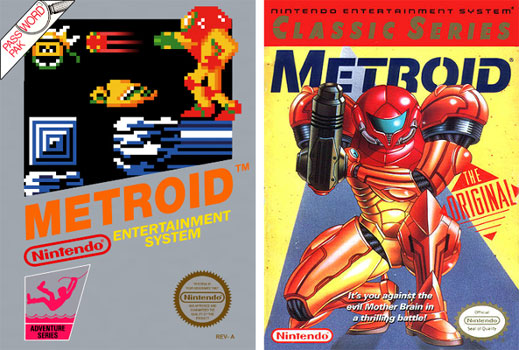


_(En%2CFr%2CDe%2CEs%2CIt)-1.jpg)
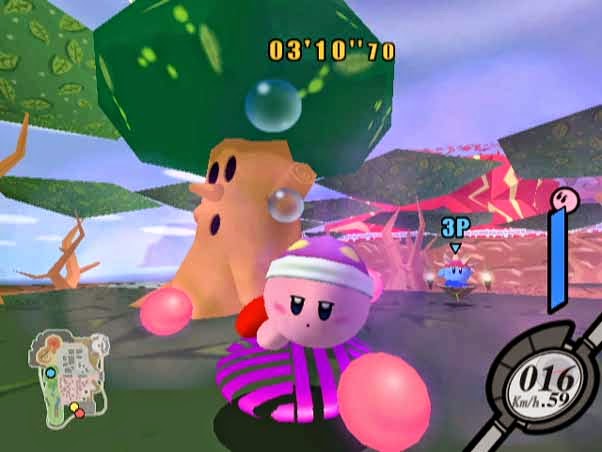


.jpg)


.jpg)


