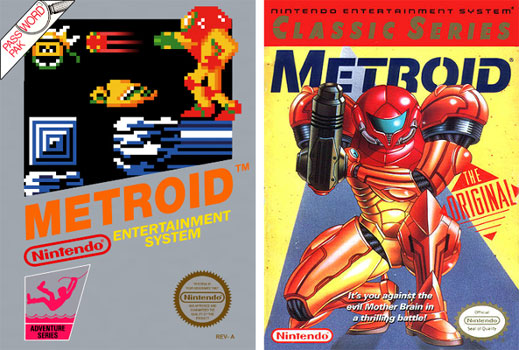
Back in the days of Super Smash Bros. Melee when I'd browse its lauded collection of lovingly-crafted trophies, I couldn't help but foster a burgeoning affinity towards one particular replica: Samus's Starship, hailing from Game Boy's Metroid II: Return of Samus. Not because I was experiencing Metroid nostalgia, you understand -- I wasn't yet a fan by Melee's release -- but more so in cultivating a touch of personal pride via its accompanying origin date of 11/91; in other words, my birth date. How vindicating is that? I've always held warm feelings towards Super Nintendo for similar reasons -- perhaps that's why it's my favorite console -- but it surely can't top that. A wonder, then, that Metroid hasn't ousted EarthBound, Kirby, and Smash Bros. from their seats as my all-time favorite Nintendo franchises.
Alas, perhaps it's that the stars only aligned for coincidence as opposed to birthing an outright classic, for Metroid II: Return of Samus never enjoyed the accolades of its successors (Super Metroid, Metroid Prime) or even its own NES progenitor. This isn't due to any untoward experimentation so commonly found in retro sequelization -- if anything, its goals breed potential finally realized in its incredible 3DS remake: Metroid: Samus Returns -- but rather that the Game Boy is ill-equipped to handle such direction; in other words, we're dealing with a game featuring familiar genre pratfalls found in its heyday. As you've likely guessed, the absence of a map system and woefully obtuse level design do little favors for Samus's Metroid-hunting expedition, but I confess my main problem lies within a particularly clumsy bait-and-switch in its music score. I cannot emphasize enough how the opening Tunnel Theme -- one I've written in the past as being a damn good tune -- instills us with urgency and drive, headlining our mission of eliminating SR388's Metroid hives.
And so, it finally begins: my foray into a certain video game phenomenon that's ballooned far past its Nintendo origins. In a development still eluding my inner seven-year-old, I've largely cooled on my Pokémon passion. This isn't to say we had a falling out -- my two visits to Pokémon: Symphonic Evolutions should be testament enough -- but that I've only just purchased Pokémon Let's Go: Pikachu! four months after release, still have yet to open it, and am currently resisting the smoldering coals of Pikachu's eyes as I type this prove it's no longer my No. 1 video game priority. I confess this as a young man whose Pokémon background mirrored that of every other young boy in 1999 America: I playedPokémonRed-- one of the two versions we're reviewing today -- to death, worshipped the localized cartoon
daily, and collected countless cards, stuffed
animals, books, and toys. Those, too, reflect the ravages of time: the teams I've forged in PokémonRed are
forgotten and erased, I've long since abandoned the (still-running!)
anime, my old cards -- despite my best efforts in preservation binders
-- still pop up in various nooks and crannies, strategy
guides and comic books lie torn and/or lost, the stuffed animals display worn seams and cat gnawed-tears, and toys lie broken, disassembled, and battery-drained.
That it took this long to cover a full-length review for Pokémon -- having previously only covered brief impressions for Pokémon Soul Silver andPokémon White while only reviewing theDetective Pikachuspin-off -- most publicly proves this shift, but make no mistake: while we could chalk up any number of reasons why I've fallen off the Pokémon ride, my same passion for writing, game analysis, and
historic study applied to its Game Boy roots. It is my dedication to nostalgia that keeps me on this path, and what better evidence than playing both Red and Blue
versions via their 3DS Virtual Console re-releases to completion? This was completely unnecessary in itself -- both only differ in version-exclusive Pokémon to catch -- but their infamous balance sparked an insatiable curiosity. If there's any
confirmation a deep love for Pikachu still beats in my heart, let it be
that.
To discuss these Nintendo progenitors is something of a difficult task: much as I adore the likes of Super Mario Bros. and The Legend of Zelda, for instance, they've certainly been outstripped not merely by modern standards but in their own successors. While Super Mario Bros.' immaculate design renders it just timeless enough to be accessible even to modern audiences, however, the same can't be said for The Legend of Zelda -- it certainly remains a masterpiece for those wishing to invest time into it, but barring one's possession of an NES Classic and its instant save states, its cycles of punishment and foraging fare quite poorly against the conveniences of today.
Much like The Legend of Zelda, Metroid is also often cited as an impenetrable classic -- the game is hard-as-nails difficult, thinking little to nothing of the player's morale. The overall "maze" design, while taking care to distinguish Planet Zebes's underground sectors from one another, does not establish the same philosophy with its room design and we're left with a homogeneous, indistinguishable look that's prone for disorientation. There are various reasons for this -- Metroid had a particularly
troubled development, for starters, and the game as we know it today
only came together in the final three months of development -- but let's be honest: it's not as if Metroid was the only 80's game that employed similar tactics, and I'd like to think the game still holds up regardless. Being a Nintendo historian, it's easier for fanboys like myself to overlook such flaws for the sake of research and personal amusement, and Samus Aran's first adventure is hardly an exception.
It's really hard for me to look at the above cover. While hardly problematic in itself, something about this localized box art for Dragon Quest II -- Dragon Warrior II in the States -- irks me more than the one for the first, which is mighty odd considering they both subscribe to the 80's style of realistic medieval fantasy. Could it be the exaggerated chest for the Princess of Moonbrooke, or that at this point I'm far, far too accustomed to Akira Toriyama's signature artwork for the series?
Ah, yes, that's more like it. And the answer is apparent as well: as much as the NES Dragon Warrior covers attempt to present the games as no-nonsense affairs, the goofy enemies obviously suggest a more tongue-in-cheek affair, and thus it's insanely difficult imagining the American art having any agency in our imaginations. Naturally, Toriyama's art is the way to go, so let us not tarry upon such incongruities.
Dear reader, should you be the gaming type--and I'm assuming you are, considering you're reading a video game blog-- let me ask you this: if you could, would you take on the impossible task of playing a game forever? Personally, there would be far too many earthly pleasures to give up for such a venture: while the luxuries of drinking Welch's White Grape Juice and stroking cats could simply be delivered to me, the simple pleasures of taking afternoon walks, watching cat videos and reading weathered One Piece and Eyeshield 21 volumes would simply be too much to give up.
And yet, a number of games pop readily to mind. I remain endlessly entertained by Super Smash Bros. for Wii U and 3DS, for example, and I've yet to grow boredof Splatoon even on the eve of its sequel. I've never tired of the cathartic seas found in The Legend of Zelda: The Wind Waker, and my fascination with Bubble Bobble on my beloved NES Classic Mini hasn't ceased. I've lost count of how many times I've completed Star Fox 64 and Tales of Symphonia; in fact, I'm at the tailend of a playthrough for the latter right now.
Yet again we're faced with another NES box art malady. While the box art for Dragon Warrior is hardly as offensive as Mega Man's, it submitted to the all-too-common illusion of making the game seem "cooler" than it actually was (which, to be fair, was present in Japan as well). Whereas the American cover portrays a generic medieval fantasy, the Japanese artwork portrays a more colorful, light-hearted affair.
As it should; after all, it was done by none other than Dragon Ball's Akira Toriyama, whose 80's trademarks of cute, squat protagonists and fleshy, rotund beasts would set the tone for the series (it's no coincidence the dragon is cuddlier than your average Final Fantasy monster: the same would echo across the game's variety of enemies, not the least of which is the famous Slime).
And note the difference in name, too: Dragon Quest became Dragon Warrior for US release. The cause may not be as immediately apparent as that of Rock Man to Mega Man, as a pen-and-paper RPG of the same name held the "Dragon Quest" name. The word "Warrior" also undoubtedly appealed to American boys more than "Quest," and so the series was dubbed as such here until 2005's Dragon Quest VIII.
Just as it does with box art, Leave Luck to Heaven represents games with their American names whenever possible. But as developer Enix (or should I say Square-Enix?) went to the trouble of retconning the Dragon Warrior name,so shall I for the reviews.
At any rate, it's well-known Dragon Quest became a phenomenon in Japan, providing the building blocks for Japanese RPGs: medieval worlds of fantasy, spells obtained upon leveling up, and a hero whose name is up to the player. Such success was not repeated in America, as its late release paved the way for its niche status over here. A 1986 RPG revolving around antiquated menus/commands would hardly light sales-charts in 1989, and while a Nintendo Power subscribergiveaway proved successful, said giveaway was initiated only to empty unsold stock.
Unfortunate, but at least we got an improved product out of it. Much of it boiled down to player convenience; for instance, no longer did the save system rely on tedious passwords, but a battery-pack save. The Famicom menu was far too cumbersome in that you had to choose the direction of the Talk command, but here it's just a simple selection. Even the graphics were adjusted across the board, as NPCs and even the hero himself are now applied directional animations. (Speaking of which, I highly recommend clicking here to witness the Japanese version's unintentional hilarity courtesy of the hero's groovin' trot. Nothing quite like 80's cringe!)
It was an ambitious undertaking directed by none other than the late Satoru Iwata, then a programming prodigy steadily rising within the ranks of HAL Laboratory. As the game that more or less forged what we know today as "JRPGs," playing Dragon Quest was something of a moving experience: to know a part of his legacy was being responsible for bringing what essentially jump-started an entire genre to our shores--and on top of all that, improving it--awakened a melancholic blend of gratitude on more than one occasion.
Alas, it's not enough to salvage the game from old age. It's vital to dispel any claims of mediocrity: Iwata's tweaks ensure Dragon Quest functions okay in a modern age, but an 80's menu-based RPG has much more going against it than the timeless likes of space-shooters and precision-based platformers.
Really, it's crazy just how much of this has to do with the game's overall pacing. There's not a whole lot of meat to Dragon Quest's campaign,so it relies on being one big grindfest from beginning to end. It's not an exaggeration to say over 80% of one's time will be spent fighting monsters, accumulating EXP and leveling up rather than embarking on swashbuckling adventures. Needless to say, tedium can settle rather quickly.
Other trappings of its age are hit or miss -- like other open-ended 80's games, the world of Alefgard is far from linear and expects players to follow vague NPC hints for progression; naturally, this results in players getting lost, and the frustration of unrelenting (not to mention random!) enemy encounters might discourage exploration. Thankfully, Alefgard isn't particularly big in comparison to future 8-bit RPGs (namely its NES sequels and the Final Fantasy games), so it's easy to memorize the lay of the land.
On the other hand, there's just no getting around the clunky menus. At best, they are what they are: an outdated element that falls into every 80's menu trap (can you say, no item stacking? Limited inventory space?), and yet Dragon Quest's execution is particularly archaic. Using commands to talk and search is clumsy enough, but for there to be one for using stairs?
There's other minor annoyances: for one thing, having NPC villagers walk around towns is a novel 8-bit touch, but it's not so "novel" when they decide to block exits and store counters. This is something hardly exclusive to Dragon Quest, mind you; after all, it's another piece of retro baggage, yet I still found myself shaking my fist at those who dared blocked my inn stops. ("I'm only at 5 HP, dammit! I'm gonna die!")
It's a good thing then that the game's world is so charming. Dragon Quest's localization took the liberty of injecting the script with Elizabethan-styled dialogue, with characters speaking like "Take now whatever thou may find in these treasure chests to aide thee in thy quest" or "Thou hast been promoted to the next level." Before playing, I was immediately apprehensive: wouldn't such an embellishment smother the script with stuffy language, particularly since Dragon Quest games are known for their witty dialogue?
I was surprised to witness that wasn't actually the case. Not only was the script relatively free of errors (a rarity in an era ripe of mistranslations and typos), but such a direction was rather fresh compared to the the dry, passive scripts commonly found in localized RPGs of the time. It's still a direction cheesy enough that I wouldn't want touching a modern localization, but within the context of those equally-cheesy 80's, it somehow fits like a glove.
Speaking of localization, most of the aforementioned graphic changes are for the best; truth be told, not only do the new sprites hue closer to the round, squishy citizens commonly found in 8-bit RPGs, but the Japanese version's NPCs look like what an ill-fated Americanized version would attempt to render it "cooler".
Really, the only aesthetic misstep is the infinitely bland title screen, which doesn't have a patch on iconic Japanese logo. Just look at all that wasted gray space!
But no amount of box art or title screen changes can stop Akira Toriyama's art from shining through. While mainly reserved for the monster designs, creatures like the Slime, Drake and the tongue-protruding, witch hat- wearing Ghost instantly captivate our hearts, whereas we immediately want nothing to do with the Axe Knights, Golems and Werewolves that cross our paths. Not that the hero should underestimate every cute enemy he comes across, mind, but Toriyama's design ensures the enemy hierarchy of power is instantly apparent.
Such moments even extent to the simple story: the rescue of Princess Gwaelin triggers an "aww" moment of the most triumphant kind -- the hero's overworld sprite carrying the princess bridal-style back to her castle. Director Yuji Horii's first attempt at an "emotionally involved" system might be rather barebones today, but that it elicits such emotions thirty years later speaks of fine craftsmenship.
And let's not forget the music by the legendary Kochi Sugiyama which...which...look, I'm sorry, but I can't avoid the elephant in the room. As much as Mr. Sugiyama is a talented composer, as much as he's contributed to the success and awareness of video game music, he's also kind of a terrible human being. Yes, the very first champion of game music is not just a history revisionist; he's a hardcore nationalist who regularly funds and participates in organizations that fuel such conspiracies.
Having grown up with Dragon Warrior Monsters and only just recently diving into the main series, this was immensely disappointing to learn. That his politics are removed from what is ultimately a playful, light-hearted series is a blessing we can all be thankful for, but knowing that his Dragon Quest proceeds go directly to history-revisionist foundations that suppress elderly rape survivors does not weigh easily on my conscience. While I will continue applauding his efforts in future Dragon Quest reviews, I won't be so neglectful in mentioning his misdeeds.
But since I've already called it out, what is effective about Dragon Quest's score? There's simply no going about reviewing Dragon Quest music without diving into the main theme, which makes its first appearance here. A bright, celebratory march that greets us at the title screen, we're up and ready to enter the game's world upon the first note.
Naturally, Sugiyama's legacy as a classical conductor dwells within every one of his compositions, but it's most apparent in the above battle theme. Creeping and slow, it recalls to mind that of a stalking menace lurking behind us. Just look at how well it translates into orchestra!
The cave theme also engages in, to my knowledge, one of the earlier experimental themes for NES/Famicom. Ignore how the above video is probably two minutes too long and click on the playlist button; see how there's eight different versions? In the game's final dungeon, the song gradually lowers in tempo as you descend deeper and deeper, echoing the apprehension before taking on the Dragonlord. How's that for scaring your pants off?
But as iconic as the main theme is, my favorite track lies in the overworld theme: Unknown World. As Dragon Quest highlights a solitary journey, it's only fitting that its world echoes a theme of loneliness. Laced with uncertainty, that we're left to discover what the game's world holds makes for a palpable effect.
Much like the game itself, actually. While not without its mishaps, Dragon Quest braved new waters for the sake of one goal: to distill the complicated RPG genre for a widespread audience. This could not just be done by simplifying the system; with Dragon Quest's hero being tied to the player's identity, we become invested easily, and so we're willing to leap over any hurdles involving clunky menus and uncertain progression.
Such an admirable achievement became the ever-improved fabric of the series going forward, but its heart still beats within its first effort. It's a relic, but a functioning relic: its age doesn't stop it from being accessible, and that alone makes a quest worth embarking on.
While Pokémon was what cultivated my interest in anime and manga, Dragon Ball was what captivated that interest and promptly skyrocketed it into a permanent hobby. Akira Toriyama's tales of monkey-tailed boys, alien combat and musclemen protruding golden hair three times their size captured my heart like every other young male living in early 2000's America, and I celebrated my fandom in every way possible. My friends and I constantly invented new adventures for our DBZ action figures. I dressed up as Vegeta for Halloween (I think the wig my mom made is still lying around somewhere!). I memorized the power levels of every character as I frequented the web for plot summaries and pictures. I downloaded translated ROMs of the Japan-exclusive games. I even discovered that, gasp, the show was being censored for American television!
That all began fifteen years ago, and after all these years, my Dragon Ball dorkiness is still alive...if not a tad more latent. Episodes from the fabled Dragon Box sets frequently serve as nostalgic background noise within my basement. I'm quite behind on the new animated adventures, having only seen the first two episodes of Dragon Ball Super and the Battle of Gods movie (for the record, I loved both). Every now and then, I take one of my old manga volumes and take a whiff of that familiar smell; once upon a time, I was convinced Japanese children reveled in that holy scent twenty years before I did.
While still regarded as an action masterpiece, it's easier to discern the flaws of something I once deemed as perfect. The childhood and adulthood periods of protagonist Goku's life--marketed outside of the original Japanese manga as Dragon Ball and Dragon Ball Z, respectively--are too thematically dissonant (if anything, I prefer the whimsy of Dragon Ball). Non-Saiyan characters are frequently shoved into the sidelines, no matter how much time had been invested into them prior. Yet no matter how much I could go on, none of it matters whether I'm reading or watching it. I could say it's just my childhood speaking, yet every story beat, every character moment have become so ingrained into shonen manga that it's little wonder it remains the cornerstone of Weekly Shonen Jump (to provide an American equivalent, I suspect many feel the same about the original Star Wars trilogy and how it impacted cinema). Needless to say, it's a series I still deeply respect and adore.
With all that said, Dragon Ball Z: Budokai requires some context. See, Japan had been living it up with Dragon Ball video games since the 80's, yet we Americans never got in on that action (not including the infamous Dragon Ball GT: Final Bout). It wasn't until 2002 when animation company Toei, American anime licenser/localizer FUNimation and game publisher Infogrames finally got off their sorry keesters and began distributing DB games across the West. While we were initially gifted with a spectacularly shitty duo of Game Boy Advance games in The Legacy of Goku and Collectible Card Game, everyone's eyes were on what was to be the first 3D DBZ fighter for PS2: Budokai.
That's a pretty big deal, as evidenced from the above intro animation. Mute the rancid (yet catchy) 90's rap song and merely observe the video. Yes, you're watching a replica of the Cha-La Head-Cha-La opening from the Japanese version. For the first time, every scene from this iconic 1989 animation had been rendered in beautiful, luscious 3D. That America was not only treated to a butchered version of the opening for the show but that the original song was axed in favor of Rock the Dragon dilutes the nostalgic impact somewhat. Thankfully, we were too distracted by the shiny PS2 graphics to really notice.
What made Budokai so special is that it framed itself as a genuine celebration of Dragon Ball. It didn't cover every chapter of the saga, but the game sprung to life from the get-go with winks and nods everywhere (just look at all the little character icons up there!). Menus were peppered with animations and stills that perfectly matched the style of Toei Animation (with how the company handled the opening sequences for the sequels, I'm convinced they at least provided the latter for this title). The voices were the same as the show, and the soundtrack--composed by series veteran Kenji Yamamoto in a collaboration with Tower of Power--was so good it had practically defined the game by itself.
And how my heart aches knowing I can no longer appreciate all that.
I say this knowing full well Dragon Ball Z: Budokai never had the deepest battle system; even back then, I was able to discern the more homogenized attacks between most characters in the first two games (the most baffling case being in this title, where one particular combo is literally just a couple kicks. Bear in mind there's a dynamic camera involved). But it was good enough...and cool-looking. Like, really cool. The game's emphasis on arena-destroying supernovas (the best being Mr. Satan-er, Hercule's, where, in a fake plea for mercy, he hands over a remote-controlled bomb to the enemy), emulating the super-fast flurries of punches/kicks through button-mashing sequences, and delivering attacks so hard they send your opponents careening into alternate arenas all authentically matched the show.
Except now it's not. Unlike most games ravaged by time, Budokai's in a...peculiar predicament. For one thing, it's the forerunner in a series that shifted over to cel-shaded graphics just the next year. The awkward graphical look would be bad enough, but there's also the matter of just about everything else. You have the voice acting, which is the same as the show but FUNimation's dubbing for DBZ has always been a mixed bag, to say the least. Then you have the music, which was...no, I don't have the heart to say it yet.
Needless to say, a "just good-enough" battle system can't support all that, no matter how flashy it is. It'd be easy to dismiss it a static relic of its time, yet somehow it's preserved its spot as the fondly-remembered DBZ game by American fans. We could just chalk it up to it being a runaway sales success over here, yet there's other matters to consider, namely that Budokai was the only Dragon Ball Z game for years to host a fully-animated Story Mode that reenacted the original series.
Not that the subsequent games up to 2008's Burst Limit didn't have a Story Mode, but they were all propped up through board games (Budokai 2), 2D "still" images (Budokai 3, although Dragon Universe was mighty cool for what it was), or the models just standing there talking (the entire Sparking!/Budokai Tenkaichi trilogy). Subsequently, Budokai's first stab at retelling the story we all know and love in 3D won by default for most folks.
And it's not like it did so through laziness. For one thing, the cinematics are well-animated for their time. Yes, we can nitpick the grainy textures (look no further than the bleached green of King Kai's planet) or that fart sound that comes out of Yamcha's clenched fist in that one cutscene, but god damn did they look cool. Take how it adapts Goku's iconic transformation into Super Saiyan, where the screen quakes with such intensity every time he screams. It was electrifying to watch as a kid, and even now it's one of the legitimate pieces of direction that holds up.
But wait, I thought I just said the game didn't age well graphically? Yes, well, note how I said it's well-animated, and even then that only applies to the cinematics. While the cutscenes may be of adequate quality, it's shocking how that all falls apart when the fighting comes down. The characters lack breathing animations, and everyone's beefcake designs renders it even more awkward, particularly when a good chunk of victory animations consist of character crossing their arms and grinning smugly into the camera (the winner goes to Piccolo, who hangs his mouth open in stupefied wonder at his endlessly-wiggling antennas).
Needless to say, it's really easy to see why they moved into cel-shading. For instance, there is nothing natural about the power-up animation: as opposed to lifting the iconic stances from the show, characters statically scrunch up into a position quite akin to that of taking a dump. Despite the beefcake designs, there's a real lifeless look to everything that was never going to hold up. While the GameCube version added in a unique cel-shaded look of its own, the animation problems persist.
Honestly, I think I'm even being generous with the cutscenes in regards to modeling. Just look how ghastly Karin (Korin) the cat looks up there. That's actually a shot from the HD version, and apparently whoever was in charge of that remaster couldn't fix such a monstrosity.
Anyway, there's also the matter of VAs. Look, let's be honest: while FUNimation may be the best anime dubbing company in America now, that'd be a difficult case to make in 2002 (let alone when they first started out). While Dragon Ball Z was what got them on the map, it fell victim to about every bad dubbing trope from the late 90's: stilted VA direction, corny scripts, a never-ending replacement BGM, and embarrassing opening songs. You cannot sit here and tell me that a dub host to a character singing "CAT LOVES FOOOOOOD YEAH YEAH YEAH YEAAAH" (if you pay attention, the dialogue exchange doesn't even match the context of the scene) or a villain randomly making homosexual advances is better than the original Japanese, a thing of beauty host to the best seiyuu in the anime industry.
But hey, don't take it from me. Why, who is that handsome young man grilling voice actors Sean Schemmel and Christopher Sabat? That would be me, at last year's Otakon! And I gotta say, while I don't entirely buy the "old equipment" answer, I'm quite impressed with their opinion on nostalgia. After all, it's not like Dragon Ball is some holy grail many of us superfans treat it as such. To some people, it's just their favorite goofy Japanese cartoon they grew up, and the meaning of "dubs vs. subs" hold little meaning to them, and that's quite alright.
With all that in mind, Budokai is a pivotal moment in researching the history of DBZ dubbing. Not only was the show coming to an end in America, but this was the first time the cast was brought together for an extensively-voiced video game. For starters, there's Chris Sabat and his dozen roles: his stern direction for Piccolo had evolved just fine, yet he still hadn't figured out how to make Vegeta sound anything other than, as Kanzenshuu once put it, a guy in a booth doing a gruff voice. Meanwhile, Sonny Strait has come a long way in his voicing Kuririn (Krillin): no longer has his direction for the character rendered him an annoying squeaky-voiced punk, but as a genuine sidekick that immediately grows on you.
And then there's voices that continue to, well, flat-out suck. Like Ocean's Pauline Newstone before her, Linda Young's Freeza remains the most notorious miscast in anime dubbing history. Don't let the lipstick fool you; the character has absolutely zero business sounding like an old woman who's had far too many smokes. Despite being the series' most infamous villain, it's hard to believe that in context when you cannot take anything he says seriously. It goes to show FUNimation's worst casting weakness lied in body type: the less said about Philip Wilburn's squeaky Android #19 and Sean Schemmel's "marble-mouth" Kaio (King Kai), the happier I'll be.
In context of the game, it's interesting to witness the juxtaposition of direction. Rumor has it that Toei representatives oversaw the localization, and it'd definitely show in the Story Mode. Regardless of any voice mismatches, there's not a single instance of dry delivery, further granting the impact these cutscenes had back in the day. And then, once again, it falls apart a bit in actual battles. Characters announce attack names super quickly to accommodate the quick frame executions (check out Gohan's take on Kamehameha), and there's an obvious glitch regarding the Cell character: no matter how much he transforms in battle, he's always stuck with the nasal "bug" voice of his first form. It's something they never actually fixed for the sequels, and it's especially odd when contrasted with the normally-dignified countenance of his Perfect Form.
Add in how the voice clips' muffledness has grown more distinct over the years, and the delivery of the bad voices are amplified. Of course, Freeza is absolutely terrible, but the most egregious cases lie in the representatives of the Ginyu Force. Chris Sabat's Arnold Schwarzenegger impression for Recoome borders on incomprehensible and obnoxious, as is also the case for Captain Ginyu himself. The elderly Brice Armstrong is a baffling replacement for the adequate Dale Kelly; he's clearly too old for the flamboyant character and it shows in his nasal delivery.
Speaking of baffling, we now arrive at the most heartbreaking case of all: Kenji Yamamoto, the soundtrack's composer. No, not the same Kenji Yamamoto who composed the Metroid Prime trilogy; the Kenji Yamamoto who's not only been involved with composing songs for DBZ since its inception, but for all the video games dating back to the Super Famicom era.
As mentioned before, Budokai's score is so damn good that it's practically impossible to discuss the game without bringing it up. What made it excel was that it struck that perfect balance between Dragon Ball's lighthearted humor and adrenaline-rushing action. The above themes, which respectively accompany the menu and character select themes, represent the former and dress up the overall presentation; they're so fun that you can't wait to dive into the action.
And what action it is! Kenji Yamamoto's collaboration with Tower of Power definitely bore fruit; yes, those are real instruments you're hearing, all accompanied through some kickass synth. Raging guitars rev up the familiar locales that are Budokai's battlefields, and they're all the better for it. Combined with the arena-shifting mechanics, one could even say they heighten the glory of a shallow combat system.
The Story Mode isn't neglected, either. They emphasize more on synth, but Yamamoto ensures they inject blood-pumping adrenaline and appropriate drama when needed. The above example is actually spliced into three different components for varying cinematics: quiet anger (when Goku observes his dead friends slain by Nappa), anticipation and encouragement (Goku convincing Gohan to take on Cell), and awesome kickassery (Goku's Super Saiyan form scaring the shit out of Freeza).
Heck, he even goes out of his way to pay homage to the original DBZ recap theme! You see what I mean when I said this game celebrates Dragon Ball? In fact, rumor has it there's a cameo from Super Famicom fighter Super Butoden 2 somewhere...
So, wait, I just spent the past four paragraphs singing the soundtrack's praises. If the music's so good, what's the problem?
Well, it's plagiarized.
Yeah, how's that for a kick in the balls?
Kenji Yamamoto's plagiarism scandal has been well-documented, and while I was careful enough to cite the tracks that (as far as we know) weren't "inspired" from other sources, therein lies the rub. It's immensely disappointing that someone who clearly had talent fell to thievery, let alone the fact that he strung along his none-the-wiser collaborators for the ride. And even in the case of my cited tracks, I'll always be asking myself if they were truly born from his "talent."
Perhaps my memories of how much I enjoyed the game are what's most important, but that they won't live on to future generations is the most heartbreaking factor of this ordeal. Just like how Dragon Ball Kai's soundtrack was swiftly replaced across the world following the scandal, any games currently on the market that had Yamamoto's involvement had their scores replaced with recycled tracks from the Tenkaichi brand of games (which, in themselves, were actually replacements of the original Japanese score).
The Budokai HD Collection for PS3/X360 was no exception to the rule. Let it be known the dance music of the Tenkaichi series is not at all like the grounded guitars of Budokai, as evident in this collection of cinematics. It's too blatant how the cutscenes were built around the original score, and all these overly-peppy tracks induce emotional cues so differently that you may as well be watching/playing a whole different game altogether.
And therein lies the real problem: I actually prefer the plagiarized score because it functions better within the game's context. Isn't that messed up? It's too ingrained into me, too loved to accept any morally-correct replacement, and that's all because some jackass in Japan decided it was okay to steal. Maybe I'm at fault, too, but to dismiss it as "it is what it is" feels so wrong.
I love everything else Budokai brings to the table. I love that the Tournament is framed within the World Tournament/Tenkaichi Budokai from the original series (complete with the lovable announcer guy!). I love the concept of custom fighters and collecting abilities through Hoi-Poi Capsules. I love the "what-if" scenarios, particularly the scenarios involving Cell's "nightmare" and The Legend of Hercule, where the big faker actually ends not up being a faker and beats up everyone attending the Cell Game.
But I love that all with a broken heart, and I can no longer call Budokai one of the truly great Dragon Ball games. It doesn't fall nearly into the "so bad it's good" rabbit hole I rediscovered last summer with Sonic Adventure DX, but the polish found in everything else can't save how it's a victim of circumstance. The combination of flash over substance, Toei-blessed presentation vs. generic models, and an amazing soundtrack tainted with plagiarism blend together to create a product with big, gaping cracks gradually rising to the surface.
I suppose it'd be a bit mean to label Budokai mediocre; I mean, I love what it tries to do too much to label it as such, but as it stands, it truly is a relic meant for study and getting one's nostalgic kicks, not entertainment.
There was a time where, for me, the Sonic Adventure games were Sonic. It was the same era where any 2D platformer that wasn't Kirby was far too hard for me, and Sonic the Hedgehog's Genesis classics were no exception. Sure, I could play Sonic Advance just fine, but hardcore Sonic fans on message boards far and wide kept dismissing them in favor of the old Genesis games.
Being a kid, I didn't really get that, much like how the same crowd held no love for the Sonic Adventure games birthed on the ill-fated Dreamcast (and eventually ported to GameCube, as seen in the cover above). The opening levels of each game had Sonic escaping from a killer whale and running over cars with a snowboard, respectively. I didn't care for rock music, yet Sonic made it cool with the likes of Live and Learn and Open Your Heart. If I was asked to describe the games with one-word answers as a kid, I would probably respond with words like "awesome," "kickass", and "deep". Yes, deep, likely in response to what I perceived as AAA-storytelling in the form of Gerald Robotnik's execution video and, in the case of the game I'm reviewing today, witnessing the poor plight of Tikal, an ancient echidna, attempting to prevent the slaughter and burning of the cuddly Chao creatures.
All wildly out of place in a Sonic game, you understand. And as we all know, it took Sega some time to learn from that. The rise and fall of Sonic the Hedgehog, all thanks to the likes of gun-toting edgy hedgehogs and woman-on-hedgehog smooching and werewolf hedgehogs and sword-wielding hedgehogs, has been widely maligned and joked about for years and years now. And yet the Sonic fanbase, chaotic as it is, can never decide whether or not it all started with Sonic's entry into 3D (or, in some deluded circles, argued to have never happened at all).
And now here we are, well over a decade since the original Sonic Adventure was ported to GameCube in the DX: Director's Cut edition, four years after its initial release in 1999. Coincidentally, that happens to be the last time I played it (2003, that is).
My friends, as those of us who've revisited our childhoods should know, there comes a time where we're forced to accept the bitter reality about what we once loved. That is why I am here today to inform you that Sonic Adventure DXsucks ass.
And I say that with zero malice whatsoever, for Sonic Adventure DX falls squarely into "so bad it's good" territory by taking all the wrong lessons from Super Mario 64 (and late-90's 3D game design in general). The result? A lovable abomination of hodgepodge game design, the worst camera ever devised, and glitches upon glitches upon glitches. Also, butt rock.
To put this all into context, Sonic Adventure DX splits the campaign into six characters: Sonic the Hedgehog, Miles "Tails" Prower, Knuckles the Echidna, Amy Goddamn Rose, E-102 the Boring-Ass Robot, and Big the Fuckin' Cat. They all take place within the same story, so the purpose is to put the pieces together from each perspective. Not that it's even remotely interesting today, mind you, but we'll get to that later. The real issue is that I'm really not kidding when I say that Sega took the opportunity to throw in every concept they could think of, be it speedy platforming, racing, chase sequences, treasure hunting, shooting, bumper cars, casino games, and, yes, fishing.
Now, are any of these actually fun? Maybe, but credit can hardly be granted to Sega and the folks at Sonic Team. See, Sonic Adventure DX makes design mistakes so elementary that it doesn't matter which character you pick, as all of their respective campaigns are riddled with pacing flaws, pointless/confusing decoration, and accompanied by some of the slipperiest controls and cameras known to man. Also, glitches.
Sonic takes most of the story meat and represents just about every level, so it's best to use him as a model. Many Adventure critics point to his campaign as being the only enjoyable one on a functional level; this argument may've held up roughly a decade ago when the game's flaws weren't nearly as apparent today, but that's definitely not the case now. The seams in nearly all the jaw-dropping set pieces (including the famous Emerald Coast whale chase) have long since eroded, and whatever remains entertaining (such as Lost World's tunnels and gravitational wall panels) is surrounded in a sea of mediocrity.
These are all meant to illustrate how fast Sonic is, but the problem is how Sonic's speed is set far too fast. This wasn't so bad in the Genesis titles considering the multi-faceted level design (that, and the speed was far more, well, measured), but the pit-ridden 3D planes of Sonic Adventure DX simply can't handle the inoperable speed of Sonic. Consequently, Sonic tends to either fall off pits, fall through glitch-ridden slopes, or dash across walls and ceilings. The last one's an intentional cool-looking mechanic, mind you, but one that's hardly useful; in fact, you'll often find yourself running into walls instead.
Actually, just about every character runs too fast. While they vary in speed, they're unable to camouflage two fatal flaws within Sonic AdventureDX's design, the first one being level structure that continually betrays player decisions and expectations. This can range from springs that often send players spiraling into an abyss (despite being intended to launch 'em up to platforms, rings, or...nothing) to sudden sequences introduced with zero context. To step away from Sonic for a moment, above is an example from one of the similarly-designed Tails levels, where a rush of air propels him upwards. As seen above, Tails tends to crash into various structures and the like, but he'll also fall back down for no apparent reason. Naturally, the player's response to press a button to get him flying again, but that'll actually accelerate his descent. Bear in mind this is within a race setting!
Problem number two is all about the camera. Put simply, the camera cannot keep up with the characters' speeds and flings about in the most nonsensical perspectives to capture them. Some of its most common habits include freezing in place as a character zooms away, attempting and failing to capture everything relevant to the character's actions/placement, or just freaking the hell out. Above is an example of the second variety: Sonic has just left a room in Casinopolis, but the camera wants to be mindful of his AI partner (Tails), so it awkwardly situates itself behind the room's glass paneling so it can display both characters at once (as opposed to where it should be: around Sonic).
In any other 3D action game, this would compel any player to toss their controller at the wall. But bad 3D Sonic games have this mysterious fascination with clunking up every area imaginable with glitches galore; in the case of Sonic Adventure DX, there's so much what-the-fuckery going on in setting/context, collision detection, and AI movement happening every 20-30 seconds. I don't know what's the nebulous secret behind why Sonic derpin' out is so damn funny , but regardless, I took the liberty of capturing some of my favorite moments.
Yes, that's Sonic showering within the bathrooms of Casinopolis, and he has a visitor! Tails had been hopping about until colliding into the wall and freezing in that walking animation, leading to the hilarious shot above. Truth be told, this actually happened just before the glass paneling camera shot, setting a scenario where Tails watches sadly as his lover moves on. I wonder how much filthy fanfiction I just inspired?
Here's Knuckles climbing the non-existent space beyond one of the Egg Carrier doors! Yes, even the game's three central hubs are hilariously glitch-ridden. Did I mention the hubs are easily the worst of the inspirations borrowed from Mario 64? I'm still not sure if you're supposed to walk on top of the trees of Mystic Ruins' jungle; I mean, me falling through every three seconds should be a clue, but anything goes with Sonic Team. Anyway, it's far preferable than getting lost in that unnavigable maze of a forest, so I don't mind.
Now, I'm told that Sonic Adventure DX brought its own share of glitches and errors during the porting process, allegedly making the game worse than it actually is. However, the idea of the level design, controls and the camera all magically turning to shit when transferred to GameCube is a hard pill to swallow, especially since some of these very complaints existed back upon its Dreamcast release. If anything, I really can't help but appreciate DX's efforts in at least making the game look pretty. Just take a look below.
Sonic Adventure
Sonic Adventure DX
I mean, both are all kinds of terrible, but for vastly different reasons. Sonic Adventure needs no explanation, as I'm certain I wouldn't be to sit through even one cutscene without collapsing in laughter. Meanwhile, Sonic Adventure DX takes the time to freshen the models to an acceptable 2003 standard, polishing 'em off with a shiny sheen. Unfortunately, they neglected to update the mouth animations, so everyone speaks with all the grace of a cow chewing cud. In case you're wondering, that's why Sonic's tongue is sticking out like that (also, why does Sonic have fangs?).
Yes, at the very least, I can't imagine the Dreamcast version excusing the very worst of Sonic Adventure. There's the voicing and scripting, for one. Like, holy shit. I knew revisiting an era where they casted unknowns to voice hackneyed dialogue wasn't going to be pretty, and I knew even as a kid there were some weak lines ("Tails! Watch out! You're going to crash! AhhHHHhH!"), but this is just on another level. You know things are bad when the entire cast of bad 90's dubbing tropes are here: the overacting ninnies (Sonic and Knuckles), the obnoxious body-type casting (E-102 and Big the Fuckin' Cat), "Good Voice, Bad Acting" (Tails' child actor), and The Actors Who Simply Don't Give A Shit (whoever they grabbed around the office to cheer Sonic's name before the final boss).
All are unintentionally hilarious. Granted, the late Deem Bristow brings some deliciously evil cheese to Dr. Eggman (one that he struggles to maintain, unfortunately, but points for effort), but this is all married to the following:
a) the aforementioned horrific attempts at lip-synching.
b) tuned to a boilerplate "ancient evil" script that attempts to be far more serious than it actually is ("THIS IS BEGINNING TO BLOW MY MIND," yells Knuckles after witnessing a mysterious vision).
c) characters constantly speaking over each others' lines.
d) the loud, blaring music constantly drowning out dialogue
Naturally, the results can't be anything but tear-inducing hilarity. You haven't lived until you've heard Tails's speech about the power of friendship.
The scripting even bleeds over to the silent human NPCs, all of who are concerned with burgers, archaeology, train station strikes, and finding love in pizza restauraunts. I'm the type that walks up to every NPC in sight, so naturally the blocky residents of Station Square and their insipid affairs fascinated me to no end. The love story moved me to tears, really.
And then there's Big the Cat. Big the Fuckin' Cat, whose only purpose is to fumble around and fish for his pet frog. This naturally begs the question "why the hell am I doing this?" as most Sonic games have done in the past decade and a half. Sega's response? "Well, because we already implemented a fishing program for some reason." Now, I just so happen to have an unhealthy obsession with cats, so I supposed I'd be willing to play ball with whatever the fuck Sega wanted me to do.
And I'm glad I did, because otherwise I never would've discovered the most beautiful level in all of gaming: Big's version of the Ice Cap segment. To clarify, the rest of his levels consist of just a pond to fish in, as they should be. No point in propping up those sections with fluff, right? For reasons I cannot even begin to decipher, the gang at Sonic Team decided to transform the Ice Cap fishing level into a labyrinth of springs, slopes, spike traps, and deep, deep water tunnels. As expected of an ice level, it's all very slippery, and I should also mention Big the Cat is ill-equipped to handle any platforming (he runs fast, but is offset by his poor jumping ability).
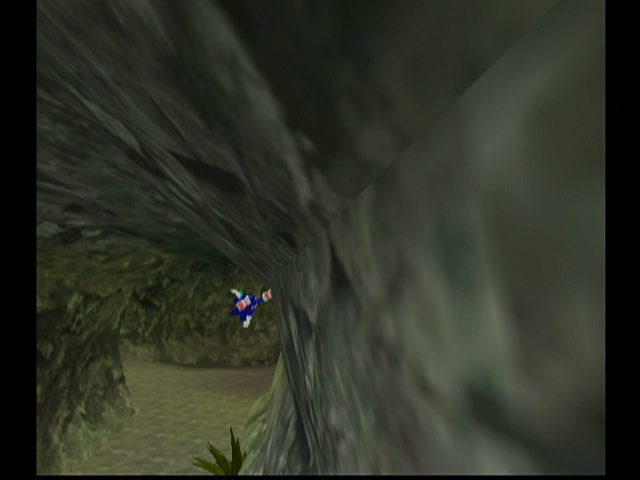
I spent roughly half an hour transitioning from mild curiosity to convulsing around the floor in laughter attempting to figure this level out. You're supposed to throw a boulder at one of the frozen ponds to find Froggy, but like me, if you don't bother to immediately seek the advice of Tikal, nothing in this level is immediately apparent. What ensued was a pattern of me briefly scoping out the bottom level, then climbing up down slopes and watching Big the Fuckin' Cat's fat ass falling all the way back down, springing over to completely irrelevant crevices and water pools (barring finding a hidden lure, but hardly worth all this fluff), and watching helplessly as the camera zoomed up at the ceilings of incredibly cramped underwater tunnels. I took the time to craft GIFs of my Ice Cap escapades, for words alone cannot capture the beauty of Ice Cap.
The last one's actually in the Mystic Ruins, but you see how Big just kinda fidgets in place for a bit? That didn't actually happen in-game. If you follow this link, you'll witness the true power of Big's spinning, gravity-defying powers, which no GIF converter could properly emulate.
Case in point, Sonic Adventure DX--nay, Sonic Adventure was the true beginning of a long, long era for Sonic, one often complemented by a never-ending series of "Why?" Why, exactly, am I doing all this? Why has the setting for Sonic suddenly changed to one populated with humans? Why did this game end up being so riddled with glitches? Why does Tails have to suddenly stop and inform me that I'm at the entrance to the Sky Deck, especially since this never happens for any other level? Why does the cutscene of Sonic falling from the sky really just consist of his running animation accompanied by an exaggerated slide whistle? Why am I fishing for frogs?
I won't lie and say Sonic Adventure DX is devoid of any redeeming factors, because it does, but boy do you have to endure a lot of shit to get to those points. Granted, it's all shit that made me laugh hard, and Sonic had yet to fall lower than this, but it's all still shit that made me ask why. I gradually learned to ignore all of it, but you also realize that you can't really escape it.
Even the soundtrack isn't safe -- with the very distinct exception of Sonic Chronicles, if there's one thing to count on in a Bad Sonic Game, it's almost guaranteed to have a damn good soundtrack. Above are two of my favorites: the theme for the Red Mountain level and E-102's theme. Note how both make excellent use of the piano despite being on opposite ends of the Sonic Adventure spectrum.
Then you have to endure butt rock; or in the example I've provided above, butt rap, assuming that is an actual term. Sung entirely from the perspective of Knuckles, his special rap claims that unlike Sonic, he "doesn't chuckle" and is something of a "bloat thrower".
In a different time, I would've argued that Sonic should follow its Saturday Morning Cartoon roots and focus on feel-good songs in the vein of Sonic R and even Tails's own theme for this game (something I've always had a guilty affection for). But in the end, Sonic's bad boy attitude won out. All still in good fun, mind; why else would I still get nostalgic chills from Live and Learn? But then I listen to that rap and I wonder if it's really worth it.
In a way, I'm still wrestling with my feelings on Sonic Adventure DX. Make no mistake: it's really bad and I thoroughly enjoyed learning why, but in more of a "my soul's been punched" kinda way. Much as I laughed at Big the Fuckin' Cat, that half-hour is not only one I'm never going to get back, but I've spent far more time wondering "why?" and so I can't even visit side stuff like raising Chao and the Mission Mode in fear I'll have the same reaction. Maybe next summer; I need time to heal.
I now fear the worst for Sonic Adventure 2: Battle, which I'll be revisiting very shortly.If you excuse me, I'm going to drown my sorrows in Welch's White Grape Juice. Maybe it'll bring my childhood back, I dunno. Anything to make Sonic cool again.
---
You may've noticed some of the screenshots varied in quality. If you hadn't guessed, all the stuff with the black borders were from my recordings. I hear there's some programs out there that can take 'em out, so you can expect that for the next game I record (Kirby's Epic Yarn, maybe?).