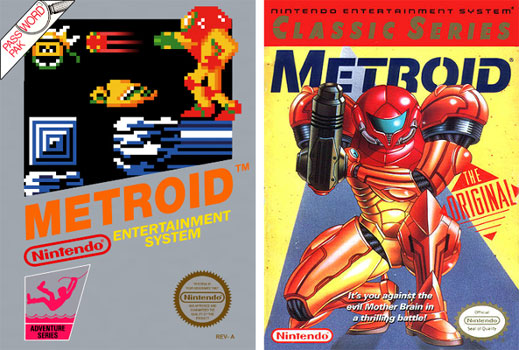
To discuss these Nintendo progenitors is something of a difficult task: much as I adore the likes of Super Mario Bros. and The Legend of Zelda, for instance, they've certainly been outstripped not merely by modern standards but in their own successors. While Super Mario Bros.' immaculate design renders it just timeless enough to be accessible even to modern audiences, however, the same can't be said for The Legend of Zelda -- it certainly remains a masterpiece for those wishing to invest time into it, but barring one's possession of an NES Classic and its instant save states, its cycles of punishment and foraging fare quite poorly against the conveniences of today.
Much like The Legend of Zelda, Metroid is also often cited as an impenetrable classic -- the game is hard-as-nails difficult, thinking little to nothing of the player's morale. The overall "maze" design, while taking care to distinguish Planet Zebes's underground sectors from one another, does not establish the same philosophy with its room design and we're left with a homogeneous, indistinguishable look that's prone for disorientation. There are various reasons for this -- Metroid had a particularly
troubled development, for starters, and the game as we know it today
only came together in the final three months of development -- but let's be honest: it's not as if Metroid was the only 80's game that employed similar tactics, and I'd like to think the game still holds up regardless. Being a Nintendo historian, it's easier for fanboys like myself to overlook such flaws for the sake of research and personal amusement, and Samus Aran's first adventure is hardly an exception.
It's really hard for me to look at the above cover. While hardly problematic in itself, something about this localized box art for Dragon Quest II -- Dragon Warrior II in the States -- irks me more than the one for the first, which is mighty odd considering they both subscribe to the 80's style of realistic medieval fantasy. Could it be the exaggerated chest for the Princess of Moonbrooke, or that at this point I'm far, far too accustomed to Akira Toriyama's signature artwork for the series?
Ah, yes, that's more like it. And the answer is apparent as well: as much as the NES Dragon Warrior covers attempt to present the games as no-nonsense affairs, the goofy enemies obviously suggest a more tongue-in-cheek affair, and thus it's insanely difficult imagining the American art having any agency in our imaginations. Naturally, Toriyama's art is the way to go, so let us not tarry upon such incongruities.
When Super Mario Bros. launched in 1985, it captivated a worldwide audience through subtle accessibility and an addicting idealism that made players say, "I can do that." It was a game that fed upon muscle memory via carefully crafted physics and manipulation of Mario's surrounding environment, all nuances anyone could enjoy thanks to its accessibility. It was a pick-up-and-play game of the best kind, with level design fine-tuned as subtle tutorials and music that manipulated us to try, try again.
In contrast, its wombmate The Legend of Zelda offers relatively fewer cues, doesn't involve as much exertion, and requires a dedicated commitment for full enjoyment, but it captivates us through a slightly different ideal: "I can do it this way." Its world of Hyrule entices us with an open world, one where we can explore anywhere and are rewarded for doing so. Much like Super Mario Bros. before it, it becomes "our game": Shigeru Miyamoto's personalized garden can be tackled any way we wish, even if it's not bound by a set order.
Have you ever stopped to think about the name Final Fantasy? It's something so highly prestigious that the game would have to be as grand as the name implies--and make no mistake; for its time, it certainly was--but it hardly makes a lick of sense when regarding the actual context. The answer lies within its development: as developer Square was in the throes of near-bankruptcy, creator Hironobu Sakaguchi wanted a title that would not only close the book on the company, but on the seemingly-inevitable end of his game-making career.
As history would have it, that wasn't the case. Final Fantasy has since gone on to produce over 15 beloved titles (not to mention countless spin-offs and ports/remakes) and became the worldwide representation--perhaps even standard--for the Japanese RPG. The "Gil" currency, the famous victory fanfare and the Chocobo/Moogle mascots have become synonymous with the genre, and continue to be associated with the series to this day.
However, not all of the them debut in the series' first game, which is often cited alongside the original Dragon Quest as kickstarting JRPGs. There is a distinct difference between the two games, however: Dragon Quest is, more or less, a grindfest for its entire duration. Final Fantasy is not.
That's not to say there isn't any level-grinding within Square's debut RPG, but there's more of a leniency in its pacing. Over a year had passed since Dragon Quest, so it only makes sense they'd arrange for the necessary improvements. The interface is simpler and less clunky; no "stairs" button in sight. There's an active, ongoing story-arc that, while not deep, breaks free of the "save the princess!" model. Western RPG tropes are brought in to enhance the battle system, such as enemy weaknesses (fire beats ice, duh)
The end result is a game still approachable today. You will grind, but there's enough player conveniences and innovations to keep thing interesting. JRPG conventions like overworld vehicles got their start here, but they weren't just 80's visual stunners; the thrilling swiftness of the Airship is just as much of a marvel as it is an effective tool for speedy progress.
Yet what's perhaps most impressive is the Class System. As opposed to the Final Fantasy games of today, you create your four-man party out of six different classes (Warrior, Thief, Black Belt, Red Mage, White Mage and Black Mage), each with their own strengths and weaknesses. White Mages don't really engage in physical combat, for instance, but are invaluable for any team thanks to their healing magic.
It's a wonderful, flexible system that ensures no two playthroughs will be the same: that there's over 60 spells to master ensures a deep, flexible variety within each party member's moveset. Citing a personal example, I initially thought I made a mistake in choosing a Thief class as my 2nd physical class(Warrior was my first, main choice), as he died quickly and possessed the strength of a mewling kitten. It wasn't until his eventual promoted to a full-blown Ninja that his usefulness was discovered: not only could he actually deal damage, but Black Magic was now at his disposal, so he'd be able to back up my Black Mage.
Moreover, it's just fresh, which is saying a lot for a game that came out in 1987.Having been acquainted with set parties in JRPGs for such a long time, it's amazing to me a game celebrating its 30th anniversary can deliver such a customization experience. Right from the beginning, Final Fantasy encourages you to forge your adventures rather than the one explicitly set by the developers, and I find it rather special that uniqueness has only grown over the years.
The class system alone should render it accessible to most, but Final Fantasy's unusual magic system is what often drives today's players away. As opposed to the multi-digit Magic Points commonly found today, spells are deducted by a single-digit "charge" system. This renders their use in dungeons and the like incredibly precious; the only method of restoration are overworld-exclusive tents, so the balance between offense and defense is vital.
One's mileage will vary; personally, I adored it for the different sort of challenge it brought. Old JRPGs often involve being trapped in dungeons and the like, so this brings a different level of challenge in choosing your battles. There's always the option of running away, of course, but the frustrating JRPG penalty for escape failure (free damage courtesy of monsters!) is a constant, lurking risk, so you'll only want to pick that as a last resort.
Needless to say, Final Fantasy is pretty hard, but that doesn't mean it's not fun. The battle system itself mostly works; whereas Dragon Quest relied on imagination, Final Fantasy displays your party and all their spell-casting glory. This is especially vital since it highlights your chosen party members, so their eventual transformation when promoted feels like much more of an accomplishment. It's even great to see Square taking advantage regarding attention to detail, as your weapon visually changes every time you switch equipment. Like every other pre-SNES RPG, unfortunately, it does fall into the archaic lack of auto-target (as in, you'll miss an attack if the enemy's already defeated, as opposed to simply switching targets).
There are other flaws common in 80's JRPGS. For all the improvements upon Dragon Quest, Square didn't take the time to adjust NPC antics and not have them block doors and counters. An endearing flaw, yes, but not all a practical one. And yes, you will receive vague directions and be at the mercy of townspeople hints, so don't feel guilty about using an online guide like I did.
There are, however, no flaws in the score. Series composer Nobuo Uematsu made his big break as an industry icon thanks to Final Fantasy, and know we're in for something special when the 8-bit harp introduces the famous Prelude opening. Soon to grace the prologues of future Final Fantasy titles, it instills a deep mystique that successfully frames the games as the otherworldly fantasies they're intended be.
Meanwhile, the Overworld Theme takes on not a somber tune, but of an upbeat one emphasizing adventure. Fitting quite well within the familiarly cheesy 8-bit range of the NES, as grand as the aforementioned "somber" themes we'd see in later Final Fantasy titles are, I find this sort of brightness to be far more welcoming. You could argue it may undermine its' serious attempt to tell a story, but let us not pretend it is a deep story by any measure; what matters it motivates us to keep going in the face of random encounters, rather than discouraging us by feeling isolated and alone (which in itself would betray the concept of a multi-man party).
Not that any "undermining" takes place considering the presence of the battle theme; while also an exercise of activity, it's a more serious one that expertly remembers the 8-bit rule of being infectiously catchy. It instantly recalls the wickedness of the fiends and monsters we slay not merely in appearance, but their rage-inducing usage of Paralysis.
I've had the pleasure of completing three NES RPGs over the past two years (EarthBound Beginnings, Dragon Quest, and this), and out of that trio, Final Fantasy is probably the best. This is especially shocking to me given my intense love for the EarthBound (Mother) franchise, yet Final Fantasy is perhaps the best realized JRPG of the 80's. There's no awkward skips in the scenario nor an overt emphasis on endless grinding; it is competently paced, living up to every one of its grand ambitions alongside a rigid difficulty set to be tackled any which way by the player.
It's the class system that keeps it alive thirty years later. I know it's not the last Final Fantasy to use them, but there's a distinct appeal in the first entry employing such depth in its design. And with the number of remakes and ports out there, I have plenty of excuses to take another go and shake up my selection. Final Fantasy is the rare NES game that matches up to Nintendo's own efforts like The Legend of Zelda and Metroid not merely in quality, but in successfully still channeling that engaging sense of hugeness, an even rarer 80's value I cherish as evidence of fine craftsmanship. It is not the complete masterpiece I imagine its SNES and PS1 successors are claimed to be, but such an accomplishment renders it a timeless classic all the same.
I'm sorry, I know the hilarious travesty of Mega Man's American box art is probably the most infamous example of packaging in video game history, but Leave Luck to Heaven represents games with NA covers whenever possible, right down to the "Angry Kirby" nonsense. Even so, just look at the contemptible thing: the indistinguishable geography, the structural disaster that is the building on the left (what's with the stairs? The random stone well?), and last but certainly not least, the mess of proportions, colors and physicality that is Mega Man himself. It's the prime example of 80's game boxarts attempting to make their respective games look way more badass than they actually were, and with how Mega Man underperformed in sales, it backfired miserably here. For shame, Capcom!
Not that Japan wasn't guilty of the same practice, you understand, but its respective cover for Mega Man--I'm sorry, Rock Man--was far more in-line with the game's aesthetic: the plush, wide-eyed animation style commonly found in 80's anime. It's clear from the very moment one lays eyes on the select screen line-up of Robot Masters that this isn't a game meant to channel any sort of realism, but the more light-hearted antics of Super Mario Bros. and Pac-Man.
Could it also be said that Mega Man matches the quality of those classics? Capcom's Mega Man games are only challenged by Konami's Castlevania in how they are the most celebrated NES action titles not associated with the Nintendo name, and that's being fairly generous considering Mega Man himself is a more recognizable 8-bit icon than Simon Belmont, what with his blinking doe eyes and squat one-inch stature. Yes, they are classics, although to what extent is debatable considering how much Capcom unabashedly milked the games (of the original series' ten entries, six are on NES).
Many agree the first three are the cream of the NES crop, and I'm included in their ranks. It's funny how all six games are homogenized around the same gameplay and aesthetics, yet it's those first three games that stick in everyone's memory. In this sense, the original we're reviewing today is a curious delight -- to my mind, it doesn't reach the heights of Mega Man 2 (the series masterpiece) or Mega Man 3 (the runner-up), yet it's such a genuinely strong first effort that I consider it a near-crime the former overshadowed its place in gaming history.
Forging the design that would soldier on in countless sequels and spin-offs, Mega Man revolves around six levels that culminate into their respective "Robot Master" bosses. Each is defined by a singular trait (Fire Man, for example, wielding the power of, well, fire) that also houses a weakness. as defeating any one Robot Master absorbs their power into Mega Man's own (which lets player experiment with Robot Master weaknesses). Each Robot Master can be tackled in any order, and once all are defeated, you head to the castle of dastardly Dr. Wily to halt his evil schemes.
Needless to say, it's a non-linear action take on rock-paper-scissors. As opposed to the physics-bound goofiness of Super Mario Bros., Mega Man relies on a level of strategy and planning not commonly found in action platformers. While thankfully this doesn't seep into the actual gameplay, it allows for nearly every run as divergent as you want it to be; for instance, do you proceed in the order of Robot Master weaknesses, or just go about any which route you wish?
As mentioned earlier, this level progression system hardly renders the original unique in retrospect, but its superiority lies in that very same retrospection. Yes, it lacks the fanciful features including Rush the robot dog and the Mega Buster and the like, but that it's forged only around three mechanics --Mega Man's arm cannon, the Robot Master abilities and good ol' fashioned jumping--ensures it's not bloated with unnecessarily flashy features, instead relying on pure grit to overcome its trials.
Which means that as fun as it is shoot things, it's also undeniably difficult. Like any other 8-bit action game, Mega Man is actively punishing in its damage-sponge robots, leaps of faith, touch of death hazards (watch out for spikes!) and grueling boss patterns. The Robot Masters in particular give Super Mario Bros. games a run for their money in that their toughness matches the rest of the level, and even memorizing their attack patterns and weaknesses won't ensure you'll make it out alive (as seen with the countless close shaves endured with Ice Man).
Could it perhaps be too difficult? Some Robot Master weaknesses aren't very apparent, so the game has to rely on certain context clues within the levels; for example, Cut Man is weak to Guts Man's Super Arm, used to pick up heavy blocks littered across the former's stage and boss room. There is some decent balance across the board, my favorite example being how anyone can memorize Ice Man's disappearing rock platforms with some careful observation.
It falls apart in other places; the game's non-linearity comes to a halt with Elec Man, who hides the vital Magnet Beam necessary for Wily's Castle. This tool can only be uncovered with the aforementioned Super Arm, and this only becomes apparent more than halfway through the level. Mega Man simply isn't the game for this kind of foreshadowing, and with the Magnet Beam being the only way to fully circumvent certain obstacles (such as Ice Man's flying Foot Holders, which by themselves are a tad too random in their placement and tend to frustrate with their mid-air laser blasting), it's a problem.
By and large though, there's hardly any missteps in foe placement and the like; in fact, the game takes steps for the player to navigate around the stage's intricacies. Take the spiky Gabyoalls (try saying that three times fast!), which patrol about on platforms and attempt to shove off Mega Man when he intrudes upon their territory. They rank among the game's most annoying enemies, but they're momentarily paralyzed by a single shot, so they're easily neutralized.
And if you have the Rolling Cutter, all the better: they're destroyed immediately. The fun of Mega Man lies in its replayability and figuring out how the game works. While the Elec Man/Magnet Beam thing limits the potential for experimentation, it's impressive how many quirks and enemy weaknesses can be perceived and utilized through the Robot Master powers. This is further perfected in Mega Man 2 and 3, but that the first title can be this experimental in spite of its flaws is worth noting.
All the better that it's so pleasing to look at. As mentioned previously, the graphics are overtly clean with a bright aesthetic. It's as much of a sci-fi adventure as it is the home of a Saturday Morning Cartoon; not too goofy, but with enough light-heartedness to win anyone over with the likes of beady-eyed blue robots and flying robot penguins.
Hammering this balance down is the wondrous music by Manami Matsumae, which is the perfect complement for such a world. Level themes dip into either motif in accordance to not merely the Robot Masters involved, but the overall motif for their respective stages. With the Cut Man Stage often being the first stage players tackle, it's only natural its theme would thrust us into action. Like the majority of the soundtrack, it's 8-bit catchiness at its finest.
On the other side of the spectrum lies the Elec Man Stage music. Apparently designed with electricity in mind, it's another song that accompanies not the character, but of the level itself. The stage is constructed vertically, with tricky ladders, vigilant Gabyoalls and electric currents seeking to knock you down. The ensuing frustration is only natural, so an upbeat theme is necessary for encouragement.
None of which we find in Wily's Castle. For the record, this is not the beloved action masterpiece found in Mega Man 2, and yet I consider this a distinctive runner-up. Ominous and foreboding, it compels us further down Wily's lair and overcome his traps one by one. Only the Guts Man Stage rivals this theme in their apprehension, which are executed not with darkness but a building degree of menace.
Any and all praising of Mega Man's sound design typically revolves around the music--and deservedly so!--but there is one sound effect I must elaborate upon. Every time Mega Man lands after jumping, a distinguished "plink!" noise always greets his impact. It is absolutely, unabashedly sci-fi; the one detail that defines Mega Man's character as a robot. That we, as the players, are the ones initiating the sound further links us into the game, and furthermore its world. Being a recurring theme throughout the series, I can't help but imagine it as the primary source of Mega Man nostalgia.
Mega Man is not a clumsy, forgotten progenitor, but is instead the treasured 8-bit example of how to initiate a long-running series. It stumbles into traps common of the era, but they're never anything fatal; not anything to the extent of how Capcom dragged the series into tedium, anyway. It's an overtly-solid action game that entertains with its creative non-linearity and thrills with its engaging Wily Castle set pieces/big boss sequences, all foreshadowing what was to come with its famous sequel.