It is November 18th, 2001.
I was pacing around around the house. The moment I had been waiting for over six months had finally arrived. It would soon be in my hands.
I was ten years old at the time, and I was in fourth grade. I don't remember whether it was a day-off or it was the weekend, but regardless, I was home. When I had woken up, my Mom had already left with Aunt Kathy to grab it at Target. I talked to them on the phone. I don't think I passed the time by doing anything else. I just waited. It took a long time.
Suddenly, the dog began to bark. My eyes perked up to the familiar jingle of the door being opened, and I rushed downstairs. The Gamecube had arrived.

Hugs were shared. My cousin had been with them and told me it was the eighteenth Gamecube they sold at the store. I just stared at the box. Imprinted on the back was a quote from
Mario and
Zelda creator Shigeru Miyamoto, who by then I had come to recognize as my messiah.
"What if everything you see is more than what you see - the person next to you is a warrior and the space that appears empty is a secret door to another world? What is something appears that shouldn't? You either dismiss it, or you accept that there is much more to the world than you think. Perhaps it is really a doorway, and if you choose to go inside, you'll find many unexpected things."
Looking at that quote now, I realize I had passed through the very same door he had spoken of even before I had read about it.
I tore apart the box and caressed my new baby. I marveled at its size. It was so
tiny. Magazine editors and internet journalists regularly pointed this fact out, but it didn't really hit me until I actually held it. I actually had focused on the controller; how on
earth was I supposed to play with that? Months of worry disintegrated right as it fit right into my hands with no resistance.
For the rest of the day, it was just me, the Gamecube, and
Luigi's Mansion. I don't really remember anything else that day other than playing it and my brother's slight interest. I was watching the opening sequence and he asked me if it was as good as
Goldeneye. Most people beat
Luigi's Mansion within a few days, but it took me two weeks. Unbeknowst to me, my childhood began to shift during this period. Discoveries were to be made and staples were to define my life as they all culminated together to form a unknown world.
--------------------
The Gamecube arrived during what was a transformative period in my life, and introduced itself by jumpstarting what was already a steady momentum. A few months before, I had discovered a wondrous website by the name of Nintendo Land, a gargantuan museum filled to the brim with a detailed history and collection of facts regarding Nintendo, along with humorous "death matches" involving the company's characters. Enthralled as I was with all this, it was the site's backgrounds that captivated me. Based off of artwork and graphics from the SNES
Mario games, they induced a dreamy hypnosis that captured my imagination. The bush backdrops from
Super Mario World were especially prominent, as memories of the game from my youth gathered out of nowhere. Staring at it led to the emergence of a warm, intoxicating sensation that enveloped my heart. It didn't go away. It tugged and persisted. It was alien and otherworldly. It was bliss.

It forever changed the way I played my games.
Months after I had first visited the site, that bliss continued to dwell within my mind. I knew it was something special, and I wanted to discover other outlets for it. Before then, my obsession and love of Nintendo stemmed from their natural expression of adventure and festivities, both of which have intense appeal to young children. This new intrusion to my hobby, however, changed everything. The notion that there was something deeper to games I played was a pleasurable enigma. I wanted to feel it again.

My wish soon became reality. On December 4th, I received the game that ignited my craving to get a Gamecube:
Super Smash Bros. Melee. On the surface, the game retained the Looney Toons-esque battling frenzy of its Nintendo 64 predecessor, but diving into its depths unearthed something much more magical. The entirety of
Melee was constructed as a loving tribute to the past twenty years of Nintendo's history, of which appealed to longtime fans in a word I later learned to be nostalgia. The game's stages were recreations of locales from the famous (
Super Mario 64 and
Zelda: Majora's Mask) to the obscure (
Earthbound and
Ice Climber), the
soundtrack was a mixture of arrangements and orchestrations of familiar songs, and the trophy gallery depicted 3D-rendered models of nearly 300 Nintendo characters. It all combined together to exude a classic, vintage enchantment and the warmth I had felt on Nintendo Land erupted into a full-scale euphoria.
A chain of events was born. My search for another website that led to my discovery of this feeling gave way to my introduction to sprite comics.
Kirby's Adventure arrived in my life not long after and, along with its Super Nintendo cousin
Kirby Super Star, marked me as a Kirby fan for life. I ventured back to Nickelodeon after an intense love affair with Cartoon Network, in the process calling myself Spongebob's biggest fan. My curiosity of Ness, a mysterious young boy that was amongst the ranks of the
Super Smash Bros., elicited a desire to finally seek out the mysterious
Earthbound. It all fit into place. It all melded together to form a worldly network of imagination and fantasy, with that mysterious euphoria at the foundation.


And it was only mine to bear.

A subject I have discussed before was my inability to connect with my peers, and this ties in well since I was never able to eloquently express these reveries, much less capable of maintaining an adequate presentation in public. I was loud and hyperactive, they were placid and composed. I was brash and ignorant to the ways of life, they were accustomed and aware. They had their Playstation 2s and Xboxes; I had my Gamecube. I was into fiction, they were grounded in reality. From back then I could tell, even if subconsciously, they kept me at an arm's length distance. They may have shared my hobbies, but never possessed the intense fascination I had and it provoked a rather annoying frustration. Whenever I tried sharing how I felt, pointing to the backgrounds of
Kirby Super Star and exclaiming "Isn't it
beautiful?", I only received raised eyebrows in return. They couldn't see it. Eventually, I gave up and delved deeper into the world I had claimed as my own.

I brought up the door Miyamoto mentioned on the Gamecube's box, and I think that applies here very well. In fact, his quote was actually the reverse for me. Real life was dull to me: I found sports boring, most anything on television that wasn't a cartoon failed to capture me (read: live-action), and my taste in music hardly ventured outside of what was featured in
Rugrats movie trailers. These were all things my peers enjoyed and what I ignored. No, I was obsessed with fantasy; what they perceived as absurd I regarded as normal. The likes of growth-inducing mushrooms, parasol-wielding marshmallows, and children combating brainwashed New Age Retro Hippies were all commonplace for me and what I was most comfortable with. My latent insecurities of not understanding common/social knowledge prevented me from entering any form of social circle, and as a result I found my dwelling within the irrational and imaginary. To me, it was normal. And safe.
I may have passed through the door long before then, but the Gamecube was the embodiment of it. I remember waking up to seeing it on my bureau, in awe that the thing of the future was in my bedroom. I still recall the exact noises it produced when I turned it on; they were a collection of clicks and gentle humming that eased away any troubles I had. To this day, it's the only console I know that had a smell. I floated in nostalgia within
Melee's Sound Test, my heart melted at
Pikmin's gorgeous scenery, I lost myself exploring and managing my town in
Animal Crossing, and I sailed the eternal seas of
Zelda: The Wind Waker. Even while being oppressed by outside factors, I could count on the Gamecube to dispel them.
"Oppressed" is the key word here, as it went both ways. My memories of the Gamecube may be fond, but in truth there was an abundance of disheartening factors. I became convinced through certain factors at school and life in general that I was "neglected" (a word introduced to me by the classic webcomic
Neglected Mario Characters) and there was some sort of conspiracy dead-set on making my life miserable. The flood of internet posters saying Nintendo was for kids pissed me off to no end and further drove home the point that I was the only one who understood. Nintendo didn't exactly have it easy, either. Fans continually pointed out their previous mistakes with the Nintendo 64 and believed history was repeating itself with the Gamecube. It couldn't play DVDs, the third-party support was lacking, it ignored online play, and Nintendo wasn't doing anything to erase their childish image. It was just
different.
Being and young and impressionable, these criticisms had a big impact on me. The more civil message boards I used to visit always discussed with an adult, perhaps intellectual tone, and given how they were in their teens and twenties, I just naturally assumed they knew what they were talking about and borrowed their stance on nearly everything, even if I didn't actually understand it. This was most prominent way back in 2002, as I think it started with me misunderstanding Starmen.net's history of
Earthbound in the United States as Nintendo having a hidden agenda against the game. Seemed as if everything had some sort of hidden treachery or catch.

Message boards were ripe with nostalgia; they wistfully discussed how
everything better back in their day, and that mentality wasn't just limited to video games. Cartoons were better, books were better, movies were better...you name it. There was a
notion of sorts that everything was going downhill, something that I readily adopted for a while, and it just so happened to start around this very time. Video games always seemed to be the strongest connection to their past, though.
Super Mario Bros. 3,
Super Metroid,
Donkey Kong Country,
Chrono Trigger, and
Zelda: A Link to the Past were among the many titles revered with awe and were provided as examples of not just what gaming was, but what it
should be. Every move made by Nintendo was met with disapproval and the shaking of heads.
On the other hand, there was the infamous misconception that Nintendo was kiddie. This was the one argument I took as being a deliberate assault on my hobby, and it became evident this was the sole reason why people didn't bother buying a Gamecube. Probably the most memorable example was the ominous warnings my friend Josh had told me regarding middle school, where people would ask what system you had. The obligatory answer was "Playstation 2" or "Xbox", and one would supposedly be ostracized/punched if they answered "Gamecube." That never happened to me when I eventually went there, but it solidified this senseless stigma that people had against the system.
I think as time went on, though, these issues dwindled less and less for me. The criticisms and oppression continued to rage on, but it faded into the background as I settled into what the Gamecube had to offer. People said
Animal Crossing got boring after few months, but I played it for much longer and learned to appreciate the fruits of my labor. Sailing in
Wind Waker was tiresome for many, but I wasn't even aware of the criticisms regarding the game until nearly a year later, and I found they didn't apply to me. Nearly every other criticism, from the
Sonic Adventures not holding a candle to the Genesis games to
Super Mario Sunshine being an abomination fell on deaf ears. I was having too much fun to care anymore.
And that's really where my connection lies: The Gamecube and I were both outcasts. The system was ridiculed for being innovative and different, and I was the same for being me. We had trouble expressing ourselves, and thus shared an affinity. The Playstation 2 and Xbox featured mafias, shoot-em 'ups, sex, and sports; The Gamecube had talking cats living in the forest and boys in chicken suits that rolled around eggs and monkeys in balls and I ranted about zombie men and spoke too fast and petted my cat a lot. The PS2 and Xbox were immediately understood because they were one with what culture understood as normal; the Gamecube and I drove away people with what we had to offer, attracting only the scant few who understood. In reality, we were both quite meditative and engaging when approached properly.
More than anything, though, was my connection with that euphoria. The following descriptions may appear rather psychedelic and nonsensical, but I assure its no fabrication. I dubbed it as nostalgia, that mystical word tossed around in
Melee reviews. I'm not sure if the exact definition is in line with what I experienced, but that's what it was called. I played games and I looked deeper into what was really there. I fought on Final Destination and Green Greens without losing focus, but I jumped into the landscape and rainforests and absorbed the beauty. I lived the sunbaked mornings in the forests of Pikmin. I was an archaeologist that seeped through dimensions, excavating the ancient temples found in
The Wind Waker. And I have yet to acquire the proper vocabulary to describe what was going on in
Kirby.
These reveries became just as central to me as the actual gameplay, and I'd produce a sentimental sigh at the images they produced within my brain.
Earthbound and
Pikmin brought about visions of houses and gardens located miles away from civilizations and placed in open fields and forests; a young boy in 1996 gazing out the window and into the clouds as the credits of
Kirby Super Star roll by; diving into the bushes of
Super Mario World brought forth memories of my first four-year old experiences; the depths of the ocean provided in
Super Monkey Ball 2's Monkey Target minigame; and the twinkling stars of
Kirby's Adventure invoked the images of dreamy car rides with my family while I was very young, staring out at the neon lights and all the stars. I suspect this was born out of my fellow gamers' sense of nostalgia so celebrated on the net, and I harnessed this feeling as yet another way to imitate them. A young appreciation of beauty was intertwined with the actual meaning of nostalgia, and it just gave my game-playing hobby a lot of heart not found anywhere else.
I'm not sure if any of the above made
any sense at all, but it's the truth. The era of the Gamecube unlocked these reveries from my heart and, in a way, instilled a philosophical personality no one ever saw. I leaped from roof to roof in Mario Sunshine while discussing out loud about what a wonderful writer Judy Blume was, nodded my head with amusement at Spongebob's antics the way adults did with their old favorite cartoons, and I looked at everything I had and enjoyed and knew that one day, many years from now, I would wistfully sigh just like those twenty-year old something internet posters and marvel at just how wonderful my childhood was.
The irony still blows my mind.
---------------------
I guess I can't write about the system's anniversary without talking about the games.
When the flood of Gamecube titles were revealed following E3 2001, the reaction was a mix-mash of bemusement and allure. The Playstation 2 and Xbox presented the usual set of genres common in that era (namely shooters and RPGs), but Nintendo's offerings were something else entirely. We had
Luigi's Mansion, set for his long-awaited big break by rescuing his brother...while armed with a vacuum cleaner contraption that sucked up ghosts.
Metroid Prime was to revive the beloved series through a controversial first-person mode of play. Shigeru Miyamoto's latest brainchild was revealed as the enigmatic
Pikmin, a concept involving flower-budding aliens that no one knew what to make of. The sequel to
Super Mario 64 arrived in the form of
Super Mario Sunshine, arming Mario with a watery jetpack of sorts with the purpose of cleaning up sludge on a tropical island. And as for the reaction to the latest
Zelda? Well, I suppose the picture below will suffice.

These titles would confirm Nintendo's direction with the Gamecube: the desire to create something new. It seemed as if every game or peripheral coming out for the system had some sort of weird gimmick attached to it. You had the cable that linked the Gamecube to the Game Boy Advance, which would serve as either a separate controller or provide bonus content. There were the bongos that came with
Donkey Konga and
Donkey Kong: Jungle Beat. You had the entire premise of
Animal Crossing. People wondered where Nintendo's brain went.
When the Gamecube's library is brought up today (primarily Nintendo-published titles), the only games ever ubiquitously considered to be perfect are
Super Smash Bros. Melee and
Metroid Prime, which I find interesting since they represent both sides of the spectrum. Melee was based off of an previous concept, yet underwent a humongous upgrade that matched the level of content expected of that generation, thus labeling it as an instant classic.
Metroid Prime is more of an interesting case; its change to a first person mode of play and its development through rather inexperienced Retro Studios spelled out a recipe for disaster, but instead produced what was undoubtedly one of the most engaging, atmospheric games of that generation. The structure of
Metroid was still there, but it was transformed in a way that lent it an entirely new identity.
Innovation is a scary thing in the game industry. The tinkering within a game developer's mind may be new, revolutionary, even well beyond its time, but why bother with the risk if it doesn't roll in the dough? No matter how arresting the concept may be, the public pays no heed and instead flocks to whatever is mainstream and popular, i.e.
Grand Theft Auto and
Call of Duty. Even those integrated with gaming culture who are aware of these titles simply shrug their shoulders and set their money obligations on the latest
AAA title, and Nintendo fans were no exception. To sell a new kind of video game takes effort, and a big name isn't enough.
Unfortunately for Nintendo and their new army of third-party developers, it didn't really work out.
Super Mario Sunshine, while a monetary success,
was released to a mixed reception both by critics and fans alike. Many embraced the eccentric gameplay of Mario cleaning up sludge, but a crowd of dissent found the entire execution to be ridiculous, claiming it was unpolished and lacked the classic status of earlier
Mario titles.
Star Fox Adventures irrationally grounded Fox McCloud in an abnormal
Zelda rehash that was considered rather inappropriate for its source material, and many fans point to its failures as the starting point for the series' downfall. The controversy surrounding
Zelda: The Wind Waker had not ebbed by its release; there were fans who managed embrace the rather whimsical artstyle and charming world it provided, but then there were those who railed against the tedious elements of sailing, fetch quests, and easy difficulty (on a slightly related note, the arguments surrounding these factors managed to split the entire fanbase in two what a
Zelda game should really represent, and the series hasn't been quite the same since).
Mario Kart: Double Dash!! nabbed the spot for Nintendo's holiday cash cow of 2003, but many longtime fans couldn't wrap their heads around the absurdity of two-character karts.
Nintendo's new IPs had a mixed reception as well.
Pikmin garnered much attention thanks to its release near the Gamecube's launch, but many could not adjust to the game's thirty-day time limit, and consequently the sequel did not gain enough steam. Many pondered with
the subject of
Animal Crossing's chances of success in America, yet it generated a big splash among and casual gamers alike; although some were left scratching their heads as to what they perceived to be a boring simulation of real life. Nintendo fans ignored the efforts of third-parties, and even the few rare successes were often commonly ported to other systems to rake in more money (
Resident Evil 4 and
Viewtiful Joe). Even games that followed
Melee's example of radically upgrading an existing formula to a new generation (
F-Zero GX and
Paper Mario: The Thousand Year Door) were shoved aside in favor of other big names and were forever branded as hidden gems.
Were there other factors? Sure. Other than
Animal Crossing and
Pikmin 2, Nintendo of America's marketing department had no idea how to properly introduce their games to the general public. Most notable were the influences of goth/sexual innuendo in the
Luigi's Mansion commercial, the weirdass Who Are You? advertisement campaign, and I'd rather not dredge up what they did with
Super Mario Sunshine. Nintendo forced peripherals on certain games (
Donkey Konga and
Zelda: Four Swords Adventures) in the later stages of the system's lifespan, but the higher cost did not agree with consumers' wallets. And, to add the cherry on top, was the young public's belief that Nintendo was for children.
How did I percept all of this?
You know, it's weird, because I accepted most of the above as a natural evolution. To explain my position, I started out my gaming life with the Nintendo 64, so the Gamecube was my first gateway into another game generation. Everything advertised for the console, ranging from a wireless controller to Game Boy Advance connectivity to cel-shaded graphics that
moved like a cartoon to a
Sonic game being on a
Nintendo console, all sounded like the stuff of the future for a ten year old. Older audiences losing faith in Nintendo may have viewed them as worthless gimmicks, but they all appeared as revolutionary to me, and that's why the console felt so fresh. This isn't to say I didn't realize the Gamecube had faults (I definitely recognized its lack of online play), nor was every game acceptable (let's pretend
Star Fox Adventures and
Pokemon Colosseum don't exist), but they never detracted from my experience.
As a result, all the controversy and disbelief regarding upcoming games almost never eclipsed my personal hype. For example, my initial balk at
Super Mario Sunshine was induced from its awkward name choice, but my love for Mario eventually brushed it off and I drooled at every screenshot that arrived on the net. I'll never forget the moment in my New York vacation where, hidden amongst the rows of game aisles in Toys R Us, I encountered a playable widescreen demo of the game presented by some guy in a graduation gown.
Mario Sunshine was received with much jubilation on my part, and the joy of a brand new
Mario overrode
most criticisms. The game wasn't without flaws (They really botched up Yoshi), but its use of the tropical island theme and the water jetpack really added to the current festive theme of my life, what with the excitement of entering fifth grade and what the fall game schedule had to offer.
I'd like to briefly go over over what were some of the most memorable video games for me on the Gamecube. I've already discussed
Mario Sunshine,
Metroid Prime, and
Melee, but what others defined my experience?
Sonic Adventure 2: Battle

Otherwise known as Sonic the Hedgehog's reemergence in my life. This is here out of an obligation to nostalgia, as I'm not so sure if
Sonic Adventure 2 passed the test of time. The story is cheesy, the character animations and voice acting are painfully awkward to witness, the presence of rap music is questionable, and even my expert mastery with suspension of disbelief isn't so useful in regards to some of the levels (Just take a look at Radical Highway).

The Chao Garden makes everything better, though.
I still remember when
Sonic games had a good track record. The fanbase wasn't as fragmented as it was today, Psyguy and gang's
Sonic-based sprite comics were relevant, and though the
Adventure/Advance games weren't really considered to be part of the hedgehog's golden age, the game-breaking features that plagued the later titles were nowhere to be found. It's not as perfect as rose-tinted glasses may make me believe, but I'll always hold this title to be his last great stand before the infamous Sonic cycle began.
Animal Crossing

I had a rather animated sense of humor back in my youth that I feel can be best described as the real-life representation of the cartoon
Adventure Time.
Animal Crossing was my outlet for this and I abused it endlessly. I spammed crazy letters to my animal neighbors, I erected a humongous sign prison to trap my most hated neighbor (it really needs to be seen to be believed), I dubbed myself "The Foolinator" and went around smacking animals with bug nets, and my house bared a vague resemblance to
Pee-Wee's Playhouse. Evidence of these events are left everywhere even today and I'd like to think they stand among my crowning achievements.
The real beauty of
Animal Crossing was that the game could be played however you want, and it succeeded by including a plethora of features that possessed a stunning amount of flexibility. The game utilizes the Gamecube's internal clock to match the seasons in the real world, yet could be manipulated at will to cheat. Texture templates could be imprinted on clothes, walls and umbrellas, yet with a little creativity could successfully clone game sprites down to the very last pixel. The game provided an equal amount of ethical choices (as in, running errands for your neighbor or pounding on them with your tools). The list goes on. I always loved
Animal Crossing for allowing the option to abide by any rules I set, no matter how far it traversed into the realm of randomness or even if it led to cruel and unusual punishment. Sorry, Ozzie, but I think you'll be stuck in that sign prison for quite some time. Like,
forever.
Super Monkey Ball 2

Monkeys and balls; what's not to like? My desire to nab this came not even a week before release, when I had played the original at my cousin's house. It had everything that appealed to me at the time - it starred one of my favorite animals, the gameplay of rolling monkeys in balls on bizarre platforms that were suspended dozens of miles above ground was both addictive and aggravating at the same time, had surprisingly gorgeous scenery, and presented a nonsensical story that featured the phrase "Magical spell is Ei-Ei-Poo!" Also, it featured a multiplayer minigame where they flew around emulating airplane dogfights by shooting explosive fruit at each other. It kicked ass.
Funny story: Sega hinted at a
Super Monkey Ball 3 in their release schedules about a half year later, and I was pumped. There was no information or screenshots, but I assumed it was a done deal. Months and years went by, and it never came. I gradually forgot about it as we received ill-received spin-offs on the Gamecube and DS, and it all culminated in the uninspired
Banana Blitz on Wii. The game was decent enough, but the twist was the characters and artstyle were all deformed in some hideous preschooler brainfart monstrosity, and since then I have not been able to simultaneously look at any future
Monkey Ball title in the eye and take it seriously.
Actually, that wasn't very funny at all. Dammit do I miss this series.
F-Zero GX

This was probably the hardest game I played on the Gamecube.
You know, I never actually got too far in
F-Zero GX. The focus on staying alive on the track had a huge detriment on my devotion to win. I could never quite juggle avoiding the guardrails, being spun out by other cars, falling off the course, and the entirety of the Story Mode. But it felt
so good. The game was incredibly fast (I have yet to encounter a current-gen successor) and it required a perfected sense of hand-eye coordination to succeed. The tracks were great fun too; any course that featured tunnels or uphill climbs instantly became my favorite due to me shamelessly taking advantage of the speed (Port Town comes to mind).
The best memory I have about
F-Zero GX lies within the game's arrangement of the
Big Blue theme. I unlocked the song after going through the arduous task of racking up the in-game credits and raced endlessly with it in the background. I turned it on one crispy September night and left it playing for hours. The windows were open and my parents were outside and it was one of those nights where they turned the giant stereo on and it probably blasting some Bruce Springsteen track (always a magical night in the household) and the two songs matched perfectly.
Childhood was the best.
Zelda: The Wind Waker
 Zelda
Zelda was always something that eluded my grasp for several years. I did enjoy
Majora's Mask and
Link's Awakening DX, but the intense worship surrounding the series (particularly
Ocarina of Time) was something I never understood and actually perceived to be rather obnoxious. Consequently, I never felt inclined to check out the rest of the series. That all changed when Josh forced this title on me. I rented
The Wind Waker when it came out and thought it was a neat diversion. This time, my hands gripped the controller as I was spellbound by the Tower of the Gods dungeon and excavated the underwater home of Hyrule Castle.
The
Wind Waker remains one of, if not
the most, atmospheric video games I've ever played. The dungeons radiate the essence of ancient civilizations long gone, sound effects were haunting and celestial, the various cultural influences (mainly Japanese and Celtic) on character design and music lent the game a worldly feel, and then there was
the sea. I was so mesmerized by the setting that right after completing the infamous Triforce Hunt, I sailed through
every single sector in the game to see all the sights. Imagine my surprise when I found out everyone hated sailing!
Ah, but child... That land will not
be Hyrule.
It will be YOUR land!
Out of all the games that captivated me on the Gamecube, I'll always point to
The Wind Waker as being the most distinct. I fell in love with the
Zelda series right after completing it and finally began to seek out the rest of the titles. I'll never forget playing this game by the ocean during a vacation to Ocean City (really, try it!) or introducing the game to as many people as I could. I'll never the forget the map of The Great Sea from GameNow magazine I used to memorize every single landmark, and I lament that it is now lost to the sands of time. I'll never forget that sea. I may never receive a true sequel, and the game has obvious marks of a rushed release, but I will probably always hold
The Wind Waker as my favorite
Zelda. In fact, now that my enchantment with
Melee has long since
vanished, I'd like to think this is my favorite Gamecube title.
Kirby Air Ride

I discussed earlier how criticism of upcoming video games hadn't affected me at the time, and this was the sole exception. The problem was this: Kirby was my childhood hero. I idolized the games, adored the character, daydreamed adventures for him and his friends, regarded said daydreams as canon, and the nostalgia provided by the games surpassed everything else. Yet here was a new
Kirby game that produced mixed impressions, with many reviews declaring the game was too simple, confusing and rather pointless as a racing game.
I wasn't really sure what to make of it. I asked my Mom to rent it. She bought it instead.
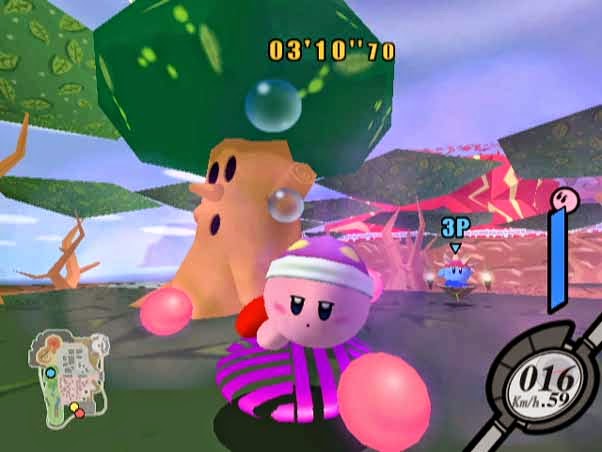
Kirby Air Ride is not a perfect video game. The actual racing mechanic feels disjointed, Kirby's trademark Copy Abilities aren't integrated that well, and jumping into the game without any previous instruction will bewilder the living crap out of you. My friends and I engaged in the City Trial mode, wandered aimlessly around, picked up power-ups with no explanation behind them, participated in an ensuing minigame that gave very brief rules, and were awarded with achievements we didn't even know we accomplished. Attempting to find out how this strange game worked conceived an abnormal addiction, and by the time we succeeded it became a common multiplayer staple for my Gamecube. What really defined the addiction was the game's use of a gigantic checklist, which listed around 360 objectives that, upon completion, yielded unlockables and bragging rights. They covered every facet of the game, and you couldn't help but go after them when the opportunity presented itself ("Hey, it's a Dragoon piece!" "Quick, let's try to find all the parts of it and for the Hydra!"). I had aggressively hounded these objectives so much that I had completely memorized the landmarks and courses, thus fallen in love with them all.
Since then, I swore to buy every
Kirby game that came out regardless of review scores. It's been that way for eight years.
Pikmin and
Pikmin 2

These two oddballs are what I consider to be the representative of what Nintendo attempted to accomplish with the Gamecube, and stand with
The Wind Waker as my favorite deviation. Playing it now, the original
Pikmin kinda reeks of a tech-demo feel, but the game bears such a bizarre character that one can't help but keep exploring its depths. It was also hauntingly blunt; a simple mistake can lead to the death of your entire platoon, and the burden of fault falls upon you as Pikmin are munched or drowning in ponds, evaporating as they whine with sorrow. What I'll always point to as the game's defining feature is the character of Olimar, who's inner monologues copy the player's reactions as he tries to tries to make sense of this distant world. That, and the revelation of a family waiting for him via his Journal Log made the thirty-day time limit rather profound.
"
I just recalled the day I took my son for a ride in this spaceship. He was so happy... I shall tell him of this journey when I return. And I shall return! I must! I can already see the look of wonder on his precious face as I describe my adventures with the Pikmin..."
 Pikmin 2
 arrived a few years later with the intention of addressing just about every complaint players issued for the first
Pikmin, which made this iteration feel much more complete. The challenge mode and multiplayer were welcome additions, yet the star attraction continues to lie within the campaign. The creative liberties taken by the development team were the highest found on the Gamecube, as the player found themselves exploring dungeons consisting of gardens and toy rooms while excavating Nintendo memorabilia and fending off an army of fire-spewing spiders.
Pikmin 2 abandoned the isolation of the original, but its focus of an expedition
into an alien world rather than escaping it appealed to every one of my nostalgic senses.
also obligatory purple fattie
 Paper Mario: The Thousand Year Door

When
Paper Mario's long-awaited sequel was announced in early 2004, I reserved a mental note to purchase it and quickly stuffed it away. This isn't to say I didn't like the original title on Nintendo 64, but the prospects of
Pikmin 2 and the Nintendo DS gained much more appeal to me and left the sequel languishing in the dark. All I knew it was likely to be another great game featuring my favorite plumber and so I had an obligation to get it.
Paper Mario was awesome and all, but I preferred the claymation-esque atmosphere of
Super Mario RPG.
What I received instead tied with
Pikmin 2 as the highlight of the year. The storyline was surprisingly compelling, even hinting at dark elements (in a
Mario game!), it actually applied the paper motif to the gameplay than just serving as a mere aesthetic, and the battle system made creative use of a "theater" structure that allowed for a more meticulous playstyle. And the
characters! Most of the NPCs in the original evoked light chuckles, yet the characters presented here were hysterical (The Curse), underwent actual character development (the rich Bob-omb family) and even tugged at your heartstrings (T.A.C). What sweetened the deal was that most of the partners had reasons to join Mario instead of screaming "OMG MARIO LEMME GET IN YOUR PARTY FOR THE LOLZ!!1"
Pikmin 2 may have been my preferred game in the end, but the game's cast and vibe lingered in my mind for months.
Years went by, and the events described for the next game obscured my memory. In 2007, I underwent reconstructive foot surgery and revisited the game out of a sudden burst of nostalgia. I had forgotten entire sequences. I had completely forgotten the penguin detective that was bad at his job and believed Mario was Luigi. I forgot about the evil face locked in chests that "cursed" Mario with upgrades. I forgot about the final boss battle. The villain is invulnerable to any attack, and the Crystal Stars disperse to spread the word of Mario's struggle as nearly everyone you've met cheers you on. The exuberance from 2004 came to visit temporarily, and I was brought to tears. It was the first time I cried at a game. This was the best
Mario game on the Gamecube.
Tales of Symphonia

Tales of Symphonia was released to much cheers from the Gamecube crowd, as the console had been severely starved from a lack of RPGs. When previewing a friend's copy, I didn't really see what the fuss was about. I didn't find the story interesting, the limited animations in the cutscenes irked me, and the gameplay appeared to be little more of a button masher. The game's memory remained only through the enthusiastic fanbase found on Nintendo Nsider forums.
Flash-forward to a year later. The past few months of being a teenager had begun to emanate a sense of dread and melancholy, and an unfamiliar change was brewing within me. Without thinking, I suddenly asked my friend to borrow
Tales of Symphonia. It was the single ray of hope for the events about to follow.
2005 was the year where everything went to hell. Growing up leads to the painful revelation the world is more morbid that the naivete of childhood would have you believe, and thanks to my habitual knowledge of searching the internet, I probably found out more than I should have. Everything I had accumulated and regarded as sacred was smashed to pieces repeatedly, as the once-ubiquitous factors of Mario and Kirby were replaced with the consistently present advocates for sex and drugs. Nothing was safe, and I concluded this depression as myself and the world going to ruin.
Tales of Symphonia was my light. The game's initial cookie-cutter plot gave way to a convoluted conspiracy, yet was peppered with amusing banter and heartwarming camaraderie. The rapport among the main cast gave them such a vibrancy that I felt like I was one of them, and the Tolkien-esque fantasy setting was the sole form of nostalgia that persisted in that dark time. The story isn't as rocksolid as I thought it was years ago, and I still hate the beginning of the game, but I will always hail
Tales of Symphonia as the game that saved my life.
Chibi-Robo!

An oddball that I wonder how many readers will recognize.
Chibi-Robo! arrived in the hellhole that was 8th grade, and unveiled to me and my friend Matt a deliberate scheme that could potentially plunge the world into destruction. The game was about a grotesque dog-chew toy dubbed Sophie, yet in truth was an abominable demon known simply as The Worm. It was accidentally brought to life by the wish of a giant robot, who now regrets its error and now spends its time gloomily rocking on the swing in the backyard, wondering where it all wrong. Confusing love with hunger, The Worm desires to lovingly consume the anthropomorphic chicken space ranger Drake Redcrest; a desire so strong that, once complete, will induce it into a ecstatic high necessary for its metamorphosis into the ultimate Butterfly form. Achievement of this goal will surely spell doom.
Actually, that's just a inside joke. It's really the story of a miniature house-keeping robot that dwells within a dysfunctional family (most notably the daughter who believes she's a frog) and meets a collection of toys that come to life. The goal of a Chibi-Robo is to bring happiness, which this particular unit accomplishes by restoring said dysfunctional family, bringing together a mummy and a princess, curing a teddy bear's honey addiction, settling the war between the egg-shaped Free Rangers and the pet dog, blowing up mechanical spiders, and going back in time with some aliens. I don't think I need to explain why this game is awesome.
Or maybe I just did. I dunno.
Just watch out for The Worm.
--------
You know what pisses me off? We will never see most of this ever again.
I remember back when I beat
Wind Waker, I immediately expected a sequel. I was completely unaware to the game's criticisms for a while, and the game's quality and ending implored for another trip to The Great Sea. It was
inadvertently announced two months before E3, to which I just nodded my head and went on with my business. Instead, we were treated to a realistic
Zelda by the name of
Twilight Princess. It signaled the beginning of a change that would take several years to form. A couple of years went by, and the Gamecube was superseded by a new console.
The Nintendo Wii was by far Nintendo's most ambitious idea yet. A system with a focus on motion controls shaped like a television remote was something unheard of, and many thought it could've wrecked the company. Nintendo insisted its purpose was what had begun with Nintendogs on the DS: To fish in the expanded market crowd (in other words, people who didn't play video games). The impact was huge; it ruthlessly penetrated the public for years as families flocked together to host Wii Sports parties.
While I've come to appreciate and love what the Wii has to offer, the amazing thing here is that I believe it wasn't as fresh as the Gamecube. The motion controls promised revolutionary gameplay, but only served to produce select forms of waggle and quick-burst shifts, and for a while weren't even 1:1. Many of Nintendo's attempted to make good on Wii's promise to revolutionize by including motorcycles (
Mario Kart Wii), simultaneous four-player (
New Super Mario Bros. Wii),
yet most clung to a previously established formula instead of a complete transformation.
Ironic how Nintendo played it safe when doing something new.
But how can you blame them? When they tried to do something different on the Gamecube, it was a disaster. Nearly every new idea and concept introduced was slammed and neglected, and Nintendo naturally went for another approach. Opening their business to the "blue ocean", radical as it may have been, seems rather tame and sensible in comparison. Gamers have decried this move as "abandoning" their fanbase, but who do we have to blame here? The reason why people had such adversity to what we saw on the Gamecube and the goals of the Wii is a phrase that's remained relevant through all of time: People hate what's different. They don't want to see changes and want things to remain the same. This applies big time to video games.
It's funny I say this, because nearly
everything Nintendo offered on the Wii is what would've constituted as a dream team ten years back, and I can't help but keep wondering what their reaction would've been to these games ten years ago. We've finally seen the revival of
Donkey Kong Country and
Kid Icarus. We've received a
Super Smash Bros. that stars Sonic the Hedgehog, Solid Snake, Pit, Wario, Meta Knight, and Diddy Kong. We got a new
Punch-Out!!.We have a new 2D
Super Mario. And yet people continue to criticize these titles all the way to hell and back for the most insignificant of issues ("Oh, it's too slow." "Oh, it doesn't have the Kremlings." "Oh, it doesn't have enough boxers."). As for third-parties, whimsical titles such as
Elebits,
A Boy and His Blob,
Little King's Story, and
Rune Factory Frontier were presented at opportune times for them to shine, yet fans continued to ignore their presence yet continue to scream for more games.
I don't get it either.
If gamers payed attention, we wouldn't have this problem, and that depresses me a little. Billy Hatcher and Viewtiful Joe would still be around. We'd have new
Super Monkey Balls that would be able to be taken seriously.
The Wind Waker probably
would've gotten a sequel. We'd get more
Chibi-Robo games in the states. We'd have a system like the Gamecube again. History has repeated itself with the Wii, and it's something I fear for the Wii U.
Time will tell.
------
It is now ten years later.
The passage of time has been harsh on me. My nostalgia has withered. It trumpets for a fleeting moment, designates its presence for a few seconds, and then disappears. I chased this nostalgia for a long time, desperately trying everything I could to grab hold of it, yet chasing illusions was futile against the growth spurts of teenagers. It was all in vain.
That's how nostalgia gets to you. You're reminded of a familiar fragrance or feeling that perfectly mirrors how you felt during a certain period of your youth, and you desperately try in vain to contain it. You attempt to revel in it to make the feeling last a lifetime, and you think of everything that happened to you to contain it, whether it was your favorite cartoon or video game and all the friends you had. It's a several month, perhaps year long experience all packed in a few seconds, and then it's gone.
There's lots of things I can associate with the Gamecube. The obvious are the reveries, but there's so much else. It was back when
Spongebob Squarepants was still funny, when Nintendo fansites and sprite comics were still relevant, when I found out the Americanized version of
Dragon Ball Z was censored for broadcast, my infamous comics of the tragedies befalling fictional snowmen, my love for
Kirby, the Game in the Basement, when I ranted about the unfairness of Invader Zim's cancellation, the internet message boards I went on,
Super Fudge, my cat Dexter, my fascination with
Earthbound, the Geocities website I had, all the friends I had, my brother, and myself back then.
You know what this means? I now have that mentality! Everyone ten years ago longed for the days of their youth, and now I'm doing the same! I'm now as bitter and grouchy as they are, yammering about how the past was so much better, yet I've finally unlocked the secret: enjoying life now. It was something that hovered beneath my nose years back, but something I've finally come to understand within the past three years. My sense of nostalgia is now a simple backdrop, but I'm fine with that.
I still have my Gamecube. In fact, I brought it with me to the dorm. It still works. The lens are faulty and I don't have the same controllers I had in my youth, but it's here. I mentioned earlier how it has a smell, and that's a perfect way to describe nostalgia. It was there all the time back during the Gamecube's prominence; now, it's fickle. Sometimes it's there, sometimes it's not. It was there today when I wished it happy birthday, and then it was gone.
And I'm fine with that.
I set it up earlier this evening and I played
Luigi's Mansion. The aging of games is a strange thing; a game could take two weeks to beat when I was young could now be completed in a day. The secret to playing short games when you're older is to mingle them with a swamp of work, which is what I'm doing right now. The graphics are aged, I can't get over Luigi's erratic movements when speaking with Professor E. Gadd, and I'm not sure if I can ever be as engaged with it as I was back then. But I still enjoy playing it.
The self of me back then may not be around anymore, but I can still feel him inside me. He's suppressed by my growth, but he hasn't disappeared. It's where the nostalgia has found a home. Every now and then, he bursts out with a hello, letting me know he's still around and that I hadn't been dreaming. The tragedies and revelations of the past few years have rendered me helpless many times, but I can always count on him to lend a hand and soothe my soul. He had defined me.

And every time I turn the Gamecube on, he'll always be there.


_(En%2CFr%2CDe%2CEs%2CIt)-1.jpg)


.jpg)


.jpg)


