Look, let's be real here: the Wii U may have been a complete, utter sales bomb, but that did not stop it from possessing the highest concentration of quality Nintendo games since Super Nintendo. Pikmin 3 and The Legend of Zelda: Breath of the Wild rank among some of the greatest Nintendo games ever created, Splatoon and Super Mario Maker debuted to worldwide acclaim, and many would argue the likes of Super Smash Bros. for Wii U, Donkey Kong Country: Tropical Freeze and Yoshi's Woolly World represent the pinnacle of their respective franchises.
Even Super Mario 3D World, my own reservations aside, isn't exempt from these accolades, what with the insane level of polish and love put into its design. However, this is the second instance in Nintendo history I can think of where a Mario spin-off surpassed mainline entries on a home console; just as how Paper Mario: The Thousand Year Door eclipsed Super Mario Sunshine way back on GameCube, Mario Kart 8 speeds past 3D World, Super Mario Maker and New Super Mario Bros. U to become what I consider to be the finest Mario experience on Nintendo's ill-fated system.
On the contrary, this is not what my previous 8/10 review for the long-deceased Gaming Grunts would imply; there, I argued that as excellent as Mario Kart 8 was, it fell just short of being a racing masterpiece due to the obvious cut corners Nintendo took with the title. Let us make no mistake: said cut corners do limit Mario Kart 8's overall potential as a complete package, but a year's worth of DLC more than made up for it in the area that matters most: the actual racing.
I mean, forget Mario Kart; has there ever been such a wondrous relationship between course design and control? I'm not by any means a racing game connoisseur, yet I imagine many such fans would be hard-pressed to cite any viable contenders. Driving alone has never felt so smooth, and when combined with the awe-inspiring heights reached by the anti-gravity feature and the mechanics re/introduced from Mario Kart 7 (gliding and collectible coins), the game proves itself beyond the visual spectacle and continues to enthrall as a compelling racer. It's the perfect hook for those previously burnt-out on the franchise: come for the dazzling new concept, stay for just how great everything feels
"Feeling," of course, is just one element of gameplay; there's a lot going on in how the game operates: for example, the way tracks curve up the wall or into the skiesis captivating, but it's just subtle enough to never distract the player and learns to fade from our concentration. Of course, the game is smart enough not to implement anti-gravity and the like in every track, lest we grow tired of visual gimmicks; after all, there's nothing wrong with a familiar, grounded test of racing skill (this is mainly the job of the Retro Cups, although as we'll discuss later, they're not afraid to reinvent the wheel).
Meanwhile, coins continue to layer a new form of strategy to preserve our top speed. Scattered across the tracks, these speed-boosting coins are enticingly placed so as to improve our racing game, be it curves instinctively requiring power-sliding or hanging just above an aerial shortcut. Mario Kart 8 not only trains us to follow the Super Mario Bros. rule in collecting coins, but builds upon it: we don't collect coins just because because they're shiny and gold, but in how they're vital to success. When losing coins upon getting smacked with a Red Shell or falling off Rainbow Road, we're driven to get them back. It turns Mario Kart's chaotic racing into a rhythmic process.
Combined with the mix-and-match nature of kart customization (karts, wheels and gliders), and it goes without saying there's quite some depth in all the frenzy. Truth be told, while I do pay attention to kart statistics and the like, I'm more of a "get in there and race!" kinda guy, so the exact specifics between, say, Sponge Tires for Light and Heavy racers is lost on me; typically, I just fashion everything with Slick/Cyber Wheels thanks to their guaranteed sweet spot in speed/handling. I also confess that just like in Mario Kart
Wii, I never quite got the hang of bikes; the inward drifting always felt off to me. Maybe when the Switch version rolls around this Friday...
But never mind that, as we still haven't discussed the courses themselves! Possibly the best Mario Kart tracks in series history, we're wowed from the get-go with how Mario Kart Stadium and Thwomp Ruins bookend the Mushroom Cup with their respective dizzying senses of height and flight. It's a thrill surpassed again and again by the likes of Toad Harbor and Cloudtop Cruise, and even well into the DLC tracks (namely Wild Woods and Dragon Driftway, although the latter focuses more on intense, close-knit loop-de-loops). As mentioned earlier, it's careful not to let anti-gravity be the only star; to my mind, this game's iteration of Bowser's Castle remains my favorite solely for the giant, lava-powered Bowser statue ready to crush anything invading its dual-track home.
Retro courses are also stunning; whereas previous entries either provided 1:1 replicas or stripped-down versions for handhelds, here they're revamped in accordance to their respective roles. For example, the familiar Super Mario World-inspired fields of Donut Plains 3 doesn't require any anti-gravity to still be interesting, as a grounded, rough-n'-tumble race retains Mario Kart's roots and provides a nice breather from all the flashy new mechanics. Meanwhile, the completely reinvented likes of Ribbon Road (Mario Kart: Super Circuit) or Toad's Turnpike (Mario Kart 64) awe in just how much new there is; Toad's Turnpike is a particular stunner thanks to flying off cars and driving on walls. Even setting the aesthetics aside, it's almost a completely different course from the sleepy Nintendo 64 highway.
Mario Kart 8 was easily the best looking game on Wii U at the time of its release, and I'd actually argue that may still be the case. There's none of the low-res leftovers from Pikmin 3 or Super Smash Bros. for Wii U, nor the intrusive slowdowns and the like from Zelda: Breath of the Wild; Mario Kart 8,however, is consistent with its own look and performance (the infamous 59 FPS glitch aside, and I'll be rather honest in saying I've never noticed it), and is always so vivid, clean and just plain delightful to look at.
Look no further than the game's visual stunner: N64 Rainbow Road. A literal explosion of colors, what was originally a nebulous, dreamy raceway decorated with neon-lights is now granted a definite setting that plays into Mario Kart 8's festive atmosphere with fireworks and soaring trains. It must, however, also channel the dreamy nostalgia of the original: the music and the firework callbacks contribute to this, but it's impossible not to be absorbed into the hypnotic nightlights of the city below.
Hailing from an era where 3D World's speck of context and Paper Mario: Sticker Star's homogenization didn't spark our imaginations, it's delightful how there's a real sense of world to everything. The aforementioned reimagination of retro tracks is great enough, but take a look at the signs hinting at world lore: did you know Yoshi Wild Sanctuaries are a thing? According to N64 Yoshi Valley, they do. I never thought of Morton Koopa as being the manager type, so I'd like to see how Morton Construction operates. Maybe he's just the mascot? Even the spectators delight: I've never entertained the thought of Gingerbread People dwelling in the world of Mario, but thanks to Sweet Sweet Canyon, I desire to see a mainline Mario game traverse through their realm. I sure hope they don't run into any, uh, "hunger" issues with what appear to be local Yoshis.
This isn't even going into the actual courses themselves; for example, did you ever stop to think about the familiar geography behind Cloudtop Cruise? And don't get distracted by the bonanza of references in Ribbon Road, as each segment follows a certain theme. Let us not forget the wondrous character animation, either; to tell the truth, I'm actually rather saddened the related memes came and went, because I engage with the highlight reels far more than I care to admit just to watch characters expressions (mainly how they slowwwwly turn their heads when they pass by each other). Angry Luigi is the oft-cited king, but I'm more fond of Donkey Kong's totem-pole expressions and Toad's gleefully murderous joy. (And let us not forget the game's greatest item: Piranha Plant, who comes equipped with its own anti-gravity wheels)
(This is, by the way, the first non-arcade Mario Kart to feature crossover content in the form of Zelda/Animal Crossing characters and courses, alongside familiar locations from F-Zero and Excitebike. Seeing Link interact with the world of Mario is certainly a delightful absurdity, although the elusive context behind Mute City/Big Blue still makes me wonder how it all works. It's certainly more cartoonish than F-Zero, but just out of reach of Mario. Truly, I am gripped in the throes of deepest lore.)
If pressed, however, I would argue Mario Kart 8's greatest asset lies not in how it plays, but in how sounds. The combination of synth and live big-band performances provides the greatest aural Mario Kart experience ever made; be it freestyle brass or track transition, it's the ultimate key to the festive, jubilant atmosphere that complementsMario Kart like never before. The live arrangements are what steal the show: Mario Kart has always lent itself to a fun score that, true to its goal, never grows old, and while Mario Kart 8 certainly represents the best of that, its the aforementioned track transitions that still awe me. Not that Mario Kart hadn't applied music dynamics for progression before, but absolutely none of the previous efforts match the stunning euphoria that is Dolphin Shoals. What starts as a subdued, synthesized underwater theme transforms into a full-blown jazz session when the racers emerge from the depths, instilling an exhilarating, climatic thrill unlike anything else. I could credit the live performers for this little slice of Nirvana, but as the composer was behind Pikmin 3, all that goes to her.
Other songs like Mario Kart Stadium and Mount Wario play well within the Mario Kart-esque archetypes, yet I'm most blown away by the orchestral tracks; Thwomp Ruins and Wild Woods are unlike anything we've heard before in Mario Kart, introducing the likes of Celtic instruments and chorus to the series. They're a touch more active than the dreamier songs we've previously in Mario Kart, and it's a perfect fit for their respective enchanted environments and the "world" they create.
Of course, the retro remixes must be up to par. Rainbow Road 64 is once again the star, the familiar flute seguing us into a new festive jazz version (alongside the aforementioned aesthetic, this is why I consider it to be the game's *real* Rainbow Road). GBA Mario Circuit and Royal Raceway (Mario Kart 64) are great fun callbacks, and I actually happen to prefer the former and its new intro to the somewhat forgettable intro. Meanwhile, SNES Donut Plains 3 and its electric piano emulates its non-amibitous nature, choosing to instead kick back with acoustic and bass guitars.
That this is the first time Zelda and Animal Crossing have been treated to big band music--in the context of video games, anyway -- is a delightful bonus; just listen to how the Animal Crossing track alternates between all four seasonal versions! Can you say, GameCube theme? And as for the F-Zero themes...well, their godly arrangements speak for themselves.
To round things off quality-wise, Mario Kart 8 is perhaps Nintendo's one of Nintendo's finer online experiences, although we must remember that Nintendo being what they are, Mario Kart 8 isn't without it's "Nintenisms" regarding online activity. The lack of friend invites is often cited as one, alongside having to exit games to switch characters and vehicles. Otherwise, the presence of friend rooms and tourneys are, like Mario Kart 7 before it, a great step above Nintendo's normally-passive online efforts; in particular, the flexibility offered in custom rules makes for even more intense races than playing solo, and I found myself turning to NeoGAF rooms rather than improving my VR score. I do imagine, however, online traffic will decrease upon Mario Kart 8 Deluxe's release.
All this would be enough to dethrone Mario Kart DS as the series masterpiece, but alas, those dang cut corners are what get in the way. Case in point: the battle mode. Whereas previous iterations offered specialized arenas for duking it out, Mario Kart 8 simply opts for reusing the racing courses. While there can still be fun mined from it, having to brake and turn around in such confined spaces quickly grows repetitive, and the alternative option (simply lapping around the courses and attacking whoever passes by) makes one feel like on autopilot. They're simply not designed at all for balloon battles, and it makes for the weakest Battle Mode since 2003's Double Dash!!.
The common defense for this is "well, Battle Mode was never good, anyway." Yes, perhaps...for you, which does not represent the Mario Kart population that disagrees. Furthermore, it's simply a shocking detriment when considering just how polished rest of the game is. Even when considering the DLC, it's what contributed to the unfortunate "bare-bones" label, as there's not much else for the game to fall back upon. It's thoroughly a rushed afterthought, and it shows.
Said rushed quality is noticeable in other areas: while the addition of the dastardly Koopalings is fantastic (Iggy fan, here!), they don't leave a lot of room for other newcomers, and Nintendo didn't exactly tap into their imaginations when it came to rounding out rest of the roster (Pink Gold Peach? Seriously?). Meanwhile, the lack of Expert Time Trials means we're stuck with the default time trials, and outside of a couple DLC outliers, hardly any put up a decent challenge.
There are other missteps it makes on its own: the Coin item continues to be a mistake, as it punishes the winning player by leaving them defenseless, especially if they've already filled their coin meter. 200cc is a delightful experiment courtesy of DLC, yet I can't help but feel certain tracks weren't designed with it in mind (*cough* Dragon Driftway *cough*). Also, obligatory "derp the gamepad only has a horn feature" complaint here, but I suppose it's best GamePad wackiness didn't end up interfering with the core game.
And despite all that, what a core game it is. Like Pikmin 3 before it, Mario Kart 8 is a delicious rush of feel-good magic akin to guzzling the finest of fruit juice. Even with my own preferences of Pikmin and Smash aside, this is perhaps the best-playing out of all of Nintendo's Wii U offerings: it's an insanely-polished feast that backs up its ambitions not only by being a pure joy to play, but what's possibly the funnest sense of atmosphere and flavor the company has ever produced.
And now, with Mario Kart 8 Deluxe for Switch ready to fix all of its flaws, we'll finally see its full potential ready to be unleashed upon the world. It's been a long three years; go take the crown, buddy.
Since the passing of 2002, the already-troublesome situation for the Nintendo Gamecube had not improved. While Metroid Prime received universal acclaim and Animal Crossing was an unexpected success in the West, other long-awaited sequels weren't so lucky. Super Mario Sunshine's unorthodox F.L.U.D.D. mechanic and brutal difficulty turned off many longtime fans, while the ground-focused combat of Star Fox Adventures--not to mention the surreal, tonally unfitting shift of setting for the series--initiated a stigma that haunted the series ever since. With the aforementioned Game Boy Advance "port breeding ground" initiating cries of laziness, things weren't looking up for the Big N.
2003 wasn't promising. The already-controversial The Legend of Zelda: The Wind Waker launched that spring to American audiences and continued to split the community, with the most negatively-cited examples including its easy difficulty, padding, and obvious evidence of rushed development. Fans were still scratching their heads at the announcement of the bongo-equipped Donkey Konga, and wondered if Nintendo had any idea of what to do with the Kong family following the recent sale of Rare. As sequels to Mario Kart, Pikmin and Paper Mario were still taking their sweet time, Nintendo began throwing whatever gimmicks they could at their consoles --be they the Game Boy Advance/Gamecube Link Cable, the card-swiping E-Reader, and the Game Boy Player peripheral for the GameCube. None of them caught the public eye, and so it was all the more embarrassing when the GBA/GC cable was front and center at Nintendo's E3 conference accompanying a yawn-inducing reveal: a multiplayer version of the original Pac-Man.
In the midst of it all was an unexpected announcement: the revival of the cancelled Nintendo 64 project, Kirby Air Ride, only this time retooled for the Gamecube. The game's troubled development still remains a mystery: we still don't quite know why the original version--originally named Kirby Bowl 64--was cancelled, much less why it was risen from the grave (our only insight into the game's development rests in a 2003 Nintendo Power interview with the game's producers, which didn't yield any answers). Air Ride's unintuitive control scheme confused journalists attending trade shows, and so the game failed to drum up hype in the face of the highly-anticipated Mario Kart: Double Dash!!. Could the fact that Kirby creator Masahiro Sakurai was at the game's helm as director turn public perception around? Having been behind the mega-hit Super Smash Bros. Melee, it seemed the young developer had nowhere to go up but up within the Nintendo echelon...
...unfortunately, it wasn't meant to be. Shortly after Kirby Air Ride's summer Japanese launch, Sakurai resigned from HAL Laboratories, dealing yet another huge blow to Nintendo. Rumors persisted he not only wasn't satisfied with Kirby Air Ride's development but of structural changes at the company, and his confirmation of being exhausted with sequels in a post-resignation interview is the only shred of evidence for those claims.
Is Wikipedia's uncited claim of his being disappointed with Air Ride development woes correct? Despite the evident use of Kirby Super Star graphical assets in the cancelled version's screenshots, it remains unknown if Sakurai was involved with the N64 game at all. if he truly held a grudge against the game, it's unlikely he would've included overt references to it in Smash Bros. games from Brawl onward. Yet if we disregard its troubled gestation, perhaps the real clue to Air Ride's sloppy, unfocused development lied within the gaming press.
In what remains the most inconsistent review amalgamation I have ever witnessed for a single title, Kirby Air Ride's scores ranged from praise to claims of boredom and dismissal. GameNow and GamePro magazines found themselves surprised at how fun the game's multiplayer turned out, but only after digesting the game's "quirks." Meanwhile, reputable sites including IGN and Gamespot led the charge with shocking 5.0 scores (out of ten), bemoaning the game's emphasis on simplicity and unintuitive controls. Electronic Gaming Monthly even took jabs at the dubious grammatical status of the title, and so Kirby Air Ride appeared destined for the forgotten halls of Nintendo mediocrity...
But that didn't happen. What rendered this inconsistency all the more divisive was the consumer reaction, which consisted of nearly unanimous praise. Despite the infamous control scheme, players found themselves endlessly amused with the flight mechanics and the gorgeous soundtrack. The City Trial mode was a particular anomaly; Nintendo World Report may have found it a missed opportunity, yet it was by far and away the most popular mode of the entire game, some say to the extent where it constituted the entirety of some players' playtime with the game.
In retrospect, I'm not that surprised at this division. Certain Sakurai titles--specifically, Kirby Air Ride and Super Smash Bros. Brawl--are blasted to hell and back for their attempts at deeper mechanics, yet most still sink countless hours into them on a surface level. The basic functions of Sakurai titles click with enough people, and I imagine the supplemented evidence of passion (be it art direction, sound quality or just plain charm) help override any perceived flaws. I also find it rather suspect that several outlets' complaints could've been solved with a quick trip to the options menu.
But what exactly divided critics and players alike on Kirby Air Ride in the first place, and furthermore, is it a good game? Perhaps a conversation with the current CEO of Nintendo can enlighten us...
---
In the Iwata Asks column for Kid Icarus: Uprising, Sakurai elaborated to Satoru Iwata on his peculiar game philosophy: disassembly and reassembly. He takes what he perceives to be the "fun" core of a genre, disassembles anything unnecessary, and then rebuilds it from the ground up. For example, beating up someone in a fighting game is fun, right? Yet are the elongated combo maneuvers necessary? Furthermore, what if we could extend that beat-em 'up fun to something of a four-player party game? The end result: Super Smash Bros.
As Kirby Air Ride's a racing game, let's say Sakurai took a look at fellow racer Mario Kart, for example. You maneuver and steer via a control pad/stick, hold down the A button to accelerate, and use the shoulder buttons to drift and break. There are several other buttons dedicated to series mechanics (such as the staple weaponry), but for all intents and purposes, it's intuitive, accurate to driving an actual car, and--most importantly--it works. It's not the world's most popular racing series for nothing.
Kirby Air Ride is...well, saying it's a tad different would be a vast understatement. See, the floating vehicles operated by Kirby and his color-coded doppelgangers--dubbed "stars"--accelerate all on their own without any input from the player. This is entirely due to the game's simplified control scheme: you use the control stick to steer and the A button for everything else. In other words, Kirby Air Ride is a one-button racer where breaking, boosting, swallowing, and utilizing Copy Abilities are shared via the same input.
It goes without saying this is not intuitive in the least, and though I probably couldn't have provided the definition of "acceleration" back at age eleven, it was obvious something was still completely off. My first memory of the game is vital: my friends and I went straight to the City Trial mode for an initial dry run only to be met with confusion. We were thrown into the middle of a city with absolutely zero context (least of all as to why there was a volcano right down the street), fumbling with the controls as we were crashing through trees, pelted by giant meteors, and discovering random underground mazes. We picked up various power-ups and weapons, yet had absolutely no clue how to use them. Then after five minutes, a bell rang, and we're suddenly in a race! One of my friends wins, and suddenly a checklist pops up saying we unlocked a vehicle or something.
Now, we could have just watched the handy tutorial videos, but you know how kids are. In any case, despite the "simplified" controls it's clear how downright relentless Kirby Air Ride is in playing by its rules. But these are rules we've never quite seen before, and I figure most everyone who's played the game went through a similar bout of confusion to the point where Air Ride was dismissed as broken, throwaway nonsense. With game critics having places to be and gamers being a fickle lot, it's little wonder Air Ride was subject to such divisive reception.
...and yet, call it Stockholm Syndrome, but much like the rising damage counter of Smash Bros. or Kid Icarus: Uprising's globe-spinning camera, I have unabashed love for Kirby Air Ride's unorthodox control scheme and cannot imagine it being played any other way. Make no mistake: it is by far the most unintuitive of Sakurai's titles, and to not label it as one of the weirdest Nintendo games ever developed would be doing it a disservice. Yet that it actually works despite its few flub-ups regarding execution deserves genuine praise, for Kirby Air Ride is very much an organic experience.
And what a coincidence: the namesake Air Ride mode is perfect in describing how this quirky racer works. The core racing mode of the game, Air Ride features nine courses and fourteen selectable stars for each Kirby to ride (King Dedede and Meta Knight also attend as unlockables, and respectively race via a Wheelie and wing-powered flight). No matter what vehicle or course you pick, Air Ride's emphasis on charging and boosting--a process Sakurai defines as "Push"--is key. Steering via control stick can only provide so much maneuvering, and so every time your Kirby avatar makes a turn, a well-executed boost is necessary for consistent movement and staying ahead of the competition.
As stated before, opinions will differ on this. Anyone can quickly pick up on Mario Kart's turns and handling, but Air Ride players must consistently depend on muscle memory and on-the-ball thinking in judging when to execute a well-timed turn via charging and boosting. Compounding on this are Air Ride's take on Copy Abilities: familiar enemies litter the courses and possess their typical powers for Kirby to utilize (Fire, Freeze, Bomb, Needle, Wheel, Wing, Tornado, Plasma, Mike, and, of course, Sleep), but their being tied to the brake/boost button can be extraordinarily awkward to adjust to. Say you're charging the Plasma ability via twirling the control stick, but have to make a turn. Regardless of how much plasma you've stocked, you have to release it in order to move on, even if you're not in a prime position to attack. A few others are inputted via spinning (Tornado) or activate automatically in the presence of rivals or enemies (Sword), but most do not, and to repeatedly brake for attacking tends to kill momentum.
It's awkward, it's unintuitive for the sake of being unintuitive, and yet through the same black magic that undoubtedly contributed to Sakurai's eternal youth, Kirby Air Ride's sense of drifting is top-notch. Despite the Copy Ability issue, drifting and boosting on their own works because the Stars are constantly sliding even as you're turning corners. There's no manual acceleration, yet there's a perpetual sense of tight control since navigating the courses requires utmost precision.
Boosting in particular grants a satisfaction unlike any other racing game; of course, the amount of boost power vary from star to star. The Rocket Star sacrifices speed over explosive, while the Swerve Star--my personal favorite--ditches handling for high top speed and precise brakes (that, and the "advanced ancient ruin" design is rad as all hell). I particularly enjoy the boost meter's presentation: it gurgles and replenishes with all the fervor of chugging down your favorite drink, the tasty fluids supercharging your energy. One could be correct in saying that playing Kirby Air Ride is much like ingesting the modern-day ambrosia known as Welch's White Grape Juice.
Beyond boosting, Kirby Air Ride emphasizes, well, the air. Much like recent Mario Karts, the game focuses on gliding rather than full-on flying. The course design reflects this via ramps and cannons and such, and while the design quality might not match Mario Kart's best, but a variety of fun gimmicks render racing a blast. Magical rail grinds and branching paths pepper each course (sometimes even being combined!), and I've always found great joy in the latter by the game encouraging me to repeatedly slam my vehicle into fragile walls.
Obstacle destruction aside, it all melds together to form a racer imbued with fantasy-stylized spectacles within gorgeous locales--and by the way, detailing Kirby Air Ride as "gorgeous" is really underselling its inspired art direction. The full-blown imagination of Kirby Air Ride's aesthetics deserve an in-depth article of their own, but their impact on gameplay is palpable. Storms of aerial grinds into active volcanoes and shortcuts in the form of airborne ferris wheels instill a laid-back catharsis of sorts into the player, and it's why the unlockable course--Nebula Belt--remains the weakest due to reverting to a more standardized, flat course. We can guess this was to emphasize the climatic "skills only" trope found in certain Sakurai titles (ala Super Smash Bros.'s Final Destination stage), but it's a real shame considering its sound (that theme!) and the potential from setting.
The genre-standard Time Trials are available, but of peculiar note are the Free Runs. Instead of being confined to a solitary three-lap for practice, this mode allows you to stick around as long as you please. If I either choose to aim for a best time or lose myself in grind rail surfing, I'm free to do so, but I find myself drifting towards the latter (in a mistake carried on from Smash Bros. Melee, the timer keeps ticking whenever you pause). Regardless, the fact remains that Kirby Air Ride is a satisfying solo racer like no other.
Emphasis on the word "solo". Multiplayer in this mode can provide some entertainment, but it possesses fatal flaws. As a racer first and foremost, Air Ride succeeds in introducing a variety of interesting vehicles for the player to operate, but "interesting" doesn't always translate into "being actually viable." Air Ride becomes so fascinated with emphasizing the gimmicky nature of certain Stars it neglects to properly balance them amid the natural, more well-rounded rounded Stars (such as Warp Star, Wing Star, and Shadow Star).
Take the Rocket Star, for instance. Its function primarily depends on charging for a good while, then unleashing a massive boost. There is an unbridled joy in mastering this vehicle for solo time trials, but it's simply too slow for a genuine race. The Slick Star is too caught up in loose turning, the Turbo Star inexplicably takes forever to charge up at the beginning of race, and the less said about the mess that is the Bulk Star, the happier I'll be.
I obviously don't mean to dismiss the Air Ride mode entirely. As stated before, mastering the world's most unconventional racer via Time Trial and Free Run provides a special--if not depressingly isolated--sort of satisfaction, but the actual races can come across as, well, unfocused, and there's no denying the Copy Abilities can feel at odds with the control scheme. These can be overlooked, but the sad truth remains that only about half--if even that--of the stars are reasonable choices for an actual race.
What is usable can be immensely enjoyable and fulfilling, even taking that in regard and for all my gushing within such confines, it all hinges on whether or not it clicks. For game journalists and a good chunk of the gaming public, it did not. I'm something of a lenient Sakurai fan--I frequently enjoy walk-offs and scrolling stages in Smash Bros. despite their infamous reputation (the former of which continues to confound me) and have no issue with Kid Icarus: Uprising's stylus controls, but even I struggle in defending what's supposed to be designed as the game's core appeal. In that respect, Kirby Air Ride's brand of mediocrity destines it to Nintendo's hallowed abyss of the forgotten...
And therein lies the true genius of Kirby Air Ride's organic constitution.
At first glance, City Trial is something entirely alien to the Kirby realm. It's the closest the series has ever teetered towards such a human-exclusive setting, and yet its entire presentation is fully immersed in surreal abstraction: a city square surrounded by biomes and man-made constructs of all sorts--a forest, a construction yard, a pair of volcanos, beaches, underground mazes, and even a miniature golf course. Absolutely zero context is given to its presentation: we don't know why a bizarrely condensed biosphere has developed on some island in the middle of a valley, let alone why Kirby and his band of doppelgangers flock to it despite the never-ending barrage of natural disasters.
It could be said that its sheer introduction is even more unintuitive than the core Air Mode, and that's why it continues to astound me it's the breakout--and just simply the best--feature of the entire game. What's even more of a miracle is that City Trial is Kirby Air Ride's ticket into the realm of legitimacy--not only in being something incredible, but actually legitimizing it's mistakes.
The mode functions as something of a time-limited massive playground. Players zoom around the city for five minutes (or up to seven, if you fiddle around in the settings), scavenging for randomly spawning Stars of their choice and busting open boxes. These boxes contain your typical multiplayer offerings in weapons and power-ups, but the main goal of gathering "Patches" take priority. By upgrading vehicles through emblems that increase top speed, boost power, offense capabilities and such on, players take their new and improved rides to compete in a random stadium event (or, if adjusted in the options, to a mini-game of the players' choice).
What makes City Trial so successful is that it's a mode that doesn't just emphasize competition; it encourages empowerment. Remember the Rocket Star? When considering its default status, it's not so hot, but now you can improve it to levels beyond viable status. By the end of your duration in City Trial, it's zipping along in the sky, crashing through trees and rock formations at top speed, and charges up into massive, prolonged boosts in no time at all. In other words, City Trial legitimizes what are, quite frankly, terrible stars in the game's core racing mode.
I cannot, for the life of me, think of another game that does this--a game that encourages me to take something fundamentally useless in its starring mode and beef it up. It's now possible for the Rocket Star to win actual races, and not only does it feel wonderful, but it feels earned. I'm not just slapping on a new part in some shoddy customization menu; I'm meticulously scavenging across the city, gradually revamping the vehicle to my liking.
And it's not alone: no longer is the Slick Star impossible to control, nor does Turbo Star have to deal with inane charging times. As much as I typically go for the Swerve and Shadow Stars, sometimes I lead myself astray into that special joy of upgrading those two stars into legitimate status. Oh, sure, it's a challenge taking hold of the reigns, but it's a fun challenge. Even the Bulk Star...well, nothing can save the Bulk Star, but I guess they can't all be winners.
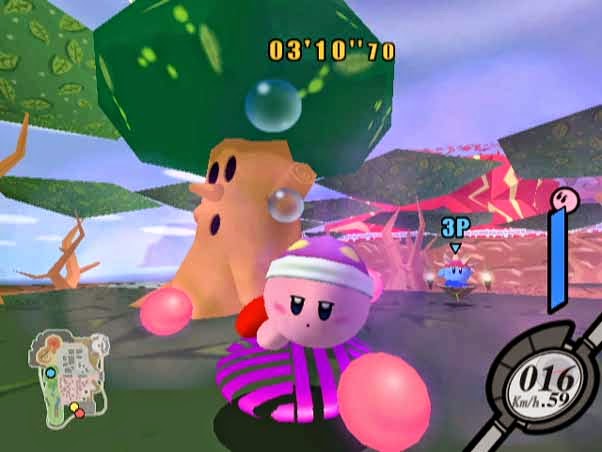
Even outside of this game-changing revelation, City Trial isa wonderful enigma in itself. The concept of gradually empowerment through smashing the shit out of boxes lends itself a fulfilling multiplayer addiction (and one that clearly held merit, as Sakurai revisited the idea in Super Smash Bros. for 3DS), but the process is so inspired, begs every ounce of the player's curiosity that their acting on it is rewarded in spades. It's all thanks to the aforementioned bizarre setting, which demands immediate attention in exploring every nook and cranny. Underground mazes and shortcut grind rails permeate the entire city, numerous ramps serving as springboards for gliding and as entryways into aforementioned mazes, and plenty of stuff--trees, giant coral, and junkyard structures--to wreck and crash into. Don't feel too bad about that; in fact, the game encourages and rewards you for clearing the forest and bullying Whispy Woods.
Implemented within the context of multiplayer, it's amazing how City Trial emphasizes isolation from other players and still succeeds as a shared interactive experience. Granted, the mode provides more than enough deadly toys to ruin someone's upgraded star (my personal favorite being the hilariously massive Gordos), but it's not uncommon for players to just disperse across the city and be left to their own devices. In that sense, it could be said City Trial's main appeal is akin the quote "the adventure being the reward", yet I still find joy in proving my vehicle's worth in the Stadium Events ...and occasionally switching gears by beaning someone with a Gordo.
My gosh, I can't stop gushing about this city. Did I mention the events? The events of which involve giant meteors plowing into the city and Dynablade wrecking shit? The easter eggs and pointless interactions just for the sake of easter eggs and pointless interactions (how many pink flowers can you find?). That it's the first and only time Kirby is running around in a full 3D environment? It's nothing more than a necessary novelty (to switch between vehicles, Kirby has to hop off), but did the gravity of that trip anyone else up? HAL Laboratory remains content dwelling within the confines of 2D space, yet for the sole purpose of a two second process, the world's expanses are suddenly open to the pink puffball. Even if he's just limited to a neutered float jump (ala Smash Bros.), many an hour was spent in the mode's Free Run exploring the city sans vehicle.
I wonder if that'd hold the same appeal as an adult.
Ah, forgive me, I haven't even discussed the game's music yet! And what perfect timing: City Trial's score is just as lopsided as the game itself. Not necessarily in song execution, mind you, but rather it's method of selection.
This is not to dismiss the mode's main theme, mind. The perfect combination of inspired mystery and urgency, it correctly functions as a grand panorama for this offbeat city (whatever instrument's playing at 1:02 always takes my breath away). But it and the alternate Backside track are unique, for there's something else at work for the mode's Events and Stadium Matches.
Ah, just listen to how the radio show-inspired beginning transitions into a Disney-esque expression of flight. But...wait a minute, this wasn't composed by the game's sound team! In fact, most of the tracks for City Trial aren't. Indeed, the mode's songs are ripped straight from from the Japanese Kirby of the Stars anime adaption. Composed by one Akira Miyagawa, a total of at least fourteen tracks play not just throughout the mode, but occasionally pop up in other facets of Air Ride as well.
This begs the question: do these serve as a loving nod to the show's incoming conclusion, or just come across as phoned-in laziness? Well, that might depend on where you live. Us foreign players are placed in a peculiar situation with these songs, as 4Kids Entertainment's English dub of the show happened to erase the original Japanese score in favor for in-house works.
Now, I could elaborate on the particular fuck-ups behind that decision, but that's not important. What is important is that holy crap, these songs fit like a glove. I'm serious, just listen to the above selection for the Falling Meteor event and tell me that doesn't perfectly convey tongue-in-cheek pandemonium. Much like the Gordos, the flaming meteors themselves are inflated to the point of absurdity, yet this theme is what truly drives the hilarity levels home. It's truly something that has to be witnessed.
Here's a example better suited for written context, in which the above Castle Lololo arrangement plays for whenever Dyna Blade flies in to wreak havoc. The song's always held an antagonistic tone, but it's cranked up to the max here as the sky turns blood red for the arrival of the rainbow-colored beast. It works quite well (and clearly HAL liked it too, as it was used once more for the actual Dynablade fight in Kirby Super Star's DS remake).
Hell, it even works within the chaos of City Trial's lack of context. There's one event where nightfall hits the city, signalling the activation of the wharf's lighthouse. What it doesn't tell you is that its mysterious light heals any injured Stars, and while that can be quickly discovered when investigating the area, one really does wonder why the alert just jubilantly exclaims "the city's lighthouse has turned on!" all the while the charmingly idyllic tones of Cappy Town's morning-time antics flutter about without a care in the world. Note also the song's title, of which I've always pronounced in the form of a grim movie trailer VO ("The City Lighthouse....Burns").
But wait, did I just describe the one flaw of City Trial? Indeed, there are a couple of events that don't survive the mode's absence of context, including the aforementioned lighthouse scenario and a mysterious fleet of Stars that float majestically in the city skies every now and then. While they possess purpose, their non-consequential effects elicit the most awkward of shrugs. We can be excited or driven away by fear from meteor strikes, fog, and rail station fires, but a lighthouse is a lighthouse no matter how amazing its accompanying score is.
However, a mode that excels this well despite a stumbled introduction deserves nothing but the utmost of praise. It's a wonderful piece of enigmatic game design that continues to captivate me to this very day, and in that I confidently state City Trial is not just one of the greatest multiplayer experiences on the Gamecube, but may very well be up there with Nintendo's best in history.
With its success being so great--to the extent of it rendering the mistakes of the main racing moot---Kirby Air Ride is granted another chance, another fresh outlook. But what ultimately sells the rest of the game to the player? The answer lies in the birth of a new Sakurai trope: checklists. Yes, checklists. Complementing the game's three modes are 360 different objectives, with 120 for each one. Be it time trials, mastering specific vehicles, or just breaking the shit out of stuff in City Trial, Kirby Air Ride rewards the player with green-flavored bragging rights or red-tinted goodies.
What renders this so successful is that it permeates the entire game. It's thoroughly organic, as just fooling around in any mode can yield from anything to the simplest of achievements to unlocking Kirby color alts, music tracks, and even a hidden character or vehicle or the like. With just how unintuitive the game is in general, Sakurai and co. no doubt realized there needed to be a compelling incentive for the player to devote their full investment, and seeing as how it's featured in nearly every game of his since, it obviously worked.
Just take the RC-inspired Top Ride, for instance. Its top-down perspective quirkiness--complete with awkward inverted handling--would normally have been tossed aside in favor of Air Ride's more eye-catching modes. But now with the prize-dangling checklist in hand, we have no choice but to engage in the mode, and we discover that the mode is actually wonderfully chaotic. You know how Baby Park in Mario Kart: Double Dash!! was the most exciting course in that game despite its simplistic, oval appearance? It's the same deal here, only instead expanded upon via constant sharp turns, interactive hazards, and a never-ending barrage of dizzying weaponry.
Even setting the checklist aside, I'm still sucked into how Top Ride fulfills the Smash-esque "just one more" cravings. These compact, bite-sized races call for close-quarters battering through explosions, fire, and gyration, all immensely satisfying and requiring the sharpest quick-on-the-draw senses players can muster. With how best courses (Sky and Metal) taking interactive advantage of Air Ride's one-button control scheme (be it the former's buttons and ramps or the latter's course-shifting machinery), I'm always coming back for more. In that sense, I suppose the mode functions as a bridge between the other two--need a break from City Trial? Settle for some quickfire Top Ride chaos.
And the checklist magic even works on the Air Ride mode. The main racing component is still a bust, but it's that checklist-inspired hook that compels me to better myself in solo. The unlockable gorgeous song arrangements and hidden characters are temporarily forgotten as I'm shaving off record after record in Time Trials, shifting between Star after Star as I strive to improve myself, gliding and grinding and soaring.
But most of all, what's more gratifying than the checklist accomplishments and time trials and Top Ride chaos is the game's possession of something truly precious. The obvious cue would be pointing out the game's stellar soundtrack, yet I've come to realize just how little praise has greeted the game's aesthetics. It's a damn shame Kirby Air Ride's erratic reception has no doubt muffled this, and that no doubt renders my opinion all the more shocking: Kirby Air Ride features one of the most striking, wondrous, downright best art styles featured in any Nintendo game.
Up to this point, Kirby aesthetics have generally drifted between nostalgia echoing baby's blanket prints and glistening fantasy found only in one's dreams, but Air Ride bursts with such imagination that it's hard to peg it down to a specific style. The fantasy tropes are still present, yet Kirby Air Ride thrives on galvanized juxtaposition-- it lifts and blends from everything to light-hearted and medieval fantasy, touches of sci-fi, and some of the most breathtaking examples of surrealism. It shifts and mixes on a dime on such an inspired level that I daresay, on an artistic level, it's Kirby at its most ambitious.
The first two Air Ride courses--Fantasy Meadows and Celestial Valley--represent the purest of outdoors high fantasy. The former provides a gorgeous backdrop complete with physically-manifested wind currents and looming planetoid, but it doesn't forget to segue its imagination into the actual track, as the players race up to an entirely flora-constructed windmill, of which leads into an illuminated underground passage. And the nightfall expanses of Celestial Valley beg to be explored, what with signs of excavation and fossil-embedded walls as pairs of hungry eyes watch racers from cracked eggshells. Just look at these.
And the music! They're accompanied by such sweeping orchestral scores, particularly in the case of Fantasy Meadows, which perfectly represents the beginning of a grand fantasy: small beginnings, with inklings of a grand adventure just waiting to unfold. Meanwhile, the melancholic windy whistles of Celestial Valley are offset by a rushing chase that no doubt echo the course's water rapids. These two songs compel me to thoroughly demand similar usage of their ilk outside of a racing environment, and I continue to be stunned at how they were practically made for an adventure.
And as the ice course, Frozen Hillside isn't satisfied with being a winter wonderland (although its wonderful song presented above might convince you otherwise). It's aerial setting--complete with rails, wind-propelling arches, and rattling bridges--presents a panoramic view of the area, featuring a white-green colored landscape and fantasy-esque constructs we never learn the context of, leaving our minds to fill in the blanks. Our only hint lies in the appearance of one majestic flying whale, the product of the game artist's desire to combine unorthodox elements (in this case, a fantasy wintry tundra and a floating marine lifeform). The end result lets our imaginations soar.
I could justsit here and rave about how aesthetic and music work together in Kirby Air Ride to create a living, breathing fantasy world just outside our reach--just barely outside the realm of context--and it's excruciating, yet downright delicious bait that prods at me every time I race within their worlds. The lava and stone dragons that dwell within the downright-frightening hellfire of Magma Flows (as shown above, note how it combines cinematic fantasy and xylophones complete with a brief cameo from Kirby Super Star's Gourmet Race theme), the flora-carnival heights of Beanstalk Park as its accompanying track gradually builds into aerial splendor, the backwards alien world just outside Machine Passage's dark halls of fast-paced techno and chorus...
Even Top Ride prods at the mind! True to their source of inspiration, the Top Ride courses are veritable top-down recreations of RC car tracks, although adapted to designs of sheer fantasy akin to Fantasy Meadows and Celestial Valley. Much as I adore Grass's country setting and Water's valley waterfalls, Sky is the clear winner. Kirby Air Ride is, after all, a racer emphasizing the air, and I can't help but be charmed by this course's ancient cubic structures and quaint, chess-inspired racing grounds. As expected from its compact origins, it's a far softer aesthetic than the ambitions of the main Air Ride mode, but one that captures my imagination with help from its carousel-esque song track. I'd love to see what lies within the landmasses below.
Again, Kirby has always been enveloped within fantasy, but the games have always stuck to one cohesive theme. And even then they'd never so much as dreamt as plunging so deep into the realms of fantasy, having been so content with sugary-sweet, heart-swelling nostalgia. Of course, not that there's anything wrong with that, but I'm just so taken with this direction into the fusion of artistic motifs. It forces me to dream, compels me to theorize on what lies beyond the race tracks, and I thoroughly demand to see it explored outside the confines of a racing title.
As stated earlier, it's a subject that demands an article of its own, but until that day arrives, I'll conclude with Air Ride's greatest success in the aesthetic department: the masterpiece of juxtaposition that is Checker Knights. Similar to Top Ride's Sky, it emphasizes floating geometric/cubic landmasses and constructs, only this time in the middle of a lake. It's fantasy, but not outright Fantasy Meadows/Celestial Valley fantasy. The backgrounds hint at something of a middle ground behind that and the typical Kirby aesthetic: it's bouncier and more familiar, but is more inspired via abstraction (ala City Trial). From here, the course's theme is apparently set...
Then you railgrind into the lake depths.
Underneath the lake hosting a cubic racing course lies an underwater city. It's not the ancient city of Atlantis, nor a coral-filled city housing merfolk.The complete details are too far to fully make out, but the abundance of neon lights prove that it's not only not the outright abstraction City Trial is, but that it's a living, breathing modern city.
By itself, such a city would have no place within Kirby's realm. The faint traces of smog and the night-time noire would be repulsive enough, and yet I am downright stunned in its symmetry with what lies above the city's waters. We could just chalk it up to the oversized jellybean-esque bubble floating about, but just its mere presence hidden under the surface of a jovial world elicits the most intense curiosity and wonder. I can't think of anything like it, and yet Kirby Air Ride pulls it off as if it's as easy as breathing.
I mentioned earlier how Kirby Air Ride's aesthetic induces a sort of catharsis into the player, of which is no small part due to the game's aerial nature. Every time I play, I'm not just enjoying the game: I'm dreaming. I wonder what's staring at me from Celestial Valley's eggs, I ponder what goes down on the surface of Sky, and most of all, what the aquatic denizens of Checker Knight's underwater city are up to these days. I could just be speaking as the most desperate of Air Ride apologists, but I find the game's dual-layer of chaos and dreams to be no joke.
Indeed, Kirby Air Ride is not a masterpiece, but I imagine it could be one had the core racing been further polished. As it stands, it's a quirky, quirky game born from the most unintuitive of premises--premises that shouldn't by any means actually work, and yet for the most part, actually do. That it not only actually succeeds in doing so, but in that it reaches peripheral ambitions so high within a genre so centered around competition renders it one of my dearest Nintendo treasures.


_(En%2CFr%2CDe%2CEs%2CIt)-1.jpg)


.jpg)


.jpg)


