2002. The Nintendo Gamecube had launched in Asian/American territories within the past fall and would eventually reach European/Australian shores later that spring. Accompanied by the new Game Boy Advance handheld system, the purple duo arrived in a harsh climate for Nintendo. While the GBA had no problems flying off store shelves, the Gamecube shriveled up in an post-launch drought much like the Nintendo 64. The bitter mentality of Nintendo being "for kids" was at its strongest, and the "purple lunchbox" design turned off older audiences. Regardless of any mended relations with third-parties (most notably Sega and Squaresoft), short-sighted marketing decisions and bad press constantly impeded Nintendo's little console. Even the successful Game Boy Advance was not exempt from criticism, as fans vocalized disappointment at upcoming
Mario and
Zelda titles being just handheld ports of decade-old Super Nintendo titles. While
Golden Sun and the introduction of the
Advance Wars/Fire Emblem franchises in the West constantly provided new experiences, Nintendo was not the least bit subtle in turning their latest handheld into a breeding ground for ports and remakes.
Having just completed the labor-intensive development of
Super Smash Bros. Melee,
Kirby creator Masahiro Sakurai was well aware of these complaints. He elaborated on this issue in an interview following his soon-to-be departure from HAL Laboratory, citing not-so-discreet examples of tired sequelization and desperation from his parent companies.
"
That's why you see places trying to stay alive by putting out tons of budget titles and re-releases. Every game company, no matter who they are, is desperate right now. So one possibility is that people will say 'I can't live off this anymore' and leave the game industry in droves. You see a lot of people use terms like 'console wars' and compare the whole thing to a fight for territory. You [the interviewer] and lots of other people in the game industry get termed 'Nintendo people' or 'Some other console's people' by someone you've never even met. But this is no time for that, I don't think."
Regardless of any likely festering doubts over the company he'd worked at for so long, Sakurai's idealism was no match for corporate. In an ironic twist, the man found himself the chief director of a
Kirby remake: to be precise, a Game Boy Advance reimagining of the NES classic
Kirby's Adventure.
If he bared any ill-will towards the project--however unlikely that may have been--it was surely left confined within the walls of HAL Laboratory. And why shouldn't it, when his pink puffball was set to become a marketing blockbuster? Japan began airing the anime adaption
Kirby of the Stars the previous September, and the show was set to be repackaged as
Kirby: Right Back at Ya! for North American audiences under the handling of licensing company 4Kids Entertainment (who were also responsible for dubbing the mega-hit
Pokémon cartoon). Numerous marketing teams
worked around the clock with a 10 million dollar budget to turn
Kirby into a media sensation following the cartoon's American debut, with his visage to be pasted onto everything from fast-food licensing deals to merchandise of all sorts. Over six weeks were spent designing the following logo, which has since been associated with nearly all localized
Kirby games to this day.
It is one of the few
Kirby trademarks left from that time. In yet another misstep from Nintendo's string of marketing failures in that era, the plans to turn Kirby into another
Pokémon-esque hit fizzled out. While the anime was a moderate success among young audiences tuning in to Fox's Saturday morning cartoon block, it never came close to matching
Pokémon rating numbers and the promises of toy lines, pajamas and backpacks mysteriously fell through--as opposed to the troves of plush merchandise commonly imported from Japan and available for purchase at conventions and even the official Nintendo World Store. Meanwhile, longtime
Kirby fans found themselves disinterested in the show's original cast and setting...if they weren't already turned off by the questionable voices attached to their favorite characters (most notably in the cases of King Dedede, Meta Knight and Rick the Hamster, who were given wildly inappropriate accents). While the show's dubbing treatment wouldn't reach the level of atrocities inflicted on Japan's famous
One Piece property a couple years later (or most other 4Kids-licensed works, for that matter), the voice miscasting and the replacement of the game-inspired score render it not only inferior to the original Japanese airing, but simply as product.
If anything, Nintendo of America's localization of
Kirby from 2002-2006 became something of a, well, joke. While the cartoon didn't set America on fire, any of its mistakes were a drop in the bucket compared to another hare-brained marketing blunder that would curse the series for years to come: the inception of "Angry Kirby". In what I can only imagine was a laughable attempt to quell the "Nintendo is kiddy" stereotype, nearly all
Kirby titles beginning with and following
Nightmare in Dream Land would have their front covers plastered with frowns and slanted eyebrows.
Nightmare in Dream Land was branded with a particularly nasty localized box art, depicting Kirby performing a Copy Ability that's not in the game (Fighter) and implying that series anti-hero Meta Knight was the game's main villain.
Common sense should indicate that if you're trying to groom your pink puffball into the next Pikachu, you shouldn't decorate him with furrowed eyebrows. In any case, the terror of Angry Kirby wouldn't be fully known until soon after, as
Nightmare in Dream Land was saddled with yet another marketing error. I mentioned Nintendo's trend of filling up the Game Boy Advance game calendar with ports and remakes, and seeing as how that was when Nintendo began to love appealing to nostalgia, it rendered the introduction of this title all the more...well, awkward. Believe it or not,
Nightmare in Dream Land was the only Game Boy Advance remake to
not be officially advertised as a remake. Not in press releases, not in trailers, not even the commercial. Only eagle-eyed fans who sifted through screenshots or purchased the early Japanese release found out the truth before its American launch.
In retrospect, aside
from few, isolated GameFAQs board cries I'm actually amazed there was no major
controversy over this. As far as I know, Japan had no issue since the
remake beared the same name as the original (just with a "deluxe" added
at the end), but Nintendo of America marketed it as an
actual new game and just about no one noticed! I imagine Kirby's sleeper hit status contributed to this; can you imagine if the same thing happened with, say,
Super Mario Bros. 3 or something? Somehow I doubt the initial batch of screenshots would've slipped by so easily.
But what's more important than anything else is that regardless of any possible misgivings Sakurai had over the project, no matter how many failed business deals or horrid Spanish accents impeded the pink's ball path, Kirby was given justice in the most important area of all: a great game.
Nightmare in Dream Land is not the perfect remake; at the very least, I would not place it in the same league as
Pokémon Soul Silver/Heart Gold or the later
Kirby Super Star Ultra, but it remains one I constantly go back and forth on. What is better than the original? What does the original do better? Every time I play, I ask myself these questions, and I love nearly every moment.
-----
At last, we have arrived at my first review of a Nintendo remake. It's one of my favorite subjects within the company's legacy, and I never tire of comparing the shiny upgraded versions in contrast to their classic source material. I suppose it's necessary to get this warning out of the way: when it comes to their remakes, I am nitpicky as all hell. As fascinating as it is to study changes between versions, the slightest blunder or inefficiency in a new background or character animation or music track or what have you has the tendency to dock off major points from me.
It was my disappointment with
Super Mario 64 DS that sparked this habit. Having discovered the masterpiece quality of the original only a year before its announcement, twelve-year-old me was hyped as all hell for its release. While it ended up being a decent remake, there were more than a few...shall we say, baffling decisions in its re-imagining..I did not care for how the hat powers were split between the four characters, and I did
not like that Snowman's Land's awesome 3D ice maze was changed into, uh, some ice blocks for Yoshi to melt, and I certainly did
not care for how they decided to throw in the original King Bob-omb battle for nostalgic shits and giggles despite already developing a perfectly upgraded replacement for the first visit into Bob-omb Battlefield. Ever since that day on, I've held Nintendo's remakes under the glass of a microscope: nitpicking, comparing,
watching...
In retrospect, it's pretty funny how easily satisfied I was with
Nightmare in Dream Land only two years earlier when considering the number of changes. Certain enemies and mini-bosses have been swapped in favor of new designs, the backgrounds and foregrounds have taken an entirely new art direction instead of simply upgrading the original sprites, and even the presence of certain disappointing level compromises to avert the NES's niftier uses of parallax scrolling. Yet even with whatever flaws I can identify today, I don't mind so much:
Nightmare in Dream Land is something of a constant mental battle for me, one where it's likely waging a losing battle against
Kirby's Adventure for superiority, but damn me if it doesn't put up one hell of a fight. The instant I spot something Adventure did better, something else quickly sprouts up in another point for NIDL.
So how to go about evaluating this remake? It's a difficult process: some Nintendo remakes have noticeable differences in their gameplay, while others may as well have replicated the original engine. How much were the graphics overhauled? The sound? Do the new properly complement the game, or does the game feel stripped down in comparison?
For this particular article, I will be evaluating
Nightmare in Dream Land from an aesthetic and sound perspective, as well as the former's impact on gameplay immersion. Regardless of whatever minor changes the remake applies to the levels, for all intents and purposes
Nightmare in Dream Land is practically identical to the original in terms of gameplay. The controls are virtually the same, the Copy Abilities function precisely as they had a decade before (excluding Backdrop, which has Kirby fully hands-on with his suplex moves), and there are no distinct differences regarding sense of control, speed, and gravity.
I do not intend to completely overshadow gameplay: there are some overhauls regarding the mini-games, for instance, as well as some exciting new features. But what I'm most interested in is how exactly do the "upgraded" visuals provide for the actual feel the game? Do they render the formally 8-bit world of Kirby's Adventure more immersive, or do they detract from the experience? Is the soundtrack faithfully reproduced, or do the chiptune sounds of yesteryear emerge triumphant? Does the remake capture even the slightest of the original's idiosyncrasies, or does it forge its own identity?
In short: does the remake do the original justice, let alone stand by itself?
Let's start with the games' respective opening sequences and title screens.
In comparing the two title screens, we can tell the general UI is far less colorful (to be specific, less pinker) than the original. Any fears of a grittier Kirby should be quickly quelled: despite the background overhaul (more on that later) the actual game provides enough color and flash to compensate; plus, the game comes with its own brand of charm and humor. While unfortunately the beloved "Draw a Circle" intro sequence was axed, we're instead treated to a barrage of Kirbys flooding the screen to give way to the title screen. Showcasing the GBA's graphical power, perhaps? I've always gotten a smile out of it, regardless.
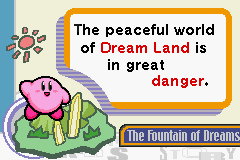
But I think the story narration demo provides a better comparison. Take a look:
Despite the obvious changes in narration text (no doubt to compliment the smaller GBA screen), take a gander at the NIDL artwork. Kirby sports a seriously thick outline, a motif that will be carried out by just about every character sprite in the game. While the artwork pieces for this particular intro bear a watercolor/"painted" theme of sorts, the in-game application of outlines grants the sprites an animated look and feel. Nothing Disney-tier, of course, but it's such an interesting aesthetic that it warrants further investigation.
But before that, let's dive into the first major change: the menus. Refresh your memory with Adventure's for a moment, why don't you?
Being attached to the title screen,
Kirby's Adventure's green menu doesn't need to overly embellish itself. Each save file displays a compact collection of both the main game and unlockables, such as mini-games, Extra Mode, and the boss rush. It gets the job done, although the sound test has a bizarre presentation (with an out-of-order soundtrack and not number-labeling the songs past tens. The latter may have been due to NES limitations, but the former makes for a rather unorthodox listening).
Nearly ten years later,
Nightmare in Dream Land wisely chooses to include a full-fledged UI menu. Sakurai fans should instantly recognize the style, having debuted in
Super Smash Bros. Melee and
designed by his future wife Michiko Takahashi. While it hasn't quite evolved to the point of
visual aids as introduced in
Kirby Air Ride and
Super Smash Bros. Brawl, the resemblance is still clear; particularly in the below screen shot with its long, sexy buttons. The above shot is still notable for a certain visual gimmick: whenever you turn off the game, a visual pops next to the percentage bar depicting artwork of whatever world you left off in (in this particular instance, it's the sunset of Orange Ocean). Nice touch!
But enough about menus! What does the actual game look like? Let's first take a step back in time.
Here's the starting point of
Kirby's Adventure. Take aside the 8-bit graphics and the leftwards bar thingamajig (what
are those things called, anyway?) and focus on the overall composition. Having been designed for home TV use,
Kirby's Adventure comes equipped with a big ol' HUD display, which I imagine was necessary to highlight the particular Copy Abilities that Kirby could possess.
Kirby's Adventure also boasts some pretty imaginative backgrounds for an NES game, albeit with a limited sense of scope. And of course,
Kirby's Adventure is all about the bright colors.
Here's the respective location of
Nightmare in Dream Land. The screen-size reduction brings about some major overhauls; for one thing, we no longer have a dedicated HUD display. Lives, health bar, and the score are all display over the bottom of the foreground, and the Copy Ability display/artwork only pops up when Kirby has one in his possession. The smaller screen also cuts down movement area somewhat, but that's to be expected for a complete GBA remake.
But mother of
god, look at that
background scope! This particular example is an excellent showcase of when the game successfully captures the look and feel of Dream Land. The wide verdant green, peculiar mountain shapes and even the the trademark "checkered" aesthetic--this time reimagined into dirt roads--immediately capture the eye and set the imagination soaring. Typically,
Nightmare in Dream Land only utilizes the base background trope from the original (in the above case, a field and a lake) and then shoots off into its own direction, but here we can see it paying tribute via the foreground: the yellow landmarks of
Adventure sticking out with a new gray look next to an adorable little fence.
And I'm really not kidding when
Nightmare in Dream Land takes off with its background art direction. Look at its take on the forest level above and tell me that's not absolutely gorgeous. It's bursting with imagination, complete with neon weather patterns decorating the forest air and powered by cherry-like energy rods. The foreground's pretty rad too; granted, I'm pretty sure the red leaves are odds with the green trees, but whatever, it's pretty!
These are the best artistic moments of
Nightmare in Dream Land: not for when it trumps Adventure, but when it leaps into the realm of absurdist fantasy of its own accord. The above scenery is the perfect example: what was once an ordinary desert is transformed into a wasteland populated by floating jellybeans. Such dreary scenery is instantly made fun by this simple, yet wild leap into fantasy.
Of course, Rainbow Resort is again the aesthetic star of the show. The Kirby vs King Dedede scenario in particular has been completely revamped, clearly inspired by the
Fountain of Dreams stage in
Super Smash Bros. Melee. The way the spring water melds with the rainbow-colored background is just sublime, and the battle is treated to a new Rainbow Resort weather pattern: strokes of suspended azure.While the dreamy theme park aesthetic has been shelved, this dazzling dreaminess is a fine substitute.
There are certainly locations where there's no contest in Nightmare in Dream Land's superiority. This mini-boss room had its background supplied by a wall, yet here we're treated to a panoramic shot of Dream Land. I could just float away.
Or take the above Grape Garden level, the original version of which I've always been rather confounded by. The hub artwork hints Kirby's about to enter another valley-themed stage, yet somehow he inexplicably finds himself inside an airship that suddenly segues into a forest. Huzzhwuh?
This sort of inexplicable transition can't really fly in 16-bit gaming--least of all in 2002--so thankfully, Nightmare in Dream Land comes up with a really neat alternative. It dumps the original airship interior concept outright and instead jumps straight into the forest, but not before crafting an entirely original section. On top of that, it's designed for players to figure out how to use the complicated Ball ability, and it gets that job done rather well with the tight spaces. Cool!
But for every graphical improvement
Nightmare in Dream Land conjures up, there's always a misstep waiting just around the corner. I say this realizing the general inevitabilty of remakes: no matter how much they get right or unique spins they create on their own, they'll always flub up in ways that'll benefit no one. The good news is that while none of
Nightmare in Dream Land's mistakes via aesthetics are game-ruining, there are some definite jarring moments even without the context of the original game.
Here's a particular area
Nightmare in Dream Land struggles in: retaining platform density
, as evidenced by the above opening sequence to Ice Cream Island.
Adventure attaches platforms to a small island hill for the purpose of adding character, yet its remake strips the hill away and just leaves us with random shingling platforms. But why? These platforms aren't built for progression, and isolating them from the background renders them pointless and out of place. Ick.
...and then the game soon makes up for it by adding in a kickass mangrove. Agh!
In any case, this is exclusively a problem with floating platforms. While cutting background intersections with the foreground (such as the aforementioned island and the above cloud structure) could be acceptable compromises in transitioning to a new style, the problem is that many platforms come across as half-baked since they have nothing to offer on their own. While the above NIDL shot may be artistically representative of your typical Kirby game, the platforms don't bear enough solidity.
.PNG)
There are time where it's easier to overlook, such as the above take on Ice Cream Island's sky level. We can still witness traces of the original ruins littered about, but the tropical theme of the world shines through in a beautifully-rendered background. As the earlier example with the world's
beginning was the most extreme example of the problem, this flaw can
perhaps be forgiven.
...but
man, I really do mean it when my mind can be changed on a dime here. Take the gorgeous shot above, where an aquatic section is provided by an absolutely stunning galactic setting...
...only for it to trip up later when
Adventure's transition into an igloo is just reduced to a door. Argh!
And as much as I boasted about the game's art direction earlier, it trips up sometimes there as well. Butter Building is, alas, the most unfortunate casualty of this direction.
Nightmare in Dream Land can get so wrapped up in its artistry that it forgets not to get too deep into realism, and so the once joyous, yellow tower finds itself in shambling ruins plopped into the middle of a dreary mountainscape. I also find it rather suspect the new pink motif doesn't quite gel with the name of
Butter Building.
By far the most egregious offender is through its feeble handling of
Adventure's most famous graphical showcase: the pseudo-3D parallax scrolling sections. While it's understandable the Game Boy Advance apparently couldn't pull that off, there's just no excuse for its replacement: you're forced to sit still in a stagnant room until the fog clears up and the Star Door opens. Considering they already replaced other rooms from the original with brand new ones, it's just a baffling design choice. Even poor Kirby is expressing disappointment!
Meanwhile, the interior goes for a dilapidated aesthetic that doesn't quite gel with the typical
Kirby visuals. While the series is no stranger to dreary scenery, it's always done so with the proper shift in tone (sound choices, for example) and it just doesn't work here with the cheery Butter Building theme playing in the background. Take a look at the above visuals, depicting the first time Kirby squares off against the mini-boss Bugzzy: the
Adventure version has the fight taking place in a sort of indoors garden, in which I always thought was something of a home to the nasty beetle. In
Nightmare in Dream Land, it's just the ol' crumbled ruins background. The relative impact to the player's imagination is rather dismal.
But that's peanuts compared to one background redesign so foul, so undeniably
rancid that it boggles the mind as to how this was approved for a
Kirby game. Observe the following
Adventure shot.
This is the beginning of a Yogurt Yard stage, throwing Kirby inside a mountain interior until he pops out and travels into a forest. The jaggy, puzzle-pieceish background, while nothing special, is one of the few depicted for cavern interiors and the like. It works, gets the job done, falls right in line with
Kirby, etc. etc.
Now here's
Nightmare in Dream Land's take on the level.
What the hell is this?
What's with the dark lighting? Why is there smoke? Erupting volcanoes? Good god, is that a
lake of blood I'm looking at?
Someone tell me it's magma. Actually, don't; I'm too scared to know. As if it's not bad enough, it sticks around for the
entire duration of the level all the while one of the
happiest, bounciest songs of the game delightfully flutters about as if there's not a wrong in the world.
Words fail me. I mean, I guess I can gloss over the mistakes made with Butter Building, but this shit is just...you
can't look away. The alarming incongruity between this clusterfuck of a backdrop and the innocent jolliness of Kirby platforming can't be described through mere words. Just look at that picture. Just
look at it.
People--and when I say "people" I mean embittered
Smash Bros. fans--associate many negative nouns and adjectives with Sakurai. They'll tell you Sakurai was an idiot for including tripping in
Smash Bros. Brawl or that he's some sort of evil conspiring marketer who intentionally made that game bad on purpose to spite people or w/e, but they're directing their anger at the wrong game. Just what exactly went through the mind of Sakurai when he approved this backdrop? Did he actually
look at this and felt this was an adequate upgrade of the original game, or was he too busy stroking the heads of his cats, not knowing he had inadvertently approved Yogurt Yard's transformation into an apocalyptic wasteland?
I guess we can chalk that up to a careless failure on his part, as I have no recollection of this...colorful choice of art as a kid. Which lucky stars to thank, I wonder?
In any case, that's all there is in regards to the level aesthetics. Some other notes of interest include the following:
-One should get used to seeing the above Kirby sprite for quite some time, as it becomes the norm for the next six years of traditional Kirby games. Not that I have a problem with that, as he's quite the charmer here. Just look at those adorable sparkling irises!
I mentioned earlier how the super thick outlines grant the characters an "animated" look. Obviosusly I'm not talking levels of, say, Rayman Legends or Wario Land: Shake It!, but under Sakurai's helm we witness characters reverting back to expressive countenances of joyous mannerisms and their horrific last moments before being swallowed/mauled by Kirby. This series' dark side is something else.
-After a prolonged absence during the Shinichi Shimomura era, Kirby hats make their triumphant return! And they've never looked better, either; they're far more expressive and animated than their Super Star counterparts. In particular, the way the flames of Fire Kirby lash about during his every move are quite beautiful. Never fear, Kirby fans, for the hats are here to stay from now on.
Of course, some new outfits are thrown into the mix as well. If I'm not mistaken, the above one for Freeze reminds me of a certain duo contestant in Smash Bros...may they rest in peace.
-Nightmare in Dream Land has an interesting habit of introducing a wide palette of colors for the enemy characters. Adventure dabbled into this as well, but definitely not to the extent of its remake. Personally, I love the idea of a remake carrying on from where the original left off, and this peculiar execution is so bright and colorful that it renders the world of Dream Land all the more eye-popping.
By the way, I find these Coners' red shells rather delicious-looking.
-While Nightmare in Dream Land forges its own artistry for the levels, Adventure fans will enjoy some nice fanservice in the hub world designs. As shown by the above screen captures, the nostalgic NES designs are faithfully replicated for the GBA. How dazzling is Rainbow Resort?
-Most of the enemies return from
Adventure except for the star-chuckin' Bounders and the above mini-boss, Rolling Turtle. Bounders are replaced by, uh, these chubby pig things with wings (Gips), while Rolling Turtle is swapped out for an elephant-themed character named Phan Phan. It's a 50/50 thing for me: the Gips are pretty ugly and don't have the wall-clinging charm of the Bounders, but I find Phan-Phan a lot cuter than Rolling Turtle. The exact reason for these changes are unknown, but here we are.
By the way, compare the sizes of the two mini-bosses. Notice how much bigger Phan-Phan is? We could simply chalk this up to the smaller GBA screen, but I'd wager it was Nintendo's philosophy of dumbing the difficulty in their ports/remakes at the time. Just about every boss is doubled in size and easier to hit, and so
Nightmare in Dream Land is much more of a cakewalk than
Adventure was.
Kirby games are, of course, easier in general, which renders it all the more interesting to see Nintendo's hand-holding reach extend all the way here.
-We can also spot this doctrine in the dark rooms, which must be lit up by the Light ability. While said ability is still required to locate the hidden doors, the bottom NIDL shot proves you may as well not need it at all if you just want to clear the level. Sadly, NIDL couldn't come up with an appropriate visual complement to Adventure's awesome neon look.
-A neat character touch in
Adventure is when every time you come across an Invincibility Candy, it's always thrown to you by a hidden Meta Knight, hinting the masked anti-hero has ulterior motives in continually testing Kirby. This is sadly removed in NIDL, where the lollipops simply fall from the heavens or are just lying in plain sight. In hindsight, given that Meta Knight's "good guy" status in the cartoon would eventually bleed over into the games, it's a rather bizarre change. Regardless, NIDL's version doesn't look that awkward, so I suppose I can let this one slide (plus, it's not as if
Kirby established a continuity
where Meta Knight spends his time plopping lollipops all over Dream Land, as funny as that would be).
That about wraps up the visuals. They're the classic definition of a mixed bag: some design choices work, others don't. And yet, I don't mind it
so much. Yes, Butter Building and that one Yogurt Yard level are travesties and I wish more attention was paid to beefing up the platforms, but the sheer beauty of everything else far outweighs those major slip-ups. The moment I spot something I abhor, another favorable aesthetic suddenly steals me away to vertigo. I always have my breath taken away by Vegetable Valley or whenever I'm in the romantic clutches of Rainbow Resort, and I refuse to let even the most heinous of Butter Building's mistakes stop me from reveling in them.
But why am I being so forgiving in this regard? The great news is that regardless of any graphical missteps,
Nightmare in Dream Land excels in just about everywhere else, both in its own accord and in staying true to
Adventure.
The three mini-games from
Adventure--Crane Fever, Egg Catcher, and Quick Draw--are all cut in favor of new ones. Whereas
Adventure's mini-games were something akin to quick-time bonus segues, the ones in Nightmare in Dream Land's come across as more full-fledged and are better suited for your go-to addiction bursts.
Bomb Rally is something of a spiritual successor to Egg Catcher, although it's more in vein of a twisted Hot Potato involving frying pans and bombs. The four colored Kirbys smack the bombs around with their pans in hopes of blasting each other off, as evident in when they increase the tempo. My heart's always pumping at this.
And for this one, too! Samurai Kirby returns from
Kirby Super Star, and much like Quick Draw, it's all in the player's skill with timing;
precise timing, might I add. The moment swords, paper fans and hammers are drawn, you'd better have that thumb at the A button ready. Expect frustration and numerous attempts (top-knot Meta Knight is such a prick).
And then we have Air Grind, of which is in the running for my favorite Kirby mini-game. No doubt intended as a sort of dry run for the upcoming Kirby Air Ride, Air Grind has four different Kirbys engaging in some serious aerial racing, where the curvy twists and turns are navigated with the simple aid of the A button. Black-tainted rails pop up occasionally to spoil the fun, but so long as you remember to let go and press again at their tail-ends for a well-earned boost, you'll come through just fine. The satisfaction with said boost can't be stated enough.
The beloved co-op mode from
Kirby Super Star also returns in a big way: for the first time in series history, four players can join the fun via link cable! Yours truly only ever played with one other gamer long ago, so unfortunately I never received the full experience. I wonder how well the levels would hold up with four players rampaging across at tiny screen? Should the opportunity ever arise, I'll update this post with further impressions.
The Extra Mode and the Boss Endurance both return with no major differences, aside from the inclusion of local multiplayer. Any relevant changes found in the main adventure and boss battles are still present, and so there remains little to be discussed. They still, however, provide suitable challenge for veteran players.
But why bother talking about those two modes when there's this slice of nirvana?
Yes, there's a mode where you play as Meta Knight. Meta Knight is playable for the first time,
and as expected from that badass description (the denizens are Dream Land are cruelly subject to anything, it would seem), it's as amazing as one would expect. It's constructed as a time-attack mode so you can't save, but it's a worthy price to pay.
While Meta Knight is limited to his sword, he's given a wider variety of swordplay than his pink counterpart. Aside from a cooler dash and flying with his bat-inspired wings, he can unleash aerial attacks and is skilled in the art of anti-aerial pokes. To build upon the staple difficulty of Time Attack, Meta Knight has less vitality than Kirby, so the mode offers an appealing brand of toughness alongside its core novelty. Meta Knight's so cool that he doesn't even bother to play the mini-games, but I don't think anyone's in a rush to see him participate in a round of Bomb Rally.
So
Nightmare in Dream Land might even surpass Adventures in features, but there's one last thing that ventures into the most divided realm of subjectivity: the sound.
This is perhaps the most difficult point to review yet. Speaking on a personal level, my nostalgia of
Kirby's Adventure is so palpable that even hearing the sound effects can melt my heart into a gooey mess, so Nightmare in Dream Land would have a lot to live up to...if I hadn't grown up with both games within the same timeframe.
Much like the graphics, NIDL's sound is something I continually wrestle with. In regards to the sound effects, I use the term "mixed bag" with some hesitancy: take the Kirby-related sounds, for example. The high-volume vacuum screech of his whirlwind swallowing is instantly memorable, as are the always colorful Copy Ability jingles and Warp Stars. Yet while the Copy Ability noises are perfectly adequate, the charming 8-bit sounds of Adventure's respective powers are so distinctive that they pale in comparison. Is that fair? For the record, I also find it criminal the UFO enemies don't produce sound.
Then there's the music.
Sweet
lord, the music.
I cannot speak highly enough of Hirokazu Ando and Jun Ishikawa's return to their source material, as just listening to the title screen theme alone screams of their excitement in returning to their first duo work. As limited as the GBA sound speakers were, every song's just
laced with the scent of nostalgia and are as soft as your childhood pillow.
Listening to the updated take on
Vegetable Valley really drives this point home. Even if the overall song is not as hyper as the 8-bit version of old, I've always perceived the new flute section at 0:27 as the game's way of saying, "Welcome Home." It adds
so much more to the song despite just being a repeated melody, and I always look forward to it.
Adventure's enrapturing, dreamy songs are again the star of the show, with
Rainbow Resort once more holding the title of the game's most beautiful piece. What was once a 8-bit lullaby is now fleshed out with chimes and an
actual choir. No, really, listen up to 0:36 and revel in what is a slice of euphoria that rolls up the chill-inducing inspiration of auroras, fireworks, foggy childhood memories and the starry night sky all in a compact eight seconds. It stole my breath away as a child and I'm
still dazzled by it.
New themes do pop up here and there, such as this peppy menu theme. Much like how the simple repetition of the Super Mario World map theme fits me in the shoes of my toddler days, I'm always transported back to the wintry excitement of 2002 whenever I hear it.
Recurring series songs appear as well, none the least of which is the "
Fountain of Dreams" version of the
Gourmet Race theme. Another inspiration from
Melee, this replaces the standard boss battle theme in the King Dedede boss fight to stellar effect. The song's orchestral origins render this arrangement all the more amazing; just listen to how well it transitioned into the tinny GBA speakers!
I could rave on and on about the soundtrack--about how the Forest Theme still induces spontaneous headboppin' and how the gentle waves of the Orange Ocean Map theme woo me into the reverie of a sunset beach, but I wonder if I'll get too carried away. The point here is even when the soundtrack initiates orchestral cues or falls back into the familiar energy of music such as the Invincibility Candy theme, there's
such a warm, pliable softness in every song that never fails rendering me into a syrupy, mushy mess.
And maybe that's why
Nightmare in Dream Land, for me, succeeds.
Despite how cutthroat the ultimate battle between
Nightmare in Dream Land and
Kirby's Adventure may be, it falls short of being the masterpiece the latter is: for all its achievements in new features, the ambitious aesthetics lack consistency and not every facet of the original game is treated fairly via upgrades and replacements. Of course, not every graphical quirk needs to be retained, but blemishes such as the Butter Building waiting rooms are indefensible. Even with NIDL's gift of new stage sections,
Adventure's pacing flows better as a cohesive gameplay experience.
And yet even with its missteps, I can't help but admire its direction. No matter how bad that one Yogurt Yard level is, the common blend of fantasy and realism is so captivating that I always slack into its embrace. And even if certain segments aren't an exact good fit for the series, I find myself mentally scrubbing it over like a bad stain.
I credit this habit to the remake's greatest triumph: the score. I never stop to think about which version has the superior soundtrack--maybe I'm just scared of how difficult the comparison process would be, but I can't help but feel Ando and Ishikawa didn't set out to one-up the NES score. Much like Shota Kageyama and Junichi Masuda's approach to
Pokemon Heart Gold and Soul Silver, the rearranged music is so obviously designed around embarking players into a heartfelt nostalgia trip and it
works. Listening to it alone is soothing enough, but the context of actually playing the game alongside such dreamy sound seduces me into Dream Land.
How beautiful is it that a game centered on produce nostalgia provides nostalgia in itself? I still remember witnessing the above screenshot--my memory says May of 2002, but IGN claims it was August--and gaping upon realization what I was looking at. It was a remake; they were remaking
Kirby's Adventure!! I immediately confirmed my findings to the Starmen.net forums. No one
believed me, but that was fine. Just like the reveries that
Kirby Super Star's backgrounds instilled into me, it would be my own little secret.
I still remember, you know?
Animal Crossing became the hot new Nintendo property overnight. I still played
Super Smash Bros. Melee religiously. The fall/winter seasons of video games had everyone on Starmen.net and Smashboards in a frenzy. I was told the American broadcast of
Dragon Ball Z was a sham, yet I continued watching anyway. Flash movies and sprite comics were common internet entertainment, and I even had a Geocities website.
And I remember being swamped in
Kirby. The anime finally arrived in America with much fanfare on my part. I role-played with the character in
Melee. I'd only first played
Adventure a year before
Nightmare in Dream Land's release, yet I greeted the remake's arrival not unlike that of an old friend. I clutched the Game Boy Advance to my chest as the galactic chorus of Rainbow Resort washed over my heart, letting myself slip away. When the ending narration informed me to fluff up my pillow, I did so. I even remember how I only ever saw
that catchy commercial twice and instead had to sit through that stupid
Zelda: A Link to the Past port one with the subway (I still <3 alttp="" you="">
Kirby's Adventure's heartbeat still trumpets in its core--a beginner's title with mechanics anyone can have fun with--but it's also
Nightmare in Dream Land, a game that melts my worries away and lets me dream. At odds with its title, I know, but I get two sides of a valuable coin, and for that I'm quite thankful for Mr. Sakurai's final
Kirby platformer.


-2.png)


-4.png)


.PNG)


.PNG)
.png)
.PNG)


.png)
.PNG)
.PNG&container=blogger&gadget=a&rewriteMime=image%2F*)


.png)
.PNG)

.PNG)

.PNG)
.png)

.PNG)
.jpg)

.PNG)

.png)
.PNG)

.jpg)
.png)
.PNG)
.png)
.PNG)


