With Donkey Kong Country and its pre-rendered 3D taking the world by storm during 1994's holiday season, it was only natural developer Rare would get to work on a sequel, this time starring Donkey Kong's breakout sidekick: Diddy Kong. Fittingly, the game was dubbed Donkey Kong Country 2: Diddy's Kong Quest, a notorious pun that slipped by young gamers and resulted in shock and awe upon sudden realization years later. Having been one of these unfortunate children, it's never ceased in irking the hell out of me, so perhaps we should not call attention to it at all? Yes, that's what we'll do.
Anyway, Donkey Kong Country 2 is often lauded as the apex of not just the Donkey Kong name but of 16-bit platforming and the Super Nintendo console, cited alongside the likes of Super Mario World and Sonic 3 & Knuckles as being the very finest the genre and/or console has to offer. This claim is not without merit: the level design is no longer basic and constructs itself around depth rather than just cheap thrills, the setting breaks free of ordinary tropes and plunges headfirst into full-on creativity, and David Wise's music is as delicious as ever, if not more so. No longer was Rare's re-imagining of Nintendo's first true gaming star a freshman effort, but a full-fledged video game that vindicated the British game developer's rise into stardom.
Plays In: Magicant Status: Original Composition Composed by: Hirokazu Tanaka
When I used the term "Starmen.net hippies" in my EarthBound review, I wondered just how accurate that term was. Believe it or not, a self-described hippie did wander onto the forums during my initial time there back in 2002. He stumbled upon the General Discussion one day and seemed genuinely confused as to where he ended up: he always wanted to shift discussions towards his herbs and continually affirm his identity as a hippie (was he perhaps attracted due to EarthBound's beloved New Age Retro Hippie?). The forum archives don't contain his antics, but he lasted for maybe a week or two, declaring his moving onto a site/forum dedicated to hippiedom.
Today's internet population would deem him as some sort of bizarre troll, but when you're ten years old and attempting to fit in with an older crowd, anything on the internet can, and will, seem real.
Did my brief anecdote come across as vague? During my English Major studies at college, I once read about how autobiographers and memoirists are often confronted with gaps in their memory, and one writer shared a childhood story where she highlighted corrections to faulty memory: a new name here, a made-up exchange of dialogue there, and so on. It sounds shady, but it's mainly done to reflect the themes and morals of the story involved. So long as it's not overdone or performed with malicious intent, what matters is that your story touches your readers the same way it did to you.
I could have filled in such gaps if I wanted to, but that it's one of many fractured memories is so fascinating to me. Childhood recollections are funny like that: you remember clear as day when Spongebob Squarepants and the Nintendo 64 arrived in your life, yet entities like Rugrats and Dragon Ball Z were either always there or just suddenly pop in, like a new chapter in a book. I can't get over it.
My early experiences on online message boards are especially funny in how fondly I look upon them despite them ranking among the more embarrassing moments in my life. I raised my Nintendo fanboy banner high, could hardly formulate sentences, and often abused all-caps, emoticons and exclamation points; in other words, I was your typical noob. I knew I was out of my element, but this was something you'd never encounter in the schoolyard; it was an organic, ever-expanding world with people well beyond my years, both literally and figuratively. (And there were jerks, too, but you can never escape those.)
As mentioned in my aforementioned review, Starmen.net was electrifying in spite of all this. My topics were frequently locked and my attempts at humor often fell flat, but I was still part of a loving cult that worshiped a forgotten masterpiece. Maybe others felt I was another annoying kid, but I was just proud to have left a mark. I signed the Mother 3 petition that had 30,000 signatures and was sent to Nintendo and Mr. Itoi, even if my comment was awkwardly-phrased ("I just got interested in this game yesterday!!"). I participated in the Apple of Enlightenment comic contests with embarrassing garbage (really, guess which one is mine). Some of my entries for both that and the Flukes section were so terrible that they never made it through.
I remember some of these vividly; others, not so much.
The original Starmen.net still exists, functioning much as it did in the internet yesteryear...except for two relevant sections: the links and the forums. Most, if not all, of the former are dead and the forums don't lead to the archives I posted earlier (and as said earlier, not every post and topic are archived). I guess I could visit the old links via archive.org if I wanted to, bless that site's heart, but that they're dead and gone forever in the public eye sends me on a mournful nostalgia trip.
I still remember the likes of GeoCities and Tripod, which hosted sprite comics like Mega Mario World Comix and Third Attempt. I remember scanning Google for troves upon troves of Dragon Ball Z pictures, notably a bunch that were hosted on a site with "otaku" in the URL. I remember Pupkin, the webcomic with nebulous quality and how a high school honors student wrote to the artist not to stop the strip. I remember how the official Pikmin site had some sort of online game involving teams. I remember when the likes of Neglected Mario Characters, That's My Sonic! and Homestar Runner were relevant and not swamped with poker ads, cheating/abuse scandals or simply left to languish. I remember being sent a Yoshi fangame over PM on the VGF forum, and the game was credited to someone named Will. I remember the fanfiction on SmashBoards, where Creative Minds was secretly the best board and I made friends with people I still know today.
And so long as I remember...they're still alive.
Final Thoughts: I want to spend the rest of the night remembering.
Note: Minor spoilers included. EarthBound Beginnings is referred to its original name, Mother, for context.
What is the video game, Earthbound? Even today, it’s so hard to answer that question.
It was like a group of children taking dolls from a toy chest. Old dishes no longer used in the kitchen. Nuts and bolts found inside a toolbox. Little flowers and leaves from the backyard. And they were all laid down on the carpet with everybody singing made-up songs. Ready to talk all day about that world they just made. That, I think was how Earthbound was made.
Well, I’m a grown-up too, so I didn’t hold back in adding things here and there, like putting more angles here, hiding a secret there, and sometimes slipping in little mean things.
Then a whole lot of friends came over to play. And they helped it grow as they were having fun as they pleased. They gave it branches, leaves and flowers, to what was once a simple story of just root and trunk. For every person that played, there are that many iterations of Earthbound.
As I met different people on unrelated occasions, they told me “I found out about you by playing Earthbound.” This was not only right after the game was out. People were telling me this after it’s been out for quite some time.
All sorts of people tell me about their memories, about all the things I left in the playground called Earthbound. From the tiny safety pins, broken pieces of colored glass to the withering leaves. When I ask them, “how do you remember so much?” With their eyes gleaming, they say, “I love that world so much I remember everything about it.” I reply right away saying “me too.”
Ah hah! That may be it. Maybe I wanted to make a playground. A playground filled with things no matter how small or unwanted, they would all be kept dear in people’s hearts. It looks like all my friends from around the world have discovered the theme to the game as they were playing – even though I didn’t think I gave it one. That’s right, that’s something I also wanted to do all along.
I was already a grown-up at the time I was making Earthbound, but now that thirty years have been added to my life, I’ve grown up even more. I think about things that I didn’t back then.
Things like, “what kind of a person do I want to be when I die?” I already know the answer to this one. It’s “someone with a lively wake.”
The person who passed away has to be in all sorts of different people’s memories. What they’ve done, how stupid they were, what kind of things they did for fun, and how kind that person was sometimes. All the people who are still alive are laughing, wanting to be the first one to bring up those things to everyone around them. The life I want to live is something that can be concluded with that kind of a party-like wake. Fame and fortune, setting records and accomplishments are all meaningless. That person is inside those stories that are told, where people talk about their episodes, casually and sincerely.
Well, it’s not dead, and it’s not even human, but to me Earthbound is a game that’s kind of like that guy.
Now that you’ll be able to play Earthbound to your heart’s content, I hope you’ll play it with someone and create all kinds of great, happy memories. I’m glad that this day has come. And I think everyone who had a part in making this game is very excited too.
Thank you for everything.
~EarthBound creator Shigesato Itoi, on the digital release of the game for Wii U. ----
When I first read Mr. Itoi's write-up, I was stunned at how much it mirrored my own feelings on EarthBound, which holds the distinction of being my favorite video game ever made. Only very recently had I realized my feelings on the game had come full circle, and the tears I shed upon its Virtual Console announcement just a few months before affirmed that EarthBound was as close to me as ever.
But despite my undying love for it, it's a title that's hardly penetrated public consciousness, so an introduction is necessary. Despite the singular name, EarthBound is actually the second of a JRPG trilogy known in Japan as Mother. Why did Mr. Itoi grant the series such an unusual name? There's his personal connection with the John Lennon song of the same name, for starters, but the name betrayed typical JRPG conventions of the time. There were no dragons or fantasies or legends implied, but a word associated with feelings of warmth and love.
That, and there are a whole lotta Motherships flying around. Choosing to instead take place in a tongue-in-cheek parody of America, protagonists in the form of children take on aliens, robots and brainwashed hippies as they gather melodies, battle with psychic powers and baseball bats and pop guns while learning the values of love. It wasn't uncommon for JRPGs to use avatars as proxies for the player, but Mother was unprecedented: for all the imagination it took to imagine yourself in Ye Olden times, here was an adventure you could forge in your very own backyard.
One that North America never gave a chance. While beloved cult classics in their native country of Japan, Mother had its own set of troubles settling into the very country that inspired it. The original Mother for the Famicom had been fully translated and localized for American NES release, but was quietly canceled in the face of the upcoming SNES. Mother 2, or what we know as EarthBound, was released in 1995, but what was perhaps the worst advertisement concept in video game history prevented any sort of mainstream success.
There were two factors that prevented EarthBound from falling into the ether. One was that the audience it did grab and speak to grew into some of the most passionate fans the industry has ever seen. Indeed, the folks at Starmen.net have created much noise for roughly two decades now, what with it hosting annual summer playthroughs for EarthBound, petitions begging for Mother 3's revival from cancellation and translation patches for titles that never made it over to America (Mother 3 and the GBA port Mother 1+2). Believe it or not, there's actually a Wikipedia article on how passionate we Mother fans are.
We'll get into the other one later, but what makes EarthBound so special? Honestly, I cannot bear to begin with any one detail without immediately seguing into another. There's the colorful, minimalist graphic style that leaves just enough detail for the players to fill in the gaps; the script, handwritten by Itoi himself and manages a wonderful balance of being rip-roaringly funny and achingly sincere; the music, an absurdly unique blend of genres, sampling and dissonance by Hirokazu Tanaka and Keiichi Suzuki; the New Age Retro Hippie, one of the brainwashed denizens you meet in Twoson who fights by brushing his teeth and whose theme music is obviously (amazingly?) inspired by Johnny B. Goode.
In case you hadn't caught on, EarthBound is something of a part-comic, part-thought-provoking deconstruction of JRPGs. But it's never a cynical one; actually, it's a progressive one. Where Itoi stumbled in the very same traps he wanted to avoid for the original Mother, none of the large, confusing maps or frustrating random battles are present here. Take the latter: not only does everything from aliens to possessed road signs traverse on the very same maps you do, but enemies you've long since outstripped will flee at first sight. If you chase them down, you'll beat them in, literally, a flash. (So long, Worthless Protoplasms!) Yes, it may throw monkey wrenches like randomly blocking players with iron pencil statues, but it's largely all for the sake of comedy. (After all, why do you think they can only be dismantled through a device known as the "Pencil Eraser"?)
It's a game that invites you in not just because of how weird and funny it is, but because it makes you the star, and it's dead-set on making you feel like one. The naming screen asks what your favorite thing is, which subsequently becomes the name of Ness's personalized PSI attack. Your favorite food isn't just whipped up by your Mom, but is the topic of conversation among several NPCs ("Bread"? Please...we do not have such trash on our menu"). Kids who play it are often tempted to name Ness and the gang after themselves and their friends. The game actually speaks to you at certain points--no, not Ness, but you, the player holding the controller.
In a way, it becomes a game that transcends "play". You don't spend your time grinding for levels or meticulously planning battle strategies like other JRPGs, but instead are actually invested in what NPCs have to say and find yourself exploring every crook and nanny of every town just to make sure you've talked to everyone. After all, why wouldn't you want to talk to Ruffini, the drugstore dog who's possessed by Itoi? And you better make it a habit to pick up every phone you see, because if Ness hasn't called his mother for a while, he'll be stricken by homesickness and rendered useless in battle.
It's a living, breathing, organic world where you can call Mach Pizza and wait at the bus stop. Concerts are attended (actually, they're woven into the storyline!) and you can experiment with what condiments go on what foods. You can ride a bike and ring its bell if only for the shortest of times (or can you?). Is that a treehouse hidden in the forests of Onett? What are those two conspicuous dots lying in the Dusty Dunes Desert, and what happens if I interact with them? Who is Nico, the little girl who sings and dances in Magicant, Ness's realm of memories? What's the deal with that tiny, inaccessible house outside the stretches of Twoson?
Itoi's toy chest comparison hits the mark; indeed, EarthBound may very well be an electronic toy chest. Not in the "build-your-world" context of Minecraft and Little Big Planet, mind, but a metaphorical one; alongside its bright colors, the game's oblique projection tilts the perspective just enough to present it as a diorama, with the characters as dolls and figures you want to pick up and play with. EarthBound's character sprites are hardly as detailed as, say, Chrono Trigger, but as mentioned before, they stay just minimalized enough for players to come up with their own personalized details. (Think about it: how many different interpretations of Ness have you seen in the game's countless troves of fan art?)
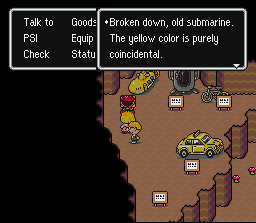
One of my favorite examples involves the lone NPC you see above. You see that guy with the blond hair? Try reading his shirt. Okay, you can't, but note how it's just legible enough to make out the famous "I Heart" brand of shirts. What does he love? We don't know, but boy can we have fun filling in the blanks. (apparently Itoi loved the character as much as we did, as the NPC reappears in Mother 3) There are other favorite designs, namely how the members of Tessie Watching Club always have binoculars glued to their faces and conspicuous Mr. T lookalikes (the best possibly being a resident of Twoson, who, after a kidnapping incident is resolved, claims he'll be "careful" not to kidnap anyone. It's not nearly as suspect as it sounds, but that it's said so straight-laced always has me howling).
So while EarthBound's graphics are hardly a looker by SNES standards, they remain timeless via the player's own projection. Just take how it treats the game's sole visual stunner: the psychedelic battle backgrounds. Pulsing and fluttering around like a music visualizer, these fluctuating abstractions steal the show of the admittedly simple battle encounters. EarthBound's battle system isn't the deepest you'll come across, and you can't even see your party, but that's okay. After all, you're the star; how the kids fend off aliens with baseball bats and frying pans and bazookas and the hexagonal chaos that are PSI attacks is entirely up to your imagination.
Take an old perception of mine as some food for thought: are you fighting in the streets of Onett, or are you zapped into dimensions host to those zany 3D backgrounds? Back when I was a kid, I perceived it as the latter, and mentally framed all the battles as such. Was I taking the presentation literally as-is, or did I take inspiration from the whole "crime-fighting kids who keep their occupation secret" cartoon trope? Regardless, even now I occasionally get caught up in that little theory, and now maybe you can, too.
But if we must praise the battle system from a "game" perspective, there is no other nominee but the rolling HP meter. Whereas enemy damage is immediately applied to your characters' HP in other RPGs, any attacks here slowly dwindle down number-by-number as according to how much was inflicted. Even if you're dealt mortal damage, a serving of Hamburgers or casting a PSI LifeUp will save yourself before the ticker reaches zero. EarthBound keeps its battle just interesting enough to keep the player invested, but it doesn't go for flashiness lest it overrides its purpose of immersion.
Needless to say, EarthBound was far ahead of its time for a 1994 video game, and so much of this has to do with the excellent, excellent writing. That Mr. Itoi is, first and foremost, a copywriter/essayist should speak for itself on how different it's going to be, but consider how he's considered to be one of Japan's most eccentric. Hardcore Gaming 101's review elaborates on how the Japanese kana for the original Mother 2 projects what can be best described as a free-flowing script that, despite the childish inclinations from that sector of the Japanese language, never comes across as patronizing.
All woefully difficult to conserve in translation, you understand, and yet Mother 2's transition into EarthBound results in what's NOA's first legitimately great localization. I'm not exaggerating here: just read up on Clyde Mandelin's super comprehensive Mother 2 vs. EarthBound comparison, and you'll realize how any mistranslations that slipped by are a drop in the bucket to how perfectly it captures Itoi's tone. Bear in mind this is from the mid-90's; granted, we'd just started to figure out this "localization" business (no more "Dodongo dislike smoke!" for us Nintendo fans), but that the localizers felt the words "crap" and "sexy" were needed to flesh out Itoi's world just proves EarthBound's localization is a real gift. (Bear in mind not only had NOA been enforcing a strict "kid's only" set of depiction guidelines at the time, but the former word only just recently became standard for Fire Emblem games, while the latter remains exclusive to good ol' EB)
And what a gift the writing itself is. It's a masterful blend of wit, parody, casual speak, and occasional sincerity. Helpful one moment and sudden (but clever!) Beatles reference the next. It'll break the fourth wall, but only in ways that'll serve the game's world and the player's connection. There are two entire dungeons dedicated to gloriously parodying RPG tropes. It's not outright manic, but it's the logic behind an earlier point: you want to explore everything the game has to offer. For example, you discover early on that while not every building is accessible, you'll still receive an answer should you knock on the door. How many houses can I enter, you might wonder, and so you're encouraged to find out what lies in them. If you can't, you're at least rewarded with funny dialogue.
The NPC dialogues are really the winner here. I could elaborate on any number of them, but I particularly enjoy the ones who betray conventions. The first woman you meet in Twoson who introduces the town, for one; I dare not spoil the punchline, but I can confirm the conversation will induce more philosophical ponderings on NPCs you never thought possible. Anyone invoking wordplay (namely the Happy-Happyist Cult, who desire to paint the world blue) is a riot, and I also appreciate the wordplay behind the towns ("Twoson--we got this name because we weren't first").
Of course, the best of the best are everyone's favorite part of the game: the Mr. Saturns, a race of tiny aliens fond of ribbons, help Ness engage in introspective coffee trips, and are, at one point, held captive by sentient piles of barf. Oh, and they speak in broken English, with their font as a mess of foreign-styled scribbles (apparently inspired by the handwriting of Itoi's daughter). This results in beautiful dialogue like in screenshot above. Basically, if they don't make you at least crack a grin, you don't have a soul.
Anyone could make a case for EarthBound's quirky, innovative writing being the best part of the game, but you could just as easily do the same for its quirky, innovative score. For the sake of context, I consider the Super Nintendo to be home to the greatest soundtracks in gaming history, be it the orchestral flair of Kirby Super Star and Chrono Trigger, the rock of Star Fox, the chill ambiance of the Donkey Kong Country games, and Super Mario RPG's repertoire of xylophones, pianos and whistles remaining the very best of Yoko Shimomura. As opposed to the limited channels of NES chiptunes and the N64's weak MIDI instrumentation, the balance of synth in SNES music is almost magic in how there's no compromises in producing truly rich scores. There's a homely, warming nostalgia to it all, and you could swear early examples like Super Mario World and SimCity were scored around this very purpose.
Maybe it's how the composers built upon Itoi's love of Lennon and based the soundtrack around how much he sang about love. Maybe it's Keiichi Suzuki's non-game music background or Hirokazu Tanaka's unique approach to producing music (perhaps he took inspiration from the "living creature" sound of Metroid?). Whatever it is, it expertly plays into the game's themes. Take the concept of Ness's home: no matter how far you've gone in your journey, no matter how many countries you've travelled, you're always welcomed home with a serving of your favorite homemade food, courtesy of Mom. Even with the fate of the world on his shoulders, Ness is still, after all, a young boy.
And all the while, a slow arrangement of the Pollyanna overworld theme from the first Mother plays. If I'm forced to choose a favorite song, it would be this. It is a Lazy Sunday and a tearful homecoming all in one, topped off with what can only be described as a heavenly choir. It always, without fail, makes me feel safe and loved, makes me reflect whether I'm playing the game or simply looking it up on YouTube.
We could spot similar themes in Eight Melodies, which plays throughout the game in various forms. It echoes in toy-box form whenever a new melody is gathered at a "Your Sanctuary", and again as a whole in the game's most heartwarming scene: Ness visiting his baby-self in monochrome. It's echoed again in the Sound Stone item; a deeper introspective that gradually morphs with the more melodies you gather. But up until all are collected, it stops after your last melody and thumps with perhaps the most unique sampling: an instrumental take on Lennon's Give Peace a Chance.
Of course, EarthBound doesn't always get all mushy. Let's not forget it is a weird, weird beast, and we learn that the moment we reach the naming screen. We're greeted with the game's first instance of ear-catching dissonance, consisting of a Monty Python's Flying Circus sampling before diving into a pop beat. It's a beat so infectious that I tend to stick around far longer than I should, staring at each character's animations as I file through their lists of default names.
Actually, EarthBound doesn't just stick to samplings; at times, it pays full-blown tributes, including one of my favorite pieces above. The theme of the Sky Runner machine is undoubtedly derived from The Who's Won't Get Fooled Again, (or, at the very least, its intro) and fans had long since speculated EarthBound took so long to reach the Virtual Console due to music licensing/infringement issues, with this song at the top of the list. If that's the case, then I dub it a necessary evil that we had to wait so long, because I cannot imagine anything more perfect than the technopop launch buildup and the steady, pronounced percussion of the actual flight.
Obviously, EarthBound's music has its roots (and rightfully so!) in the Western sphere. Its parody of American culture comes alive best in Twoson, a laid-back tune I actually once wrote about. All the numbered-town tunes with their own brand of American nostalgia, but I particularly enjoy this one in how it's the sort of the tune that'd accompany a country drive. I'm also fond of the theme for the town's Chaos Theater, undoubtedly one of the game's top atmospheric tracks (just listen to all the little clinks!).
There are so, so many more I could elaborate upon---the snowy nostalgia of Winters and the Snow Wood Boarding School, the latter of which is another atmospheric winner through its borrowing of of Mother's Snowman theme. The tribal, jubilant walk of The Lost Underworld. My favorite of the psychedelic battle themes, which is reserved for mini-boss fights. The climatic fusion of 8-bit marches, rock guitars and haunting ambience for the masterpiece that is the final boss battle. The heartwrenching duo of Because I Love You and Smiles And Tears for their respective ending setpieces. There are many others.
But I fear I've shared too much already, and I haven't even discussed what I love most about the game.
The reason why EarthBound resonated so much with its fans is because while it's a fantastical sci-fi experience following the tale of four children, it's all framed within very human circumstances.Just ask the guy who grew up without a father and was comforted by how Ness communicated with his absent father through telephone (which is the game's method of saving). *Or the gay man who had anti-gay rallies take place on his street, and could only find solace in Jeff's friend: Tony, a homosexual child who dreams of taking walks with his bespectacled roommate.
*This story
was shared on a Starmen.net forum post nearly a decade ago. I've since
been unable to find it, but the tale's stuck with me as a prime example
of EarthBound's immersion.
And take me. The other factor that prevented EarthBound from falling into the American abyss--the one hooked me into the game--was that Ness was included in the roster for the Nintendo 64's crossover fighter Super Smash Bros. The character fascinated me all the way up through the GameCube's Melee:
here was a young boy who sauntered into a Nintendo all-star fray as
if he was on the same level as Mario or Donkey Kong, and all he had to
show for it was his brand of psionic powers. That was rad.
What
was even radder was how his source game ticked off every box that 4th
Grade me identified with. It was weird not just for the sake of being
weird, but was entirely self-aware (NPCs commonly mention the game's
title) and ripped on RPG tropes (the aforementioned Pencil Statue). I was out-of-touch and
awkward and the game's "neglected" status became an identifiable symbol,
a treasure hidden within the flood of "I rented Enter the Matrix over the weekend" during Circle Time.
Oh, and I also liked random humor. The likes of Invader Zim and Ed, Edd n' Eddy warped my young mind with their mall security zombies and buttered toast, and soon a new outlet of humor was born and eventually expressed through the likes of Games in the Basement and writings/drawings revolving around Kung Fu Animal Forces and Zombie Men. And now for the first in my favorite medium, I had a refuge in a game that hosted Mr. Saturns, peanut-cheese bars, and trout-flavored yogurt. Even if others didn't accept me, I was vindicated through this one game alone.
Of course, I've grown to further appreciate the game's satire as I've gotten older, but the way it's transformed the mundane into the hysterical is just phenomenal. Here's an example I've grown to recognize as one of my favorites: after collecting the first of the Eight Melodies, Ness is accosted by Onett's police (who, just so you know, are going for the world record in road-blocking) for trespassing in a restricted area, and is told to report the station. There, the chief explains that while he's aware Ness wishes to travel to Twoson, the roads shall remain blocked unless he completes a certain test. Leading him down to an isolated room, he turns to Ness and asks if he can "get past five of my best men..."
At the time, I took this at face-value. So Ness had to take on some policemen now, okay. I'd already put a stop to the biggest, baddest gang in town and took down a giant ant, and it's not like I wasn't already running over police in Grand Theft Auto: Vice City. How was fighting cops any different than stomping on Goombas? It wasn't until I was replaying it in college when I realized this guy legitimately pitted a little boy against trained policemen. Cops that chose to battle with karate chops rather than firearms, mind, but it was enough to send me into hysterics (that it was already home to some of the game's best quotes was icing on the cake).
And even still, the best examples of EarthBound's humor are those rare moments when it blends weird with the genuinely heartfelt; case in point, the Camera Man. Every so often, stepping on an unassuming spot will trigger a trumpeting fanfare as a bearded man spirals down the sky and, after announcing his profession, will snap a picture of Ness's party. He'll claim the picture will bring back the greatest of memories and, just as quickly as he came, spins back into the heavens.
That this seemingly pointless event occurs again and again throughout the game tricks you into thinking it's just one of EarthBound's gleeful methods of screwing with the player. And maybe it kind of is; I'll admit I actually hated him as a kid for interrupting my game. But right after the character roll call at the end, you realize his purpose when he pulls up a camera stand: as the credits roll, those very same photographs scroll by as Smiles and Tears instills the warmest of smiles or renders you a sobbing mess.
The very fondest of my video game memories lie within EarthBound. I was only ten and was just discovering internet forums and sprite comics and the history of a company I'd been busy worshiping for the past four years. The passion surrounding EarthBound struck me the hardest, what with the achievements of Starmen.net and their forums of teens and young adults endlessly discussing their love for the game. Naturally, a ten year old can't quite mingle with a size gap that big; my topics were frequently locked and my entries for the Apple of Enlightenment contests were nothing sort of embarrassing (I'll leave to you to guess which one is mine). But it was how I was part of a beloved secret--a masterpiece forgotten by society--that mattered most.
That, and how I learned the word "nostalgia". Imagine it: a ten year old knowing the word nostalgia! It's true. The Starmen.net hippies I idolized used the word to describe their memories of EarthBound and how Super Smash Bros. Melee glorified Nintendo history and I wanted in on whatever they were talking about. Was it the way the towns of Onett and Twoson recalled memories of a youth I didn't have, or how I imagined kids back in 1995 waking up in the languid hours of the morning and rushing downstairs to play EarthBound, or how I felt when I listened to Melee's arrangement of Pollyanna?
Whatever it was, it was the greatest feeling in the world; my most cherished secret of all. And now it's fourteen years later and I'm still playing EarthBound. It's a game that has grown up with me, gradually building upon what I adored about it as a child alongside all the trials and tribulations of being a young adult. It's a game all about nostalgia and making memories, and now I can mine that very same nostalgia I once sought to discover. The irony continues to blow my mind; I can't think of anything else like it.
EarthBound is not a game of excitement or thrills, the most common reasons people play games. In that sense, I often don't recommend as a game
game. But for games that require any sort of investment, or introduce
any sort of theme or message, or push the boundaries of what exactly is defined as a video game, it is, with the very possible exception of its own sequel, the very best video game not just
under Nintendo's banner, but the best video game you can play, on any console. EarthBound is a game that will grow the more you play it, and I eagerly anticipate to see what I'll discover next time I visit its world: where I can be a kid and an adult all in one. Say fuzzy pickles!
Notice: while this is part of my Ten Years of Kirby retrospective, this review does not meet my current quality standards and will be superseded in the future. A link to the new version will be provided whenever it arrives.
Following the incredible success of 1993's Kirby's Adventure, our favorite pink puffball was making quite the name for himself. Immediately after the game's launch, Masahiro Sakurai got to work on a Game Boy spin-off by the name of Kirby's Pinball Land, a quirky pinball titlethat perfectly emulated the frantic nature of its platforming cousins. Released late within the same year, Pinball Land had no trouble riding the cash flow and established itself firmly into the gold-adorned "Player's Choice" label, granted to Nintendo titles that sold over a million copies. In the blink of an eye, a new star had rose in Nintendo's pantheon of heroes.
Having crafted three Kirby games in such quick succession, Sakurai seemed content to briefly lend the reigns to other members of HAL Laboratory while pursuing plans for an SNES title. The ensuing period from 1994-1998 introduced a deluge of spin-offs, beginning with the fan-favorite Kirby's Dream Course. Its eccentric golf-esque adventures aside, the game provided a valuable insight to HAL in that the Kirby brand was truly malleable thanks to the character's Copy Ability, and he could seamlessly ease himself into just about any genre of gaming. Dream Course proved to be particularly interesting considering that the game originally didn't feature Kirby at all, having initially been developed as a miniature golf game of sorts.
Collaborative efforts with other companies were also underway to further establish the new brand, albeit intended for a Western audience.Through some creative re-visioning by HAL and Compile, the SNES version of the cult classic puzzler Puyo Puyo was adapted into a Kirby title by the name of Kirby's Avalanche. The changes were completely cosmetic: the characters and settings were all culled from the series and rearranged songs from Kirby's Adventure supplied its soundtrack. Meanwhile, a little-known prequel named Kid Kirby was headed by DMA Design (which eventually began Rockstar North, creators of Grand Theft Auto) for the purpose of utilizing the SNES Mouse, but the project was quietly cancelled due to the peripheral's gradual irrelevance.
With Sakurai busy on his 16-bit adventure and endless spin-offs filling in the gap, HAL perhaps felt a new adventure was necessary to tide fans over. A new team was established for the creation of a Game Boy title, headed by the man responsible for the level design of Kirby's Adventure. Shinichi Shimomura was assigned his directorial debut for what was to be the sequel to the best-selling Kirby's Dream Land. Simply named Kirby's Dream Land 2, the game proved to replicate much of the original's success and even outsold the original's tales in native Japan. Mr. Shimomura would go on to direct two more games within the franchise, setting what fans dub the "Dark Matter Trilogy" (in reference to the evil black mass that serves as the antagonist for the three games). The games within this trilogy (Dream Land 2, Kirby's Dream Land 3, and Kirby 64: The Crystal Shards) are noted for being a tad slower than the typical hyperactivity found within Kirby, of which more than several fans could never quite adjust to despite the various gameplay quirks found within.
While I can't say I bear this ill will towards the latter two games of the trilogy, Kirby's Dream Land 2 remains the one title within the whole series I can never quite pin my feelings on, for it is the Kirby game I love with a broken heart.
----
Kirby's Dream Land 2 was something of a forbidden enigma from the very beginning of my Kirby fanhood; that is to say, I could never find the game anywhere. I found copies of Kirby's Adventure and Kirby Super Star in stores (R.I.P. Funcoland), and, er, "acquired" other Kirby games via the internet, but searches for Deram Land 2 proved fruitless. Yes, believe it or not, even scavenging through the endless, pirated troves of the web failed to produce even one functioning result, and I was forced to give up my search empty-handed.
It was rather frustrating too, as the game was hailed as something of a classic by Kirby fans. Dream Land 2 continually charted high on Top Kirby/Game Boy game lists, the bigger-than-life Kirby's Rainbow Resort fanpage gushed about it, and Kirby discussions on message boards mentioned how difficult it was for a Kirby title. The only dissenter? Some crazy lady on Gamefaqs who couldn't stop talking about hyenas. Somewhere within the jumbled mess that was her criticism was the bemoaning of how dumbed-down the gameplay was following Adventure, right down to the shrunken world hubs and lack of content. I was too distracted by the hyenas to listen.
When I finally got the chance to play it some five years later, I couldn't believe she was actually right. What made it hurt even worse was that I actually requested it as a gift following a major foot reconstruction surgery, and nothing about Dream Land 2 sparked a tinge of excitement in me. And for all my disappointment, I couldn't pin down as to why the game sucked. It played like Kirby, it sounded like Kirby, it was the first Kirby to introduce the beloved animal partner system (more on that in a bit), I didn't chalk it up to a change in tastes, either; Kirby's Adventure came out on the Virtual Console around the same time and I still had a blast. I went back and gave Dream Land 2 more than enough chances to redeem itself, as the years went by with remakes and yarn adventures. I walked away every time crestfallen, drugged with boredom. And the worst part of it was that I couldn't come up with a discernable answer as to why I couldn't enjoy it.
It was only last year when the Dream Collection arrived that I finally forced myself to chug all the way through the damn thing, and you know something? I jumped the gun a little. Kirby's Dream Land 2 is a good game. It's a genuine game. It's a fun game! But I struggle in deeming it a great one, and I cannot lie to the rest of the internet crowd and say it ranks among Kirby's best, for it all boils down to why the game turned me off initially.
No, it's not the lesser scale following Kirby'sAdventure. With the Game Boy being a much weaker system than the NES, I have no choice but to be lenient on that front. And besides, it's not like I can complain when it brings back the hub worlds from Adventure. Despite starting off with three levels per world, it quickly ramps up the number to about six or seven; in other words, a perfectly healthy amount for the Game Boy.
Nor do I mind the halved amount of Copy Abilities. Only a fraction of Kirby's powers return from Adventure (Fire, Spark, Cutter, Needle, Stone, Ice, and Parasol), but what's here is actually improved from their original forms. No longer does Spark cause immense slowdown, and Stone has the cool side-effect of rolling down sloped hills! And hey, I can't be completely disinterested when they brought back my beloved Parasol. And, and, and the animal partners!
Yeah, those guys are pretty rad. Marking the first appearance of Rick the Hamster, Coo the Owl, and Kine the Fish, these three friends of Kirby serve as a unique conduit for the hero's powers when caught for a ride. For example, using Spark while clutched by Coo's talons lets the duo conjure thunderbolts onto the hapless baddies below, soaring through the air all the while. Meanwhile, Rick wrecks havoc on the ground when transformed into a rolling Stone, forcing Kirby to perform a balancing act as they crush everything in their way.
And as for Kine's take on the Parasol? He just kinda, uh, sticks it out of his mouth. Whatever, he gets points for effort.
Obviously the selling point of the game, the animal partners offer the perfect compromise for the lack of Copy Abilities. Yes, the more unique stuff like Laser and Ball are missed, but who cares when you're riding a fire-breathing hamster? Much like the introduction of Yoshi in Super Mario World, the animal partners channel an alternative sense of power into the player through their optional status. Do you have to use them? Well, no, but considering how they morph Kirby's Copy Abilities into such exciting superpowers, why wouldn't you?
This begs the question: how can I go wrong with this? If the core concept of Kirby gameplay is handled relatively well, why should I have a problem with it? If I can accept limitations, then what's the big deal? Hell, if I get to ride on a hamster, why so much apprehension in naming it a great Kirby, then?
The big problem with Dream Land 2 is this: the level design composing the first third of the game is utter shit.
I say this knowing full well that stage design has never been Kirby's forte, but I have yet to encounter any other 2D action-adventure title within Nintendo's legacy with early levels sobanal, so devoid of lifethat deriving any form of entertainment from them is near impossible. Save for an occasional widened level scope, nothing within the first two worlds showcase even a speck of intelligence behind its obstacle placement, simply choosing to sparsely decorate landscapes with trademark tiered hills and the steep slope here and there.
This is where the unfortunate downgrades following Adventure begin to negatively impact the game; in particular, the lack of a dash input for Kirby is the spring-point for Dream Land 2's initially sluggish nature. While Dream Land had the same control issue, it was an acceptable compromise for the exchange of chaotic level design and frantic enemy mobs. Strip away those factors, and we're left with nothing but a dreadfully slow bore. Enemies crawl along at a snail's pace and the brain-dead level design erases any caution pitfalls present.
Dammit, even the aesthetic settings pisses me off! Gone are the alliterative food inspired days of Adventure's Vegetable Valley and Orange Ocean, for Dream Land 2 plops us straight off into the offensively bland Grass Land. And you know, maybe I'd be able to forgive such an uninspired location if it was just limited to the first world, but I can't really do that. And why's that? Because the game won't let me, as its segue into the next world creates quite possibly the worst sense of level progression I have ever seen in a game. You know how most platforming games often start out with a grassland and then move on to a desert or a beach or something? Well, Dream Land 2 has its own perfect antithesis to this:
A forest. That's right. The first two worlds are entirely dedicated to a grass field and a forest. Are you fucking kidding me? That these are next-door biomes is bad enough, but you know what's even worse? It's that the game invests absolutely zero effortto distinguish them from each other. I'm not even kidding! Other than the occasional branch platform and, uh, blockades of Star Boxes, the Big Forest is little more than a mere palette swap of Grass Land. They both entirely take place outdoors instead of initiating any transitional scenery. Both worlds have only one screen where you move up instead of going right. Both are entirely ass.
When arriving at any such relative point in any other bad game, it is at this point that any player worth their salt in gaming knowledge has already accepted the bitter truth: there is no hope. If a game fails to present any form of appealing hook at its beginning, why continue? Dream Land 2 is a tad more of a dire case in this regard, for the first two worlds are so vapid in design, so lethargic in movement and tedious in its sense of progress that there is no incentive to discover what lies beyond. Not even the gimmicks of Rick the Hamster and Coo the Owl can suppress the boredom, as Dream Land 2 seems destined for failure.
And that is the miracle of Kirby'sDream Land 2.
It is in the the next world, the watery Ripple Fields, where it's as if the game designers suddenly had an epiphany regarding 2-D platforming design: if a game desires to present interesting levels, it requires level-oriented obstacles and to engage the player. Dream Land 2 is quick to take this lesson to heart, and begins to present obstructions in spades, whether it's stripped right from Adventure (spikes that litter the floor and exploding coconuts rain that down on Kirby) or through its own volition (turbulent currents gushing out of deep-sea pipes).
From this point on, Dream Land 2 ushers in a landslide of quality, and it's as if the game is figuring out one logical equation of successful level design after the other. For example, while keeping the player on their toes with deadly coconuts is all well and good, focusing entirely on a single environmental motif (grassland, desert, forest, etc.) within an entire world gets boring rather quickly. Dream Land 2's solution to its previous screw-ups? Pitch-black caves (of which are cleverly illuminated through Kine's Spark power) and exciting underwater sections in the depths of Red Mountain. And by "exciting", I mean holy shit you better have Kirby stuffed inside Kine's mouth because otherwise you'll be at the mercy of those aforementioned current-spewing pipes.
The game isn't afraid to ape Adventure through levels built around Copy Abilities, but the best parts are when Dream Land 2 goes on to establish new tropes for the series. The game isn't clever enough to entirely create original 2-D platforming tropes, but its early age is the key. Dream Land and Adventure could only cover so much within their brief sugar rushes, which leaves all the more room for Dream Land 2 to pick up the slack. Frustrating scrolling screens of death? Check. Collapsing platforms? Check. An entire world based on icy traction that's compounded upon by precision-based jumps and weather effects? Check. Cleverly hidden mystical trinkets that are required to fight an insanely difficult final boss? Yikes.
This is all a long way of saying: man, does this game get brutal! I mean, the bountiful harvest of 1-ups do a great job of not applying any pressure onto the player, but that doesn't make it any less frustrating to endure. You remember how Super Mario Bros.: The Lost Levels was fond of abnormally small platforms that stood erect within bottomless pits? Yeah, Dream Land 2 has some of those lying around. Don't even get me started on the enemy swarms; actually, no, the less said about the above flying bag with the split personality disorder, the happier I'll be. Better hold on to your animal buddies tight, because they have a nasty
penchant for kidnapping them for reasons of pure evil that are never disclosed.
Yet for all its difficulty, for all of its struggles in learning level design, Dream Land 2 achieves what should be impossible for a game of its caliber. With such clear evidence of the developers learning the ropes of game design throughout the title's progress, there's no chance of of the game. And yet, it does. In preparation for the endgame, all the stops are pulled to produce one of the very best moments in all of Kirby: the Cloudy Park segment.
The best stages of 2-D platforming will always be the ones that surprise, challenge, and entrance the player, but how exactly do you define what's created from those three? The answers often lie in what are the simplest of solutions, yet are the easiest to flub up in design; for example, there could be a form of external pressure suddenly pushing against the player (such as gusts of wind or bursts of water), thus leading to creative scenarios such as navigating mazes or exposing weakspots within the terrain. But how can it be made so the player isn't frustrated through what they perceive to be cheap deaths and faulty controls? Cloudy Park is representative of this philosophy executed perfectly. Air currents of all kinds push Kirby through tight mazes of clouds and platforms, yet not once does the player lose control of the character. When they're introduced as tough segments of a level, they're constructed around the quick timing of the player to destroy or dodge obstacles in satisfying fashion. When presented as aesthetic forms of transition, they serve as dreamy visual pieces that embrace the player fully into its world. It's a perfect balance.
And the music. While unfortunately the game's soundtrack (composed by series regular Hirokazu Ando and newcomer Tadashi Ikegami) is largely uninteresting and bland, this sticks out along with Coo's Theme as being abnormal masterpieces. While every bit as nostalgic as the lullaby of Adventure's Rainbow Resort, Cloudy Park takes on a more elaborate note of easing the player into the world's majesty. It doesn't need the booming of an orchestra to produce the awe of approaching the title's finale, but simply a tad more activity and sentimentality to help the player reflect on just how far they've come. When I first heard this song last year, I found myself absorbed in a reverie not quite unlike those Super Star and Adventure/Nightmare in Dream Land had trapped me within so long ago. I was a kid again.
The game even ends in the vein of a classic. After slaying what may very be the most grueling final boss in all of Kirby, the tiny sprite of Kirby lets go of the Rainbow Sword and slowly closes his eyes, descending to Pop Star. Various stills of his animal friends are shown, patiently waiting his return. King Dedede gazes up towards the sky and smiles, having been freed of his nightmarish possession. The power of sprite animation has been proven time and time again, and this one scene alone depicts a gracefully silent side of Kirby we've never seen before, nor since.
...so what just happened? What the fuck just happened? This is not normal. Games don't suddenly bounce up from the realm of shit just like that. I spent years thinking this game was an failure! Years! And it was all because the first two words had to present the most dismal, lifeless examples of level design I have ever seen in a 2D platforming game. I have to suffer through this shit every time I make a new file! Could I just go back and play my old one? Well, yeah, but do I really want to pretend I'm starting a new game at world three? What kind of sense does that make? I'm the kind of guy who loves replaying old games just for that heightened achievement of beating the shit out everything it has to offer, just to celebrate its whole as a complete, cohesive package. I'm fresh out of luck, don't you see?!? Fucked, that's what I am!
I'm sorry, excuse my outburst. I know all the crap I threw just now at Dream Land 2 isn't entirely justified to the game's entirety, but it just pisses me off just like how this summer's abhorrent Game & Wario did. See, as much as the likes of Zelda: Skyward Sword and Paper Mario: Sticker Star offended me, I consider Game & Wario a truly tragic piece of virtual entertainment because the presentation and humor involved proves the guys behind it still have it (check out this Kotaku article to see what I mean). The unlockable videos and trinkets are gold! The exaggerated artwork for each minigame is a hysterical throwback to the cover-art for NES games! Yet I can't enjoy this stuff for even a moment because they're shackled to an unbelievably shitty game devoid of any inspiration behind its gameplay ideas (save for the Gamer title, which only makes me wish for a return to the original WarioWare formula).
Kirby's Dream Land 2 is in the same boat. This article has proven the people behind the title have actual talent, yet why does the beginning of the game open with shit? Is this a joke? Are we supposed to believe the designers just suddenly learned how to make a game halfway through? Why couldn't they just go back and patch up the earlier levels, then? You know what? Maybe Dream Land 2 didn't really have a miracle at all. The first two worlds are complete shit on purpose; in other words, they were dumbed down just enough to ensure the brainless beginner can get past the first couple of worlds for a sense of accomplishment.
With the exception of Squeak Squad, just about every other Kirby game proves this mentality wrong. You don't have to remove any sense of danger and strip levels out of any unique design just to hook a beginner. It boggles the mind that Dream Land and Adventure would have zero problems with this, yet suddenly this game does? Yeah, Sakurai didn't work on this one, but you'd think the guy behind Adventure's levels would get the hint regardless. Or maybe it was just that it was his first time as director? Who knows.
Look, I like this game, I really do. I dig that second half, and if the rest of the game followed its example, it could be one of my Kirby favorites. But being baited does not a great game make, and I don't wish to suffer through tedium just to get to the good parts. Kirby's Dream Land 2 is ultimately a worthwhile video game with some notable talent and ingenuity behind it, but it just misses that cusp of greatness.
----
Welp, over a month and a half! Much better than missing three straight months, no? I've recently gotten my procrastination under control, so I think you'll be seeing me much quicker next time around. I'll be back soon with a new review, new entry in this series, and FINALLY the beginning to the Top 25 Wii games! Seeya!