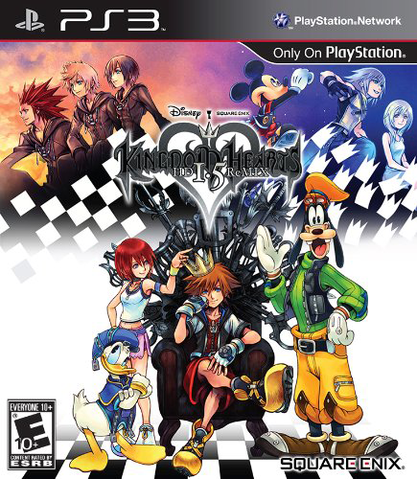
Full Disclosure: This article will serve as the "main" review for
Kingdom Hearts: Final Mix, as I have no interest in importing the
original version.
And so begins our journey into the world of Kingdom Hearts
remasters. For the uninformed, the three we'll be reviewing are
three-course meal packages -- two upgraded ports and a cinematic
feature "retelling" the story behind one of the handheld spinoffs --
designed for the purpose of uniting the series onto one console in
PlayStation 3 (barring Kingdom HeartsHD 2.8 Final Chapter Prologue, which exclusively released for PlayStation 4 and would later be repackaged in Kingdom Hearts - The Story So Far
on the same console). Given my peculiar relationship with this bizarre
franchise, I simply cannot ignore reiterations that've hooked new fans,
and so here we are.
In this case, we are reviewing Kingdom Hearts HD 1.5 ReMIX. Putting aside the series' latest in bizarre names, this first collection contains the "Final Mix" upgrade of the original Kingdom Hearts, PlayStation 2's Kingdom Hearts: Re:Chain of Memories remake of the Game Boy Advance game, and a movie version of Kingdom Hearts: 358/2 Days. As you may recall, I have conflicting feelings on all three: the first one's an aged, wannabe masterpiece that's more of a bizarrely enchanting freshman project, Re:Chain of Memories is an inferior remake worth only for 3D novelty, and 358/2 Days' pretentious presentation can't mask its identity as mediocre product. For the weathered Kingdom Hearts fan as myself, barring the first-ever release of Kingdom Hearts: Final Mix in the West, this is not an especially enticing purchase, particularly when considering 1.5 ReMIX has been repackaged into two further collections: Kingdom Hearts HD 1.5 + 2.5 ReMIX and Kingdom Hearts -The Story So Far-.
You know what? I'm skipping ahead. I don't have to play Kingdom Hearts: re:Coded to know it's utterly expendable to the series at large and that it was only designed for capitalizing upon the brand. The latter's particularly indefensible upon having the arduous displeasure of watching its movie adaption in Kingdom Hearts 2.5 HD ReMIX, wherein I was begging, pleading for the bloated mess to end. We'll get to that when the time comes, but needless to say, I have very little interest in repeating my trauma with something so mercenary.
Anyway, here we are with 2012's Kingdom Hearts 3D: Dream Drop Distance for 3DS. Commemorating Kingdom Hearts' tenth anniversary, it's only fitting that a) this would be the very last game to (finally!) utilize the original graphical engines and b) this would be the first in a line of games paving the way to Kingdom Hearts III. In fairness, I cannot recall if the latter was an explicit decision (the "lineup" bit, I mean), but it certainly exists now: there's the mobile Kingdom Hearts χ (which I haven't bothered with, and apparently will have key references in Kingdom Hearts III; groovy) and 2/3rds of Kingdom Hearts HD 2.8 Final Chapter Prologue: the playableKingdom Hearts 0.2: Birth by Sleep – A Fragmentary Passage (the very end of which directly leads into Kingdom Hearts III's opening) and Kingdom Hearts χ Back Cover. (A cinematic adaption of the aforementioned mobile game, which further convinced me it wasn't bothering with.)
And so along comes the second title in Kingdom Hearts' never-ending flood of side-games, this time on a console I have absolutely no interest in owning. As mentioned in an earlier review, I was only able to play Kingdom Hearts: Birth by Sleep on a PSP lent by a buddy at college, and have since purchased the remaster contained within PS3's Kingdom Hearts HD 2.5 ReMIX. There are, I am certain, other good games on the system. Great games. Amazing games. But for the life of me, I cannot bring myself to care about it, and so I suspect this will be the one and only PSP review we'll see on here for some time. Perhaps my other Worldly Weekend retrospectives will eventually lead me to cross paths with Sony's handheld once more, but for now, I'm afraid you'll have to make do with this one article.
Regardless, I dub Birth by Sleep as a side-game with some mighty hesitation there, and that's for two reasons: a) Birth by Sleep is absolutely essential in comprehending the Kingdom Hearts story from here on out, and b) it's easily the series' best since Chain of Memories; actually, that probably remains the case. Not that it doesn't fumble in that typical Kingdom Hearts manner -- that, and while I hate to keep dragging the PSP, I heavily question its existence on the platform -- but we'll get to those problems when they come. For now, let's get into the good stuff.
Not even one game later, and we've already arrived at Final Fantasy's infamous identity crisis. The game we are reviewing today is not the Final Fantasy II hailed as a SNES classic, but the Famicom's Final Fantasy II that released in 1988, never left Japan's shores, and is often cited as one of those experimental black sheep sequels that plagued the NES. For the moment, let us put aside the fact Western fans wouldn't experience the same frustration bestowed by Zelda II and Castlevania II until roughly a decade's time, and hone in on a more well-known source of frustration -- that, of course, being the name discrepancies exchanged among the first six Final Fantasys. With three Final Fantasy games -- Final Fantasy II, Final Fantasy III, and Final Fantasy V -- skipped over at release, Square had no choice but to dub their Western localizations of Final Fantasy IV and Final Fantasy VI as Final Fantasy II and III, respectively.
Needless to say, what resulted was an endless source of confusion regarding Square's retconning as they made their Western debuts via PlayStation, Game Boy Advance and DS incarnations, be they altered ports or elaborate remakes. And yet, in the case of Final Fantasy II, I cannot help but feel this was the correct decision: whereas Final Fantasy IV is a series masterpiece, II is certainly its retro nadir, filled with antagonistic design decisions that smother any goodwill it sought to bring. While hardly the worst JRPG, said decisions render it a slog of mediocrity as opposed to the prestigious, glorified adventure established from the very first game.
Note: Merely discussing the content of this game -- or even just looking at the below cover -- paves way for some early spoilers regarding Kingdom Hearts II. If you're planning on going into the series blind, you'd best skip ahead.
And so begins not just Kingdom Hearts further wedging itself into the realm of indecipherable names, but spawning what remains its biggest folly: an endless line of "bridge" games consisting of side-stories, prequels, and pseudo-sequels, all for the purpose of either divulging a particular interim between certain games or setting the stage for Kingdom Hearts III. Be it the fault of a developer (Square-Enix) caring only to capitalize upon a successful brand or the burgeoning over-ambition of a short-sighted director (Tetsuya Nomura), it's vital to discuss why, exactly, this direction was problematic, beginning with the most obvious reason: it's been eleven years since the first three spin-off games (358/2 Days, Birth by Sleep, and Re:coded) were announced, and we're only just getting Kingdom Hearts III this year. Whoops.
This past decade's worth of wasted time and frustration is more than enough for fans to jump ship, especially when factoring in cost: over the next six years, engaging in the full Kingdom Hearts experience required the purchase of a Sony PlayStation 2, a Nintendo DS, a Sony PSP and a Nintendo 3DS. Being an episodic series, this is not like Final Fantasy's individualized entries where one can simply pass, say, Final Fantasy IX on PlayStation and pick up Final Fantasy X on PlayStation 2 without missing any context; nay, you must at the very least engage in Birth by Sleep and Dream Drop Distance to make any sense of the series hereafter, and for the most dedicated of Kingdom Hearts fans, that potentially means shelling out cash for systems you don't particularly want (or, in my example, you're lucky enough to know someone at college who's willing to let you borrow their PSP and copy of Birth by Sleep).
And so begins Kingdom Hearts's foray into befuddling names. Admittedly, Re:Chain of Memories is hardly as ridiculous and pretentious as the goofy titles we'll become acquainted with down the road; if anything, I'll grant the "Re:" here actually makes sense -- the involved prefix meaning it's another attempt at a previous title -- but its sudden intrusion before the subtitle has always irked me. Still, it's of little consequence.
Really, what I find more fascinating is the brisk turnover between the original Game Boy Advance game and this remake for PlayStation 2: for those not aware of the dates involved, the original Chain of Memories launched at the very end of 2004, while this 3D remake -- a bonus game packaged alongside the Kingdom Hearts II Final Mix re-release in Japan -- released in Spring of 2007 (it received a standalone American release at 2008's end). I struggle to think of any game redone in such a short span of time, and I am never not impressed by this probable record and at Square-Enix's brilliant marketing strategy (what, KH2 with additional features isn't enough for you? Okay, then here's a GODDAMN 3D REMAKE OF A GAME BOY GAME)
Note: minor spoilers within this review. There's nothing too major, but I simply had to talk about how much the story bothered me here.
My dear readers, I ask you to journey with me to a different time: 2005, where Japan's Weekly Famitsu magazine was hyping up Kingdom Hearts II as if it were the Second Coming of Jesus Christ. This is not an exaggeration -- every week, Japanese readers (and Western fans dependent on online scans and translations) were subject to adrenaline-inducing eye candy, with the game's revamped engine providing flashy Reaction Commands and Drive Form acrobatics for protagonist Sora. Clamored Disney films such as Mulan and The Lion King were joining the world lineup, as groundbreaking inclusions like Pirates of the Caribbean, Steamboat Willie and TRON continually surprised fans the world over. A Keyblade-wielding Mickey Mouse was jumping around like Yoda, as the Final Fantasy cameos ramped up with Final Fantasy X's Auron as a party member, Advent Children outfits for the FF7 cast, and even including folks not designed by series director Tetsuya Nomura (Vivi and Setzer, to be precise). Even once-maligned efforts like the Gummi Ship and The Little Mermaid's Atlantica were completely reworked, operating respectively in the vein of Disneyland rides and theater musicals.
In other words, whereas the first game was a good-natured but rough-around-the-edges freshman project, Kingdom HeartsII was set to finally realize the original's dream: a masterful celebration of Disney and wistful nostalgia blended with brooding Final Fantasy influences, all framed within a gameplay engine that could do it justice. Naturally, I myself awaited it as a supernatural revelation, but what did I ultimately think of it when came out?
It's really hard for me to look at the above cover. While hardly problematic in itself, something about this localized box art for Dragon Quest II -- Dragon Warrior II in the States -- irks me more than the one for the first, which is mighty odd considering they both subscribe to the 80's style of realistic medieval fantasy. Could it be the exaggerated chest for the Princess of Moonbrooke, or that at this point I'm far, far too accustomed to Akira Toriyama's signature artwork for the series?
Ah, yes, that's more like it. And the answer is apparent as well: as much as the NES Dragon Warrior covers attempt to present the games as no-nonsense affairs, the goofy enemies obviously suggest a more tongue-in-cheek affair, and thus it's insanely difficult imagining the American art having any agency in our imaginations. Naturally, Toriyama's art is the way to go, so let us not tarry upon such incongruities.
Not even one game later, and we arrive at the embryonic stage of Kingdom Hearts'
ultimate folly: "bridge" games released across multiple platforms. The
Disney/Square-Enix saga was not to continue just through numbered
mainline entries, but through what series director Tetsuya Nomura
described as games that would "bridge" -- or rather, set the stage for
-- said numbered entries together. Kooky executive antics and Nomura's
own over-ambition would eventually drive this direction out of control,
as evidenced by the fact it's been twelve years since Kingdom Hearts II first launched in Japan and we've only just recently received a tentative date for the long-awaited third entry.
But we'll get to that mess when it comes. Really, what I want to talk about is how undeserving Kingdom Hearts: Chain of Memories
-- the first of these bridge games, which arrived on Game Boy Advance
in 2004 -- is of this blame, for I daresay it is perhaps the very finest
title under the Kingdom Hearts banner. Not because it possesses
the very highest highs of the series -- although quite a few are present
here -- but rather in how it is the most consistent: what we
have here is a game that not only recognizes its purpose, but is aware
of its limitations and tries its damnedest to work around them to
provide one of the most compelling JRPGs on the platform.
Note: Please excuse the imbalance of quality for screenshots here; for whatever reason, viable screenshots of earlier PS2 game are especially hard to find.
Dear readers not familiar with Kingdom Hearts, I implore you to look, just look, at the cover above. Yes, that is Goofy and Donald Duck of Disney fame chilling in the moody, moonlit sky alongside three anime teenagers. Their normally-cheery faces are now solemn, decorated with such wistful melancholy that does away with their kid-friendly personas, evoking an aura of maturity never before displayed to the public eye.
Needless to say, Kingdom Hearts was one of the most bizarre debuts of the PS2/GC/Xbox era, and yet somehow it ended up being one of the most beloved. A collaboration between Disney and famed RPG developer Squaresoft (now Square-Enix), the 2002 action-RPG's outlandish concept of pitting Disney icons and zipper-laden, key-wielding adolescents against Disney villains in command of heart-harvesting shadows--a tale bookended by Hikaru Utada pop songs, mind--is so uniquely ludicrous that it demands your attention. But why?
My theory? By framing itself as a "darker" take on Disney, Kingdom Hearts ropes in the nostalgic RPG player who once associated with their films in early youth. I am no exception to this: the game was responsible for restarting my fervent following in Disney animation, the soundtrack never left my CD player and I clocked out the "Hours Played" stat in the course of a year. Since then, my association with Kingdom Hearts has floundered over the years: it birthed as an obsession that required a near-intervention, followed by a burning hate that wanted nothing more to do with the series, and am now settled as a casual fan who partakes in it like the finest of junk food.
Have you ever stopped to think about the name Final Fantasy? It's something so highly prestigious that the game would have to be as grand as the name implies--and make no mistake; for its time, it certainly was--but it hardly makes a lick of sense when regarding the actual context. The answer lies within its development: as developer Square was in the throes of near-bankruptcy, creator Hironobu Sakaguchi wanted a title that would not only close the book on the company, but on the seemingly-inevitable end of his game-making career.
As history would have it, that wasn't the case. Final Fantasy has since gone on to produce over 15 beloved titles (not to mention countless spin-offs and ports/remakes) and became the worldwide representation--perhaps even standard--for the Japanese RPG. The "Gil" currency, the famous victory fanfare and the Chocobo/Moogle mascots have become synonymous with the genre, and continue to be associated with the series to this day.
However, not all of the them debut in the series' first game, which is often cited alongside the original Dragon Quest as kickstarting JRPGs. There is a distinct difference between the two games, however: Dragon Quest is, more or less, a grindfest for its entire duration. Final Fantasy is not.
That's not to say there isn't any level-grinding within Square's debut RPG, but there's more of a leniency in its pacing. Over a year had passed since Dragon Quest, so it only makes sense they'd arrange for the necessary improvements. The interface is simpler and less clunky; no "stairs" button in sight. There's an active, ongoing story-arc that, while not deep, breaks free of the "save the princess!" model. Western RPG tropes are brought in to enhance the battle system, such as enemy weaknesses (fire beats ice, duh)
The end result is a game still approachable today. You will grind, but there's enough player conveniences and innovations to keep thing interesting. JRPG conventions like overworld vehicles got their start here, but they weren't just 80's visual stunners; the thrilling swiftness of the Airship is just as much of a marvel as it is an effective tool for speedy progress.
Yet what's perhaps most impressive is the Class System. As opposed to the Final Fantasy games of today, you create your four-man party out of six different classes (Warrior, Thief, Black Belt, Red Mage, White Mage and Black Mage), each with their own strengths and weaknesses. White Mages don't really engage in physical combat, for instance, but are invaluable for any team thanks to their healing magic.
It's a wonderful, flexible system that ensures no two playthroughs will be the same: that there's over 60 spells to master ensures a deep, flexible variety within each party member's moveset. Citing a personal example, I initially thought I made a mistake in choosing a Thief class as my 2nd physical class(Warrior was my first, main choice), as he died quickly and possessed the strength of a mewling kitten. It wasn't until his eventual promoted to a full-blown Ninja that his usefulness was discovered: not only could he actually deal damage, but Black Magic was now at his disposal, so he'd be able to back up my Black Mage.
Moreover, it's just fresh, which is saying a lot for a game that came out in 1987.Having been acquainted with set parties in JRPGs for such a long time, it's amazing to me a game celebrating its 30th anniversary can deliver such a customization experience. Right from the beginning, Final Fantasy encourages you to forge your adventures rather than the one explicitly set by the developers, and I find it rather special that uniqueness has only grown over the years.
The class system alone should render it accessible to most, but Final Fantasy's unusual magic system is what often drives today's players away. As opposed to the multi-digit Magic Points commonly found today, spells are deducted by a single-digit "charge" system. This renders their use in dungeons and the like incredibly precious; the only method of restoration are overworld-exclusive tents, so the balance between offense and defense is vital.
One's mileage will vary; personally, I adored it for the different sort of challenge it brought. Old JRPGs often involve being trapped in dungeons and the like, so this brings a different level of challenge in choosing your battles. There's always the option of running away, of course, but the frustrating JRPG penalty for escape failure (free damage courtesy of monsters!) is a constant, lurking risk, so you'll only want to pick that as a last resort.
Needless to say, Final Fantasy is pretty hard, but that doesn't mean it's not fun. The battle system itself mostly works; whereas Dragon Quest relied on imagination, Final Fantasy displays your party and all their spell-casting glory. This is especially vital since it highlights your chosen party members, so their eventual transformation when promoted feels like much more of an accomplishment. It's even great to see Square taking advantage regarding attention to detail, as your weapon visually changes every time you switch equipment. Like every other pre-SNES RPG, unfortunately, it does fall into the archaic lack of auto-target (as in, you'll miss an attack if the enemy's already defeated, as opposed to simply switching targets).
There are other flaws common in 80's JRPGS. For all the improvements upon Dragon Quest, Square didn't take the time to adjust NPC antics and not have them block doors and counters. An endearing flaw, yes, but not all a practical one. And yes, you will receive vague directions and be at the mercy of townspeople hints, so don't feel guilty about using an online guide like I did.
There are, however, no flaws in the score. Series composer Nobuo Uematsu made his big break as an industry icon thanks to Final Fantasy, and know we're in for something special when the 8-bit harp introduces the famous Prelude opening. Soon to grace the prologues of future Final Fantasy titles, it instills a deep mystique that successfully frames the games as the otherworldly fantasies they're intended be.
Meanwhile, the Overworld Theme takes on not a somber tune, but of an upbeat one emphasizing adventure. Fitting quite well within the familiarly cheesy 8-bit range of the NES, as grand as the aforementioned "somber" themes we'd see in later Final Fantasy titles are, I find this sort of brightness to be far more welcoming. You could argue it may undermine its' serious attempt to tell a story, but let us not pretend it is a deep story by any measure; what matters it motivates us to keep going in the face of random encounters, rather than discouraging us by feeling isolated and alone (which in itself would betray the concept of a multi-man party).
Not that any "undermining" takes place considering the presence of the battle theme; while also an exercise of activity, it's a more serious one that expertly remembers the 8-bit rule of being infectiously catchy. It instantly recalls the wickedness of the fiends and monsters we slay not merely in appearance, but their rage-inducing usage of Paralysis.
I've had the pleasure of completing three NES RPGs over the past two years (EarthBound Beginnings, Dragon Quest, and this), and out of that trio, Final Fantasy is probably the best. This is especially shocking to me given my intense love for the EarthBound (Mother) franchise, yet Final Fantasy is perhaps the best realized JRPG of the 80's. There's no awkward skips in the scenario nor an overt emphasis on endless grinding; it is competently paced, living up to every one of its grand ambitions alongside a rigid difficulty set to be tackled any which way by the player.
It's the class system that keeps it alive thirty years later. I know it's not the last Final Fantasy to use them, but there's a distinct appeal in the first entry employing such depth in its design. And with the number of remakes and ports out there, I have plenty of excuses to take another go and shake up my selection. Final Fantasy is the rare NES game that matches up to Nintendo's own efforts like The Legend of Zelda and Metroid not merely in quality, but in successfully still channeling that engaging sense of hugeness, an even rarer 80's value I cherish as evidence of fine craftsmanship. It is not the complete masterpiece I imagine its SNES and PS1 successors are claimed to be, but such an accomplishment renders it a timeless classic all the same.