Not even one game later, and we've already arrived at Final Fantasy's infamous identity crisis. The game we are reviewing today is not the Final Fantasy II hailed as a SNES classic, but the Famicom's Final Fantasy II that released in 1988, never left Japan's shores, and is often cited as one of those experimental black sheep sequels that plagued the NES. For the moment, let us put aside the fact Western fans wouldn't experience the same frustration bestowed by Zelda II and Castlevania II until roughly a decade's time, and hone in on a more well-known source of frustration -- that, of course, being the name discrepancies exchanged among the first six Final Fantasys. With three Final Fantasy games -- Final Fantasy II, Final Fantasy III, and Final Fantasy V -- skipped over at release, Square had no choice but to dub their Western localizations of Final Fantasy IV and Final Fantasy VI as Final Fantasy II and III, respectively.
Needless to say, what resulted was an endless source of confusion regarding Square's retconning as they made their Western debuts via PlayStation, Game Boy Advance and DS incarnations, be they altered ports or elaborate remakes. And yet, in the case of Final Fantasy II, I cannot help but feel this was the correct decision: whereas Final Fantasy IV is a series masterpiece, II is certainly its retro nadir, filled with antagonistic design decisions that smother any goodwill it sought to bring. While hardly the worst JRPG, said decisions render it a slog of mediocrity as opposed to the prestigious, glorified adventure established from the very first game.
Have you ever stopped to think about the name Final Fantasy? It's something so highly prestigious that the game would have to be as grand as the name implies--and make no mistake; for its time, it certainly was--but it hardly makes a lick of sense when regarding the actual context. The answer lies within its development: as developer Square was in the throes of near-bankruptcy, creator Hironobu Sakaguchi wanted a title that would not only close the book on the company, but on the seemingly-inevitable end of his game-making career.
As history would have it, that wasn't the case. Final Fantasy has since gone on to produce over 15 beloved titles (not to mention countless spin-offs and ports/remakes) and became the worldwide representation--perhaps even standard--for the Japanese RPG. The "Gil" currency, the famous victory fanfare and the Chocobo/Moogle mascots have become synonymous with the genre, and continue to be associated with the series to this day.
However, not all of the them debut in the series' first game, which is often cited alongside the original Dragon Quest as kickstarting JRPGs. There is a distinct difference between the two games, however: Dragon Quest is, more or less, a grindfest for its entire duration. Final Fantasy is not.
That's not to say there isn't any level-grinding within Square's debut RPG, but there's more of a leniency in its pacing. Over a year had passed since Dragon Quest, so it only makes sense they'd arrange for the necessary improvements. The interface is simpler and less clunky; no "stairs" button in sight. There's an active, ongoing story-arc that, while not deep, breaks free of the "save the princess!" model. Western RPG tropes are brought in to enhance the battle system, such as enemy weaknesses (fire beats ice, duh)
The end result is a game still approachable today. You will grind, but there's enough player conveniences and innovations to keep thing interesting. JRPG conventions like overworld vehicles got their start here, but they weren't just 80's visual stunners; the thrilling swiftness of the Airship is just as much of a marvel as it is an effective tool for speedy progress.
Yet what's perhaps most impressive is the Class System. As opposed to the Final Fantasy games of today, you create your four-man party out of six different classes (Warrior, Thief, Black Belt, Red Mage, White Mage and Black Mage), each with their own strengths and weaknesses. White Mages don't really engage in physical combat, for instance, but are invaluable for any team thanks to their healing magic.
It's a wonderful, flexible system that ensures no two playthroughs will be the same: that there's over 60 spells to master ensures a deep, flexible variety within each party member's moveset. Citing a personal example, I initially thought I made a mistake in choosing a Thief class as my 2nd physical class(Warrior was my first, main choice), as he died quickly and possessed the strength of a mewling kitten. It wasn't until his eventual promoted to a full-blown Ninja that his usefulness was discovered: not only could he actually deal damage, but Black Magic was now at his disposal, so he'd be able to back up my Black Mage.
Moreover, it's just fresh, which is saying a lot for a game that came out in 1987.Having been acquainted with set parties in JRPGs for such a long time, it's amazing to me a game celebrating its 30th anniversary can deliver such a customization experience. Right from the beginning, Final Fantasy encourages you to forge your adventures rather than the one explicitly set by the developers, and I find it rather special that uniqueness has only grown over the years.
The class system alone should render it accessible to most, but Final Fantasy's unusual magic system is what often drives today's players away. As opposed to the multi-digit Magic Points commonly found today, spells are deducted by a single-digit "charge" system. This renders their use in dungeons and the like incredibly precious; the only method of restoration are overworld-exclusive tents, so the balance between offense and defense is vital.
One's mileage will vary; personally, I adored it for the different sort of challenge it brought. Old JRPGs often involve being trapped in dungeons and the like, so this brings a different level of challenge in choosing your battles. There's always the option of running away, of course, but the frustrating JRPG penalty for escape failure (free damage courtesy of monsters!) is a constant, lurking risk, so you'll only want to pick that as a last resort.
Needless to say, Final Fantasy is pretty hard, but that doesn't mean it's not fun. The battle system itself mostly works; whereas Dragon Quest relied on imagination, Final Fantasy displays your party and all their spell-casting glory. This is especially vital since it highlights your chosen party members, so their eventual transformation when promoted feels like much more of an accomplishment. It's even great to see Square taking advantage regarding attention to detail, as your weapon visually changes every time you switch equipment. Like every other pre-SNES RPG, unfortunately, it does fall into the archaic lack of auto-target (as in, you'll miss an attack if the enemy's already defeated, as opposed to simply switching targets).
There are other flaws common in 80's JRPGS. For all the improvements upon Dragon Quest, Square didn't take the time to adjust NPC antics and not have them block doors and counters. An endearing flaw, yes, but not all a practical one. And yes, you will receive vague directions and be at the mercy of townspeople hints, so don't feel guilty about using an online guide like I did.
There are, however, no flaws in the score. Series composer Nobuo Uematsu made his big break as an industry icon thanks to Final Fantasy, and know we're in for something special when the 8-bit harp introduces the famous Prelude opening. Soon to grace the prologues of future Final Fantasy titles, it instills a deep mystique that successfully frames the games as the otherworldly fantasies they're intended be.
Meanwhile, the Overworld Theme takes on not a somber tune, but of an upbeat one emphasizing adventure. Fitting quite well within the familiarly cheesy 8-bit range of the NES, as grand as the aforementioned "somber" themes we'd see in later Final Fantasy titles are, I find this sort of brightness to be far more welcoming. You could argue it may undermine its' serious attempt to tell a story, but let us not pretend it is a deep story by any measure; what matters it motivates us to keep going in the face of random encounters, rather than discouraging us by feeling isolated and alone (which in itself would betray the concept of a multi-man party).
Not that any "undermining" takes place considering the presence of the battle theme; while also an exercise of activity, it's a more serious one that expertly remembers the 8-bit rule of being infectiously catchy. It instantly recalls the wickedness of the fiends and monsters we slay not merely in appearance, but their rage-inducing usage of Paralysis.
I've had the pleasure of completing three NES RPGs over the past two years (EarthBound Beginnings, Dragon Quest, and this), and out of that trio, Final Fantasy is probably the best. This is especially shocking to me given my intense love for the EarthBound (Mother) franchise, yet Final Fantasy is perhaps the best realized JRPG of the 80's. There's no awkward skips in the scenario nor an overt emphasis on endless grinding; it is competently paced, living up to every one of its grand ambitions alongside a rigid difficulty set to be tackled any which way by the player.
It's the class system that keeps it alive thirty years later. I know it's not the last Final Fantasy to use them, but there's a distinct appeal in the first entry employing such depth in its design. And with the number of remakes and ports out there, I have plenty of excuses to take another go and shake up my selection. Final Fantasy is the rare NES game that matches up to Nintendo's own efforts like The Legend of Zelda and Metroid not merely in quality, but in successfully still channeling that engaging sense of hugeness, an even rarer 80's value I cherish as evidence of fine craftsmanship. It is not the complete masterpiece I imagine its SNES and PS1 successors are claimed to be, but such an accomplishment renders it a timeless classic all the same.
I gotta say, I haven't been this floored by a third-party Smash character since Snake! As incredible as the rest of the third-party cast is, they're far more hands-on with Nintendo than Cloud. Like Snake, the broody swordsman kickstarted his popularity off of Sony PlayStation, but even then that's where the similarities end: while Snake's starred in a couple of games on Nintendo consoles, Cloud's only made periphery appearances in a scant few Final Fantasy and Kingdom Hearts spin-offs.
It's an inclusion straight out of the GameFAQs wishlist netherworld, and yet...it's the most natural, beautiful thing in the world. Only in Smash Bros. can we see famous icons like Mario, Pac-Man, Sonic, Link, Mega Man, Ryu, Pikachu, and Cloud join together, and it remains as special and euphoric as ever. Oh, if only Snake was here!
I forgot if I mentioned this before, but when I announced Worldly Weekend, I stated I'd use the column as a means to introduce myself to new games outside of Nintendo's sphere. I may or may not have cited Final Fantasy as an example, but just in case I didn't, I was already planning on that from the column's conception. In fact, I actually purchased the NES cartridge for the first game when I was at Otakon this year! That's right: alongside Dragon Quest, I aim to play through both series chronologically.
...although that means it'll be a while before I reach VII, which stars Cloud. I was going to start next January, but perhaps I'll start just a bit earlier...? Regardless, congratulations, Mr. Strife! The nostalgic explosion of celebration that is Smash welcomes you with open arms!
Anyway, what else happened this Direct? Zelda:Twilight Princess HD, for one. We don't know too much about it, and the game might not look too different, but take look at this comparison video. The HUD's far less cluttered, for one, and the absence of blurry jaggies give way to some great detail (take a look at the Zant close-up to see what I mean). It's definitely far less of a graphical endeavor than the other three Zelda remasters, but that shouldn't be the focus. Twilight Princess had far too much padding and bloat for its own good, and how this version will handle all that should be the focus.
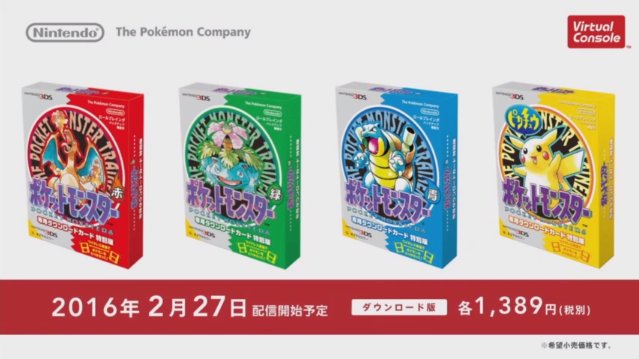
Splatoon updates? Good, now I'll continue to worship that game at a snail's pace. Star Fox Zero launches in April? Enough time for me to play through and review the first two games. Pokémon Red, Blue, and Yellow are launching on 3DS Virtual Console? Wait, what? Really?
So they are! And what's more, Japan's getting some retail boxed copies. I'd say not fair, but hey, they're finally coming out EVERYWHERE digitally! Many had long suspected the games'...uh, "complicated" coding would prevent such a thing, and here we are. I wonder if my old, treasured copy of Red still works properly...
By the way, I didn't know about what I'm about to show you below until just a few hours ago. How cool is this?!?
Apparently, this not only happened on Yellow when played on GBC, but for Red/Blue on the Super Game Boy! Sadly, Game Boy games on the VC don't display in their GBC/SGB versions, so the same effect probably won't be replicated...but I imagine it'll still be quite the nostalgia for many!
Anyway, that's all the time I have. Off to party in New York for a couple days, and then I'll get right back to work on my next review! See ya.