Okay, we're getting warmer: Mega Man 2's American boxart is no prize, but maligned as it is, I like to think it's not the catastrophe that was the original. Say what you will about inaccurate character design, but as they feature something resembling actual proportion, I think of it as a relative success in that patented 80's way of box arts fulfilling the template for our imaginations. This fantastic Eurogamer interview with artist Marc Erickson reveals it was a uncoordinated hodgepodge of circumstances -- a hapless art director's interpretation of Mega Man ("he's obviously shooting, so he must be using a pistol"), Erickson simply assuming the character was an actual man, and an overall lack of cooperation between the various Capcom branches in conserving the original character design. Simply put: let us not judge Erickson for simply doing his job.
Nay, we are here to judge Mega Man 2, otherwise known as one of the finest classics of the 8-bit era and what truly etched our Blue Bomber into gaming history. By the same token of the former, it's no stretch declaring it one of the NES's masterworks, and for my money, I consider it the system's finest third-party effort. When consideringhow many Mario knock-offs stumbled and fell in their ill-fated attempts to capture the golden goose, that it can stand arm-in-arm with the actual Marios and Kirby's Adventure is a miracle I cherish dearly. There's no slippery controls, no projectiles nonsensically thrown in arcs, no absurd difficulty for the sake of absurd difficulty -- it's just a damn good video game, one I'd dare even say reaches the vertigo of perfection.
Before I begin this review proper, I must confess there exist two factors that've always dumbfounded me regarding Super Mario Bros. 3, the NES game revered as the system's masterwork. Admittedly, one bears little on the game's quality in itself; mainly, the shock that its original Japanese release was a whole two years earlier in 1988 than its 1990 American release. Technically speaking, that's more so a year-and-a-half (Japan's October 23, 1988 to America's February 12, 1990 -- and that's to say nothing of Europe's August 29, 1991!), but the point is, I just think it's silly 1988 America was busy greeting a reassembled black sheep in Super Mario Bros. 2 while Japan was living it up with the Holy Grail of 8-Bit Gaming. As always with the medium, The Land of the Rising Sun really does have it good.
The other cause -- one immediately more relevant and, as evidenced by this Koji Kondo interview, has certainly confounded others -- is how I am never not baffled by the silent title screen. Anyone who's played the Super Mario All-Stars remake should certainly recall the jubilant ragtime remix of the classic Underwater Theme, perfectly accompanying the game's curtain-raising opening via choreography: the subdued drone introducing Mario and Luigi, the trumpeting eruption of delight greeting not only both the title and the theater's showers of enemies and power-ups, but our joy in playing one of the greatest 2D platformers ever crafted. A disorientation perhaps exclusive to those who played the SNES/GBA versions first (including yours truly), this aural absence unveils our first impressions of Super Mario Bros. 3 as a stunning retcon, its reduction to silent pantomime a bewildering relic.
To discuss these Nintendo progenitors is something of a difficult task: much as I adore the likes of Super Mario Bros. and The Legend of Zelda, for instance, they've certainly been outstripped not merely by modern standards but in their own successors. While Super Mario Bros.' immaculate design renders it just timeless enough to be accessible even to modern audiences, however, the same can't be said for The Legend of Zelda -- it certainly remains a masterpiece for those wishing to invest time into it, but barring one's possession of an NES Classic and its instant save states, its cycles of punishment and foraging fare quite poorly against the conveniences of today.
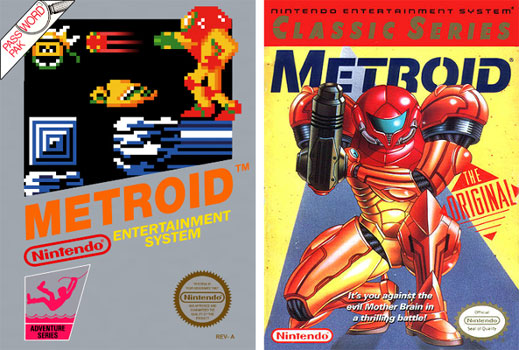
Much like The Legend of Zelda, Metroid is also often cited as an impenetrable classic -- the game is hard-as-nails difficult, thinking little to nothing of the player's morale. The overall "maze" design, while taking care to distinguish Planet Zebes's underground sectors from one another, does not establish the same philosophy with its room design and we're left with a homogeneous, indistinguishable look that's prone for disorientation. There are various reasons for this -- Metroid had a particularly
troubled development, for starters, and the game as we know it today
only came together in the final three months of development -- but let's be honest: it's not as if Metroid was the only 80's game that employed similar tactics, and I'd like to think the game still holds up regardless. Being a Nintendo historian, it's easier for fanboys like myself to overlook such flaws for the sake of research and personal amusement, and Samus Aran's first adventure is hardly an exception.
Not even one game later, and we've already arrived at Final Fantasy's infamous identity crisis. The game we are reviewing today is not the Final Fantasy II hailed as a SNES classic, but the Famicom's Final Fantasy II that released in 1988, never left Japan's shores, and is often cited as one of those experimental black sheep sequels that plagued the NES. For the moment, let us put aside the fact Western fans wouldn't experience the same frustration bestowed by Zelda II and Castlevania II until roughly a decade's time, and hone in on a more well-known source of frustration -- that, of course, being the name discrepancies exchanged among the first six Final Fantasys. With three Final Fantasy games -- Final Fantasy II, Final Fantasy III, and Final Fantasy V -- skipped over at release, Square had no choice but to dub their Western localizations of Final Fantasy IV and Final Fantasy VI as Final Fantasy II and III, respectively.
Needless to say, what resulted was an endless source of confusion regarding Square's retconning as they made their Western debuts via PlayStation, Game Boy Advance and DS incarnations, be they altered ports or elaborate remakes. And yet, in the case of Final Fantasy II, I cannot help but feel this was the correct decision: whereas Final Fantasy IV is a series masterpiece, II is certainly its retro nadir, filled with antagonistic design decisions that smother any goodwill it sought to bring. While hardly the worst JRPG, said decisions render it a slog of mediocrity as opposed to the prestigious, glorified adventure established from the very first game.
And now, to reiterate gaming's most famous switcheroo: what we know as Super Mario Bros. 2 in Western territories is not the actual Super Mario Bros. 2, which was deemed too difficult and too similar for foreign audiences. The solution: take an unrelated platformer (Yume Kōjō: Doki Doki Panic, a Fuji TV collaboration that originally featured an Arabian cast), repackage it with Mario characters, get Shigeru Miyamoto and co. to polish up the gameplay, and voila -- you have gaming's greatest magic trick. It wouldn't be until five years later with the remake collection that was Super Mario All-Stars that rumors and urban legends whispered about Western audiences, with internet inertia finally dawning what would place among Nintendo's most historic fun facts.
In other words, this is why Mario and the gang are suddenly throwing vegetables at bad guys rather than stomping them. Without this knowledge, it becomes all too easy to label Super Mario Bros. 2 as one of the many infamous "black sheep sequel" so dreaded on NES -- sequels in the vein of Zelda II: Adventure of Link, Castlevania II: Simon's Quest or even the Japan-only Final Fantasy II, all which were being divisive experiments that messed with their predecessor's formulas a tad too much -- but even knowing that, is it really the game's fault it doesn't live up to the Super Mario name? Adding to the confusion is how despite the Japanese version being called "Super Mario USA," Nintendo has been all too quick to brush Super Mario Bros. 2 under the rug and not only inducting this localized version into series canon, but has since referred to this game as the realSuper Mario Bros. 2 (as recently as being heavily referenced in Super Mario 3D World, in fact).
It's really hard for me to look at the above cover. While hardly problematic in itself, something about this localized box art for Dragon Quest II -- Dragon Warrior II in the States -- irks me more than the one for the first, which is mighty odd considering they both subscribe to the 80's style of realistic medieval fantasy. Could it be the exaggerated chest for the Princess of Moonbrooke, or that at this point I'm far, far too accustomed to Akira Toriyama's signature artwork for the series?
Ah, yes, that's more like it. And the answer is apparent as well: as much as the NES Dragon Warrior covers attempt to present the games as no-nonsense affairs, the goofy enemies obviously suggest a more tongue-in-cheek affair, and thus it's insanely difficult imagining the American art having any agency in our imaginations. Naturally, Toriyama's art is the way to go, so let us not tarry upon such incongruities.
Have you ever stopped to think about the name Final Fantasy? It's something so highly prestigious that the game would have to be as grand as the name implies--and make no mistake; for its time, it certainly was--but it hardly makes a lick of sense when regarding the actual context. The answer lies within its development: as developer Square was in the throes of near-bankruptcy, creator Hironobu Sakaguchi wanted a title that would not only close the book on the company, but on the seemingly-inevitable end of his game-making career.
As history would have it, that wasn't the case. Final Fantasy has since gone on to produce over 15 beloved titles (not to mention countless spin-offs and ports/remakes) and became the worldwide representation--perhaps even standard--for the Japanese RPG. The "Gil" currency, the famous victory fanfare and the Chocobo/Moogle mascots have become synonymous with the genre, and continue to be associated with the series to this day.
However, not all of the them debut in the series' first game, which is often cited alongside the original Dragon Quest as kickstarting JRPGs. There is a distinct difference between the two games, however: Dragon Quest is, more or less, a grindfest for its entire duration. Final Fantasy is not.
That's not to say there isn't any level-grinding within Square's debut RPG, but there's more of a leniency in its pacing. Over a year had passed since Dragon Quest, so it only makes sense they'd arrange for the necessary improvements. The interface is simpler and less clunky; no "stairs" button in sight. There's an active, ongoing story-arc that, while not deep, breaks free of the "save the princess!" model. Western RPG tropes are brought in to enhance the battle system, such as enemy weaknesses (fire beats ice, duh)
The end result is a game still approachable today. You will grind, but there's enough player conveniences and innovations to keep thing interesting. JRPG conventions like overworld vehicles got their start here, but they weren't just 80's visual stunners; the thrilling swiftness of the Airship is just as much of a marvel as it is an effective tool for speedy progress.
Yet what's perhaps most impressive is the Class System. As opposed to the Final Fantasy games of today, you create your four-man party out of six different classes (Warrior, Thief, Black Belt, Red Mage, White Mage and Black Mage), each with their own strengths and weaknesses. White Mages don't really engage in physical combat, for instance, but are invaluable for any team thanks to their healing magic.
It's a wonderful, flexible system that ensures no two playthroughs will be the same: that there's over 60 spells to master ensures a deep, flexible variety within each party member's moveset. Citing a personal example, I initially thought I made a mistake in choosing a Thief class as my 2nd physical class(Warrior was my first, main choice), as he died quickly and possessed the strength of a mewling kitten. It wasn't until his eventual promoted to a full-blown Ninja that his usefulness was discovered: not only could he actually deal damage, but Black Magic was now at his disposal, so he'd be able to back up my Black Mage.
Moreover, it's just fresh, which is saying a lot for a game that came out in 1987.Having been acquainted with set parties in JRPGs for such a long time, it's amazing to me a game celebrating its 30th anniversary can deliver such a customization experience. Right from the beginning, Final Fantasy encourages you to forge your adventures rather than the one explicitly set by the developers, and I find it rather special that uniqueness has only grown over the years.
The class system alone should render it accessible to most, but Final Fantasy's unusual magic system is what often drives today's players away. As opposed to the multi-digit Magic Points commonly found today, spells are deducted by a single-digit "charge" system. This renders their use in dungeons and the like incredibly precious; the only method of restoration are overworld-exclusive tents, so the balance between offense and defense is vital.
One's mileage will vary; personally, I adored it for the different sort of challenge it brought. Old JRPGs often involve being trapped in dungeons and the like, so this brings a different level of challenge in choosing your battles. There's always the option of running away, of course, but the frustrating JRPG penalty for escape failure (free damage courtesy of monsters!) is a constant, lurking risk, so you'll only want to pick that as a last resort.
Needless to say, Final Fantasy is pretty hard, but that doesn't mean it's not fun. The battle system itself mostly works; whereas Dragon Quest relied on imagination, Final Fantasy displays your party and all their spell-casting glory. This is especially vital since it highlights your chosen party members, so their eventual transformation when promoted feels like much more of an accomplishment. It's even great to see Square taking advantage regarding attention to detail, as your weapon visually changes every time you switch equipment. Like every other pre-SNES RPG, unfortunately, it does fall into the archaic lack of auto-target (as in, you'll miss an attack if the enemy's already defeated, as opposed to simply switching targets).
There are other flaws common in 80's JRPGS. For all the improvements upon Dragon Quest, Square didn't take the time to adjust NPC antics and not have them block doors and counters. An endearing flaw, yes, but not all a practical one. And yes, you will receive vague directions and be at the mercy of townspeople hints, so don't feel guilty about using an online guide like I did.
There are, however, no flaws in the score. Series composer Nobuo Uematsu made his big break as an industry icon thanks to Final Fantasy, and know we're in for something special when the 8-bit harp introduces the famous Prelude opening. Soon to grace the prologues of future Final Fantasy titles, it instills a deep mystique that successfully frames the games as the otherworldly fantasies they're intended be.
Meanwhile, the Overworld Theme takes on not a somber tune, but of an upbeat one emphasizing adventure. Fitting quite well within the familiarly cheesy 8-bit range of the NES, as grand as the aforementioned "somber" themes we'd see in later Final Fantasy titles are, I find this sort of brightness to be far more welcoming. You could argue it may undermine its' serious attempt to tell a story, but let us not pretend it is a deep story by any measure; what matters it motivates us to keep going in the face of random encounters, rather than discouraging us by feeling isolated and alone (which in itself would betray the concept of a multi-man party).
Not that any "undermining" takes place considering the presence of the battle theme; while also an exercise of activity, it's a more serious one that expertly remembers the 8-bit rule of being infectiously catchy. It instantly recalls the wickedness of the fiends and monsters we slay not merely in appearance, but their rage-inducing usage of Paralysis.
I've had the pleasure of completing three NES RPGs over the past two years (EarthBound Beginnings, Dragon Quest, and this), and out of that trio, Final Fantasy is probably the best. This is especially shocking to me given my intense love for the EarthBound (Mother) franchise, yet Final Fantasy is perhaps the best realized JRPG of the 80's. There's no awkward skips in the scenario nor an overt emphasis on endless grinding; it is competently paced, living up to every one of its grand ambitions alongside a rigid difficulty set to be tackled any which way by the player.
It's the class system that keeps it alive thirty years later. I know it's not the last Final Fantasy to use them, but there's a distinct appeal in the first entry employing such depth in its design. And with the number of remakes and ports out there, I have plenty of excuses to take another go and shake up my selection. Final Fantasy is the rare NES game that matches up to Nintendo's own efforts like The Legend of Zelda and Metroid not merely in quality, but in successfully still channeling that engaging sense of hugeness, an even rarer 80's value I cherish as evidence of fine craftsmanship. It is not the complete masterpiece I imagine its SNES and PS1 successors are claimed to be, but such an accomplishment renders it a timeless classic all the same.
Gaming before Super Mario Bros. was not exclusive to dark backdrops accompanied by blinding neon or an absence of jumping maneuvers, but they were certainly pervasive enough to define what we call the third generation of video games. Games had only begun to invent the likes of parallax scrolling and side-scrolling movement, but to one Shigeru Miyamoto, gaming began to settle a little too comfortably into dark screens and arena-based repetition.
While Nintendo was hardly exempt from these styles of games--look no further than the famous likes of Donkey Kong and Balloon Fight -- Miyamoto refused to be outdone by imitators encroaching upon what he envisioned as his pioneering work; that is, jumping games. His answer was to develop an ultimate swan song to the Japanese Famicom--about to be superseded by the Famicom Disk System-- by combining the philosophies behind Donkey Kong and Mario Bros. (jumping), Excitebike (side-scrolling), Balloon Fight (floating in the air; or in this case, the sea) and Devil World (control of a larger character).
What's ordinary and by-the-book today was set to be revolutionary in 1985: an open, side-scrolling game bursting with color and crossed land, air and sea. Us Americans probably wouldn't know it from the cover -- whereas the original Japanese box art (seen above) was illustrated by Miyamoto himself, the American release disguised its glorious setting via yet another black-themed package (its odd composition also became something of an in-joke: ever stop to think about how Mario's about to fall in lava?)
Perhaps it was for the best; I mean, who could've expected such an explosion of color with a cover like that? Even better, it merely frames how Super Mario Bros.'s innate design resonated immediately with the world at large. The presence of player empowerment and visual feedback is the very same design philosophy that illuminated proto-open world in The Legend of Zelda, or when 1996's Super Mario 64 stunned 2D veterans with the realization that, yes, you can climb that mountain in the distance.
Over thirty years later, Super Mario Bros. remains as much of a masterpiece. We've since seen its ideas improved and expanded upon by the likes of Super Mario Bros. 3, World, and the New Super Mario Bros. series, but its innate sense of pick-up-and-play still enchants newcomers to this day. It's all about the jumping, really; whereas arcade heavy-hitters like Donkey Kong and Mario Bros. may feel clunky today, it's amazing how Super Mario Bros. runs as fluid as it did back in 1985.
Look no further than level 1-1--the famous standard for all opening levels in gaming-- to see why. It's evident from the very first question block you see that Super Mario Bros. is a game that rewards via jumping: you will hit that block, because it's gold and shiny and everything attractive. Out pops a coin; you want more, but a stray Goomba is honing in on you. Jump over that guy (or stomp it flat!) and pop another block; out comes not a coin, but a mushroom, which is meticulously designed to reach you....yet it grants not death, but growth. You can jump higher, and can take one additional hit before reverting back to Small Mario.
Unlike the army of platforming clones that would follow after its release, jumping in Mario feels sublime not because it follows preordained path or is at the mercy of wonky physics, but because it takes everything from acceleration, momentum and weight into account. Jumping after holding the dash button, for example, will send Mario flying into an soaring arc. Tapping the jump button lightly will make him hop an inch. Observant players recognize a necessary balance: you know you won't succeed without the big jump, but you shouldn't use it all the time lest you careless fall into a bottomless pit.
Because the controls feel so perfect, experimentation is inevitable. The player's habit of jumping everywhere may unearth a hidden 1-Up Mushroom. Landing on a Koopa Troopa's shell bowls over enemies. Careful precision and timing with dashing/jumping will land Mario on the flagpole goalpost's very top (and, with very careful consideration to the timer, lead to bonus fireworks!). All of are varying difficulty, but Nintendo's subtle education for what's actually essential is vital. Just look at the block formations below: the first leads leads nowhere so players learn to dash and jump over its ilk, which prepares them for its fatal twin.
This isn't even getting into the other mechanics introduced via the first level: the Warp Pipe, which leads to underground coin-filled hideaways and let you skip half the level; the Fire Flower, which again transforms Mario, but this time into a fireball-spewing visage of orange; the Starman, which renders Mario invincible and demolishes any enemy that dares touch him (not to the mention introducing the famous samba theme).
And underneath all that lies the ultimate question: how do I utilize all this? Will diving underground and skipping half the level just to nab coins really lead to the most points? Will grabbing the Starman interfere with my Koopa Shell-kickin' skills? How do I trigger the fireworks at the end of the level via flagpole? Why not ignore the Super Mushroom and play through the entire level as Small Mario for a challenge? Or, heck, why not the whole game?
Now, such freedom in play and player choice are hardly unique to Super Mario Bros. itself: the likes of open-world games, fighters, shooters, horror survival, life simulators, and strategy games all possesses their unique traits of flexibility and the like. But how many of those are accessible as just running and jumping? What renders Super Mario Bros. so special is its accessibility, and that the first level is this inviting is no coincidence: it was one of the very last made in development, constructed with all the knowledge obtained throughout development.
It's a seamless transition from discovery to play, as echoed in 1-2 (the first Underground Level), yet another captivating case of flexibility via the importance of brick-breaking. We already learned that bricks were breakable via Super Mario's jumps, but now here's a level essentially composed of bricks hiding coins, 1-Up Mushrooms, and even shortcuts leading to the Warp Zone. But moderation is key here; smashing bricks may be fun, but with the timer ticking down, you shouldn't dawdle for long.
And from there it becomes more of a subtle tutorial. Floating, interconnected platforms that respond to your weight are initially placed over towering cliffs, but eventually suspend over no landing points. Castles are armed with spinning firebars that gradually grow in size, complete with perilous mazes. Bullet Bill Cannons are visually introduced before they learn to fire off-screen, the first Hammer Bros. strategically hop up and down from floating brick blocks (could that be used to our advantage?), and yes, it's possible to knock out Lakitu from his cloud the moment he's spotted.
Note how many of the above involve enemies. What's beautiful about Super Mario Bros.'s cast of minions is how they aren't merely obstacles to be dodged, but tools for success. Koopa Troopas and their shells are a favorite secret weapon, but how about stomping on Goombas propelling us to greater heights? Could other enemies be used the same way? And who's to say Bowser's invulnerable to fireballs?
How we tackle all this is up to us. Miyamoto once described as Super Mario Bros. eventually becoming "our game": as muscle memory settles in, we opt for the best routes available for us. We
grow the courage to try new things; accordingly, the game becomes comfortable enough to throw new surprises once the shock of the first level wears off, and so it becomes an engaging learning process for the game's duration.
Easy to learn, hard to master: the creed of difficulty that defines the best of games. As it's an 80's game, it should come as no surprise that Super Mario Bros. is rather tough. The game's experimentation and discovery arises as a response to the game's difficulty, which can't be surmounted easily. There's the underwater levels with bastard Bloopers, for instance, and whereas there is a way to rid of them and their Cheep Cheep cohorts (a certain power-up, perhaps?), that you're at the mercy of swimming physics not only restricts your movement options, but renders Mario all the more vulnerable to losing his only means of defense. Hammer Bros. and the castle mazes are also beatable nightmares, yet they, too, will likely give players a thrashing before a solid, formulated strategy is developed.
But that's okay, because Koji Kondo's music keeps us coming back for more. Perhaps the first famous songs in gaming, Kondo was conscious of the limited sound options for the Famicom/NES--only five channels!--and labored over songs that wouldn't irritate the player. Such songs would not be action-packed techno, but instead colorful songs that would encourage the player and never grow old.
And what gaming song is more immortal than the Main Theme (less commonly known as the Ground Theme)? Infectious from the very first 8-bit note, the Latin-based theme conveys an instinctive rhythm that can't be anything but an explosion of exuberant, light-hearted activity. That it never wracks on our nerves is vital: we're driven to action immediately after Game Over.
But why exactly is that? Perhaps the secret lies in how Kondo actually based the song on Mario's movement. Through the rhythm of player control, the music is the ultimate mastermind behind our enjoyment. From the moment Super Mario Bros. starts, it becomes a song that sets into your bones.
In contrast, the Underground Theme doesn't inspire the same sense of wonder, but its short repetition and comparatively muted nature belies an instant earworm. (That, and, well, it's not as if a dreary underground is supposed to sound all that lively, anyway) While future iterations would install percussion-filled back-beats and the like, the original steady beat hollowed by silent intervals is somehow just as fun to hum along as its jolly counterparts.
Jolly as in the lovely Underwater Theme above. A wondrous waltz that, while perhaps betraying the treacherous waters which it accompanies, frame Mario's underwater movement as if echoing an actual dance. It too channels its Ground Theme counterpart in how they instill that very same player-moving rhythm.
All this grants it an all-too vital identity: that everything is fun. Obviously, this is not to say that previous arcade/video game efforts weren't such, Super Mario Bros. ups the ante by having "fun" be the theme of everything in it. Even putting the controls and gameplay aside, the colors and setting are fun to watch and absorb. The scenario of two plumbers rescuing a princess and her entourage of mushroom-capped retainers from evil turtles is as delightful as it is bizarre. The music is meticulously crafted to keep us engaged and hum along.
There's a reason why Super Mario Bros. saved the industry from the market
crash: it's a game about inviting people. There's no barriers: only a prevailing sense of "I can do it, too," that can be applied any which way you want. Yes, it's challenging, but it possesses a power that makes you want to try one more time. That
it would introduce the world to the denizens and world of the Mushroom
Kingdom is only secondary to its revolution of bringing people back into the world
of gaming.
Even now, I still feel bound to my own direction of playing it. I only grab the first Starman if I time the first Koopa Shell kick just right. The secret coins and 1-Ups in the first underground level are never missed. I never bother with the Warp Zones, choosing to instead gradually accumulate all the coins and 1-Ups coming my way. I still roar in exhilaration as I plow through my favorite level: 2-3, where Mario dashes across a series of bridges while avoiding leaping Cheep Cheeps.
I've only beaten Super Mario Bros. twice in my lifetime, but in all the countless attempts I've made to do so, I've more or less tackled it the same exact way. Perhaps it's time for a change? Even now, when I skip by it on the NES Classic Mini menu, I think to myself, "maybe I can." If only I had the time, I say, but I still hear it calling.
Like its NES counterpart The Legend of Zelda, that I can still find new ways to play more than thirty years after release is nothing less than sheer wizardry. What makes Super Mario Bros. gaming's most well-known masterpiece is not merely for what it defined, not merely because it revived the industry: it's because even after this time, we can still approach it and go, "I can do that."
Yet again we're faced with another NES box art malady. While the box art for Dragon Warrior is hardly as offensive as Mega Man's, it submitted to the all-too-common illusion of making the game seem "cooler" than it actually was (which, to be fair, was present in Japan as well). Whereas the American cover portrays a generic medieval fantasy, the Japanese artwork portrays a more colorful, light-hearted affair.
As it should; after all, it was done by none other than Dragon Ball's Akira Toriyama, whose 80's trademarks of cute, squat protagonists and fleshy, rotund beasts would set the tone for the series (it's no coincidence the dragon is cuddlier than your average Final Fantasy monster: the same would echo across the game's variety of enemies, not the least of which is the famous Slime).
And note the difference in name, too: Dragon Quest became Dragon Warrior for US release. The cause may not be as immediately apparent as that of Rock Man to Mega Man, as a pen-and-paper RPG of the same name held the "Dragon Quest" name. The word "Warrior" also undoubtedly appealed to American boys more than "Quest," and so the series was dubbed as such here until 2005's Dragon Quest VIII.
Just as it does with box art, Leave Luck to Heaven represents games with their American names whenever possible. But as developer Enix (or should I say Square-Enix?) went to the trouble of retconning the Dragon Warrior name,so shall I for the reviews.
At any rate, it's well-known Dragon Quest became a phenomenon in Japan, providing the building blocks for Japanese RPGs: medieval worlds of fantasy, spells obtained upon leveling up, and a hero whose name is up to the player. Such success was not repeated in America, as its late release paved the way for its niche status over here. A 1986 RPG revolving around antiquated menus/commands would hardly light sales-charts in 1989, and while a Nintendo Power subscribergiveaway proved successful, said giveaway was initiated only to empty unsold stock.
Unfortunate, but at least we got an improved product out of it. Much of it boiled down to player convenience; for instance, no longer did the save system rely on tedious passwords, but a battery-pack save. The Famicom menu was far too cumbersome in that you had to choose the direction of the Talk command, but here it's just a simple selection. Even the graphics were adjusted across the board, as NPCs and even the hero himself are now applied directional animations. (Speaking of which, I highly recommend clicking here to witness the Japanese version's unintentional hilarity courtesy of the hero's groovin' trot. Nothing quite like 80's cringe!)
It was an ambitious undertaking directed by none other than the late Satoru Iwata, then a programming prodigy steadily rising within the ranks of HAL Laboratory. As the game that more or less forged what we know today as "JRPGs," playing Dragon Quest was something of a moving experience: to know a part of his legacy was being responsible for bringing what essentially jump-started an entire genre to our shores--and on top of all that, improving it--awakened a melancholic blend of gratitude on more than one occasion.
Alas, it's not enough to salvage the game from old age. It's vital to dispel any claims of mediocrity: Iwata's tweaks ensure Dragon Quest functions okay in a modern age, but an 80's menu-based RPG has much more going against it than the timeless likes of space-shooters and precision-based platformers.
Really, it's crazy just how much of this has to do with the game's overall pacing. There's not a whole lot of meat to Dragon Quest's campaign,so it relies on being one big grindfest from beginning to end. It's not an exaggeration to say over 80% of one's time will be spent fighting monsters, accumulating EXP and leveling up rather than embarking on swashbuckling adventures. Needless to say, tedium can settle rather quickly.
Other trappings of its age are hit or miss -- like other open-ended 80's games, the world of Alefgard is far from linear and expects players to follow vague NPC hints for progression; naturally, this results in players getting lost, and the frustration of unrelenting (not to mention random!) enemy encounters might discourage exploration. Thankfully, Alefgard isn't particularly big in comparison to future 8-bit RPGs (namely its NES sequels and the Final Fantasy games), so it's easy to memorize the lay of the land.
On the other hand, there's just no getting around the clunky menus. At best, they are what they are: an outdated element that falls into every 80's menu trap (can you say, no item stacking? Limited inventory space?), and yet Dragon Quest's execution is particularly archaic. Using commands to talk and search is clumsy enough, but for there to be one for using stairs?
There's other minor annoyances: for one thing, having NPC villagers walk around towns is a novel 8-bit touch, but it's not so "novel" when they decide to block exits and store counters. This is something hardly exclusive to Dragon Quest, mind you; after all, it's another piece of retro baggage, yet I still found myself shaking my fist at those who dared blocked my inn stops. ("I'm only at 5 HP, dammit! I'm gonna die!")
It's a good thing then that the game's world is so charming. Dragon Quest's localization took the liberty of injecting the script with Elizabethan-styled dialogue, with characters speaking like "Take now whatever thou may find in these treasure chests to aide thee in thy quest" or "Thou hast been promoted to the next level." Before playing, I was immediately apprehensive: wouldn't such an embellishment smother the script with stuffy language, particularly since Dragon Quest games are known for their witty dialogue?
I was surprised to witness that wasn't actually the case. Not only was the script relatively free of errors (a rarity in an era ripe of mistranslations and typos), but such a direction was rather fresh compared to the the dry, passive scripts commonly found in localized RPGs of the time. It's still a direction cheesy enough that I wouldn't want touching a modern localization, but within the context of those equally-cheesy 80's, it somehow fits like a glove.
Speaking of localization, most of the aforementioned graphic changes are for the best; truth be told, not only do the new sprites hue closer to the round, squishy citizens commonly found in 8-bit RPGs, but the Japanese version's NPCs look like what an ill-fated Americanized version would attempt to render it "cooler".
Really, the only aesthetic misstep is the infinitely bland title screen, which doesn't have a patch on iconic Japanese logo. Just look at all that wasted gray space!
But no amount of box art or title screen changes can stop Akira Toriyama's art from shining through. While mainly reserved for the monster designs, creatures like the Slime, Drake and the tongue-protruding, witch hat- wearing Ghost instantly captivate our hearts, whereas we immediately want nothing to do with the Axe Knights, Golems and Werewolves that cross our paths. Not that the hero should underestimate every cute enemy he comes across, mind, but Toriyama's design ensures the enemy hierarchy of power is instantly apparent.
Such moments even extent to the simple story: the rescue of Princess Gwaelin triggers an "aww" moment of the most triumphant kind -- the hero's overworld sprite carrying the princess bridal-style back to her castle. Director Yuji Horii's first attempt at an "emotionally involved" system might be rather barebones today, but that it elicits such emotions thirty years later speaks of fine craftsmenship.
And let's not forget the music by the legendary Kochi Sugiyama which...which...look, I'm sorry, but I can't avoid the elephant in the room. As much as Mr. Sugiyama is a talented composer, as much as he's contributed to the success and awareness of video game music, he's also kind of a terrible human being. Yes, the very first champion of game music is not just a history revisionist; he's a hardcore nationalist who regularly funds and participates in organizations that fuel such conspiracies.
Having grown up with Dragon Warrior Monsters and only just recently diving into the main series, this was immensely disappointing to learn. That his politics are removed from what is ultimately a playful, light-hearted series is a blessing we can all be thankful for, but knowing that his Dragon Quest proceeds go directly to history-revisionist foundations that suppress elderly rape survivors does not weigh easily on my conscience. While I will continue applauding his efforts in future Dragon Quest reviews, I won't be so neglectful in mentioning his misdeeds.
But since I've already called it out, what is effective about Dragon Quest's score? There's simply no going about reviewing Dragon Quest music without diving into the main theme, which makes its first appearance here. A bright, celebratory march that greets us at the title screen, we're up and ready to enter the game's world upon the first note.
Naturally, Sugiyama's legacy as a classical conductor dwells within every one of his compositions, but it's most apparent in the above battle theme. Creeping and slow, it recalls to mind that of a stalking menace lurking behind us. Just look at how well it translates into orchestra!
The cave theme also engages in, to my knowledge, one of the earlier experimental themes for NES/Famicom. Ignore how the above video is probably two minutes too long and click on the playlist button; see how there's eight different versions? In the game's final dungeon, the song gradually lowers in tempo as you descend deeper and deeper, echoing the apprehension before taking on the Dragonlord. How's that for scaring your pants off?
But as iconic as the main theme is, my favorite track lies in the overworld theme: Unknown World. As Dragon Quest highlights a solitary journey, it's only fitting that its world echoes a theme of loneliness. Laced with uncertainty, that we're left to discover what the game's world holds makes for a palpable effect.
Much like the game itself, actually. While not without its mishaps, Dragon Quest braved new waters for the sake of one goal: to distill the complicated RPG genre for a widespread audience. This could not just be done by simplifying the system; with Dragon Quest's hero being tied to the player's identity, we become invested easily, and so we're willing to leap over any hurdles involving clunky menus and uncertain progression.
Such an admirable achievement became the ever-improved fabric of the series going forward, but its heart still beats within its first effort. It's a relic, but a functioning relic: its age doesn't stop it from being accessible, and that alone makes a quest worth embarking on.
I'm sorry, I know the hilarious travesty of Mega Man's American box art is probably the most infamous example of packaging in video game history, but Leave Luck to Heaven represents games with NA covers whenever possible, right down to the "Angry Kirby" nonsense. Even so, just look at the contemptible thing: the indistinguishable geography, the structural disaster that is the building on the left (what's with the stairs? The random stone well?), and last but certainly not least, the mess of proportions, colors and physicality that is Mega Man himself. It's the prime example of 80's game boxarts attempting to make their respective games look way more badass than they actually were, and with how Mega Man underperformed in sales, it backfired miserably here. For shame, Capcom!
Not that Japan wasn't guilty of the same practice, you understand, but its respective cover for Mega Man--I'm sorry, Rock Man--was far more in-line with the game's aesthetic: the plush, wide-eyed animation style commonly found in 80's anime. It's clear from the very moment one lays eyes on the select screen line-up of Robot Masters that this isn't a game meant to channel any sort of realism, but the more light-hearted antics of Super Mario Bros. and Pac-Man.
Could it also be said that Mega Man matches the quality of those classics? Capcom's Mega Man games are only challenged by Konami's Castlevania in how they are the most celebrated NES action titles not associated with the Nintendo name, and that's being fairly generous considering Mega Man himself is a more recognizable 8-bit icon than Simon Belmont, what with his blinking doe eyes and squat one-inch stature. Yes, they are classics, although to what extent is debatable considering how much Capcom unabashedly milked the games (of the original series' ten entries, six are on NES).
Many agree the first three are the cream of the NES crop, and I'm included in their ranks. It's funny how all six games are homogenized around the same gameplay and aesthetics, yet it's those first three games that stick in everyone's memory. In this sense, the original we're reviewing today is a curious delight -- to my mind, it doesn't reach the heights of Mega Man 2 (the series masterpiece) or Mega Man 3 (the runner-up), yet it's such a genuinely strong first effort that I consider it a near-crime the former overshadowed its place in gaming history.
Forging the design that would soldier on in countless sequels and spin-offs, Mega Man revolves around six levels that culminate into their respective "Robot Master" bosses. Each is defined by a singular trait (Fire Man, for example, wielding the power of, well, fire) that also houses a weakness. as defeating any one Robot Master absorbs their power into Mega Man's own (which lets player experiment with Robot Master weaknesses). Each Robot Master can be tackled in any order, and once all are defeated, you head to the castle of dastardly Dr. Wily to halt his evil schemes.
Needless to say, it's a non-linear action take on rock-paper-scissors. As opposed to the physics-bound goofiness of Super Mario Bros., Mega Man relies on a level of strategy and planning not commonly found in action platformers. While thankfully this doesn't seep into the actual gameplay, it allows for nearly every run as divergent as you want it to be; for instance, do you proceed in the order of Robot Master weaknesses, or just go about any which route you wish?
As mentioned earlier, this level progression system hardly renders the original unique in retrospect, but its superiority lies in that very same retrospection. Yes, it lacks the fanciful features including Rush the robot dog and the Mega Buster and the like, but that it's forged only around three mechanics --Mega Man's arm cannon, the Robot Master abilities and good ol' fashioned jumping--ensures it's not bloated with unnecessarily flashy features, instead relying on pure grit to overcome its trials.
Which means that as fun as it is shoot things, it's also undeniably difficult. Like any other 8-bit action game, Mega Man is actively punishing in its damage-sponge robots, leaps of faith, touch of death hazards (watch out for spikes!) and grueling boss patterns. The Robot Masters in particular give Super Mario Bros. games a run for their money in that their toughness matches the rest of the level, and even memorizing their attack patterns and weaknesses won't ensure you'll make it out alive (as seen with the countless close shaves endured with Ice Man).
Could it perhaps be too difficult? Some Robot Master weaknesses aren't very apparent, so the game has to rely on certain context clues within the levels; for example, Cut Man is weak to Guts Man's Super Arm, used to pick up heavy blocks littered across the former's stage and boss room. There is some decent balance across the board, my favorite example being how anyone can memorize Ice Man's disappearing rock platforms with some careful observation.
It falls apart in other places; the game's non-linearity comes to a halt with Elec Man, who hides the vital Magnet Beam necessary for Wily's Castle. This tool can only be uncovered with the aforementioned Super Arm, and this only becomes apparent more than halfway through the level. Mega Man simply isn't the game for this kind of foreshadowing, and with the Magnet Beam being the only way to fully circumvent certain obstacles (such as Ice Man's flying Foot Holders, which by themselves are a tad too random in their placement and tend to frustrate with their mid-air laser blasting), it's a problem.
By and large though, there's hardly any missteps in foe placement and the like; in fact, the game takes steps for the player to navigate around the stage's intricacies. Take the spiky Gabyoalls (try saying that three times fast!), which patrol about on platforms and attempt to shove off Mega Man when he intrudes upon their territory. They rank among the game's most annoying enemies, but they're momentarily paralyzed by a single shot, so they're easily neutralized.
And if you have the Rolling Cutter, all the better: they're destroyed immediately. The fun of Mega Man lies in its replayability and figuring out how the game works. While the Elec Man/Magnet Beam thing limits the potential for experimentation, it's impressive how many quirks and enemy weaknesses can be perceived and utilized through the Robot Master powers. This is further perfected in Mega Man 2 and 3, but that the first title can be this experimental in spite of its flaws is worth noting.
All the better that it's so pleasing to look at. As mentioned previously, the graphics are overtly clean with a bright aesthetic. It's as much of a sci-fi adventure as it is the home of a Saturday Morning Cartoon; not too goofy, but with enough light-heartedness to win anyone over with the likes of beady-eyed blue robots and flying robot penguins.
Hammering this balance down is the wondrous music by Manami Matsumae, which is the perfect complement for such a world. Level themes dip into either motif in accordance to not merely the Robot Masters involved, but the overall motif for their respective stages. With the Cut Man Stage often being the first stage players tackle, it's only natural its theme would thrust us into action. Like the majority of the soundtrack, it's 8-bit catchiness at its finest.
On the other side of the spectrum lies the Elec Man Stage music. Apparently designed with electricity in mind, it's another song that accompanies not the character, but of the level itself. The stage is constructed vertically, with tricky ladders, vigilant Gabyoalls and electric currents seeking to knock you down. The ensuing frustration is only natural, so an upbeat theme is necessary for encouragement.
None of which we find in Wily's Castle. For the record, this is not the beloved action masterpiece found in Mega Man 2, and yet I consider this a distinctive runner-up. Ominous and foreboding, it compels us further down Wily's lair and overcome his traps one by one. Only the Guts Man Stage rivals this theme in their apprehension, which are executed not with darkness but a building degree of menace.
Any and all praising of Mega Man's sound design typically revolves around the music--and deservedly so!--but there is one sound effect I must elaborate upon. Every time Mega Man lands after jumping, a distinguished "plink!" noise always greets his impact. It is absolutely, unabashedly sci-fi; the one detail that defines Mega Man's character as a robot. That we, as the players, are the ones initiating the sound further links us into the game, and furthermore its world. Being a recurring theme throughout the series, I can't help but imagine it as the primary source of Mega Man nostalgia.
Mega Man is not a clumsy, forgotten progenitor, but is instead the treasured 8-bit example of how to initiate a long-running series. It stumbles into traps common of the era, but they're never anything fatal; not anything to the extent of how Capcom dragged the series into tedium, anyway. It's an overtly-solid action game that entertains with its creative non-linearity and thrills with its engaging Wily Castle set pieces/big boss sequences, all foreshadowing what was to come with its famous sequel.
Origin: EarthBound Beginnings (Mother) Plays In: Mt. Itoi Cabin Status: Original Composition Composed by: Hirokazu "Hip" Tanaka/Keiichi Suzuki
Over the past several years, I've gradually decided that I want to be a hermit. I'd live in the mountain country home I've always dreamed of, surrounded by trees, fields and mountains that stimulate my inner nostalgia. Walks within forests and alongside mountain roads will be my zen, blue skies and dew-adorned flowers providing endless wonder. It would be a paradise all to my own (barring the company of some cats, naturally).
But why isolate myself? Have my social anxieties and insecurities reached their limit? Is it because I have Asperger's? Sensory issues? Indeed, they're all very likely answers, but I wonder if the more suspicious might believe I'm running away from something; safeguarding myself from a potential trauma, if you will.
In that case, is it because I'm afraid to be hurt by love?
Maybe it's because I realize my dream of young love will never come true.
I have never once dated in my life. After my court jester persona simultaneously ruined my reputation and forced me into seclusion during my grade school years, I never once entertained the idea of dating any of the individuals that helped ruin my social life. Opportunities never sprang in college, either, as I was much too focused in achieving my goals.
Deep down, though, I think I was still wishing for my dream to come true. It was one I secretly cherished for ten years, one centered around an individual I believed understood me more than anyone else. She was the epitome of young love: laughter abound, a never-ending plethora of inside jokes and memories reminisced in warmth, the golden scent of hair, and in possession of the the world's most headspinning smile.
It was an impossible dream, for she never felt the same way. I was just "the friend." But I never stopped dreaming. When I was sailing the high seas of Zelda: The Wind Waker, she and I built a life together on a tropical island. When I was an awkward teenager and endlessly reading video game fanfiction, I'd insert ourselves as the romantic leads. She was my Kairi, my Tetra, my Colette Brunel. Even when I thought I didn't love her, dreams of my mountain abode had her waiting for me at the doorstep.
As they say, however, love is cruel. The dream shattered in a million pieces as we reached twenty, when she began prizing drama and attention above all else. People found themselves being cut out of her life...repeatedly. Being "the friend," I was always the first to get the boot, watching helplessly as the breadth between us grew wider and wider. My own thoughts and feelings become inconsequential, a decade of memories and friendship rendered irrelevant as I soon found myself with nothing but a broken heart and tarnished memories.
It's so easy to say, "I will never fall in love again." It's a mantra I've repeated over the past year and a half, one that has only induced confusion and disbelief from those who've heard it. I do not wish to love because it's so scary to me. For every fairy tale romance that I personally witness, I can cite five more involving closed Facebook accounts, dramatic runaways and abusive relationships. The prospect of investing years into someone else only to end with heartbreak is pointless and far too risky for me.
It's wrong to stereotype, I know, especially after having dealt with the most selfish drama queen on the planet. But when you've invested ten years of unrequited love only to be betrayed not as a romantic partner but as a best friend, it does something to your ego. Any and all conceptions of romance are ruined for you I do not see the point in any of it. I do not understand why people constantly shut out their friends over ill-fated romantic pursuits, and I do not understand why age-gap relationships are a thing, and I do not understand why some establish cruel hierarchies of power and control to foster distorted notions of love.
It's all incredibly judgmental of me to say, as even the question of "why do people stay in abusive relationships?" often crosses my mind. If my decision to become a hermit hadn't already shown it, such statements prove that even I, too, am selfish. They're born from fear that I'll repeat my mistakes, and anger that things didn't go my way. The maelstrom of insecurities born from Asperger's, sensory issues and previous social encounters gone wrong seem to only cement the deal...
But, say, if I were ever to move on from all that, and I were to love again, who would it be with? Deep down, I already know the answer. It would be with someone who respects me, someone who does not judge me based on my background, but instead understands it and always supports me. Our thoughts and feelings are, respectively, of the utmost importance to each other.
Such a love would prove that the boons from young love are not exclusive. It'll flutter and waltz with grace and passion, just as when Ana asked Ninten to dance with her. It will not be something I will purposely seek out, but it's a path I'm gradually beginning to accept and possibly open. Maybe sooner than I think.
Final Thoughts: ...is the first time I've ever elaborated on this subject at length on here? It's why experimenting with this column is so fun.
I never get the chance to speak about my favorite Nintendo franchise on here, do I? What a shame. An even bigger shame is that I never actually played the first game all the way through until the Wii U release, yikes!
Anyway, I wrote a tribute to it via Nintendojo. As for the blog's version of the review...hmm, let's say December?
Plays In: Title Screen, Balloon Trip mode, Bonus Round
Status: Original Composition
Composer: Hirokazu "Hip" Tanaka
There are those out there who say that we shouldn't mourn Iwata's death through tears, but through the joy we channel from the games he brought to life. Today, I'll be doing just that with this song.
When I revisited Balloon Fight the other night, I was struck by how good it feels all these years later. As according to the game's balloon motif, the controls are floaty, but feels so naturally light and speedy that they never get in the player's way at all. Like any good Nintendo action game, any error is entirely on the fault of the player. Indeed, the controls are so good that even Super Mario Bros. itself took a lesson or two from it.
All thanks to Iwata's programming mastery, of course. It was also thanks to Iwata that I was even playing it at all that night; after all, if it weren't were his generosity following the 3DS price drop, I wouldn't be playing the ambassador version on my 3DS. I find that the system's ergonomics suit the game quite well, and should a modern sequel ever be made, I thoroughly demand it be on that system.
I think the man even played a practical joke on me that same night. For those who haven't played the game, everyone's worst nightmare revolves around the stray bolts of lightning that sometimes zap out of the occasional storm cloud. I'd knocked down an enemy fighter and was about to pursue, but then got caught from behind from another fighter. The instant I spawned on the ground, one of the lightning bolts zapped my character and I lost yet another life. All the while, the bird-masked fighter I knocked down earlier was chilling nearby. It was as if Iwata was saying "Stop crying! Laugh again!'
But Balloon Fight's greatness can't be solely attributed to Iwata. Indeed, the song you're listening to was composed by none other than Hirokazu "Hip" Tanaka. Balloon Trip is absolutely the goofiest classic on Nintendo's NES catalog of music, perhaps losing only in the "feel-good" category to the Super Mario Bros. theme and the entirety of Kirby's Adventure. But make no mistake: it's just as infectious as the former and will permanently remain an earworm.
Tanaka himself seems quite fond of the song. Above is his spectacular arrangement for the latest Smash Bros. games, designed particularly for the 3DS version's Balloon Fight stage. Easily one of the finest remixes in the new games, Tanaka's chiptune direction fully retains the original's spirit (that climax!) If you listen closely, you can hear traces of the game's other songs mixed subtly within.
And here is a version Tanaka created shortly after Iwata's passing. It's a tad more composed, but the mixture of techno and chiptune let it come alive as a beautiful tribute. It was hard to listen to upon its arrival, but now that the news has sunk in, it's become far more cathartic. I can just feel the nostalgia in the air.
I wonder how high Iwata's flying up there.
Final Thoughts: I demand an orchestral version. We had a great slow-paced version within one of Smashing...Live's medleys, but I'd love a dedicated suite. What a wonderful tribute that would be.
Origin: Super Mario Bros. 3
Plays In: Underwater sections
Status: Composition
Composer: Koji Kondo
Yet another water theme! Can't blame me for this one; those areas are treasure troves for quality game music.
Anyway, this song is particularly interesting in that it's somewhat emblematic of a certain experience I've been chugging through lately. See, I've been playing the 2D Super Mario games in the past half year and one question--well, okay, questions revolving around a certain subject--keeps prodding at the back of my mind: how superior or inferior are these classics to their respective remakes in the beloved SNES compilation Super Mario All-Stars? How are the backgrounds, the character sprite animation? Is the color palette more effective here or there? Is this particular song more catchy in the 16-bit era or is it better left off in the chiptune 8-bit era? I keep playing and judging, unable to stop myself from mentally sifting through my memory banks of my ancient Mario-All Stars playthroughs. What is better? What is worse?
As is implied and will become very evident in an upcoming Kirby Reverie, I'm very harsh and analytical when it comes to Nintendo remakes and their original. It all began some ten years back (wow!) when I was giddily anticipating the release of Super Mario 64 DS, only to find myself disappointed at the numerous changes within (despite the coolness of the new characters). That disappointment eventually morphed into a rigorous habit of studying Nintendo remakes and their numerous upgrades/downgrades, and I've found it rather scary as to what can turn me off.
So imagine my surprise when I downloaded Super Mario Bros. 3 on the Virtual Console one day and was kinda...sorta..stunned at how it was not the All-Stars version I grew up with on the SNES and GBA. I'm serious! I was playing an old-school Mario and couldn't have any fun at all because I was constantly comparing it to a remake! Holy cow, was that really the original Airship Theme? What the heck's up with Fire Mario being drenched in orange paint? Good god, what was that hideous graphical glitch constantly buzzing at the side of the screen?
Even with my current playthrough today, the struggle is very much real. Bear in mind that, yes, I still recognize the game's an all-time masterpiece and am able to have a jolly ol' time playing it while having various South Park episodes play in the background, but boy can I have trouble accepting this isn't the SMB3 from my childhood. In particular, those scrolling visual glitches I mentioned earlier still kinda piss me off. Apparently they have something to do with the memory for backgrounds and weren't too noticeable on the TVs of yesteryear. I guess Nintendo lacked foresight on this since it's plain as day on my flat-screen TV.
But there's one thing that never fails to not piss me off: this lovely piece of yet another underwaltz waltz. Despite being heard by at least twenty million people, Super Mario Bros. 3's Underwater Theme is often neglected in favor of the original one from the, well, original Super Mario Bros. I don't necessarily have a problem with this seeing as how iconic that game is, but I'd be lying if I said I preferred it to this. Probably what I love most about it is how unlike practically everything else in Super Mario Bros. 3, it sounds nearly identical to its SNES counterpart. Seriously, have a listen!
Okay, I'm bullshitting you; it's just another hopeless case of selective hearing. Yet this is still one of the very few exceptions within SMB3 where I get the same exact vibe I did in the SNES/GBA versions. I'm still there, in 1988 or 1990 or 1993 or wherever at the turn of the decade, when The Simpsons was plowing through pop culture and the Teenage Mutant Ninja Turtles are capturing the imaginations of children everywhere and my parents have just gotten married and I'm starting to walk. I'm there in Super Mario Bros. 3's aqueducts, tubes and warp pipes witnessing all this happening in a colorful collage of the past. It's the past I cherished to learn about, the ones my family and people I never knew cherished to have a part of their lives. I speed along as the water pressure pushes me away, feeling the rush of past and present join together.
This is an obscure Mario song--which is pretty mindblowing considering it's one of the most famous Mario games--but its for its obscurity that I love it. It's a SMB3 element that was almost never referenced in the countless Super Mario games and spin-offs that followed (save for a brief Super Paper Mario reappearance), and so it's isolated. Out of place, alone. But it's still a piece attached to a world-famous work beloved and cherished by many. I, too, can feel alienated and alone, yet I remember I am a vital component of so many peoples' lives. I am connected.
So long as I can keep swimming, I can go forward with the love and burden the past provides with the exciting future held for me.
Final Thoughts: man this game is hard as balls though