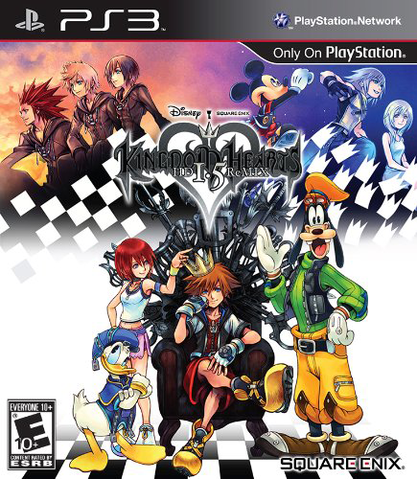
Disclaimer: This article serves as the "main" reviews for Kingdom Hearts II Final Mix and Kingdom Hearts: Birth by Sleep Final Mix, as I possess no interest in importing the original versions.
Now, here's something certainly more bang for your buck: two Final Mixes in one collection. Sure, there's a rancid movie adaption included, but why complain when there's two Holy Grails finally localized into English? To say Kingdom Hearts 2.5 HD ReMIX -- the second of the three Kingdom Hearts collections we're reviewing -- chronologically focuses on the post-Kingdom Hearts portion of the saga would be a tad misleading considering the presence of prequel Birth by Sleep, but it's not like 358/2 Days -- a game requiring intimate knowledge of Kingdom Hearts II -- being present in the first collection made much sense either. As we've elaborated countless times, no one really knows what goes on with this series, so let's just roll with it.
So anyway: Kingdom Hearts II Final Mix, Birth by Sleep Final Mix, and a movie adaption of Kingdom Hearts Re:Coded. For the moment, let us pretend that last one doesn't exist, and observe the majesty previously denied to us Westerners. True, dedicated PSP owners may've circumvented the handheld's region-freecapabilities for Birth by Sleep, but let's not pretend the English language's presence doesn't produce convenience for everyone else. Yet with Kingdom Hearts II Final Mix being the more famed of the two, it's only natural we begin with the collection's main attraction.
Full Disclosure: This article will serve as the "main" review for
Kingdom Hearts: Final Mix, as I have no interest in importing the
original version.
And so begins our journey into the world of Kingdom Hearts
remasters. For the uninformed, the three we'll be reviewing are
three-course meal packages -- two upgraded ports and a cinematic
feature "retelling" the story behind one of the handheld spinoffs --
designed for the purpose of uniting the series onto one console in
PlayStation 3 (barring Kingdom HeartsHD 2.8 Final Chapter Prologue, which exclusively released for PlayStation 4 and would later be repackaged in Kingdom Hearts - The Story So Far
on the same console). Given my peculiar relationship with this bizarre
franchise, I simply cannot ignore reiterations that've hooked new fans,
and so here we are.
In this case, we are reviewing Kingdom Hearts HD 1.5 ReMIX. Putting aside the series' latest in bizarre names, this first collection contains the "Final Mix" upgrade of the original Kingdom Hearts, PlayStation 2's Kingdom Hearts: Re:Chain of Memories remake of the Game Boy Advance game, and a movie version of Kingdom Hearts: 358/2 Days. As you may recall, I have conflicting feelings on all three: the first one's an aged, wannabe masterpiece that's more of a bizarrely enchanting freshman project, Re:Chain of Memories is an inferior remake worth only for 3D novelty, and 358/2 Days' pretentious presentation can't mask its identity as mediocre product. For the weathered Kingdom Hearts fan as myself, barring the first-ever release of Kingdom Hearts: Final Mix in the West, this is not an especially enticing purchase, particularly when considering 1.5 ReMIX has been repackaged into two further collections: Kingdom Hearts HD 1.5 + 2.5 ReMIX and Kingdom Hearts -The Story So Far-.
The gradual decline of Tales over the past decade has been heavily disputed, with its journey into HD at the heart of the matter. Any potential brought forward by Vesperia was quickly snuffed in favor of rushed products and randomly adapting to AAA-standards. Namco clearly didn't have the budget to elevate Tales to Final Fantasy production values, and it showed in the mediocrity that were the Xillia games, what with the banal fields that stretched on forever and various cut corners (not the least of which were the limitless assets reuse; how many identical, music-less port towns were in the game, again?). Aimless stories and Motoi Sakuraba's homogenized score only cemented the notion that Tales games had grown creatively bankrupt.
When I reviewedTales of Xillia 2, I dismissed the game as being the latest in a series of JRPG junk food because, really, that's what the series had become: an assembly line of fast food that barely scratch that RPG itch. That analogy is inapplicable as of Tales of Zestiria, a complete failure in everything from level design, pacing and progression, modern graphical standards and proper storytelling. I can't claim to have played every Tales game of the past nine years, but I remain confident in stating it's the absolute worst since the abominable Tales of Symphonia: Dawn of the New World (and what a coincidence that they're from the same series; I can't think of any game I've hated as much since).
I mean, Jesus Christ. I knew during pre-release the game was likely to continue the series stagnation, as the previews showed little evidence of Namco learning from Xillia's missteps. It's not that I believed such a tone-deaf game would reinvigorate the series (not to mention the controversy surrounding the Alisha character, which signaled alarm bells rivaling that of Xillia 2's debt system), so I walked into Zestiria thinking it'd be the latest batch of sub-par takeout that I'd maybe write about.
Boy, oh boy, was I not ready. I wish I could say the game's return to swords and sorcery was as base as its overall presentation; in particular, the latter is just a stunning display of laziness and inadequacy. I mean, where do I even begin? The inconsistent character framerate? The empty dungeon design? The terrible facial animation? The pathetic pop-in and draw distance? The pixelated tree shadows? The sound glitches that plagued the PC release? That one scene where two characters not only talked over
each other when they were clearly not supposed to, but the dialogue
didn't even match the subtitles? How some of the anime cutscenes output sound with all the glory of a 240p stream video, including the very first one you see?
Needless to say, I'm beyond shocked production values have fallen below even that of the Xillia games. The framerate particularly caught my attention; it's not like Zestiria looks even that different from those games, but apparently Namco spent a couple years developing a new graphics engine that can't produce 60 FPS for an overworld monster unless you're standing less than five feet away from it. With how ghastly their movements carry even into battle, I wonder if 30 FPS would be pushing it.
Not even the in-game cutscenes are exempt from this, as it's not rare for characters to fluctuate in frame animation and slowdown from the most minor of movement. On top of how the rocky character animation itself, you can hardly take them seriously regardless of context. Above is an example of the blank facial animation: here, the character is supposed to be shellshocked at a betrayal, but the way her mouth morphs into a near-smile renders the scene almost comical. Oh, and just to clarify, that GIF is from the Playstation 4 version. Let that sink in for a moment.
To top it off even further, Xillia's dry color scheme and static field designs are alive and well. I mean, the former was at least kinda acceptable before considering the new setting, but there's just no excuse for the latter anymore. The Tales team is clearly ill-equipped in adapting the series to an "open-world" environment and it shows in everything from the needlessly broad overworld maps to the boring mazes. It's gotten to the point where I have to ask what's the point in suddenly pretending Tales an AAA effort when all the obvious cut corners immediately dispel such fantasy.
The dungeons are the perfect example here. No matter how bombastic Go Shiina's music may be, the level design never lives up to any such standard no matter how much the context wills it to be. Rooms are designed with bare minimum effort, devoid of any aesthetic value or interesting features besides enemy/treasure chest placement and whatever half-baked gimmick each respective dungeon decides to throw at you (the most torturous of all being the water dungeon, a convoluted maze which zaps you back to the entrance whenever you come across a sentry's line of sight.)
So how on earth did Zestiria end up being this cheap? With the Tales Studio being laid-off/absorbed into Namco and other huge internal projects developed within the same timeframe (notably Super Smash Bros. for 3DS and Wii U, which borrowed a portion of Tales staff), Namco had no choice but to rely on heavy outsourcing; more than any Tales game before, in fact. While it's unfair to say outsourcing is solely for conserving money, that the game required such a ridiculous extent and still looked this terrible proves just how limited the game's budget was (the convoluted web of external assets likely contributed to the mess).
And what was it all for, really? It only serves as a detriment to the actual gameplay, as already seen in the worthless dungeon and field design, but what about the combat? For the first time in Tales, Zestiria opts for seguing battles into the overworld rather than transitioning to specialized battlefields. See, there's a neat idea for evolving the series...had the overworld been competently designed and the characters/battle camera didn't get stuck behind walls and pillars (seriously, just watch this).
It's actually pretty funny how much it falls into the pitfalls as Xillia 2. Just like Xillia 2, the impact of attacking monsters feels as dull as pounding on a wet paper bag. And just like Xillia 2, it's only worth using the characters gifted with super cool awesome Plot Powers (in this case, Sorey and Rose's Armatization, where they combine with one of their element-coded Seraph friends). And hey, just like Xillia 2, they try to make you work for those via combos, but unlike Xillia 2, there's no limit or penalty to how long you can use Armatization. Consequently, battles just boil down to pounding down on enemy weaknesses, and the inclusion of Graces' CC combo system does little to ease the tedium.
The second point is particularly interesting, considering how just like Xillia 2, the whole game is a vehicle for a plot not worth a damn. Of course, that's how JRPGs work, but everything from the overworld to the combat just renders Zestiria a slow, terrible slog to wade through, one that not even the fast travel option can fix (something you actually have to pay Gald for!). That, and...well, JUST LIKE XILLIA 2, it decides to piss me off with horrible, horrible padding. I was not at all happy to discover I was being gated off from continuing at one point until I gathered all the Iris Gems, which magically project the disposable backstory of the generic villain.
Rare is the Tales game that actually has a well-rounded story (that would be Tales of the Abyss), but it's especially bad here since in recent years, Tales has fallen into a bad rut with goody
two-shoes protagonists and characters who join your party just because. Not once am I given a reason to care about Sorey (who falls squarely into the "Chosen One" trope right down to pulling the generic sword from the generic stone) and his band of Seraphs and squires, as Zestiria frequently screws around with natural foreshadowing and player expectations.
Just take the character Edna. The diminutive, snarky Seraph only joins Sorey's gang in the faint hopes of reverting her brother back from being a dragon, yet apparently the developers had the bright idea of relegating that subplot to a sidequest. As far as the main plot is concerned, not once do Sorey's idealistic dreams of curing dragons from malevolence ever become important, and not once does Edna ever embark on a character arc, remaining static in her snarky ways of harassing party members. Other party members fall in similar traps, but she's the most striking example.
On top of out-of-whack story beats and base "twists", there is no reason for investment in anything that goes on. A character turns into a monster? That other one betrays me? Someone dies? I don't care because the game won't let me care, because it refuses to properly foreshadow, engage in proper pacing or, y'know, develop its characters. As to why, a good chunk of this can be chalked up to the elephant in the room: a shift in party members so nonsensical in concept I'm beyond baffled it was actually executed.
I'm talking, of course, about the Alisha bait-and-switch. Yes, we can bring up her gradual absence in pre-release material or producer Hideo Baba claiming they never said she was the heroine despite her being the very first female character they introduced, but how it happens in-game is ultimately what's important. There's just no getting around how jarring it is, as the character is the catalyst for Sorey leaving his village of Seraphim and fulfilling his destiny of becoming The Shepard. While there's nothing particularly nuanced about her character, her role as Sorey's squire sets one of the game's few fathomable themes in stone: two people with entirely separate backgrounds helping the world in ways the other cannot (in this case, an idealistic country orphan and a troubled princess knight).
That is, until said role randomly causes Sorey to temporarily grow blind and she decides to up and leave six, maybe seven hours in. It's as random as it sounds, and what makes it even worse is that her replacement (Rose) is later thrust into the role despite being casually introduced as a NPC (some have defended this saying it plays into the revelation of her spoiler-related job, but, well, she's right on the box. Every other Tales party member has had an elaborate introduction).
I'll refrain from citing any of the vague *conspiracy theories regarding the situation, but regardless, it's just so easy to frame the contextual reason as "well, Alisha wasn't working out for whatever reason, so here's another character that works better just because!" It's not even as if Rose brings anything to the party that Alisha couldn't aside from having a foul mouth and her relationship with Dezel, a Seraph whose endearing traits are being reclusive and getting pissed off at everybody. (This isn't even getting into how poorly Rose takes over Alisha's role; heck, her fellow guildmates don't even acknowledge her absence!)
In attempting to have Alisha take care of Zestiria's events by holding the fort back at her kingdom, all it does is invalidate her character. Rather than sharing a dual role, any appearances from then on are fleeting, and she possesses absolutely zero involvement with the climax. As it is, it's the biggest screw-up in an indecisive tale right down to the context of the "surprised" GIF: a delayed reaction to a twist we already knew and don't care about since she's become superfluous; at that point, we've gotten so used to Rose cementing over her role that Alisha may as well have been that background character.
Can I say anything positive about Zestiria? It has a solid localization with solid voice acting (despite that aforementioned "speaking over each other" goof-up), and there's some sidequest meat to chew on. Sidequests I chose not to partake, but they exist in case you enjoy the contemptible thing. Oh, and being able to customize flair and costumes for characters. Having Sorey wearing giant sunglasses and Mikleo being stalked by a floating Yuri Lowell doll was the only thing that dulled my pain (aside from South Park episodes playing on my tablet. "Suck my b-b-balls, PC Principal!").
Is that it? I don't know, and honestly, I don't care anymore. Between this, the fiasco that was the Tales of Symphonia Steam port (and to a lesser extent, its PS3 "remaster"), a separate Namco development team being unable to tell who Zestiria's main heroine is (look up the controversy surrounding the Tales of Asteria mobile game), and the upcoming Tales of Berseria being a prequel to this game, I've given up hope Namco and the Tales team can provide a quality experience for the series in this age. They're clearly unable to manage quality control across the board, and so any aspirations for evolving a niche RPG series remain futile.
The days of relatable characters and fun battle systems are over. Tales is dead.
*Which reminds me, there's nothing in the main plot that even remotely
hints at a homosexual relationship between Sorey and his BFF Mikleo.
Sorry, Fanfiction.net!
Note: This review was originally published in 2014 for Gaming Grunts,
which went under some time ago. Having recently salvaged most of my
articles on there, I've decided to give them a new home here for
archival purposes. Please bear in mind they differ in structure from
this blog's reviews, and be sure to join me at the end for a bonus
reflection!
The Japanese mega-hit anime/manga One Piece once again lands on
Playstation 3, this time with the latest installment in the Unlimited
series. Unlike the pure brawling action of the Pirate Warriors series,
Unlimited World Red emphasizes the beloved adventuring of the source
material, featuring the Straw Hat pirate crew exploring distant lands
and collecting materials and crafts alongside combat. With new
characters designed by series creator Eiichiro Oda, Unlimited World
Red’s resume is off to a great start…but alas, some head scratching
flaws and downgrades render the game appealing only to hardcore One
Piece fans.
STORY
As if the World Government didn’t have enough on their hands, the
legendary pirate Redfield has resurfaced! He wastes no time in attacking
Marine forces, but why do his companions sport some familiar
faces? Meanwhile, the Straw Hat Pirates–the series
protagonists–accompany a tanuki named Pato to “the Island of Promises,”
but is the talking critter all that he seems?
Anyone who’s intimately familiar with the term “anime filler” should
know what to expect: nothing special. While Redfield and Pato fit in
with the Straw Hat crew just fine and–to their credit–have some
genuinely touching scenes by the game’s end, the story just can’t lift a
candle to Oda’s hard-hitting original themes. The after-school special
themes of “it’s never too late to give up” simply don’t gel with One
Piece and it even clumsily enforces plot twists just for the sake of
plot twists. For what it is, it’s still tolerable, but don’t expect to
be blown away.
GRAPHICS
With cel-shading being the go-to presentation for anime-based video
games, it’s no surprise Unlimited World Red heads down the same path.
The characters are true to Oda’s overly-cartoonish artstyle: full of
exaggerated body proportions, hilarious facial expressions and bright
colors everywhere. Any fan can tell it’s also a good sign when the
new Oda-designed characters fit right in.
But that’s just the characters. Developer Ganbarion has always
struggled with graphical presentation in just about every other area,
and Unlimited World Red is not exempt from this. Embarrassing Nintendo
64-levels of draw distance “pop-up” effects are a common sight, and it
wouldn’t be a stretch to say environmental textures and models would
feel right at home in the early PS2 era. If only the same care given to
character animation was shared across the board.
HUB Unlimited World Red introduces Transtown (before you ask, no, it’s
not home to the gender-ambiguous “okama” of the series), a budding port
town that serves as the game’s hub. In exchange for free lodging, the
Straw Hats are roped into a material-gathering scheme to help the town
expand. As the pirates discover gold and nab loot from their adventures,
they’re able to contribute their hard-earned materials for crafting new
tools, pay off construction for new facilities, and even contribute to
the local museum.
Home to disposable mini-games and infrequent music transitions,
completionists might still find some worth in Transtown. Of particular
note are with the numerous expedition/mission requests; with DLC thrown
into the mix, hunting treasure and tracking down familiar
outlaws can keep players busy. Having Luffy’s Gum-Gum Rocket as an
interactive quick-jump is also a fun–and much appreciated–touch.
ADVENTURING
By far the most disappointing aspect of the game is how Unlimited
World Red has stripped down the series’ core element: exploration.
Whereas in earlier games it was fun to get lost in exotic jungles and
caverns, areas are stripped down here to a more linear model.
Progression comes packaged with all the excitement of exploring your
nearest hallway, and so the novelty of revisiting fan-favorite locales
such as Alabasta and Marineford is rendered rather dull.
This isn’t so bad in the aforementioned mission requests since the
streamlined level design eases their progress, but it comes across
as cookie-cutter and lazy in the actual campaign. Even worse, those
interested in collecting materials and insects and the like will find
the process to be a laborious, tedious process, as it just consists of
revisiting the same flat planes over and over. So rarely does the game
apply any twists on level design (such as Skypiea’s maze-like jungle)
that it makes the player wonder why they even bothered.
Even the unique actions for each crew member feel superfluous; for
example, crew archaeologist Robin could once decipher hieroglyphics for
clues, yet the equivalent action here grants the player a coconut (wait,
what?).
COMBAT
“Clunky” is appropriate for describing Unlimited World Red’s combat.
Combat in earlier games ran smooth as butter, yet Unlimited World Red is
rather sluggish in comparison. Excluding the gauge-consuming special
moves, attacks barely feel like they’re landing on enemy characters and
it takes forever for many of ‘em to keel over.
It’s not totally throwaway, though. Fighting side-by-side with fellow
crew members provides for a somewhat engaging experience, and there are
some undeniably cool maneuvers characters can pull off; in particular,
fans should get a nice kick out of how Cyborg Franky’s carpenter skills
are put to use in the heat of battle, and witnessing Brook’s hypnotic
musician skills is always a delightful sight.
COLISEUM
Based off the current Dressrosa story arc in the original series, the
Straw Hats–along with fellow pirate Trafalgar Law–enter Donquixite
Doflamingo’s Coliseum tournament in hopes of winning whatever mystery
prize the warlord has in store. Anyone who’s familiar with the series
should know Doflamingo is not the type to hand over anything so easily,
and rumor has it he’s pulling some strings with his Marine contacts…
Unfortunately, while the Coliseum is a decent diversion via solo and
multiplayer, there just isn’t enough variety for the player to chew on.
Fights often boil down to one-on-one duels or fending off mobs, and
while the original story involves recent new characters, its
predictably struggles to maintain further interest. Its saving grace are
the unlockable promises of fan-favorite characters (including Ace,
Jimbei, and Crocodile), yet one can’t help but feel their potential is
wasted here.
SOUND
True to the anime, Unlimited World Red utilizes classical-style music
to express the romance of adventure. While there are a couple of
stellar tunes expressing the grandeur of The Grand Line’s imaginative
locations (such as the sand kingdom Alabasta and the floating
islands/jungles of Skypiea), much of the music comes across as overly
typical classicism or just simply misplaced. Fans who remember the
daunting government facility Enies Lobby will be perplexed as to why
its accompanying score would suit a walk in the park, and it’s a shame
how woefully inadequate the song for the ravaged Marineford is.
Thankfully, the immaculate, ever-present Japanese voice cast from the
anime step in for their roles. If you’ve watched the show in its native
language, you understand what they’re capable of, and therefore know
they’re practically perfect at what they do. Redfield and Pato are
provided some nice pipes as well, although in the end I wished I could
have seen their full potential in Oda’s hands.
Summary
Unlimited
World Adventure is a decent diversion for One Piece fans, yet its
half-baked features are too jarring to overlook. While fun can still be
mined from the title regardless, it's a shame the title is so stripped
down from what made the series fun. Only hardcore One Piece fans should
give it a look.
6/10
PROS
Great character animation; models are true to Oda’s art
Cool new characters
Transtown provides some fulfilling sidequest material
CONS
Focus on linearity renders general gameplay tedious
Combat feels clunky
Poor graphical presentation aside from character models
Coliseum feels throwaway
Uninspired, clumsy music score
Bonus Reflection: Honestly, I haven't touched this since I reviewed it. It's weird how Unlimited Adventure wasn't even that great, yet that they downgraded what was good about it in an Oda-involved game is really disappointing. I doubt another in-depth review courtesy of Worldly Weekend would differ much from what I've written down here (however, rumor has it another One Piece game might be hitting the column soon...)
By the way, the new Zou arc in the manga is just incredible. Those cat gags get me every time.
When Ico begins, we're treated to a long cinematic of tribesmen escorting a peculiar young boy with horns protruding from his head. Emerging from a forest, they approach an ancient castle first on horseback, then enter its watery underside with a small boat. Stairs are climbed, elevators are ridden and magic swords cast aside door-blocking golems until they reach their destination: a hall of sarcophaguses. As if sentient, one of the stone coffins has already foreseen their arrival, brimming to life with an ominous blue light. It opens its maw, ready to participate in the ritual.
"Do not be angry with us," says one of the guardsmen to the horned boy in a foreign tongue, "this is for the good of the village."
The boy's lack of resistance implies he's already resigned to his fate, but when a mysterious quake shakes the castle, inspiration strikes. He tugs at his restraints just as the stone flooring beneath him crumbles, breaking the sarcophagus and tumbling him out. He rises to his feet and absorbs his surroundings.
Then the player assumes control, and that's it. No control tutorial, no HUD, no signs blaring "THIS IS THE WAY OUT!". We're simply left to figure out what to do with this horned boy in the enigmatic castle.
Having first played Ico's spiritual successor (the masterpiece Shadow of the Colossus) many years before, this came as something of a shock. For all the similarities in tone and visuals, Shadow of the Colossus gives you a purpose, a destination and a couple weapons by the end of the first cinematic. In Ico, we have nothing, and so we are left as confused and aimless as the horned boy we control.
All in part to designer Fumito Ueda, perhaps gaming's most humble auteur. In subscribing to "subtracted game design", Ueda's sense of granting immersion remains unchallenged in this industry. The elements of story, color and sound are tantalizingly minimized, beating just beneath the surface of a deceptively simple game. The world of Ico is outwardly defined by simple puzzles and a simple story, yet it's howthe game is constructed around that captivates us.
Take what happens after the aforementioned beginning, when Ico, the horned boy, rescues another child in captivity: an older girl with otherworldly snow-white skin wearing wispy clothes. The girl, Yorda, also speaks a foreign language, but as shown by subtitles, it's one entirely different from Ico's. It's only by linking hands do they recognize a mutual goal: to escape.
So sets the contextual stage for Ico. In navigating the castle, Ico and Yorda are in consistent physical contact, as they cannot escape without the other despite their respective weaknesses. Note how this very fact allows Ico to subvert typical gaming tropes; for instance, take how the game handles combat. There's no elaborate combo system or leveling-up, for despite having horns, Ico is no different from any other boy. The only means he has in fending off the shadow men that chase the pair around is picking up the nearest torch or sword and swinging away. What would be shallow and repetitive in any other game complements the world Ico builds.
But the game's vision never obstructs the actual gameplay, as seen in the case of Yorda. As only she can magically open the idol gates strewn about the castle, her frailty doesn't override her importance. But she's still left vulnerable most times, and as escort missions are often frowned upon in games (typically in their being slow and how often your partners get lost), it can be easy to dismiss Ico as being basically just one big fat embodiment of that unpopular trope. Yet Yorda never feels like a burden: the essential call button pans the camera over to her in times of progression or in frantic attempts to spot her when the shadow men attack. But as she's still too weak to swim and climb ropes, you can't rely on that button forever.
Guided by meticulous design, such subtle clues beg the player further into Ico's embrace. Growing so accustomed to its spare color palette--gray, black, white, and brown--we gasp when we see the first traces of green grass. The foreboding nightmare that is the shadow men theme makes us shiver at how subdued it is. We wonder if we've seen Yorda's powers somewhere before.
It goes without saying that Ico is an acquired taste. We could say the game gives as much as the player wants, but wouldn't the game's presentation be more active if that were the case? It's because Ico is so sparse in detail that we're given no choice but to analyze everything going on around the pair. If Shadow of the Colossus balanced thrill, immersion and pathos, then Ico juggles only the last two while honing in on something resembling critical thinking.
Shadow of the Colossus evokes such thoughts too, mind, but consider how that game largely consists of tragedy while Ico follows all the beats of a fairy tale. There's an evil queen, acts of love and companionship that save the day, and a nebulous happy ending. What's amazing about Ico is the density packed into these wafer-thin concepts; the queen's plot, for instance, isn't so uncommon in the realm of fiction. Instead, it's how this ill-fated goal is nearly achieved that reveals such a poignant darkness. It's something not explicitly told, but instead shown in a chilling pre-final battle sequence. All I'll say is that a second playthrough will require much pity unto the shadow "men".
But can a game like this have replay value? Seeing as how much extensive analysis has been performed onto the game, I can only conclude that what I've discovered in Ico will continue to branch off and grow in ways I never imagined. Much as it saddened me at times, such a thought excites me to return to the castle at some point and further scrutinize.
And to listen, too. The use of music in Ico is sparse too, but shown above is the game's single point of solace: Heal, which plays whenever Ico and Yorda rest upon the save benches. True to its purpose, it is the faintest of lullabies, free from the darkness and utter isolation the rest of the game's chilling soundtrack provides.
I bring the subject of replay up considering I get the feeling my opinion on Ico is not wholly complete. At the moment, I don't think it's quite the masterpiece Shadow of the Colossus is. That Ico compels me to dig beneath its simple surface is a wonderful feat of game design, yet its successor is such a leap in not just gameplay and sound, but in areas Ico never dared to cross (exploration, for one thing). Yet that I'm compelled to dig even further begs the question if that leap is so big after all.
Ico remains one of the most celebrated examples of art in gaming for a reason, one that I'm glad to have enjoyed on its PS3 remaster (as opposed to allowing the dreary NA PS2 boxart to grace my household, which just...well, just look at the contemptible thing). In an age where gritty games have already lost their luster, how amazing it is that Ueda's vision still strikes home fourteen years later. Here's to hoping The Last Guardian finally comes out next year.
2015 marks the 10th anniversary of when I first began reading manga; you know, those silly backwards Japanese comic books you might've spotted at Borders before its untimely demise (may it and its holy smell rest in peace). As an undergraduate with an English major, the fact that manga has constituted the majority of my reading since '05 is rather embarrassing to admit, but as my precious comics got me through a brother's drug addiction, the gloomy terror of high school and recovering from reconstructive foot surgery, it's a medium I'm much thankful for. So much did I love manga that I treated my Dragon Ball volumes like they were the New Testaments, that the poems at the beginning of every Bleach volume were considered as the finest heights of literature (stop laughing), and even requested my parents for a massive bookshelf to house all my manga in.
Today, things are a tad different. Much as I still (still!) love Dragon Ball, its flaws are far easier to discern now. I don't read Naruto or Bleach anymore, having been crushingly disappointed by their future story directions. That bookcase still stands in my room, but I've gradually recognized its position renders my volumes vulnerable to sun damage (my poor Case Closed volumes!).
But I still love manga. Even if I'm less-than-pleased with Viz's translations, I still purchase their volumes for One Piece (my favorite manga for the past eight years) and Case Closed. I dearly wish that new volumes of SGT Frog will hit our shores and that Vinland Saga will survive in America. One of the reasons I'm taking Japanese courses this fall is to collect manga that remain unlocalized (Sket Dance), were dropped midway (Gintama), or have unsatisfactory changes (Shaman King).
If you haven't picked up on it by now, I love the shonen (young boy) manga genre; to be precise, those featured in the famous Weekly Shonen Jump magazine. I guess a guy my age (23) should be focusing on seinen (young adult) manga, but, well, I already read Yotsuba&! and Vinland Saga, so cut me some slack. Just goes to show I'll always be a big kid.
Anyway, so strong is my love for shonen manga that J-Stars Victory Vs.+ actually kickstarted my shonen marathon over the past year and the half, long before it even came out in Japan. I mean, I knew the game wasn't going to be that great (after all, it's by Spike Chunsoft, the king of phoned-in anime tie-ins), but I figured it was finally time to check out classics I missed (Rurouni Kenshin) or enigmas I didn't recognize from the game's roster (Medaka Box). Just for fun, here's a ranked list of what I've read as according to the blog's ratings (albeit on more of a subjective scale):
Masterpiece
Rurouni Kenshin Shaman King
Near-Masterpiece
Sket Dance
Kinnikuman
Really Great Jojo's Bizarre Adventure Parts 1/2 Rokudenashi Blues
Medaka Box Bobobo-bo Bo-bobo Slam Dunk
Sakigake!! Otokojuku
Great
Pyuu to Fuku! Jaguar
Yu Yu Hakusho
Toriko
Okay/Mediocre
Beelzebub
Pretty solid list, eh? There's some opinions that differ from the norm;for example, I did enjoy Yu Yu Hakusho, but I didn't think the storytelling quality was all that cohesive (and as opposed to the famed Dark Tournament, I hail the Chapter Black arc as the series's highpoint). Slam Dunk was pretty damn great, but as a sports manga, it never reached the highs of Eyeshield 21 for me. I probably love Bobobo and Shaman King more than I should, but I have a huge soft-spot for goofy-ass random humor (Bobobo, that is) and the way the latter subverts the typical "defeat the final bad guy in epic fight while protagonist achieves dream" trope is nothing less than brilliant and even heartwarming.
But opinions are opinions. One Piece, Dragon Ball, Eyeshield 21, Gintama and Rurouni Kenshin remain the five Weekly Shonen Jump kings for me, yet I wonder if anything else can join their ranks. Next up on the list is Fist of the North Star and the rest of Jojo, both of which I can't wait to start after I finish rereading Dragon Ball.
Wait, what was the point of this article again? Right, J-Stars Victory Vs.+. The whole reason why it fueled that marathon was because the game itself was inspired by Jump's 45th anniversary. And what better way to celebrate that with a video game featuring all the famous Jump manga heroes and villains beating the snot out of each other? You have the Jump heroes of yore (Dragon Ball's Goku, Rurouni Kenshin, Dr. Slump's Arale, Yu Yu Hakusho's Yusuke) culled together with the biggest heroes of the 2000s (Naruto, One Piece's Luffy, Bleach's Ichigo) and...well, a lot of new guys (Kuroko the basketball player, the enigmatic Koro-Sensei from Assassination Classroom, and the tsundere romance of Nisekoi's Chitoge)
Like any Spike-Chunsoft game, the catch with J-Stars Victory Vs.+ is it's only enjoyable on a "turn-your-brain-off" level. Is it bad? Well, so long as you dive in without any expectations for the battle system, then it's pretty fun as a mindless button masher. But aside from the shiny character models, it's evident from the get-go that Spike, once again, rushed the game out to market with minimal budget.
And it kinda stings here. I mean, this is supposed to be a celebration of Jump! That the game is mediocre isn't the problem; it's how one of the most famous, prestigious sources of Japanese entertainment gets this dream video game crossover and yet that doesn't really get its due here aside from the customary fanservice. Just look at the opening intro: yeah, the fight in Naruto's Hidden Leaf Village is kinda cool, but that it's preceded by all the PS2-quality models running around in the beginning already sets the stage for disappointment.
Then there's the matter of the story mode. Man, would you look at those talking stills! Yeah, I know this isn't the first anime game to do this (there's the wonderful Dragon Ball Z Budokai 3, for one), but what's with that insanely cheesy rock music blaring endlessly in the background? Why do the cameo characters from Rurouni Kenshin and Dr. Slump have such huge eyes? Why do the Nisekoi and Assassination Classroom character conversations lack backgrounds?
I got my answer after finishing one of the four "arcs", which starred the lovable Luffy, his brother Ace and the titular protagonist of Saint Seiya. It was a huge slog as it was, and it had a story or something, concluding with boring-ass ghost versions of the three heroes and the mysterious voice (which remained anonymous) showering them with sprites of chicken dinner. I went over to start Naruto's story only to quickly recognize I was following the same exact story beats, with the same exact quests, with the same exact scripted encounters. I imagine the remaining two arcs follow the same pattern, so I can only chalk all that up to good ol' laziness. And what a goddamn shame that is.
Oh, how silly, I haven't even discussed how the game actually plays yet. Like Spike's earlier efforts with Dragon Ball, J-Stars is a 3D arena fighter divided into team play. There's assists to be summoned, and directions for your AI partner to follow (they call each other by name, so if you've ever wanted to hear Vegeta say Kenshin's name, here ya go). As said before, it qualifies for a mindless pastime so long as you invest nothing into it. It's clunky, and it always devolves into button-mashing, but the attacks register enough oomph and there's enough destructible terrain to go around. The real enemy's the camera, which tends to flip and flop around on its own will and never has a firm grasp on your player character. Consequently, it's not difficult to lose track of the overall action (perhaps this is why the support characters feel so non-existent?).
And check out that roster. J-Stars clocks in at 59 characters, providing a decent representation of Jump's history. While it succeeds in balancing out the usual suspects (Dragon Ball, One Piece, Naruto) with some relatively minor hits (Hell Teacher Nube, Tottemo! Luckyman), that emphasizes so many newer properties is rather...yeah. Okay, having Nisekoi's Chitoge as an assist is pretty cute and playing as Koro-Sensei is pretty amazing, but when legends like Slam Dunk's Sakuragi are axed in favor of the hot new basketball series, you know there's a problem (let alone how this even seeps into older IPs like Jojo; you could argue the inclusion of Jonathan and Joseph is a fresh take as opposed to Jotaro and Dio--and it is--but there's no getting around that they're in there to advertise the recent anime adaptions of Part 1 and 2).
Granted, is it that big of a deal? Dividing roster space from 45 years of history is certainly no easy task, particularly in regards to series expected to have more than one character (Dragon Ball, One Piece, Yu Yu Hakusho...the big boys, really), so I guess I'm not surprised stuff like Shaman King just missed the boat. But even then there's questionable selections; for example, while the effort to represent One Piece's massive diversity in character is appreciated, is Boa Hancock really all-star material? On the other side of the spectrum, what should be an impeccable selection of villains (Freeza, Shishio, Younger Toguro) are marred by absolute shitstains like Naruto's Madara Uchiha. I mean, I'm not surprised Naruto has three playable characters, but that what's quite possibly the most boring villain in Jump history gets to join an all-star celebration leaves me more than a little salty (and considering how he ended up being steamrolled by an even more boring villain after the fact, it stings even more). At least I'm given the option to never unlock him or Bleach's Sosuke Aizen.
This isn't even considering potential licensing issues or the presence of Jump's more mediocre franchises (specifically, Katekyo Hitman Reborn! and Beelzebub), but I digress. What is impressive is that despite Spike never working with most of the properties before, they certainly did their homework. You know that one Dragon Ball/KochiKame crossover oneshot where Ryotsu arrests Freeza for parking violations? That's referenced in here. You remember that one fight from Sakigake!! Otokojuku where the opposing schools had all the non-combatants shoved into two cages, with one doomed to fall off the mountain should their representative lose in battle? That's a stage in here. You know how people love shitting on Yamcha from Dragon Ball? You'll get a kick out of Gintoki's death pose. Actually, you'll get huge laughs out of Gin and Bobobo in general.
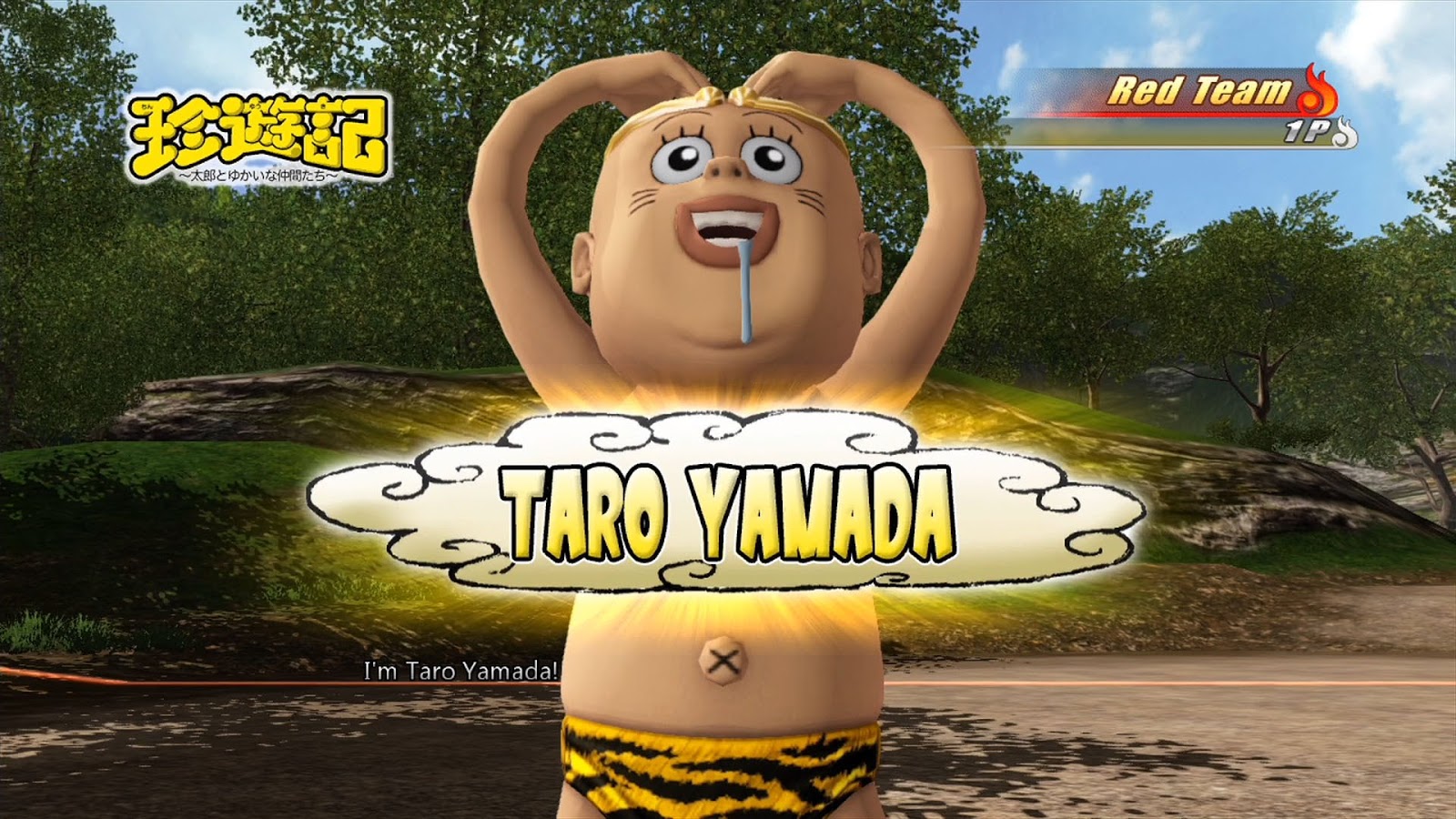
And this guy, too. The inclusion of Yamada Taro, the protagonist of Chinyuki: Taro To Yukaina Nakama Tachi, generally pissed off the English-speaking world for being gross and annoying. That it's near-impossible to find anything about the series on the English web likely didn't help, but from what I can gather he's an assassin cursed into the body of a baby/monkey hybrid after defecating on people's graves. Apparently the series got cancelled because it disturbed Jump's audience, and given how utterly bizarre his ultimate attack is (seriously, words do it no justice. Go look it up), I'm willing to believe in my new savior. Color me intrigued!
Oh, and the voices are all in Japanese with English subtitles. Given how a) publishing this game in America must've been a licensing nightmare unto itself and b) it's by and large the preferred language option by hardcore anime fans, which just so happen to be this game's audience, it's more than an acceptable compromise. Unfortunately, it's already been used as a springboard for people to hate on Goku's Japanese voice, who for for the uninitiated is performed by an old woman and American fans often mistake her performance as sounding like such. We'll discuss this in detail within a future Worldy Weekend, but as she's able to fluctuate between all three male members of the Son family (Goku, Gohan and Goten), these people are wrong and should feel bad.
But it's not like that'll matter for long, because the sloppy-ass localization courtesy of Namco-Bandai will immediately capture everyone's attention. Anyone familiar with the rush-jobs on the One Piece: Pirate Warriors series won't be surprised to see the same flood of grammatical errors and out-of-character dialogue. I'd be more lenient for the latter since I'm not expecting the average American localizer to know the quirks of every Saiki Kusuo no Psi-nan character, but apparently they still haven't gotten the hang of One Piece and Bleach characters they've worked with for years. You have Ichigo yelling "I am victorious!", Luffy possessing an expanded vocabulary ("specimen" comes to mind), and, my personal favorite, mistranslating the Skypiea island from One Piece as "Sky Pier".
Be it mistranslations ruining fun character dialogue (see if you can make any sense of the conversation between Goku and Gintoki, which was originally one of the best) or, you know, leaving over half the credits in Japanese, it's seriously shocking how little care and effort was put into this localization. Not even the series logos are translated or shifted to their American counterparts, and regardless of any rights issues involving that, when considering how roughly half of the game's cast are complete unknowns to even America's anime fanbase (let alone the general public), the character gallery alone can't settle English-speaking newcomers into this mess.
And that's what really sums J-Stars Victory Vs.+ up. For every labor of love it forges, it's all buried within a mess of design that fails to hook players for longer than a week. Be it how the fighting system lacks any sense of direction or cohesion (let alone a proper camera...), its gross excuse for a splitscreen UI in multiplayer, or the outright laziness of it's "story," it's a game completely undeserving of its brands, serving only quick laughs and things to smash. J-Stars Victory Vs.+ should not be anime game junk food, not when Shinpachi breaks the fourth wall within Gintoki's presence or when the the opening singers for Dragon Ball Z, One Piece, and Toriko collaborate to write the game's awesome theme. But it is, and that only its accompanying brands can't even salvage it into the depths of mediocrity is just, well, depressing.
Oh well, at least there's always Jump Ultimate Stars.
---
Man, to think I'd start out Worldly Weekend with two stinkers! The next game will be of much higher quality, I promise.