Sadly, my grandmother passed away last Sunday, which is why things have been quiet/getting delayed here for the past couple weeks. At least writing this perked my spirits up a bit -- Dragon Ball fans owe it to themselves to check this piece of hilarity out.
Anyway, this is also why my Kingdom Hearts: Dream Drop Distance review hasn't popped up yet. I've had to juggle a bunch of other committed works in the meantime and will be quite busy up until Super Smash Bros. Ultimate's December 7th release, but rest assured, it'll be here by the week's end.
While Pokémon was what cultivated my interest in anime and manga, Dragon Ball was what captivated that interest and promptly skyrocketed it into a permanent hobby. Akira Toriyama's tales of monkey-tailed boys, alien combat and musclemen protruding golden hair three times their size captured my heart like every other young male living in early 2000's America, and I celebrated my fandom in every way possible. My friends and I constantly invented new adventures for our DBZ action figures. I dressed up as Vegeta for Halloween (I think the wig my mom made is still lying around somewhere!). I memorized the power levels of every character as I frequented the web for plot summaries and pictures. I downloaded translated ROMs of the Japan-exclusive games. I even discovered that, gasp, the show was being censored for American television!
That all began fifteen years ago, and after all these years, my Dragon Ball dorkiness is still alive...if not a tad more latent. Episodes from the fabled Dragon Box sets frequently serve as nostalgic background noise within my basement. I'm quite behind on the new animated adventures, having only seen the first two episodes of Dragon Ball Super and the Battle of Gods movie (for the record, I loved both). Every now and then, I take one of my old manga volumes and take a whiff of that familiar smell; once upon a time, I was convinced Japanese children reveled in that holy scent twenty years before I did.
While still regarded as an action masterpiece, it's easier to discern the flaws of something I once deemed as perfect. The childhood and adulthood periods of protagonist Goku's life--marketed outside of the original Japanese manga as Dragon Ball and Dragon Ball Z, respectively--are too thematically dissonant (if anything, I prefer the whimsy of Dragon Ball). Non-Saiyan characters are frequently shoved into the sidelines, no matter how much time had been invested into them prior. Yet no matter how much I could go on, none of it matters whether I'm reading or watching it. I could say it's just my childhood speaking, yet every story beat, every character moment have become so ingrained into shonen manga that it's little wonder it remains the cornerstone of Weekly Shonen Jump (to provide an American equivalent, I suspect many feel the same about the original Star Wars trilogy and how it impacted cinema). Needless to say, it's a series I still deeply respect and adore.
With all that said, Dragon Ball Z: Budokai requires some context. See, Japan had been living it up with Dragon Ball video games since the 80's, yet we Americans never got in on that action (not including the infamous Dragon Ball GT: Final Bout). It wasn't until 2002 when animation company Toei, American anime licenser/localizer FUNimation and game publisher Infogrames finally got off their sorry keesters and began distributing DB games across the West. While we were initially gifted with a spectacularly shitty duo of Game Boy Advance games in The Legacy of Goku and Collectible Card Game, everyone's eyes were on what was to be the first 3D DBZ fighter for PS2: Budokai.
That's a pretty big deal, as evidenced from the above intro animation. Mute the rancid (yet catchy) 90's rap song and merely observe the video. Yes, you're watching a replica of the Cha-La Head-Cha-La opening from the Japanese version. For the first time, every scene from this iconic 1989 animation had been rendered in beautiful, luscious 3D. That America was not only treated to a butchered version of the opening for the show but that the original song was axed in favor of Rock the Dragon dilutes the nostalgic impact somewhat. Thankfully, we were too distracted by the shiny PS2 graphics to really notice.
What made Budokai so special is that it framed itself as a genuine celebration of Dragon Ball. It didn't cover every chapter of the saga, but the game sprung to life from the get-go with winks and nods everywhere (just look at all the little character icons up there!). Menus were peppered with animations and stills that perfectly matched the style of Toei Animation (with how the company handled the opening sequences for the sequels, I'm convinced they at least provided the latter for this title). The voices were the same as the show, and the soundtrack--composed by series veteran Kenji Yamamoto in a collaboration with Tower of Power--was so good it had practically defined the game by itself.
And how my heart aches knowing I can no longer appreciate all that.
I say this knowing full well Dragon Ball Z: Budokai never had the deepest battle system; even back then, I was able to discern the more homogenized attacks between most characters in the first two games (the most baffling case being in this title, where one particular combo is literally just a couple kicks. Bear in mind there's a dynamic camera involved). But it was good enough...and cool-looking. Like, really cool. The game's emphasis on arena-destroying supernovas (the best being Mr. Satan-er, Hercule's, where, in a fake plea for mercy, he hands over a remote-controlled bomb to the enemy), emulating the super-fast flurries of punches/kicks through button-mashing sequences, and delivering attacks so hard they send your opponents careening into alternate arenas all authentically matched the show.
Except now it's not. Unlike most games ravaged by time, Budokai's in a...peculiar predicament. For one thing, it's the forerunner in a series that shifted over to cel-shaded graphics just the next year. The awkward graphical look would be bad enough, but there's also the matter of just about everything else. You have the voice acting, which is the same as the show but FUNimation's dubbing for DBZ has always been a mixed bag, to say the least. Then you have the music, which was...no, I don't have the heart to say it yet.
Needless to say, a "just good-enough" battle system can't support all that, no matter how flashy it is. It'd be easy to dismiss it a static relic of its time, yet somehow it's preserved its spot as the fondly-remembered DBZ game by American fans. We could just chalk it up to it being a runaway sales success over here, yet there's other matters to consider, namely that Budokai was the only Dragon Ball Z game for years to host a fully-animated Story Mode that reenacted the original series.
Not that the subsequent games up to 2008's Burst Limit didn't have a Story Mode, but they were all propped up through board games (Budokai 2), 2D "still" images (Budokai 3, although Dragon Universe was mighty cool for what it was), or the models just standing there talking (the entire Sparking!/Budokai Tenkaichi trilogy). Subsequently, Budokai's first stab at retelling the story we all know and love in 3D won by default for most folks.
And it's not like it did so through laziness. For one thing, the cinematics are well-animated for their time. Yes, we can nitpick the grainy textures (look no further than the bleached green of King Kai's planet) or that fart sound that comes out of Yamcha's clenched fist in that one cutscene, but god damn did they look cool. Take how it adapts Goku's iconic transformation into Super Saiyan, where the screen quakes with such intensity every time he screams. It was electrifying to watch as a kid, and even now it's one of the legitimate pieces of direction that holds up.
But wait, I thought I just said the game didn't age well graphically? Yes, well, note how I said it's well-animated, and even then that only applies to the cinematics. While the cutscenes may be of adequate quality, it's shocking how that all falls apart when the fighting comes down. The characters lack breathing animations, and everyone's beefcake designs renders it even more awkward, particularly when a good chunk of victory animations consist of character crossing their arms and grinning smugly into the camera (the winner goes to Piccolo, who hangs his mouth open in stupefied wonder at his endlessly-wiggling antennas).
Needless to say, it's really easy to see why they moved into cel-shading. For instance, there is nothing natural about the power-up animation: as opposed to lifting the iconic stances from the show, characters statically scrunch up into a position quite akin to that of taking a dump. Despite the beefcake designs, there's a real lifeless look to everything that was never going to hold up. While the GameCube version added in a unique cel-shaded look of its own, the animation problems persist.
Honestly, I think I'm even being generous with the cutscenes in regards to modeling. Just look how ghastly Karin (Korin) the cat looks up there. That's actually a shot from the HD version, and apparently whoever was in charge of that remaster couldn't fix such a monstrosity.
Anyway, there's also the matter of VAs. Look, let's be honest: while FUNimation may be the best anime dubbing company in America now, that'd be a difficult case to make in 2002 (let alone when they first started out). While Dragon Ball Z was what got them on the map, it fell victim to about every bad dubbing trope from the late 90's: stilted VA direction, corny scripts, a never-ending replacement BGM, and embarrassing opening songs. You cannot sit here and tell me that a dub host to a character singing "CAT LOVES FOOOOOOD YEAH YEAH YEAH YEAAAH" (if you pay attention, the dialogue exchange doesn't even match the context of the scene) or a villain randomly making homosexual advances is better than the original Japanese, a thing of beauty host to the best seiyuu in the anime industry.
But hey, don't take it from me. Why, who is that handsome young man grilling voice actors Sean Schemmel and Christopher Sabat? That would be me, at last year's Otakon! And I gotta say, while I don't entirely buy the "old equipment" answer, I'm quite impressed with their opinion on nostalgia. After all, it's not like Dragon Ball is some holy grail many of us superfans treat it as such. To some people, it's just their favorite goofy Japanese cartoon they grew up, and the meaning of "dubs vs. subs" hold little meaning to them, and that's quite alright.
With all that in mind, Budokai is a pivotal moment in researching the history of DBZ dubbing. Not only was the show coming to an end in America, but this was the first time the cast was brought together for an extensively-voiced video game. For starters, there's Chris Sabat and his dozen roles: his stern direction for Piccolo had evolved just fine, yet he still hadn't figured out how to make Vegeta sound anything other than, as Kanzenshuu once put it, a guy in a booth doing a gruff voice. Meanwhile, Sonny Strait has come a long way in his voicing Kuririn (Krillin): no longer has his direction for the character rendered him an annoying squeaky-voiced punk, but as a genuine sidekick that immediately grows on you.
And then there's voices that continue to, well, flat-out suck. Like Ocean's Pauline Newstone before her, Linda Young's Freeza remains the most notorious miscast in anime dubbing history. Don't let the lipstick fool you; the character has absolutely zero business sounding like an old woman who's had far too many smokes. Despite being the series' most infamous villain, it's hard to believe that in context when you cannot take anything he says seriously. It goes to show FUNimation's worst casting weakness lied in body type: the less said about Philip Wilburn's squeaky Android #19 and Sean Schemmel's "marble-mouth" Kaio (King Kai), the happier I'll be.
In context of the game, it's interesting to witness the juxtaposition of direction. Rumor has it that Toei representatives oversaw the localization, and it'd definitely show in the Story Mode. Regardless of any voice mismatches, there's not a single instance of dry delivery, further granting the impact these cutscenes had back in the day. And then, once again, it falls apart a bit in actual battles. Characters announce attack names super quickly to accommodate the quick frame executions (check out Gohan's take on Kamehameha), and there's an obvious glitch regarding the Cell character: no matter how much he transforms in battle, he's always stuck with the nasal "bug" voice of his first form. It's something they never actually fixed for the sequels, and it's especially odd when contrasted with the normally-dignified countenance of his Perfect Form.
Add in how the voice clips' muffledness has grown more distinct over the years, and the delivery of the bad voices are amplified. Of course, Freeza is absolutely terrible, but the most egregious cases lie in the representatives of the Ginyu Force. Chris Sabat's Arnold Schwarzenegger impression for Recoome borders on incomprehensible and obnoxious, as is also the case for Captain Ginyu himself. The elderly Brice Armstrong is a baffling replacement for the adequate Dale Kelly; he's clearly too old for the flamboyant character and it shows in his nasal delivery.
Speaking of baffling, we now arrive at the most heartbreaking case of all: Kenji Yamamoto, the soundtrack's composer. No, not the same Kenji Yamamoto who composed the Metroid Prime trilogy; the Kenji Yamamoto who's not only been involved with composing songs for DBZ since its inception, but for all the video games dating back to the Super Famicom era.
As mentioned before, Budokai's score is so damn good that it's practically impossible to discuss the game without bringing it up. What made it excel was that it struck that perfect balance between Dragon Ball's lighthearted humor and adrenaline-rushing action. The above themes, which respectively accompany the menu and character select themes, represent the former and dress up the overall presentation; they're so fun that you can't wait to dive into the action.
And what action it is! Kenji Yamamoto's collaboration with Tower of Power definitely bore fruit; yes, those are real instruments you're hearing, all accompanied through some kickass synth. Raging guitars rev up the familiar locales that are Budokai's battlefields, and they're all the better for it. Combined with the arena-shifting mechanics, one could even say they heighten the glory of a shallow combat system.
The Story Mode isn't neglected, either. They emphasize more on synth, but Yamamoto ensures they inject blood-pumping adrenaline and appropriate drama when needed. The above example is actually spliced into three different components for varying cinematics: quiet anger (when Goku observes his dead friends slain by Nappa), anticipation and encouragement (Goku convincing Gohan to take on Cell), and awesome kickassery (Goku's Super Saiyan form scaring the shit out of Freeza).
Heck, he even goes out of his way to pay homage to the original DBZ recap theme! You see what I mean when I said this game celebrates Dragon Ball? In fact, rumor has it there's a cameo from Super Famicom fighter Super Butoden 2 somewhere...
So, wait, I just spent the past four paragraphs singing the soundtrack's praises. If the music's so good, what's the problem?
Well, it's plagiarized.
Yeah, how's that for a kick in the balls?
Kenji Yamamoto's plagiarism scandal has been well-documented, and while I was careful enough to cite the tracks that (as far as we know) weren't "inspired" from other sources, therein lies the rub. It's immensely disappointing that someone who clearly had talent fell to thievery, let alone the fact that he strung along his none-the-wiser collaborators for the ride. And even in the case of my cited tracks, I'll always be asking myself if they were truly born from his "talent."
Perhaps my memories of how much I enjoyed the game are what's most important, but that they won't live on to future generations is the most heartbreaking factor of this ordeal. Just like how Dragon Ball Kai's soundtrack was swiftly replaced across the world following the scandal, any games currently on the market that had Yamamoto's involvement had their scores replaced with recycled tracks from the Tenkaichi brand of games (which, in themselves, were actually replacements of the original Japanese score).
The Budokai HD Collection for PS3/X360 was no exception to the rule. Let it be known the dance music of the Tenkaichi series is not at all like the grounded guitars of Budokai, as evident in this collection of cinematics. It's too blatant how the cutscenes were built around the original score, and all these overly-peppy tracks induce emotional cues so differently that you may as well be watching/playing a whole different game altogether.
And therein lies the real problem: I actually prefer the plagiarized score because it functions better within the game's context. Isn't that messed up? It's too ingrained into me, too loved to accept any morally-correct replacement, and that's all because some jackass in Japan decided it was okay to steal. Maybe I'm at fault, too, but to dismiss it as "it is what it is" feels so wrong.
I love everything else Budokai brings to the table. I love that the Tournament is framed within the World Tournament/Tenkaichi Budokai from the original series (complete with the lovable announcer guy!). I love the concept of custom fighters and collecting abilities through Hoi-Poi Capsules. I love the "what-if" scenarios, particularly the scenarios involving Cell's "nightmare" and The Legend of Hercule, where the big faker actually ends not up being a faker and beats up everyone attending the Cell Game.
But I love that all with a broken heart, and I can no longer call Budokai one of the truly great Dragon Ball games. It doesn't fall nearly into the "so bad it's good" rabbit hole I rediscovered last summer with Sonic Adventure DX, but the polish found in everything else can't save how it's a victim of circumstance. The combination of flash over substance, Toei-blessed presentation vs. generic models, and an amazing soundtrack tainted with plagiarism blend together to create a product with big, gaping cracks gradually rising to the surface.
I suppose it'd be a bit mean to label Budokai mediocre; I mean, I love what it tries to do too much to label it as such, but as it stands, it truly is a relic meant for study and getting one's nostalgic kicks, not entertainment.
2015 marks the 10th anniversary of when I first began reading manga; you know, those silly backwards Japanese comic books you might've spotted at Borders before its untimely demise (may it and its holy smell rest in peace). As an undergraduate with an English major, the fact that manga has constituted the majority of my reading since '05 is rather embarrassing to admit, but as my precious comics got me through a brother's drug addiction, the gloomy terror of high school and recovering from reconstructive foot surgery, it's a medium I'm much thankful for. So much did I love manga that I treated my Dragon Ball volumes like they were the New Testaments, that the poems at the beginning of every Bleach volume were considered as the finest heights of literature (stop laughing), and even requested my parents for a massive bookshelf to house all my manga in.
Today, things are a tad different. Much as I still (still!) love Dragon Ball, its flaws are far easier to discern now. I don't read Naruto or Bleach anymore, having been crushingly disappointed by their future story directions. That bookcase still stands in my room, but I've gradually recognized its position renders my volumes vulnerable to sun damage (my poor Case Closed volumes!).
But I still love manga. Even if I'm less-than-pleased with Viz's translations, I still purchase their volumes for One Piece (my favorite manga for the past eight years) and Case Closed. I dearly wish that new volumes of SGT Frog will hit our shores and that Vinland Saga will survive in America. One of the reasons I'm taking Japanese courses this fall is to collect manga that remain unlocalized (Sket Dance), were dropped midway (Gintama), or have unsatisfactory changes (Shaman King).
If you haven't picked up on it by now, I love the shonen (young boy) manga genre; to be precise, those featured in the famous Weekly Shonen Jump magazine. I guess a guy my age (23) should be focusing on seinen (young adult) manga, but, well, I already read Yotsuba&! and Vinland Saga, so cut me some slack. Just goes to show I'll always be a big kid.
Anyway, so strong is my love for shonen manga that J-Stars Victory Vs.+ actually kickstarted my shonen marathon over the past year and the half, long before it even came out in Japan. I mean, I knew the game wasn't going to be that great (after all, it's by Spike Chunsoft, the king of phoned-in anime tie-ins), but I figured it was finally time to check out classics I missed (Rurouni Kenshin) or enigmas I didn't recognize from the game's roster (Medaka Box). Just for fun, here's a ranked list of what I've read as according to the blog's ratings (albeit on more of a subjective scale):
Masterpiece
Rurouni Kenshin Shaman King
Near-Masterpiece
Sket Dance
Kinnikuman
Really Great Jojo's Bizarre Adventure Parts 1/2 Rokudenashi Blues
Medaka Box Bobobo-bo Bo-bobo Slam Dunk
Sakigake!! Otokojuku
Great
Pyuu to Fuku! Jaguar
Yu Yu Hakusho
Toriko
Okay/Mediocre
Beelzebub
Pretty solid list, eh? There's some opinions that differ from the norm;for example, I did enjoy Yu Yu Hakusho, but I didn't think the storytelling quality was all that cohesive (and as opposed to the famed Dark Tournament, I hail the Chapter Black arc as the series's highpoint). Slam Dunk was pretty damn great, but as a sports manga, it never reached the highs of Eyeshield 21 for me. I probably love Bobobo and Shaman King more than I should, but I have a huge soft-spot for goofy-ass random humor (Bobobo, that is) and the way the latter subverts the typical "defeat the final bad guy in epic fight while protagonist achieves dream" trope is nothing less than brilliant and even heartwarming.
But opinions are opinions. One Piece, Dragon Ball, Eyeshield 21, Gintama and Rurouni Kenshin remain the five Weekly Shonen Jump kings for me, yet I wonder if anything else can join their ranks. Next up on the list is Fist of the North Star and the rest of Jojo, both of which I can't wait to start after I finish rereading Dragon Ball.
Wait, what was the point of this article again? Right, J-Stars Victory Vs.+. The whole reason why it fueled that marathon was because the game itself was inspired by Jump's 45th anniversary. And what better way to celebrate that with a video game featuring all the famous Jump manga heroes and villains beating the snot out of each other? You have the Jump heroes of yore (Dragon Ball's Goku, Rurouni Kenshin, Dr. Slump's Arale, Yu Yu Hakusho's Yusuke) culled together with the biggest heroes of the 2000s (Naruto, One Piece's Luffy, Bleach's Ichigo) and...well, a lot of new guys (Kuroko the basketball player, the enigmatic Koro-Sensei from Assassination Classroom, and the tsundere romance of Nisekoi's Chitoge)
Like any Spike-Chunsoft game, the catch with J-Stars Victory Vs.+ is it's only enjoyable on a "turn-your-brain-off" level. Is it bad? Well, so long as you dive in without any expectations for the battle system, then it's pretty fun as a mindless button masher. But aside from the shiny character models, it's evident from the get-go that Spike, once again, rushed the game out to market with minimal budget.
And it kinda stings here. I mean, this is supposed to be a celebration of Jump! That the game is mediocre isn't the problem; it's how one of the most famous, prestigious sources of Japanese entertainment gets this dream video game crossover and yet that doesn't really get its due here aside from the customary fanservice. Just look at the opening intro: yeah, the fight in Naruto's Hidden Leaf Village is kinda cool, but that it's preceded by all the PS2-quality models running around in the beginning already sets the stage for disappointment.
Then there's the matter of the story mode. Man, would you look at those talking stills! Yeah, I know this isn't the first anime game to do this (there's the wonderful Dragon Ball Z Budokai 3, for one), but what's with that insanely cheesy rock music blaring endlessly in the background? Why do the cameo characters from Rurouni Kenshin and Dr. Slump have such huge eyes? Why do the Nisekoi and Assassination Classroom character conversations lack backgrounds?
I got my answer after finishing one of the four "arcs", which starred the lovable Luffy, his brother Ace and the titular protagonist of Saint Seiya. It was a huge slog as it was, and it had a story or something, concluding with boring-ass ghost versions of the three heroes and the mysterious voice (which remained anonymous) showering them with sprites of chicken dinner. I went over to start Naruto's story only to quickly recognize I was following the same exact story beats, with the same exact quests, with the same exact scripted encounters. I imagine the remaining two arcs follow the same pattern, so I can only chalk all that up to good ol' laziness. And what a goddamn shame that is.
Oh, how silly, I haven't even discussed how the game actually plays yet. Like Spike's earlier efforts with Dragon Ball, J-Stars is a 3D arena fighter divided into team play. There's assists to be summoned, and directions for your AI partner to follow (they call each other by name, so if you've ever wanted to hear Vegeta say Kenshin's name, here ya go). As said before, it qualifies for a mindless pastime so long as you invest nothing into it. It's clunky, and it always devolves into button-mashing, but the attacks register enough oomph and there's enough destructible terrain to go around. The real enemy's the camera, which tends to flip and flop around on its own will and never has a firm grasp on your player character. Consequently, it's not difficult to lose track of the overall action (perhaps this is why the support characters feel so non-existent?).
And check out that roster. J-Stars clocks in at 59 characters, providing a decent representation of Jump's history. While it succeeds in balancing out the usual suspects (Dragon Ball, One Piece, Naruto) with some relatively minor hits (Hell Teacher Nube, Tottemo! Luckyman), that emphasizes so many newer properties is rather...yeah. Okay, having Nisekoi's Chitoge as an assist is pretty cute and playing as Koro-Sensei is pretty amazing, but when legends like Slam Dunk's Sakuragi are axed in favor of the hot new basketball series, you know there's a problem (let alone how this even seeps into older IPs like Jojo; you could argue the inclusion of Jonathan and Joseph is a fresh take as opposed to Jotaro and Dio--and it is--but there's no getting around that they're in there to advertise the recent anime adaptions of Part 1 and 2).
Granted, is it that big of a deal? Dividing roster space from 45 years of history is certainly no easy task, particularly in regards to series expected to have more than one character (Dragon Ball, One Piece, Yu Yu Hakusho...the big boys, really), so I guess I'm not surprised stuff like Shaman King just missed the boat. But even then there's questionable selections; for example, while the effort to represent One Piece's massive diversity in character is appreciated, is Boa Hancock really all-star material? On the other side of the spectrum, what should be an impeccable selection of villains (Freeza, Shishio, Younger Toguro) are marred by absolute shitstains like Naruto's Madara Uchiha. I mean, I'm not surprised Naruto has three playable characters, but that what's quite possibly the most boring villain in Jump history gets to join an all-star celebration leaves me more than a little salty (and considering how he ended up being steamrolled by an even more boring villain after the fact, it stings even more). At least I'm given the option to never unlock him or Bleach's Sosuke Aizen.
This isn't even considering potential licensing issues or the presence of Jump's more mediocre franchises (specifically, Katekyo Hitman Reborn! and Beelzebub), but I digress. What is impressive is that despite Spike never working with most of the properties before, they certainly did their homework. You know that one Dragon Ball/KochiKame crossover oneshot where Ryotsu arrests Freeza for parking violations? That's referenced in here. You remember that one fight from Sakigake!! Otokojuku where the opposing schools had all the non-combatants shoved into two cages, with one doomed to fall off the mountain should their representative lose in battle? That's a stage in here. You know how people love shitting on Yamcha from Dragon Ball? You'll get a kick out of Gintoki's death pose. Actually, you'll get huge laughs out of Gin and Bobobo in general.
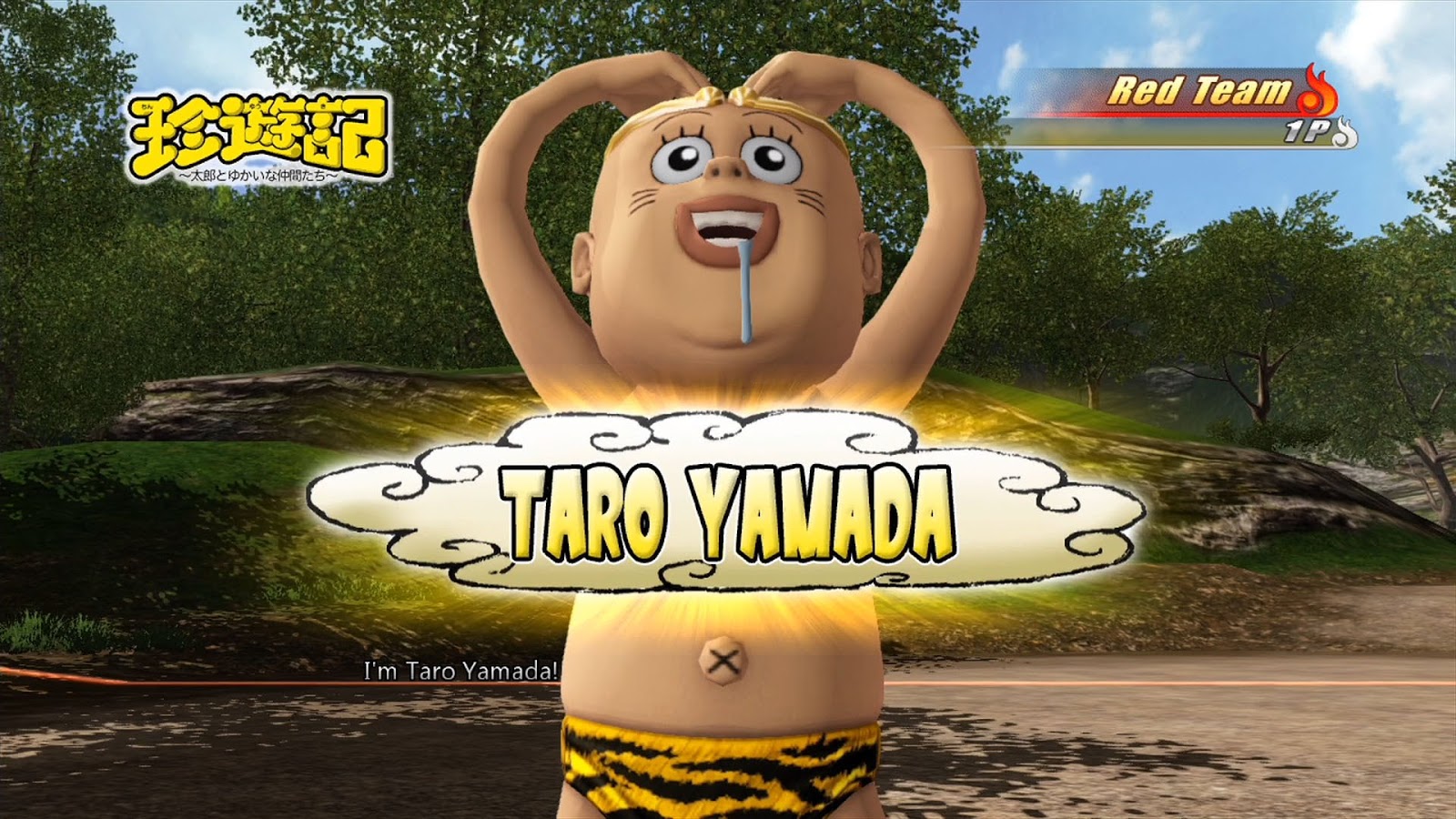
And this guy, too. The inclusion of Yamada Taro, the protagonist of Chinyuki: Taro To Yukaina Nakama Tachi, generally pissed off the English-speaking world for being gross and annoying. That it's near-impossible to find anything about the series on the English web likely didn't help, but from what I can gather he's an assassin cursed into the body of a baby/monkey hybrid after defecating on people's graves. Apparently the series got cancelled because it disturbed Jump's audience, and given how utterly bizarre his ultimate attack is (seriously, words do it no justice. Go look it up), I'm willing to believe in my new savior. Color me intrigued!
Oh, and the voices are all in Japanese with English subtitles. Given how a) publishing this game in America must've been a licensing nightmare unto itself and b) it's by and large the preferred language option by hardcore anime fans, which just so happen to be this game's audience, it's more than an acceptable compromise. Unfortunately, it's already been used as a springboard for people to hate on Goku's Japanese voice, who for for the uninitiated is performed by an old woman and American fans often mistake her performance as sounding like such. We'll discuss this in detail within a future Worldy Weekend, but as she's able to fluctuate between all three male members of the Son family (Goku, Gohan and Goten), these people are wrong and should feel bad.
But it's not like that'll matter for long, because the sloppy-ass localization courtesy of Namco-Bandai will immediately capture everyone's attention. Anyone familiar with the rush-jobs on the One Piece: Pirate Warriors series won't be surprised to see the same flood of grammatical errors and out-of-character dialogue. I'd be more lenient for the latter since I'm not expecting the average American localizer to know the quirks of every Saiki Kusuo no Psi-nan character, but apparently they still haven't gotten the hang of One Piece and Bleach characters they've worked with for years. You have Ichigo yelling "I am victorious!", Luffy possessing an expanded vocabulary ("specimen" comes to mind), and, my personal favorite, mistranslating the Skypiea island from One Piece as "Sky Pier".
Be it mistranslations ruining fun character dialogue (see if you can make any sense of the conversation between Goku and Gintoki, which was originally one of the best) or, you know, leaving over half the credits in Japanese, it's seriously shocking how little care and effort was put into this localization. Not even the series logos are translated or shifted to their American counterparts, and regardless of any rights issues involving that, when considering how roughly half of the game's cast are complete unknowns to even America's anime fanbase (let alone the general public), the character gallery alone can't settle English-speaking newcomers into this mess.
And that's what really sums J-Stars Victory Vs.+ up. For every labor of love it forges, it's all buried within a mess of design that fails to hook players for longer than a week. Be it how the fighting system lacks any sense of direction or cohesion (let alone a proper camera...), its gross excuse for a splitscreen UI in multiplayer, or the outright laziness of it's "story," it's a game completely undeserving of its brands, serving only quick laughs and things to smash. J-Stars Victory Vs.+ should not be anime game junk food, not when Shinpachi breaks the fourth wall within Gintoki's presence or when the the opening singers for Dragon Ball Z, One Piece, and Toriko collaborate to write the game's awesome theme. But it is, and that only its accompanying brands can't even salvage it into the depths of mediocrity is just, well, depressing.
Oh well, at least there's always Jump Ultimate Stars.
---
Man, to think I'd start out Worldly Weekend with two stinkers! The next game will be of much higher quality, I promise.