Disclaimer: This article serves as the "main" reviews for Kingdom Hearts II Final Mix and Kingdom Hearts: Birth by Sleep Final Mix, as I possess no interest in importing the original versions.
Now, here's something certainly more bang for your buck: two Final Mixes in one collection. Sure, there's a rancid movie adaption included, but why complain when there's two Holy Grails finally localized into English? To say Kingdom Hearts 2.5 HD ReMIX -- the second of the three Kingdom Hearts collections we're reviewing -- chronologically focuses on the post-Kingdom Hearts portion of the saga would be a tad misleading considering the presence of prequel Birth by Sleep, but it's not like 358/2 Days -- a game requiring intimate knowledge of Kingdom Hearts II -- being present in the first collection made much sense either. As we've elaborated countless times, no one really knows what goes on with this series, so let's just roll with it.
So anyway: Kingdom Hearts II Final Mix, Birth by Sleep Final Mix, and a movie adaption of Kingdom Hearts Re:Coded. For the moment, let us pretend that last one doesn't exist, and observe the majesty previously denied to us Westerners. True, dedicated PSP owners may've circumvented the handheld's region-freecapabilities for Birth by Sleep, but let's not pretend the English language's presence doesn't produce convenience for everyone else. Yet with Kingdom Hearts II Final Mix being the more famed of the two, it's only natural we begin with the collection's main attraction.
Notice: Unfortunately, there wasn't time to access my SD-card saved screenshots for this review, so aside from my Miiverse archives, you may witness press screenshots of varying sizes. An error in formatting also excised most of the music links. Please excuse the inconsistency for now.
Again, the same disclaimer found within my Super Smash Bros. for 3DS review applies here: namely, any and all analysis on Super Smash Bros. for Wii U's
worth as a competitive fighter shan't be present here. This is not a
matter of passive-aggression, but merely one of disinterest, as I simply
don't approach fighting games in that manner. Truth be told, however,
the "casual" moniker is one I've soured on, as it doesn't accurately
convey my relationship with Smash Bros. in the slightest; indeed, as both these reviews prove, my Smash
intimacy demands I grant them in-depth evaluations as functioning
video games, be it how much I delight in smashing things or the quality of
alternative play provided.
And given director Masahiro
Sakurai's God-given design philosophies -- "always consider the
beginner player" and "make every game as it were your last" -- there
is certainly no shortage of that to go around.Like every Smash Bros. before it,Super Smash Bros. for Wii U is my kingdom -- one divided alongside its 3DS cousin, with which it shares the same gameplay engine and massive character roster. Common sense would entail I enjoy this version just as much -- if not more so -- but with an expanded empire such as this, its imperfections become far more prominent. As a self-proclaimed Nintendo fanboy, I am not blind to these faults -- much as I desire for Wii U to be a masterpiece, it only just misses the cut, and that wounds me just as much as I deeply adore it.
Being that I have elaborated on my love for Super Smash Bros. countless times on this blog without having penned a single review, it's imperative I open this essay with an admonition: namely, I do not possess any interest in a fighting's game competitive depth. This is not a passive-aggressive jab against others' personal tastes -- I've long since stopped begrudging those for their preferences, as I was one of those who conflated vitriolic attacks on post-Melee iterations/series director Masahiro Sakurai with the competitive fanbase at large -- but the point is, whether or not the latest iteration of Smash Bros., Street Fighter, a Dragon Ball game or even a debut in last year's ARMS presents offensive or defensive playstyles or sufficient movement options are matters beneath my notice. This is not a matter of willful ignorance; they're simply not things I have an eye for.
Nay, my occupation with fighting games lies in three factors: a) whether it's fun hitting things, b) whether they maintain -- at least on a base level -- a functioning combat system, and c) if they possess enough content otherwise to keep me interested. Admittedly, this isn't always upheld across the board -- the Smash Bros. apologist in me can admit even now that tripping in Super Smash Bros. Brawl was a fundamentally bad concept, even if I don't personally care about it -- but the point is, not much of that is very different from what the general gaming media typically elaborates upon in fighting games; in other words, if you're looking for a systematic breakdown of Super Smash Bros. for Wii U and 3DS as fighting games, I suggest you look elsewhere.
While we're questioning the eleven-year absence of Kirby spin-offs,
we must also ask: why did it take it so long for King Dedede to get his
own game? I mean, really, who doesn't love the gluttonous, self-proclaimed king
of Dream Land? His plush design, self-centered antics, not-quite-a-good-guy but
not-quite-a-villain morality and penchant for bugged-out eyes have won over
many a Kirby fan, myself included, and it is simply ridiculous HAL
Laboratory has not granted his own Popstar-trotting adventure to the gaming
populace. No matter how you look at it, a downloadable rhythm game ain't gonna
cut it!
Still, you could do with a lot worse than Dedede's Drum Dash Deluxe. Like
its brother Kirby Fighters Deluxe, this spin-off is also based on a Kirby:
Triple Deluxe sub-game by the name of Dedede's Drum Dash, wherein
the penguin king hopped along on giant drums to reach the goal all the while
clapping and bouncing to the beat of classic Kirby tunes (or perhaps not
so classic: not many may recognize the secret Extra song was from Kirby's
Dream Collection: Special Edition) Requiring careful precision of jumping,
clapping, and navigating obstacles, these four levels were not only among some
of the most difficult of Triple Deluxe’s trials, but introduced a welcome
dosage of variety hardly explored in the series hitherto (that’s to say, rhythm;
only one of Mass Attack’s mini-games
springs to mind)
Koei-Tecmo’s brand of Warriors games – hack-and-slash spectacles wherein one character
takes on entire armies – are, to my mind, excellent stress-relievers. They are
not the most polished or ambitious on the market, but their elaborate power
fantasies are instant addictions, the thrill of smashing through endless
platoons and capturing bases instilling a bountiful catharsis. This isn’t to
say the games are doormats – the various missions and down-to-the-wire missions
engage us to the point of anxiety, but overcoming such odds is what makes them
constantly satisfying to play.
I confess my experience with Warriors is limited – while I’ve played the entire One Piece: Pirate Warriors trilogy and
extensively played both Nintendo-themed offerings (Hyrule Warriors, the game we’re reviewing today, and Fire Emblem Warriors), my experience
with series progenitor Dynasty Warriors is
limited only to the aged Dynasty Warriors
2. A mistake I aim to rectify in the future, but the point is, it is not
uncommon at all for fans to claim Hyrule
Warriors – a Nintendo and Koei-Tecmo collaboration based on The Legend of Zelda – is the best of
them all. Even putting aside the celebrated mechanical improvements, the Wii U
game is an insane labor of love and passion from developers clearly enamored
with Nintendo’s famous fantasy series, with two years’ worth of DLC culminating
with a boatload of content, a 3DS version with exclusive features (Hyrule Warriors Legends), and a Switch
version collectively including all aforementioned content (Hyrule Warriors: Definitive Edition).
In retrospect, the absence of Kirby spin-offs following Kirby Air Ride is quite odd when considering how much of them populated the series' early life: nothing in the vein of Kirby's Dream Course, Kirby's Pinball Land or Kirby's Block Ball ever arrived in the DS era or even GBA. Perhaps HAL felt the sub-games found in Amazing Mirror and Super Star Ultra were enough, the mainline games being a priority as opposed to rebuilding a franchise empire. Whatever the reason may be, the eleven-year absence is evident, and so we must ask ourselves: what compelled HAL Laboratory to develop downloadable expansions on Kirby: Triple Deluxe's own brand of sub-games?
Thankfully, that's an easy one: because they're probably the best sub-games in series history. At the very least, Kirby Fighters Deluxe is a common-sense idea: the original Kirby Fighters was a slightly-altered tweak on Triple Deluxe's engine framed within Super Smash Bros. mechanics, complete with multiple Copy Abilities, stages, items and even its own little campaign. As opposed to the previous design rhetoric of Kirby sub-games -- little time wasters deviating our attention from the main game for just a teensy-bit -- it was the closest any mini-game had reached "game within a game" status within the series hitherto, and its addictive nature repeatedly kept fans coming back for more.
My friends, as you all certainly learned back in 2014, we lost the Angry Kirby war. What you see above is not just the cover for American audiences, but for worldwide consumers; sadly, this includes Kirby's native homeland of Japan. Whether it be HAL's belief that this was the best way to show off the new Hypernova power or them being sick of adjusting the cover nearly every time Kirby leaves his Eastern shores, it proves he's not safe even in his home country. While the above cover is hardly among the worst Angry Kirby offenders -- that it's at least designed from the ground up renders it not nearly as awkward-- what it represents proves it won't be going away anytime soon.
Let it be reminded that Angry Kirby is an aesthetic paradox at odds with the presentation and spirit of Kirby, yet I can't think of any case more true than Kirby: Triple Deluxe, which is such a downright pleasant game that very nearly reaches the heights of Epic Yarn, Dream Land 3 and Rainbow Curse. This is not an exaggeration; every time we start the game, the main menu greets us with an assortment of blue skies, vines hosting collectible keychains of old Kirby sprites dangling accordingly to the 3DS's gyroscope, and a mandolin-accompanied arrangement of the gentle Save Hut theme from Kirby Super Star. Coaxing us into that warm, heart-gooey nostalgia that traps us into reverie, we're immediately at home.
2015 marks the 10th anniversary of when I first began reading manga; you know, those silly backwards Japanese comic books you might've spotted at Borders before its untimely demise (may it and its holy smell rest in peace). As an undergraduate with an English major, the fact that manga has constituted the majority of my reading since '05 is rather embarrassing to admit, but as my precious comics got me through a brother's drug addiction, the gloomy terror of high school and recovering from reconstructive foot surgery, it's a medium I'm much thankful for. So much did I love manga that I treated my Dragon Ball volumes like they were the New Testaments, that the poems at the beginning of every Bleach volume were considered as the finest heights of literature (stop laughing), and even requested my parents for a massive bookshelf to house all my manga in.
Today, things are a tad different. Much as I still (still!) love Dragon Ball, its flaws are far easier to discern now. I don't read Naruto or Bleach anymore, having been crushingly disappointed by their future story directions. That bookcase still stands in my room, but I've gradually recognized its position renders my volumes vulnerable to sun damage (my poor Case Closed volumes!).
But I still love manga. Even if I'm less-than-pleased with Viz's translations, I still purchase their volumes for One Piece (my favorite manga for the past eight years) and Case Closed. I dearly wish that new volumes of SGT Frog will hit our shores and that Vinland Saga will survive in America. One of the reasons I'm taking Japanese courses this fall is to collect manga that remain unlocalized (Sket Dance), were dropped midway (Gintama), or have unsatisfactory changes (Shaman King).
If you haven't picked up on it by now, I love the shonen (young boy) manga genre; to be precise, those featured in the famous Weekly Shonen Jump magazine. I guess a guy my age (23) should be focusing on seinen (young adult) manga, but, well, I already read Yotsuba&! and Vinland Saga, so cut me some slack. Just goes to show I'll always be a big kid.
Anyway, so strong is my love for shonen manga that J-Stars Victory Vs.+ actually kickstarted my shonen marathon over the past year and the half, long before it even came out in Japan. I mean, I knew the game wasn't going to be that great (after all, it's by Spike Chunsoft, the king of phoned-in anime tie-ins), but I figured it was finally time to check out classics I missed (Rurouni Kenshin) or enigmas I didn't recognize from the game's roster (Medaka Box). Just for fun, here's a ranked list of what I've read as according to the blog's ratings (albeit on more of a subjective scale):
Masterpiece
Rurouni Kenshin Shaman King
Near-Masterpiece
Sket Dance
Kinnikuman
Really Great Jojo's Bizarre Adventure Parts 1/2 Rokudenashi Blues
Medaka Box Bobobo-bo Bo-bobo Slam Dunk
Sakigake!! Otokojuku
Great
Pyuu to Fuku! Jaguar
Yu Yu Hakusho
Toriko
Okay/Mediocre
Beelzebub
Pretty solid list, eh? There's some opinions that differ from the norm;for example, I did enjoy Yu Yu Hakusho, but I didn't think the storytelling quality was all that cohesive (and as opposed to the famed Dark Tournament, I hail the Chapter Black arc as the series's highpoint). Slam Dunk was pretty damn great, but as a sports manga, it never reached the highs of Eyeshield 21 for me. I probably love Bobobo and Shaman King more than I should, but I have a huge soft-spot for goofy-ass random humor (Bobobo, that is) and the way the latter subverts the typical "defeat the final bad guy in epic fight while protagonist achieves dream" trope is nothing less than brilliant and even heartwarming.
But opinions are opinions. One Piece, Dragon Ball, Eyeshield 21, Gintama and Rurouni Kenshin remain the five Weekly Shonen Jump kings for me, yet I wonder if anything else can join their ranks. Next up on the list is Fist of the North Star and the rest of Jojo, both of which I can't wait to start after I finish rereading Dragon Ball.
Wait, what was the point of this article again? Right, J-Stars Victory Vs.+. The whole reason why it fueled that marathon was because the game itself was inspired by Jump's 45th anniversary. And what better way to celebrate that with a video game featuring all the famous Jump manga heroes and villains beating the snot out of each other? You have the Jump heroes of yore (Dragon Ball's Goku, Rurouni Kenshin, Dr. Slump's Arale, Yu Yu Hakusho's Yusuke) culled together with the biggest heroes of the 2000s (Naruto, One Piece's Luffy, Bleach's Ichigo) and...well, a lot of new guys (Kuroko the basketball player, the enigmatic Koro-Sensei from Assassination Classroom, and the tsundere romance of Nisekoi's Chitoge)
Like any Spike-Chunsoft game, the catch with J-Stars Victory Vs.+ is it's only enjoyable on a "turn-your-brain-off" level. Is it bad? Well, so long as you dive in without any expectations for the battle system, then it's pretty fun as a mindless button masher. But aside from the shiny character models, it's evident from the get-go that Spike, once again, rushed the game out to market with minimal budget.
And it kinda stings here. I mean, this is supposed to be a celebration of Jump! That the game is mediocre isn't the problem; it's how one of the most famous, prestigious sources of Japanese entertainment gets this dream video game crossover and yet that doesn't really get its due here aside from the customary fanservice. Just look at the opening intro: yeah, the fight in Naruto's Hidden Leaf Village is kinda cool, but that it's preceded by all the PS2-quality models running around in the beginning already sets the stage for disappointment.
Then there's the matter of the story mode. Man, would you look at those talking stills! Yeah, I know this isn't the first anime game to do this (there's the wonderful Dragon Ball Z Budokai 3, for one), but what's with that insanely cheesy rock music blaring endlessly in the background? Why do the cameo characters from Rurouni Kenshin and Dr. Slump have such huge eyes? Why do the Nisekoi and Assassination Classroom character conversations lack backgrounds?
I got my answer after finishing one of the four "arcs", which starred the lovable Luffy, his brother Ace and the titular protagonist of Saint Seiya. It was a huge slog as it was, and it had a story or something, concluding with boring-ass ghost versions of the three heroes and the mysterious voice (which remained anonymous) showering them with sprites of chicken dinner. I went over to start Naruto's story only to quickly recognize I was following the same exact story beats, with the same exact quests, with the same exact scripted encounters. I imagine the remaining two arcs follow the same pattern, so I can only chalk all that up to good ol' laziness. And what a goddamn shame that is.
Oh, how silly, I haven't even discussed how the game actually plays yet. Like Spike's earlier efforts with Dragon Ball, J-Stars is a 3D arena fighter divided into team play. There's assists to be summoned, and directions for your AI partner to follow (they call each other by name, so if you've ever wanted to hear Vegeta say Kenshin's name, here ya go). As said before, it qualifies for a mindless pastime so long as you invest nothing into it. It's clunky, and it always devolves into button-mashing, but the attacks register enough oomph and there's enough destructible terrain to go around. The real enemy's the camera, which tends to flip and flop around on its own will and never has a firm grasp on your player character. Consequently, it's not difficult to lose track of the overall action (perhaps this is why the support characters feel so non-existent?).
And check out that roster. J-Stars clocks in at 59 characters, providing a decent representation of Jump's history. While it succeeds in balancing out the usual suspects (Dragon Ball, One Piece, Naruto) with some relatively minor hits (Hell Teacher Nube, Tottemo! Luckyman), that emphasizes so many newer properties is rather...yeah. Okay, having Nisekoi's Chitoge as an assist is pretty cute and playing as Koro-Sensei is pretty amazing, but when legends like Slam Dunk's Sakuragi are axed in favor of the hot new basketball series, you know there's a problem (let alone how this even seeps into older IPs like Jojo; you could argue the inclusion of Jonathan and Joseph is a fresh take as opposed to Jotaro and Dio--and it is--but there's no getting around that they're in there to advertise the recent anime adaptions of Part 1 and 2).
Granted, is it that big of a deal? Dividing roster space from 45 years of history is certainly no easy task, particularly in regards to series expected to have more than one character (Dragon Ball, One Piece, Yu Yu Hakusho...the big boys, really), so I guess I'm not surprised stuff like Shaman King just missed the boat. But even then there's questionable selections; for example, while the effort to represent One Piece's massive diversity in character is appreciated, is Boa Hancock really all-star material? On the other side of the spectrum, what should be an impeccable selection of villains (Freeza, Shishio, Younger Toguro) are marred by absolute shitstains like Naruto's Madara Uchiha. I mean, I'm not surprised Naruto has three playable characters, but that what's quite possibly the most boring villain in Jump history gets to join an all-star celebration leaves me more than a little salty (and considering how he ended up being steamrolled by an even more boring villain after the fact, it stings even more). At least I'm given the option to never unlock him or Bleach's Sosuke Aizen.
This isn't even considering potential licensing issues or the presence of Jump's more mediocre franchises (specifically, Katekyo Hitman Reborn! and Beelzebub), but I digress. What is impressive is that despite Spike never working with most of the properties before, they certainly did their homework. You know that one Dragon Ball/KochiKame crossover oneshot where Ryotsu arrests Freeza for parking violations? That's referenced in here. You remember that one fight from Sakigake!! Otokojuku where the opposing schools had all the non-combatants shoved into two cages, with one doomed to fall off the mountain should their representative lose in battle? That's a stage in here. You know how people love shitting on Yamcha from Dragon Ball? You'll get a kick out of Gintoki's death pose. Actually, you'll get huge laughs out of Gin and Bobobo in general.
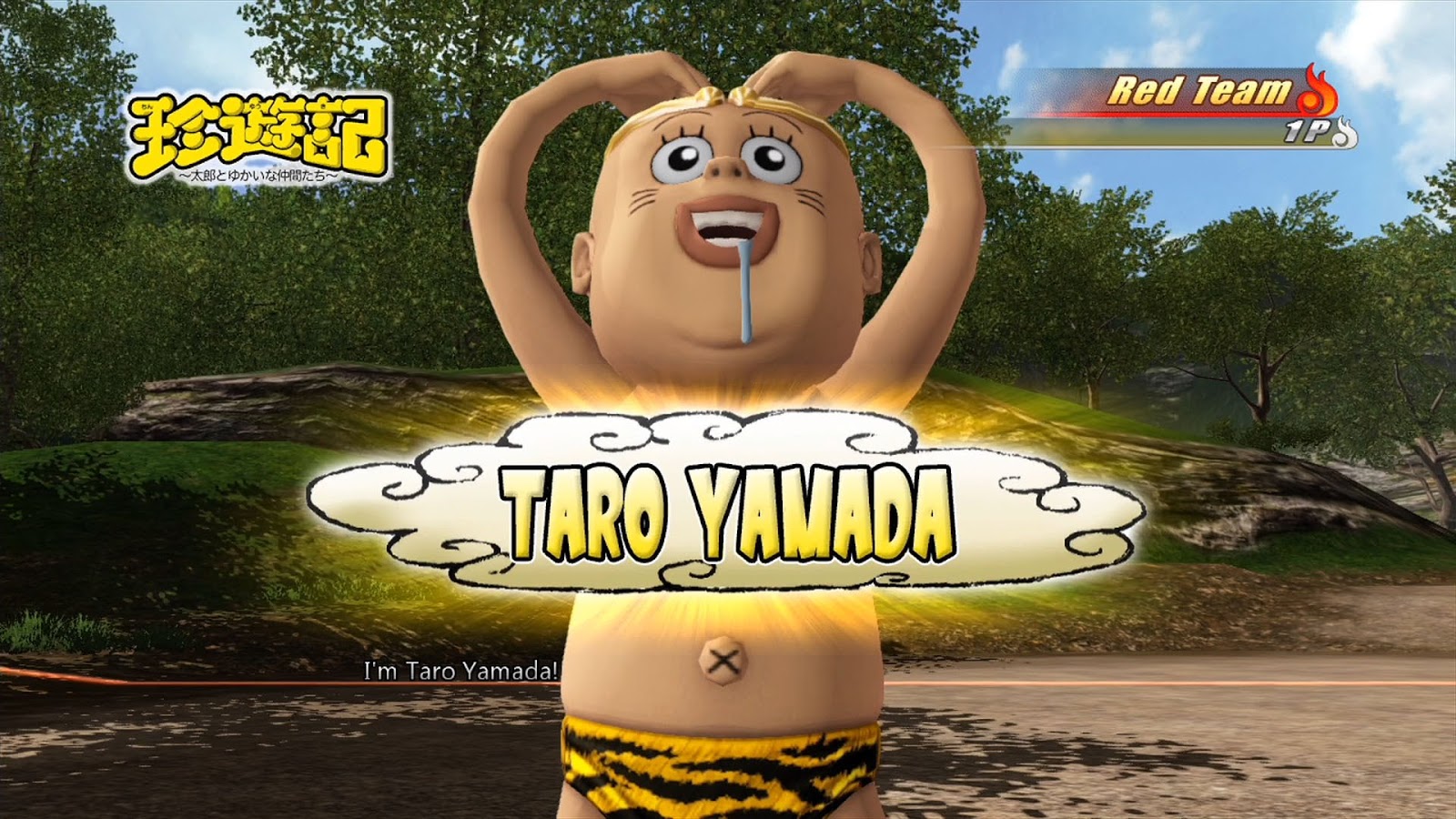
And this guy, too. The inclusion of Yamada Taro, the protagonist of Chinyuki: Taro To Yukaina Nakama Tachi, generally pissed off the English-speaking world for being gross and annoying. That it's near-impossible to find anything about the series on the English web likely didn't help, but from what I can gather he's an assassin cursed into the body of a baby/monkey hybrid after defecating on people's graves. Apparently the series got cancelled because it disturbed Jump's audience, and given how utterly bizarre his ultimate attack is (seriously, words do it no justice. Go look it up), I'm willing to believe in my new savior. Color me intrigued!
Oh, and the voices are all in Japanese with English subtitles. Given how a) publishing this game in America must've been a licensing nightmare unto itself and b) it's by and large the preferred language option by hardcore anime fans, which just so happen to be this game's audience, it's more than an acceptable compromise. Unfortunately, it's already been used as a springboard for people to hate on Goku's Japanese voice, who for for the uninitiated is performed by an old woman and American fans often mistake her performance as sounding like such. We'll discuss this in detail within a future Worldy Weekend, but as she's able to fluctuate between all three male members of the Son family (Goku, Gohan and Goten), these people are wrong and should feel bad.
But it's not like that'll matter for long, because the sloppy-ass localization courtesy of Namco-Bandai will immediately capture everyone's attention. Anyone familiar with the rush-jobs on the One Piece: Pirate Warriors series won't be surprised to see the same flood of grammatical errors and out-of-character dialogue. I'd be more lenient for the latter since I'm not expecting the average American localizer to know the quirks of every Saiki Kusuo no Psi-nan character, but apparently they still haven't gotten the hang of One Piece and Bleach characters they've worked with for years. You have Ichigo yelling "I am victorious!", Luffy possessing an expanded vocabulary ("specimen" comes to mind), and, my personal favorite, mistranslating the Skypiea island from One Piece as "Sky Pier".
Be it mistranslations ruining fun character dialogue (see if you can make any sense of the conversation between Goku and Gintoki, which was originally one of the best) or, you know, leaving over half the credits in Japanese, it's seriously shocking how little care and effort was put into this localization. Not even the series logos are translated or shifted to their American counterparts, and regardless of any rights issues involving that, when considering how roughly half of the game's cast are complete unknowns to even America's anime fanbase (let alone the general public), the character gallery alone can't settle English-speaking newcomers into this mess.
And that's what really sums J-Stars Victory Vs.+ up. For every labor of love it forges, it's all buried within a mess of design that fails to hook players for longer than a week. Be it how the fighting system lacks any sense of direction or cohesion (let alone a proper camera...), its gross excuse for a splitscreen UI in multiplayer, or the outright laziness of it's "story," it's a game completely undeserving of its brands, serving only quick laughs and things to smash. J-Stars Victory Vs.+ should not be anime game junk food, not when Shinpachi breaks the fourth wall within Gintoki's presence or when the the opening singers for Dragon Ball Z, One Piece, and Toriko collaborate to write the game's awesome theme. But it is, and that only its accompanying brands can't even salvage it into the depths of mediocrity is just, well, depressing.
Oh well, at least there's always Jump Ultimate Stars.
---
Man, to think I'd start out Worldly Weekend with two stinkers! The next game will be of much higher quality, I promise.