Konbonwa! Genki desuka? Anata mo neko desuka?
As briefly mentioned in a review last month, I'm taking Japanese courses! I've been attending for nearly two months now, and what an experience it's been! I'm not sure if I've discussed this before, but my acquaintance with the language has roots from over a decade ago, back when I was in 7th grade. Given my love for Nintendo and anime, it was only natural I'd want to take a Japanese course even then, but alas, it wasn't meant to be. Roughly half the students who took the course weren't so much interested in learning another language as much as they saw another opportunity to constantly goof around and interrupt class, and the sensei was ill-equipped to handle classroom control.
Combined with the immense pressure of learning a notoriously-difficult language, it was a recipe for disaster. I gave it another shot in my freshman year, but depression and self-destructive anxiety on my part rendered it impossible to continue.
But I never gave up on the dream, and my patience has now finally borne fruit. How, you ask? By salvaging what I did memorize from those ill-fated classroom ventures: the hiragana/katakana vowels and tables! My exact memorization of the latter alphabet is a bit rusty, but it helps that they share the same sounds as hiragana (and typically involve pronouncing English words!). Not only that, but a decade's worth of watching subtitled anime has gradually etched the flow and quirks of the Japanese language into my brain. Of course, many anime fans have picked up on Japanese phrases through that medium, but as I watched the entirety of Dragon Ball Z in Japanese last year, I grew to recognize I'd subconsciously accumulated various quirks of the language, including words and placement of grammar. As you'd expect, it's been a tremendous help in my class.
So why am I telling you all this? Because I plan on further studying the language, there's the very real possibility I'll be able to review Japan-only games! Y'know, ones that probably don't have any translation patches. Wowza. Of course, such a prospect probably won't happen for some time, not to mention my review schedule for the next half-year or so is already lined up. But hey, so far I've been able to translate one full panel of a Japanese Kirby manga volume I picked up some eight years ago, so it can't be too far, right? I'm also incredibly interested in playing Japanese versions of text-heavy Nintendo games so as properly gauge the untouched, Japan-native vision of the developers (like the recently-reviewed Paper Mario), so maybe some comparison articles could be in the future...?
All bragging aside, if you haven't already guessed, my new obsession with the Japanese language has been why October's been a bit sparse for the blog. Sorry about that! We've also been job-hunting lately; much as Nintendojo's a dream to work with, it's a volunteer position, so it doesn't pay the bills. As you may recall, Daily Gamer was set for that role, but unfortunately it fell through before it even began, so I'm searching high and low for another gaming outlet. I tell ya, if there's one thing worse than never hearing back from a prospective employer, it's sifting through all the terrible, eye-burning site layouts. With how web-design's slowly been homogenized into blogging formats over the past decade, it's not pretty.
Anyway, to make up for my lack of October presence, how about I whip up not one, but two reviews within the next week! We'll finally return to Ten Years of Kirby and get acquainted with another Worldly Weekend. While this means we won't have Biweekly Music Wednesday this week, we'll instead be able to jumpstart things back up on here. Look forward to them!
Tuesday, October 27, 2015

Wednesday, October 14, 2015
Biweekly Music Wednesday! ~No. 30~ Fallin' Love (Mother/EarthBound Beginnings)
Origin: EarthBound Beginnings (Mother)
Plays In: Mt. Itoi Cabin
Status: Original Composition
Composed by: Hirokazu "Hip" Tanaka/Keiichi Suzuki
Over the past several years, I've gradually decided that I want to be a hermit. I'd live in the mountain country home I've always dreamed of, surrounded by trees, fields and mountains that stimulate my inner nostalgia. Walks within forests and alongside mountain roads will be my zen, blue skies and dew-adorned flowers providing endless wonder. It would be a paradise all to my own (barring the company of some cats, naturally).
But why isolate myself? Have my social anxieties and insecurities reached their limit? Is it because I have Asperger's? Sensory issues? Indeed, they're all very likely answers, but I wonder if the more suspicious might believe I'm running away from something; safeguarding myself from a potential trauma, if you will.
In that case, is it because I'm afraid to be hurt by love?
Maybe it's because I realize my dream of young love will never come true.
I have never once dated in my life. After my court jester persona simultaneously ruined my reputation and forced me into seclusion during my grade school years, I never once entertained the idea of dating any of the individuals that helped ruin my social life. Opportunities never sprang in college, either, as I was much too focused in achieving my goals.
Deep down, though, I think I was still wishing for my dream to come true. It was one I secretly cherished for ten years, one centered around an individual I believed understood me more than anyone else. She was the epitome of young love: laughter abound, a never-ending plethora of inside jokes and memories reminisced in warmth, the golden scent of hair, and in possession of the the world's most headspinning smile.
It was an impossible dream, for she never felt the same way. I was just "the friend." But I never stopped dreaming. When I was sailing the high seas of Zelda: The Wind Waker, she and I built a life together on a tropical island. When I was an awkward teenager and endlessly reading video game fanfiction, I'd insert ourselves as the romantic leads. She was my Kairi, my Tetra, my Colette Brunel. Even when I thought I didn't love her, dreams of my mountain abode had her waiting for me at the doorstep.
As they say, however, love is cruel. The dream shattered in a million pieces as we reached twenty, when she began prizing drama and attention above all else. People found themselves being cut out of her life...repeatedly. Being "the friend," I was always the first to get the boot, watching helplessly as the breadth between us grew wider and wider. My own thoughts and feelings become inconsequential, a decade of memories and friendship rendered irrelevant as I soon found myself with nothing but a broken heart and tarnished memories.
It's so easy to say, "I will never fall in love again." It's a mantra I've repeated over the past year and a half, one that has only induced confusion and disbelief from those who've heard it. I do not wish to love because it's so scary to me. For every fairy tale romance that I personally witness, I can cite five more involving closed Facebook accounts, dramatic runaways and abusive relationships. The prospect of investing years into someone else only to end with heartbreak is pointless and far too risky for me.
It's wrong to stereotype, I know, especially after having dealt with the most selfish drama queen on the planet. But when you've invested ten years of unrequited love only to be betrayed not as a romantic partner but as a best friend, it does something to your ego. Any and all conceptions of romance are ruined for you I do not see the point in any of it. I do not understand why people constantly shut out their friends over ill-fated romantic pursuits, and I do not understand why age-gap relationships are a thing, and I do not understand why some establish cruel hierarchies of power and control to foster distorted notions of love.
It's all incredibly judgmental of me to say, as even the question of "why do people stay in abusive relationships?" often crosses my mind. If my decision to become a hermit hadn't already shown it, such statements prove that even I, too, am selfish. They're born from fear that I'll repeat my mistakes, and anger that things didn't go my way. The maelstrom of insecurities born from Asperger's, sensory issues and previous social encounters gone wrong seem to only cement the deal...
But, say, if I were ever to move on from all that, and I were to love again, who would it be with? Deep down, I already know the answer. It would be with someone who respects me, someone who does not judge me based on my background, but instead understands it and always supports me. Our thoughts and feelings are, respectively, of the utmost importance to each other.
Such a love would prove that the boons from young love are not exclusive. It'll flutter and waltz with grace and passion, just as when Ana asked Ninten to dance with her. It will not be something I will purposely seek out, but it's a path I'm gradually beginning to accept and possibly open. Maybe sooner than I think.
Final Thoughts: ...is the first time I've ever elaborated on this subject at length on here? It's why experimenting with this column is so fun.
Friday, October 9, 2015
Retro Scope: EarthBound Beginnings (Nintendojo)

I never get the chance to speak about my favorite Nintendo franchise on here, do I? What a shame. An even bigger shame is that I never actually played the first game all the way through until the Wii U release, yikes!
Anyway, I wrote a tribute to it via Nintendojo. As for the blog's version of the review...hmm, let's say December?
Anyway, I wrote a tribute to it via Nintendojo. As for the blog's version of the review...hmm, let's say December?
Wednesday, October 7, 2015
Paper Mario

To the prudent eye, the name Paper Mario isn't completely accurate to the game's theme. Yes, all the characters and various portions of the world are rendered in flat 2D sprites, but all that hardly recalls paper. While the name rolls off the American tongue easier than its Japanese name, Mario Story, the watercolor backgrounds and cutesy character designs would rather evoke the bedtime storybooks of youth.
And that's exactly what this game is: a living children's storybook. It's bigger than most, it having eight chapters and all, but every one of those tales are so charming, so delightful in how they reimagine the world of Mario within not just a "My First RPG" framework but one of such self-parody and humor that it's impossible not to fall in love with it. Be it the 80's Nintendo veteran familiar with all the references or the eight-year-old that's likely as big a fan of Mario as the Goombario character, there's something for everyone no matter how old you are.
I mentioned reimagining Mario, which is funny considering Paper Mario's origins. The game started as something of a sequel to Super Mario RPG, which, as the very first Mario RPG, presented the dangerous risk of transitioning the series over to the RPG format. What ensued was something far more outlandish than Paper Mario: being developed by RPG legend SquareSoft, the game was stuffed with Final Fantasy-inspired tropes of all sorts. As a result, it was a Mushroom Kingdom the likes of which we'd never seen before; for instance, platforming was distilled into an isometric framework. Mario was still the silent protagonist, but now Toads and Koopas alike spoke on behalf of a cheeky script. There was an actual plot, one populated by dozens upon dozens of bizarre new characters that we'd never see again. And despite what the prologue might imply, Princess Peach does not remain the damsel in distress by the tale's end, nor does Bowser remain the antagonist; in fact, they both join Mario's party!

While Super Mario RPG was a masterpiece in it's own right, Paper Mario chose to dial back on the craziness. It eventually settled on being something of a spiritual successor, borrowing the most pivotal elements for a beginner's RPG format (the "timed" attack system) and for a Mario game (the aforementioned self-parody and humor). The result: a much more familiar Mushroom Kingdom -- there are new characters, yes, but here we witness settlements of not just Toads, but Goombas, Koopas, and Boos alike, some of who even join Mario on his adventure. Bowser starts as the villain and ends as the villain. The plot revolves around magical stars again, but they now possess countenance and even speech.
Whether or not this is actually better is up to preference, but the end result is so undeniably sweet-natured, so fun and bursting with life. Toads of every sort roam the streets of Toad Town, be it the guy screaming about current events, the little old lady who'll cook you treats, or the dude raising money-grubbing piglets. When visiting home, Mario receives letters from all sorts, right down to the Ninja Turtle-ripoffs he trounced in Chapter 1 (and in return, you can deliver lost letters courtesy of Parakarry). And no matter who they are, your friend Goombario has the deets on every single NPC.
Because the game hews closer to home, we delight in witnessing the every day routines of supporting Mario characters. We smile at how Shy Guys, for instance, invade Toad Town with all the giddiness of prankster children (a prelude, you understand, to the bit where you have to infiltrate their lair: a Shy Guy Toybox). We shake our heads at how we're forced to explore a volcano with a zealous Koopa treasure hunter. We giggle when we discover Luigi's diary, chock-full of all his latent desires. And while Peach may be a prisoner in her own castle, her post-chapter escapades with an aspiring star child ensure not just her relevance, but an adorable tale of friendship.

I admit this Paper Mario doesn't have me rolling in hysterics like it's later sequels (The Thousand Year Door and Super); rather, I'm more prone to innocuous giggle fits. And that's really where Paper Mario's humor lies: whereas those two sequels delight in exploring the darker underbelly of the Mario universe, there's not a single cynical bone within their predecessor. It frames a good deal of its conflicts within light-hearted mischief, which is why the game's "darkest" scenario--Mario being the prime suspect of a penguin murder mystery--is also its most ridiculous.

Hence why the game's depiction of Bowser is Paper Mario's funnest character. The big softie in Super Mario RPG may be echoed in the cuddly design, but the Bowser here is a big bully who adores his title and revels in his newfound powers. He's also kind of an idiot, as we witness in one of the game's best scenes where he interrogates Peach on Mario's weaknesses. Here the aforementioned mischief theme comes into play: we could lie and say that Mario hates Mushrooms for a free snack, but it's far funner to pick, say, wimpy enemies and watch them cower in the face of Mario (my favorite being the shell-shocked Goomba: "feel my, uh...wrath, I guess!").

Which reminds me: let us not forget the efforts of NOA's localization. Indeed, it was Paper Mario that shifted the course for Treehouse translations. No more dry scripts or awkward translations of Japanese nouns (as seen in Zelda: Ocarina of Time and Zelda: A Link to the Past, respectively), for this was to be a fun localization! Lively characters everywhere! Liberties to be taken with the dialogue!
But what sparked this new direction? Were they attempting to emulate Ted Woosley's Super Mario RPG localization? Could it be how it was the very first localization project for now-famed Treehouse member Nate Bihldorff? Was it simply times and standards changing? All are viable guesses--indeed, that the previous fall's Majora's Mask was a significant improvement over OOT in this regard already proved changes were coming to Nintendo's localization practices, and boy do they deliver.

Note, for instance, how slang starts seeping into the English-speaking Mushroom Kingdom. Of course, the American localization team was already on this way back in the days of Super Mario World (via the special world stages; "Tubular", anyone?), but there was nothing as radical as, say, Kammy Koopa--Bowser's elderly Magikoopa assistant--referring to her king as "your Gnarliness". It's a word obviously not present in the Japanese version, but as she frequently varies her evil-themed appellations, even today I am amused at the thought that she meditates day and night coming up with new titles to address her king. So thank you for that imagery, Mr. Bihldorff.

And let us dispel the concern Paper Mario wasn't inherently funny in it's native Japanese language; after all, that would dismiss any of the aforementioned scenarios (particularly the Koopa Bros., undoubtedly birthed from Japan's fascination with Teenage Mutant Ninja Turtles). That's not even mentioning how the game pokes fun at RPG tropes, such as how Merlon's family elaborates on pretentious, useless backstories of their youth. You don't need the world's best game localization team to see the humor in that, although it certainly helps!
I mentioned earlier that Paper Mario is best described as a children's storybook. Obviously, that's not to say the games are only for kids, but I remain amazed at how in regards to actual play, it strikes a perfect balance for any audience to master. This is mainly regarding the battle system; at first glance, that attacks rarely venture into the realm of double-digit damage seems like a significant downgrade, but Paper Mario expands upon what made Super Mario RPG so fun to play: the "timed" hits. Note how every one of Mario's companions possess unique button commands -- we're encouraged to aim with the control stick, flick it back and forth, and even holding the A button for brief, intermittent periods. Through this process, we learn that they're not just immensely satisfying to pull off; when we slip up on a timed press, we're legitimately disappointed and strive to do better.
And that's not even bringing up the equippable badges, flexible to any player's tastes and needs as according to a limited point system. For instance, do I spend huge badge points on boosting Mario's HP and FP, or do I balance all three point upgrades for the level-up rewards? Do I stick with just one set of attack and defense-based badges for the entire adventure, or switch 'em around as I go? Be it solely for use of battle or even for convenience within battles or the overworld, there's an unlimited amount of combination for players to choose from.
Of course, the true star of Paper Mario's battles is the impossibly fun battle theme. Fire Emblem veteran Yuka Tsujiyoko, a master of the xylophone, draws out every ounce of that instrument to craft a lively cacophony I always look forward to. RPG battle themes have the reputation of growing old, but I daresay this song ranks alongside Mario & Luigi: Superstar Saga's as being the very best within Mario RPG canon.
Indeed, so much of Paper Mario's innocuous adorableness hails from its soundtrack. As seen above, it's no surprise Toad Town is the game at it's most idyllic (except for Chapter 4, anyway). Its accompanying song varies from location to location, but the core melody always establishes a warm sense of familiarity and home. Being the central hub of the game, it's undeniable this is the song that sparks nostalgia for longtime Paper Mario fans.
Speaking of which, as a children's storybook, Paper Mario never forgets that wistful scent of dreamy nostalgia. It pops up in spades near the game's climax, with its best example displayed above. Snow Road encapsulates so much of those misty, snowy December nights you might've spent gazing out the window as a child. It's the perfect segue into the village of the Star Children, who I imagine frolic about within those very same nights.
With all this lavish praise, would it be easy to deem Paper Mario the best Mario RPG? Perhaps, but the highs and lows in relation to it's GameCube successor, Paper Mario: The Thousand Year Door, grant me pause. In particular, the perfect cast of TTYD really shines a light on how bland most of the original's party members are even by themselves. Fun as they are in battle, there's a stark contrast regarding who's actually well-written and who's not. There's a world of difference between, say, Lady Bow and Bombette, as the former is a driving force for the plot whereas Bombette is, well, Bombette.
But let us not linger on any such imperfections. Paper Mario may not reach the highest of highs found in TTYD and even Super Mario RPG, but that it possesses hardly any lows is a sign of fine craftsmanship. It's a warm, feel-good adventure, one that embraces any audience and certainly one I know I'll revisit whenever I'm down in the dumps as a full-grown adult with very real responsibilities. Lord knows I need to project my troubles into Jr. Troopa, another bully who decides his life mission is to stalk Mario and lay the beatdown on him. What a prick.

----
This is probably my shortest review yet! As I'm aiming for a five-to-seven day waiting period between reviews, more condensed pieces like this will be inevitable. At the very least, I hope I struck that balance of "less is more" with this one! Please let me know what you think.
Anyway, see you guys tomorrow with another Retro Scope courtesy of Nintendojo!
Saturday, September 26, 2015
Super Mario Maker: How I Learned to Embrace Happy Accidents (Nintendojo)

Article Here
Good news! Not only is this my first Nintendojo article in over a month, but it's one of the Super Mario Maker posts I promised! Yay!
...unfortunately, Nintendojo has been afflicted with some sort of adware/hyperlink exploits over the past several weeks, which is why I haven't written anything on there for a while. You may've noticed certain articles were taken down since, and as my article has been infected, I don't know how long it'll stay up. Rest assured, this is not a subliminal message for viagra!
In any case, this was super fun to write! I'm not sure how soon I can whip up another Mario Maker article, as there's many other pieces that take priority. I'm trying my hardest to make sure this fall lives up to my expectations, so on that note, please look forward to my next review very soon!
Thursday, September 17, 2015
Biweekly Music Wednesday! ~No. 29~ Great Fairy Fountain (The Legend of Zelda: The Wind Waker)
Origin: The Legend of Zelda: The Wind Waker
Plays in: Fairy Fountains
Status: Arrangement
Arrangers: Kenta Nagata, Hajime Wakai, Toru Minegishi, Koji Kondo
Gueeeess who's attending the Master Quest tour for The Legend of Zelda: Symphony of the Goddesses this Friday? That's right, I'll heading down the Mann Center in Philly to have sweet, sweet orchestrated Zelda music grace my ears once more. I attended the first tour back some three years ago, so I figured it was about time to revisit.
So for today, I thought I'd share one of the songs that's scheduled to play: the Great Fairy's Fountain. Anyone who calls themselves a Zelda fan should be intimately familiar with this theme, as it not only signals the start of a magical new adventure via the file select, but it also plays within the mysterious fairy fountains hidden across Hyrule. However, this particular Fairy Fountain theme is located not within the hidden crevices of Hyrule, but in the blue expanses of The Wind Waker's Great Sea. It also happens to be my personal favorite.
And why's that? Just listen to that video! Look at that background! Wind Waker was in no short supply of gorgeous setpieces, and the Fairy Fountains were among the cream of the crop. Home of the spiral streamer-adorned Great Fairies, these interiors are decorated with an ethereal blue so stunning it never fails to take your breath away. And that choir! The choir! This is actually the one and only Fairy Fountain theme with vocals, whiiich is pretty much the main reason why it's my favorite. Can you believe how well it elevates those familiar harps?

The Wind Waker was the very first Zelda game to capture my imagination as a child, back in the later era of my prepubescent age. I'd played Zelda games before, but it was here where I first lost myself in the immersion of dungeons lost to time and abandoned treasures waiting to be discovered. It was the dawn of a new hidden reverie for me, one very different from the sugary sweetness of Kirby and the wistful nostalgia of EarthBound.
So often would I lose myself in the game's locales. I was no longer the player, but a lone explorer who seeped between dimensions. I inhaled the musty, ancient air of the Wind Temple. I crossed the holographic projections of the Tower of the Gods. I sunk deep, deep down into the forgotten realm of Hyrule.
I would stand in awe within the Fairy Fountains. I'd gaze up, the heavenly chorus filling my ears as the luminous lights lifted themselves higher and higher into a mystical abyss. Where did they lead? Why did they go? I didn't know, but I did know I was no longer the awkward 6th grader trying to fit into a scary new environment, or the one everyone thought was mentally retarded. I was the me I always dreamed of.
Will this version of Great Fairy Fountain be at Symphony of the Goddesses? No, but the non-vocal harps everyone knows will be there. And The Wind Waker suite will be there to greet me again, along with many other familiar faces. Just like how last year I was transported into the old shoes of a young Pokémon Trainer, I'll once again be the free adventure-seeking boy that linked me to paradise.
Final Thoughts: ...gotta say, though, I'm not sure why they have two separate Majora's Mask suites in the Master Quest set list. That they don't have the Link's Awakening suite (or at the very least, the brilliant Ballad of the Windfish arrangement) is a crying shame. Also not looking forward to the Skyward Sword suite, ick.
Wednesday, September 16, 2015
Notice
Hey, guys. Unfortunately, it seems my grandmother is approaching the end of her life, so the family's prepping for the inevitable. It's why the blog's been a tad sparse lately; for example, we spent today potentially saying our goodbyes, so I wasn't able to spend time on this week's installment of Biweekly Music Wednesday!..
But it's not as if work wasn't already started on it, and I'd rather it come out this week as it coincides with a certain event I'm attending this Friday. To make up for it, I'll share it tomorrow alongside a new column I've mentioned before. Hopefully, the next review will be up this weekend as well.
See you soon.
But it's not as if work wasn't already started on it, and I'd rather it come out this week as it coincides with a certain event I'm attending this Friday. To make up for it, I'll share it tomorrow alongside a new column I've mentioned before. Hopefully, the next review will be up this weekend as well.
See you soon.
Saturday, September 5, 2015
Worldly Weekend: J-Stars Victory Vs.+ (PS3)

And now, to geek out a little.
2015 marks the 10th anniversary of when I first began reading manga; you know, those silly backwards Japanese comic books you might've spotted at Borders before its untimely demise (may it and its holy smell rest in peace). As an undergraduate with an English major, the fact that manga has constituted the majority of my reading since '05 is rather embarrassing to admit, but as my precious comics got me through a brother's drug addiction, the gloomy terror of high school and recovering from reconstructive foot surgery, it's a medium I'm much thankful for. So much did I love manga that I treated my Dragon Ball volumes like they were the New Testaments, that the poems at the beginning of every Bleach volume were considered as the finest heights of literature (stop laughing), and even requested my parents for a massive bookshelf to house all my manga in.

Today, things are a tad different. Much as I still (still!) love Dragon Ball, its flaws are far easier to discern now. I don't read Naruto or Bleach anymore, having been crushingly disappointed by their future story directions. That bookcase still stands in my room, but I've gradually recognized its position renders my volumes vulnerable to sun damage (my poor Case Closed volumes!).
But I still love manga. Even if I'm less-than-pleased with Viz's translations, I still purchase their volumes for One Piece (my favorite manga for the past eight years) and Case Closed. I dearly wish that new volumes of SGT Frog will hit our shores and that Vinland Saga will survive in America. One of the reasons I'm taking Japanese courses this fall is to collect manga that remain unlocalized (Sket Dance), were dropped midway (Gintama), or have unsatisfactory changes (Shaman King).
If you haven't picked up on it by now, I love the shonen (young boy) manga genre; to be precise, those featured in the famous Weekly Shonen Jump magazine. I guess a guy my age (23) should be focusing on seinen (young adult) manga, but, well, I already read Yotsuba&! and Vinland Saga, so cut me some slack. Just goes to show I'll always be a big kid.
Anyway, so strong is my love for shonen manga that J-Stars Victory Vs.+ actually kickstarted my shonen marathon over the past year and the half, long before it even came out in Japan. I mean, I knew the game wasn't going to be that great (after all, it's by Spike Chunsoft, the king of phoned-in anime tie-ins), but I figured it was finally time to check out classics I missed (Rurouni Kenshin) or enigmas I didn't recognize from the game's roster (Medaka Box). Just for fun, here's a ranked list of what I've read as according to the blog's ratings (albeit on more of a subjective scale):
Masterpiece
Rurouni Kenshin
Shaman King
Shaman King
Near-Masterpiece
Sket Dance
Kinnikuman
Really Great
Jojo's Bizarre Adventure Parts 1/2
Rokudenashi Blues
Jojo's Bizarre Adventure Parts 1/2
Rokudenashi Blues
Medaka Box
Bobobo-bo Bo-bobo
Slam Dunk
Bobobo-bo Bo-bobo
Slam Dunk
Sakigake!! Otokojuku
Great
Pyuu to Fuku! Jaguar
Yu Yu Hakusho
Toriko
Okay/Mediocre
Beelzebub
Pretty solid list, eh? There's some opinions that differ from the norm; for example, I did enjoy Yu Yu Hakusho, but I didn't think the storytelling quality was all that cohesive (and as opposed to the famed Dark Tournament, I hail the Chapter Black arc as the series's highpoint). Slam Dunk was pretty damn great, but as a sports manga, it never reached the highs of Eyeshield 21 for me. I probably love Bobobo and Shaman King more than I should, but I have a huge soft-spot for goofy-ass random humor (Bobobo, that is) and the way the latter subverts the typical "defeat the final bad guy in epic fight while protagonist achieves dream" trope is nothing less than brilliant and even heartwarming.
But opinions are opinions. One Piece, Dragon Ball, Eyeshield 21, Gintama and Rurouni Kenshin remain the five Weekly Shonen Jump kings for me, yet I wonder if anything else can join their ranks. Next up on the list is Fist of the North Star and the rest of Jojo, both of which I can't wait to start after I finish rereading Dragon Ball.

Like any Spike-Chunsoft game, the catch with J-Stars Victory Vs.+ is it's only enjoyable on a "turn-your-brain-off" level. Is it bad? Well, so long as you dive in without any expectations for the battle system, then it's pretty fun as a mindless button masher. But aside from the shiny character models, it's evident from the get-go that Spike, once again, rushed the game out to market with minimal budget.
And it kinda stings here. I mean, this is supposed to be a celebration of Jump! That the game is mediocre isn't the problem; it's how one of the most famous, prestigious sources of Japanese entertainment gets this dream video game crossover and yet that doesn't really get its due here aside from the customary fanservice. Just look at the opening intro: yeah, the fight in Naruto's Hidden Leaf Village is kinda cool, but that it's preceded by all the PS2-quality models running around in the beginning already sets the stage for disappointment.

Then there's the matter of the story mode. Man, would you look at those talking stills! Yeah, I know this isn't the first anime game to do this (there's the wonderful Dragon Ball Z Budokai 3, for one), but what's with that insanely cheesy rock music blaring endlessly in the background? Why do the cameo characters from Rurouni Kenshin and Dr. Slump have such huge eyes? Why do the Nisekoi and Assassination Classroom character conversations lack backgrounds?
I got my answer after finishing one of the four "arcs", which starred the lovable Luffy, his brother Ace and the titular protagonist of Saint Seiya. It was a huge slog as it was, and it had a story or something, concluding with boring-ass ghost versions of the three heroes and the mysterious voice (which remained anonymous) showering them with sprites of chicken dinner. I went over to start Naruto's story only to quickly recognize I was following the same exact story beats, with the same exact quests, with the same exact scripted encounters. I imagine the remaining two arcs follow the same pattern, so I can only chalk all that up to good ol' laziness. And what a goddamn shame that is.
Oh, how silly, I haven't even discussed how the game actually plays yet. Like Spike's earlier efforts with Dragon Ball, J-Stars is a 3D arena fighter divided into team play. There's assists to be summoned, and directions for your AI partner to follow (they call each other by name, so if you've ever wanted to hear Vegeta say Kenshin's name, here ya go). As said before, it qualifies for a mindless pastime so long as you invest nothing into it. It's clunky, and it always devolves into button-mashing, but the attacks register enough oomph and there's enough destructible terrain to go around. The real enemy's the camera, which tends to flip and flop around on its own will and never has a firm grasp on your player character. Consequently, it's not difficult to lose track of the overall action (perhaps this is why the support characters feel so non-existent?).
And check out that roster. J-Stars clocks in at 59 characters, providing a decent representation of Jump's history. While it succeeds in balancing out the usual suspects (Dragon Ball, One Piece, Naruto) with some relatively minor hits (Hell Teacher Nube, Tottemo! Luckyman), that emphasizes so many newer properties is rather...yeah. Okay, having Nisekoi's Chitoge as an assist is pretty cute and playing as Koro-Sensei is pretty amazing, but when legends like Slam Dunk's Sakuragi are axed in favor of the hot new basketball series, you know there's a problem (let alone how this even seeps into older IPs like Jojo; you could argue the inclusion of Jonathan and Joseph is a fresh take as opposed to Jotaro and Dio--and it is--but there's no getting around that they're in there to advertise the recent anime adaptions of Part 1 and 2).

Granted, is it that big of a deal? Dividing roster space from 45 years of history is certainly no easy task, particularly in regards to series expected to have more than one character (Dragon Ball, One Piece, Yu Yu Hakusho...the big boys, really), so I guess I'm not surprised stuff like Shaman King just missed the boat. But even then there's questionable selections; for example, while the effort to represent One Piece's massive diversity in character is appreciated, is Boa Hancock really all-star material? On the other side of the spectrum, what should be an impeccable selection of villains (Freeza, Shishio, Younger Toguro) are marred by absolute shitstains like Naruto's Madara Uchiha. I mean, I'm not surprised Naruto has three playable characters, but that what's quite possibly the most boring villain in Jump history gets to join an all-star celebration leaves me more than a little salty (and considering how he ended up being steamrolled by an even more boring villain after the fact, it stings even more). At least I'm given the option to never unlock him or Bleach's Sosuke Aizen.
This isn't even considering potential licensing issues or the presence of Jump's more mediocre franchises (specifically, Katekyo Hitman Reborn! and Beelzebub), but I digress. What is impressive is that despite Spike never working with most of the properties before, they certainly did their homework. You know that one Dragon Ball/KochiKame crossover oneshot where Ryotsu arrests Freeza for parking violations? That's referenced in here. You remember that one fight from Sakigake!! Otokojuku where the opposing schools had all the non-combatants shoved into two cages, with one doomed to fall off the mountain should their representative lose in battle? That's a stage in here. You know how people love shitting on Yamcha from Dragon Ball? You'll get a kick out of Gintoki's death pose. Actually, you'll get huge laughs out of Gin and Bobobo in general.
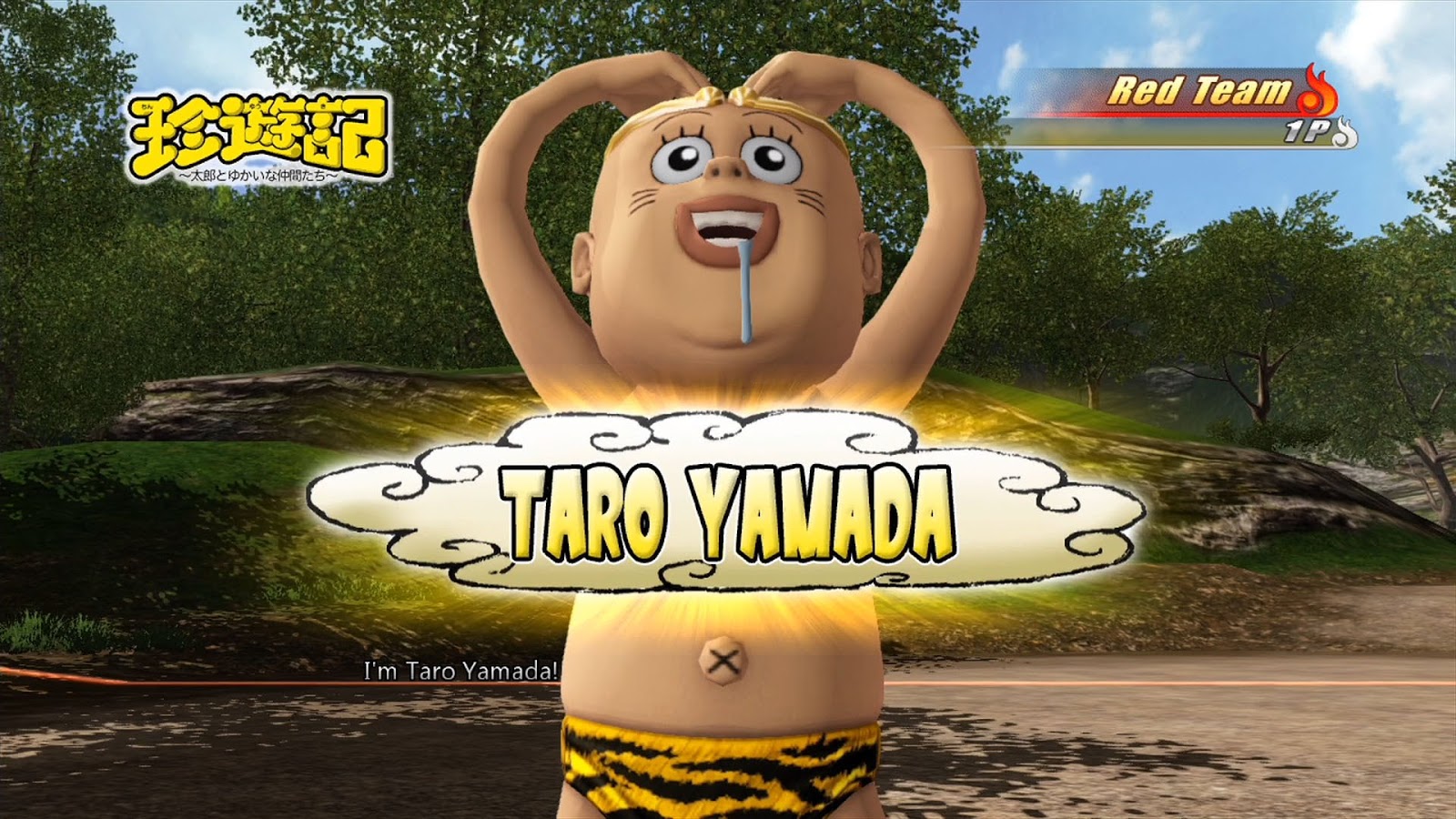
And this guy, too. The inclusion of Yamada Taro, the protagonist of Chinyuki: Taro To Yukaina Nakama Tachi, generally pissed off the English-speaking world for being gross and annoying. That it's near-impossible to find anything about the series on the English web likely didn't help, but from what I can gather he's an assassin cursed into the body of a baby/monkey hybrid after defecating on people's graves. Apparently the series got cancelled because it disturbed Jump's audience, and given how utterly bizarre his ultimate attack is (seriously, words do it no justice. Go look it up), I'm willing to believe in my new savior. Color me intrigued!
Oh, and the voices are all in Japanese with English subtitles. Given how a) publishing this game in America must've been a licensing nightmare unto itself and b) it's by and large the preferred language option by hardcore anime fans, which just so happen to be this game's audience, it's more than an acceptable compromise. Unfortunately, it's already been used as a springboard for people to hate on Goku's Japanese voice, who for for the uninitiated is performed by an old woman and American fans often mistake her performance as sounding like such. We'll discuss this in detail within a future Worldy Weekend, but as she's able to fluctuate between all three male members of the Son family (Goku, Gohan and Goten), these people are wrong and should feel bad.
But it's not like that'll matter for long, because the sloppy-ass localization courtesy of Namco-Bandai will immediately capture everyone's attention. Anyone familiar with the rush-jobs on the One Piece: Pirate Warriors series won't be surprised to see the same flood of grammatical errors and out-of-character dialogue. I'd be more lenient for the latter since I'm not expecting the average American localizer to know the quirks of every Saiki Kusuo no Psi-nan character, but apparently they still haven't gotten the hang of One Piece and Bleach characters they've worked with for years. You have Ichigo yelling "I am victorious!", Luffy possessing an expanded vocabulary ("specimen" comes to mind), and, my personal favorite, mistranslating the Skypiea island from One Piece as "Sky Pier".
Be it mistranslations ruining fun character dialogue (see if you can make any sense of the conversation between Goku and Gintoki, which was originally one of the best) or, you know, leaving over half the credits in Japanese, it's seriously shocking how little care and effort was put into this localization. Not even the series logos are translated or shifted to their American counterparts, and regardless of any rights issues involving that, when considering how roughly half of the game's cast are complete unknowns to even America's anime fanbase (let alone the general public), the character gallery alone can't settle English-speaking newcomers into this mess.

Oh well, at least there's always Jump Ultimate Stars.
---
Man, to think I'd start out Worldly Weekend with two stinkers! The next game will be of much higher quality, I promise.
Wednesday, September 2, 2015
Biweekly Music Wednesday! No. 28 ~Celestial Valley~ (Kirby Air Ride)
Origin: Kirby Air Ride
Plays in: Celestial Valley
Status: Original Composition
Composer: Hirokazu Ando
It's bizarre just how much Kirby Air Ride aesthetically differentiates itself from the rest of Kirby. Whereas the main series typically dives into sugary bedtime fantasy, Air Ride's courses evoke higher levels of fantasy commonly associated with swords and sorcery. Granted, the game is bursting with such imagination that it refuses to stick with just that theme (most notably Machine Passage and the entirety of City Trial), nor do any actual instances of swordplay or spellcasting actually happen. But the locales of Fantasy Meadows, Magma Flows, and Celestial Valley certainly look like they could house such scenarios, couldn't they?

Just look at our subject for today: Celestial Valley. The course uses shades of blue and purple not commonly associated with Kirby, all the while introducing aesthetic concepts entirely new to the series (giant floating illuminating mushrooms, fossil-embedded mountains and half-opened dinosaur eggs). When complimented by the nostalgic whistles and rushing adventure of today's song, it strikes that perfect balance of wonder within the context of high-speed play.
So much did this juxtaposition of fantasy strike out to me as a child that I crafted what the game didn't supply: a scenario. Kirby Air Ride didn't take place on Planet Popstar, but within Kirby's dreams. As opposed to being fictional manifestations of the sleeping mind, however, these dreams allowed to him to interact with different-colored Kirbys from parallel dimensions! All possessing the minds of children, they compete in races featuring famed locations from their respective home worlds.
As evidence from the course's purple hue, Celestial Valley is the realm of Purple Kirby. To this day, I stop and wonder: do the mining tunnels hint at the existence of dwarves, who share their spoils with the fairies that might live in the mushrooms? What about the existence of dinosaurs, who apparently died out yet continue to hide in eggs? Perhaps they're shier than our dwarves and fairies. And on top of it all, how does Purple Kirby interact with them?
Part of the fun in Kirby Air Ride is within it's lack of context, which I now worry that like Mario & Luigi: Paper Jam, Nintendo and HAL Labs will take a sledgehammer to and reveal that, say, City Trial is really just where the Broom Hatters like to chill on Sunday nights. But then I remember the following portion from a Nintendo Power interview and recognize I have nothing to fear:
"NP: We have to ask a geeky Kirby Air Ride question for those Kirby superfans who've been following the "Kirby story" in his games and in the TV animation: How do you explain the presence of multiple Kirby characters -- and in a variety of colors?
Tanikawa: Many story elements from Kirby Air Ride remain wrapped in mystery. Why are there more than one Kirby? Why aren't there any people in the city found in City Trial? Is Kirby Air Ride set on Planet Popstar or in Dream Land? We might reveal the answers in future games . . ."
"Is Kirby Air Ride set on Planet Popstar or in Dream Land?" That's like asking if I'm currently living in America or on Earth. Regardless, this was from twelve years ago, and so far no one else seems that invested in figuring out what's the deal with City Trial's emptiness, so I think I'm safe. Just let me dream, Nintendo!
Final Thoughts: By the way, a rip of this very song plays on The Great Cave Offensive stage in Super Smash Bros. for Wii U. Alongside its fellow Air Ride track Frozen Hillside, I think it complements the stage incredibly well.
Sunday, August 30, 2015
Worldly Weekend Delay + Regarding Super Mario Maker
Augh!! The next Worldly Weekend entry is just about wrapped up, but Blogger's image uploader is suddenly on the fritz! That'll teach me not to promise it anymore, haha. But anyway, I can't stay up all night waiting for it to get working again, so I'll have it ready by this Saturday. Sorry for the delay, but in return, Biweekly Music Wednesday! will return this week and I'll hopefully have my next review up by Friday evening. As mentioned earlier, this fall's gonna be busy, so I'm hoping September will begin with a bang!
Oh, and I never said what the next review was, did I? It's actually not Kirby Super Star Ultra (won't analyzing that be fun), but actually another Mario game! In fact, it's actually one of his more famed spin-offs. I'll let you guess as to what that is...
By the way, how many of you have been following Super Mario Maker? Me, I'm psyched as all get-out and am beyond amazed at the creativity on display. Already I can't wait to get crafting levels and unlocking amiibo costumes like mad, but I'm curious to know: would you guys like to see what I cook up? Learning how to make fun, imaginative levels is going to be a process, and I'd love to share my progress with you all. Please lemme know!
Oh, and I never said what the next review was, did I? It's actually not Kirby Super Star Ultra (won't analyzing that be fun), but actually another Mario game! In fact, it's actually one of his more famed spin-offs. I'll let you guess as to what that is...
By the way, how many of you have been following Super Mario Maker? Me, I'm psyched as all get-out and am beyond amazed at the creativity on display. Already I can't wait to get crafting levels and unlocking amiibo costumes like mad, but I'm curious to know: would you guys like to see what I cook up? Learning how to make fun, imaginative levels is going to be a process, and I'd love to share my progress with you all. Please lemme know!
Subscribe to:
Posts (Atom)

