Good news! Not only is this my first Nintendojo article in over a month, but it's one of the Super Mario Maker posts I promised! Yay!
...unfortunately, Nintendojo has been afflicted with some sort of adware/hyperlink exploits over the past several weeks, which is why I haven't written anything on there for a while. You may've noticed certain articles were taken down since, and as my article has been infected, I don't know how long it'll stay up. Rest assured, this is not a subliminal message for viagra!
In any case, this was super fun to write! I'm not sure how soon I can whip up another Mario Maker article, as there's many other pieces that take priority. I'm trying my hardest to make sure this fall lives up to my expectations, so on that note, please look forward to my next review very soon!
Origin: The Legend of Zelda: The Wind Waker Plays in: Fairy Fountains Status: Arrangement Arrangers: Kenta Nagata, Hajime Wakai, Toru Minegishi, Koji Kondo
Gueeeess who's attending the Master Quest tour for The Legend of Zelda: Symphony of the Goddesses this Friday? That's right, I'll heading down the Mann Center in Philly to have sweet, sweet orchestrated Zelda music grace my ears once more. I attended the first tour back some three years ago, so I figured it was about time to revisit.
So for today, I thought I'd share one of the songs that's scheduled to play: the Great Fairy's Fountain. Anyone who calls themselves a Zelda fan should be intimately familiar with this theme, as it not only signals the start of a magical new adventure via the file select, but it also plays within the mysterious fairy fountains hidden across Hyrule. However, this particular Fairy Fountain theme is located not within the hidden crevices of Hyrule, but in the blue expanses of The Wind Waker's Great Sea. It also happens to be my personal favorite.
And why's that? Just listen to that video! Look at that background! Wind Waker was in no short supply of gorgeous setpieces, and the Fairy Fountains were among the cream of the crop. Home of the spiral streamer-adorned Great Fairies, these interiors are decorated with an ethereal blue so stunning it never fails to take your breath away. And that choir! The choir! This is actually the one and only Fairy Fountain theme with vocals, whiiich is pretty much the main reason why it's my favorite. Can you believe how well it elevates those familiar harps?
The Wind Waker was the very first Zelda game to capture my imagination as a child, back in the later era of my prepubescent age. I'd played Zelda games before, but it was here where I first lost myself in the immersion of dungeons lost to time and abandoned treasures waiting to be discovered. It was the dawn of a new hidden reverie for me, one very different from the sugary sweetness of Kirby and the wistful nostalgia of EarthBound.
So often would I lose myself in the game's locales. I was no longer the player, but a lone explorer who seeped between dimensions. I inhaled the musty, ancient air of the Wind Temple. I crossed the holographic projections of the Tower of the Gods. I sunk deep, deep down into the forgotten realm of Hyrule.
I would stand in awe within the Fairy Fountains. I'd gaze up, the heavenly chorus filling my ears as the luminous lights lifted themselves higher and higher into a mystical abyss. Where did they lead? Why did they go? I didn't know, but I did know I was no longer the awkward 6th grader trying to fit into a scary new environment, or the one everyone thought was mentally retarded. I was the me I always dreamed of.
Will this version of Great Fairy Fountain be at Symphony of the Goddesses? No, but the non-vocal harps everyone knows will be there. And The Wind Waker suitewill be there to greet me again, along with many other familiar faces. Just like how last year I was transported into the old shoes of a young Pokémon Trainer, I'll once again be the free adventure-seeking boy that linked me to paradise.
Final Thoughts: ...gotta say, though, I'm not sure why they have two separate Majora's Mask suites in the Master Quest set list. That they don't have the Link's Awakening suite (or at the very least, the brilliant Ballad of the Windfish arrangement) is a crying shame. Also not looking forward to the Skyward Sword suite, ick.
Hey, guys. Unfortunately, it seems my grandmother is approaching the end of her life, so the family's prepping for the inevitable. It's why the blog's been a tad sparse lately; for example, we spent today potentially saying our goodbyes, so I wasn't able to spend time on this week's installment of Biweekly Music Wednesday!..
But it's not as if work wasn't already started on it, and I'd rather it come out this week as it coincides with a certain event I'm attending this Friday. To make up for it, I'll share it tomorrow alongside a new column I've mentioned before. Hopefully, the next review will be up this weekend as well.
2015 marks the 10th anniversary of when I first began reading manga; you know, those silly backwards Japanese comic books you might've spotted at Borders before its untimely demise (may it and its holy smell rest in peace). As an undergraduate with an English major, the fact that manga has constituted the majority of my reading since '05 is rather embarrassing to admit, but as my precious comics got me through a brother's drug addiction, the gloomy terror of high school and recovering from reconstructive foot surgery, it's a medium I'm much thankful for. So much did I love manga that I treated my Dragon Ball volumes like they were the New Testaments, that the poems at the beginning of every Bleach volume were considered as the finest heights of literature (stop laughing), and even requested my parents for a massive bookshelf to house all my manga in.
Today, things are a tad different. Much as I still (still!) love Dragon Ball, its flaws are far easier to discern now. I don't read Naruto or Bleach anymore, having been crushingly disappointed by their future story directions. That bookcase still stands in my room, but I've gradually recognized its position renders my volumes vulnerable to sun damage (my poor Case Closed volumes!).
But I still love manga. Even if I'm less-than-pleased with Viz's translations, I still purchase their volumes for One Piece (my favorite manga for the past eight years) and Case Closed. I dearly wish that new volumes of SGT Frog will hit our shores and that Vinland Saga will survive in America. One of the reasons I'm taking Japanese courses this fall is to collect manga that remain unlocalized (Sket Dance), were dropped midway (Gintama), or have unsatisfactory changes (Shaman King).
If you haven't picked up on it by now, I love the shonen (young boy) manga genre; to be precise, those featured in the famous Weekly Shonen Jump magazine. I guess a guy my age (23) should be focusing on seinen (young adult) manga, but, well, I already read Yotsuba&! and Vinland Saga, so cut me some slack. Just goes to show I'll always be a big kid.
Anyway, so strong is my love for shonen manga that J-Stars Victory Vs.+ actually kickstarted my shonen marathon over the past year and the half, long before it even came out in Japan. I mean, I knew the game wasn't going to be that great (after all, it's by Spike Chunsoft, the king of phoned-in anime tie-ins), but I figured it was finally time to check out classics I missed (Rurouni Kenshin) or enigmas I didn't recognize from the game's roster (Medaka Box). Just for fun, here's a ranked list of what I've read as according to the blog's ratings (albeit on more of a subjective scale):
Masterpiece
Rurouni Kenshin Shaman King
Near-Masterpiece
Sket Dance
Kinnikuman
Really Great Jojo's Bizarre Adventure Parts 1/2 Rokudenashi Blues
Medaka Box Bobobo-bo Bo-bobo Slam Dunk
Sakigake!! Otokojuku
Great
Pyuu to Fuku! Jaguar
Yu Yu Hakusho
Toriko
Okay/Mediocre
Beelzebub
Pretty solid list, eh? There's some opinions that differ from the norm;for example, I did enjoy Yu Yu Hakusho, but I didn't think the storytelling quality was all that cohesive (and as opposed to the famed Dark Tournament, I hail the Chapter Black arc as the series's highpoint). Slam Dunk was pretty damn great, but as a sports manga, it never reached the highs of Eyeshield 21 for me. I probably love Bobobo and Shaman King more than I should, but I have a huge soft-spot for goofy-ass random humor (Bobobo, that is) and the way the latter subverts the typical "defeat the final bad guy in epic fight while protagonist achieves dream" trope is nothing less than brilliant and even heartwarming.
But opinions are opinions. One Piece, Dragon Ball, Eyeshield 21, Gintama and Rurouni Kenshin remain the five Weekly Shonen Jump kings for me, yet I wonder if anything else can join their ranks. Next up on the list is Fist of the North Star and the rest of Jojo, both of which I can't wait to start after I finish rereading Dragon Ball.
Wait, what was the point of this article again? Right, J-Stars Victory Vs.+. The whole reason why it fueled that marathon was because the game itself was inspired by Jump's 45th anniversary. And what better way to celebrate that with a video game featuring all the famous Jump manga heroes and villains beating the snot out of each other? You have the Jump heroes of yore (Dragon Ball's Goku, Rurouni Kenshin, Dr. Slump's Arale, Yu Yu Hakusho's Yusuke) culled together with the biggest heroes of the 2000s (Naruto, One Piece's Luffy, Bleach's Ichigo) and...well, a lot of new guys (Kuroko the basketball player, the enigmatic Koro-Sensei from Assassination Classroom, and the tsundere romance of Nisekoi's Chitoge)
Like any Spike-Chunsoft game, the catch with J-Stars Victory Vs.+ is it's only enjoyable on a "turn-your-brain-off" level. Is it bad? Well, so long as you dive in without any expectations for the battle system, then it's pretty fun as a mindless button masher. But aside from the shiny character models, it's evident from the get-go that Spike, once again, rushed the game out to market with minimal budget.
And it kinda stings here. I mean, this is supposed to be a celebration of Jump! That the game is mediocre isn't the problem; it's how one of the most famous, prestigious sources of Japanese entertainment gets this dream video game crossover and yet that doesn't really get its due here aside from the customary fanservice. Just look at the opening intro: yeah, the fight in Naruto's Hidden Leaf Village is kinda cool, but that it's preceded by all the PS2-quality models running around in the beginning already sets the stage for disappointment.
Then there's the matter of the story mode. Man, would you look at those talking stills! Yeah, I know this isn't the first anime game to do this (there's the wonderful Dragon Ball Z Budokai 3, for one), but what's with that insanely cheesy rock music blaring endlessly in the background? Why do the cameo characters from Rurouni Kenshin and Dr. Slump have such huge eyes? Why do the Nisekoi and Assassination Classroom character conversations lack backgrounds?
I got my answer after finishing one of the four "arcs", which starred the lovable Luffy, his brother Ace and the titular protagonist of Saint Seiya. It was a huge slog as it was, and it had a story or something, concluding with boring-ass ghost versions of the three heroes and the mysterious voice (which remained anonymous) showering them with sprites of chicken dinner. I went over to start Naruto's story only to quickly recognize I was following the same exact story beats, with the same exact quests, with the same exact scripted encounters. I imagine the remaining two arcs follow the same pattern, so I can only chalk all that up to good ol' laziness. And what a goddamn shame that is.
Oh, how silly, I haven't even discussed how the game actually plays yet. Like Spike's earlier efforts with Dragon Ball, J-Stars is a 3D arena fighter divided into team play. There's assists to be summoned, and directions for your AI partner to follow (they call each other by name, so if you've ever wanted to hear Vegeta say Kenshin's name, here ya go). As said before, it qualifies for a mindless pastime so long as you invest nothing into it. It's clunky, and it always devolves into button-mashing, but the attacks register enough oomph and there's enough destructible terrain to go around. The real enemy's the camera, which tends to flip and flop around on its own will and never has a firm grasp on your player character. Consequently, it's not difficult to lose track of the overall action (perhaps this is why the support characters feel so non-existent?).
And check out that roster. J-Stars clocks in at 59 characters, providing a decent representation of Jump's history. While it succeeds in balancing out the usual suspects (Dragon Ball, One Piece, Naruto) with some relatively minor hits (Hell Teacher Nube, Tottemo! Luckyman), that emphasizes so many newer properties is rather...yeah. Okay, having Nisekoi's Chitoge as an assist is pretty cute and playing as Koro-Sensei is pretty amazing, but when legends like Slam Dunk's Sakuragi are axed in favor of the hot new basketball series, you know there's a problem (let alone how this even seeps into older IPs like Jojo; you could argue the inclusion of Jonathan and Joseph is a fresh take as opposed to Jotaro and Dio--and it is--but there's no getting around that they're in there to advertise the recent anime adaptions of Part 1 and 2).
Granted, is it that big of a deal? Dividing roster space from 45 years of history is certainly no easy task, particularly in regards to series expected to have more than one character (Dragon Ball, One Piece, Yu Yu Hakusho...the big boys, really), so I guess I'm not surprised stuff like Shaman King just missed the boat. But even then there's questionable selections; for example, while the effort to represent One Piece's massive diversity in character is appreciated, is Boa Hancock really all-star material? On the other side of the spectrum, what should be an impeccable selection of villains (Freeza, Shishio, Younger Toguro) are marred by absolute shitstains like Naruto's Madara Uchiha. I mean, I'm not surprised Naruto has three playable characters, but that what's quite possibly the most boring villain in Jump history gets to join an all-star celebration leaves me more than a little salty (and considering how he ended up being steamrolled by an even more boring villain after the fact, it stings even more). At least I'm given the option to never unlock him or Bleach's Sosuke Aizen.
This isn't even considering potential licensing issues or the presence of Jump's more mediocre franchises (specifically, Katekyo Hitman Reborn! and Beelzebub), but I digress. What is impressive is that despite Spike never working with most of the properties before, they certainly did their homework. You know that one Dragon Ball/KochiKame crossover oneshot where Ryotsu arrests Freeza for parking violations? That's referenced in here. You remember that one fight from Sakigake!! Otokojuku where the opposing schools had all the non-combatants shoved into two cages, with one doomed to fall off the mountain should their representative lose in battle? That's a stage in here. You know how people love shitting on Yamcha from Dragon Ball? You'll get a kick out of Gintoki's death pose. Actually, you'll get huge laughs out of Gin and Bobobo in general.
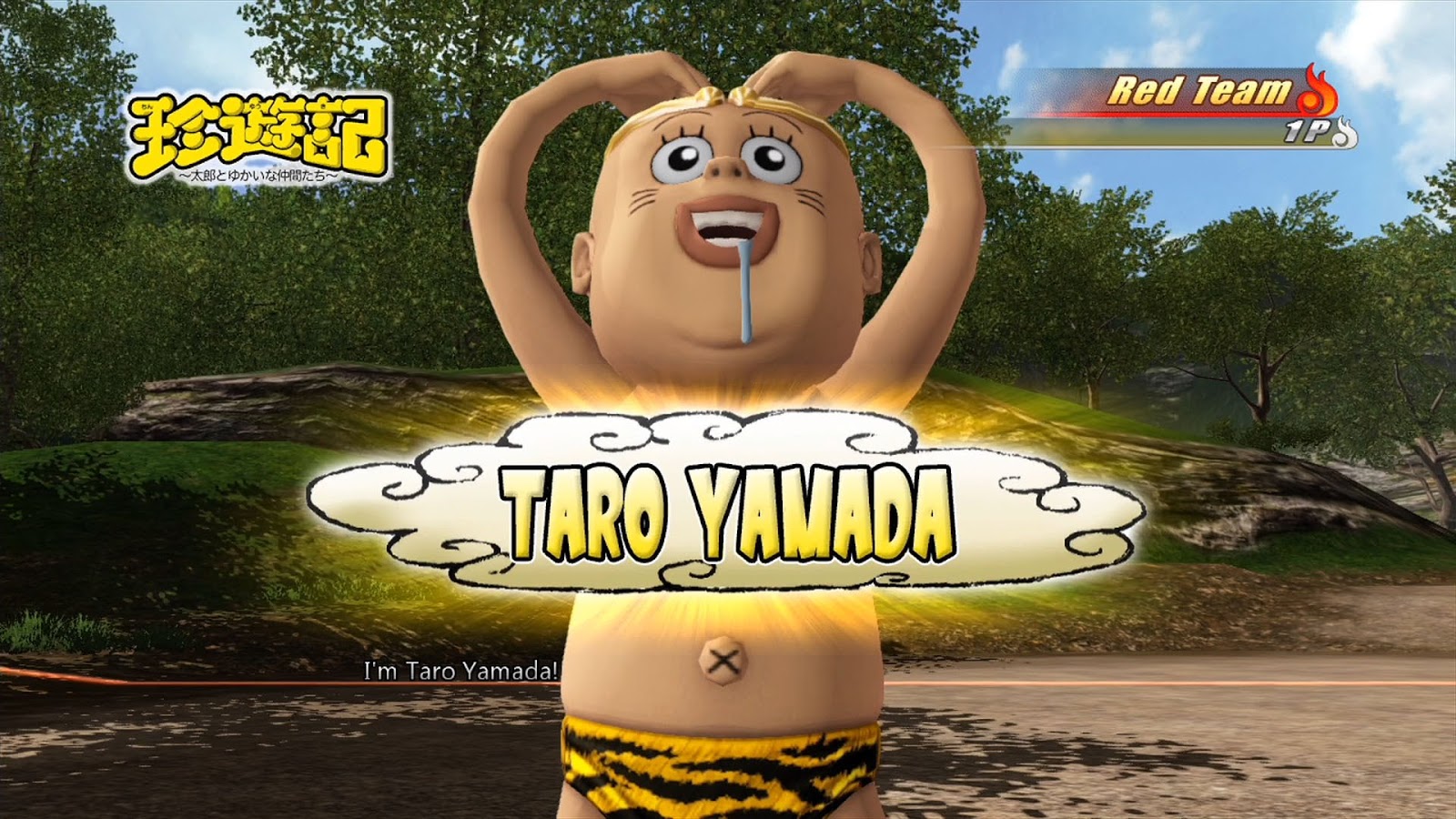
And this guy, too. The inclusion of Yamada Taro, the protagonist of Chinyuki: Taro To Yukaina Nakama Tachi, generally pissed off the English-speaking world for being gross and annoying. That it's near-impossible to find anything about the series on the English web likely didn't help, but from what I can gather he's an assassin cursed into the body of a baby/monkey hybrid after defecating on people's graves. Apparently the series got cancelled because it disturbed Jump's audience, and given how utterly bizarre his ultimate attack is (seriously, words do it no justice. Go look it up), I'm willing to believe in my new savior. Color me intrigued!
Oh, and the voices are all in Japanese with English subtitles. Given how a) publishing this game in America must've been a licensing nightmare unto itself and b) it's by and large the preferred language option by hardcore anime fans, which just so happen to be this game's audience, it's more than an acceptable compromise. Unfortunately, it's already been used as a springboard for people to hate on Goku's Japanese voice, who for for the uninitiated is performed by an old woman and American fans often mistake her performance as sounding like such. We'll discuss this in detail within a future Worldy Weekend, but as she's able to fluctuate between all three male members of the Son family (Goku, Gohan and Goten), these people are wrong and should feel bad.
But it's not like that'll matter for long, because the sloppy-ass localization courtesy of Namco-Bandai will immediately capture everyone's attention. Anyone familiar with the rush-jobs on the One Piece: Pirate Warriors series won't be surprised to see the same flood of grammatical errors and out-of-character dialogue. I'd be more lenient for the latter since I'm not expecting the average American localizer to know the quirks of every Saiki Kusuo no Psi-nan character, but apparently they still haven't gotten the hang of One Piece and Bleach characters they've worked with for years. You have Ichigo yelling "I am victorious!", Luffy possessing an expanded vocabulary ("specimen" comes to mind), and, my personal favorite, mistranslating the Skypiea island from One Piece as "Sky Pier".
Be it mistranslations ruining fun character dialogue (see if you can make any sense of the conversation between Goku and Gintoki, which was originally one of the best) or, you know, leaving over half the credits in Japanese, it's seriously shocking how little care and effort was put into this localization. Not even the series logos are translated or shifted to their American counterparts, and regardless of any rights issues involving that, when considering how roughly half of the game's cast are complete unknowns to even America's anime fanbase (let alone the general public), the character gallery alone can't settle English-speaking newcomers into this mess.
And that's what really sums J-Stars Victory Vs.+ up. For every labor of love it forges, it's all buried within a mess of design that fails to hook players for longer than a week. Be it how the fighting system lacks any sense of direction or cohesion (let alone a proper camera...), its gross excuse for a splitscreen UI in multiplayer, or the outright laziness of it's "story," it's a game completely undeserving of its brands, serving only quick laughs and things to smash. J-Stars Victory Vs.+ should not be anime game junk food, not when Shinpachi breaks the fourth wall within Gintoki's presence or when the the opening singers for Dragon Ball Z, One Piece, and Toriko collaborate to write the game's awesome theme. But it is, and that only its accompanying brands can't even salvage it into the depths of mediocrity is just, well, depressing.
Oh well, at least there's always Jump Ultimate Stars.
---
Man, to think I'd start out Worldly Weekend with two stinkers! The next game will be of much higher quality, I promise.
Origin: Kirby Air Ride Plays in: Celestial Valley Status: Original Composition Composer: Hirokazu Ando
It's bizarre just how much Kirby Air Ride aesthetically differentiates itself from the rest of Kirby. Whereas the main series typically dives into sugary bedtime fantasy, Air Ride's courses evoke higher levels of fantasy commonly associated with swords and sorcery. Granted, the game is bursting with such imagination that it refuses to stick with just that theme (most notably Machine Passage and the entirety of City Trial), nor do any actual instances of swordplay or spellcasting actually happen. But the locales of Fantasy Meadows, Magma Flows, and Celestial Valley certainly look like they could house such scenarios, couldn't they?
Just look at our subject for today: Celestial Valley. The course uses shades of blue and purple not commonly associated with Kirby, all the while introducing aesthetic concepts entirely new to the series (giant floating illuminating mushrooms, fossil-embedded mountains and half-opened dinosaur eggs). When complimented by the nostalgic whistles and rushing adventure of today's song, it strikes that perfect balance of wonder within the context of high-speed play.
So much did this juxtaposition of fantasy strike out to me as a child that I crafted what the game didn't supply: a scenario. Kirby Air Ride didn't take place on Planet Popstar, but within Kirby's dreams. As opposed to being fictional manifestations of the sleeping mind, however, these dreams allowed to him to interact with different-colored Kirbys from parallel dimensions! All possessing the minds of children, they compete in races featuring famed locations from their respective home worlds.
As evidence from the course's purple hue, Celestial Valley is the realm of Purple Kirby. To this day, I stop and wonder: do the mining tunnels hint at the existence of dwarves, who share their spoils with the fairies that might live in the mushrooms? What about the existence of dinosaurs, who apparently died out yet continue to hide in eggs? Perhaps they're shier than our dwarves and fairies. And on top of it all, how does Purple Kirby interact with them?
Part of the fun in Kirby Air Ride is within it's lack of context, which I now worry that like Mario & Luigi: Paper Jam, Nintendo and HAL Labs will take a sledgehammer to and reveal that, say, City Trial is really just where the Broom Hatters like to chill on Sunday nights. But then I remember the following portion from a Nintendo Power interview and recognize I have nothing to fear:
"NP: We have to ask a geeky Kirby Air Ride question for those Kirby superfans who've been following the "Kirby story" in his games and in the TV animation: How do you explain the presence of multiple Kirby characters -- and in a variety of colors?
Tanikawa: Many story elements from Kirby Air Ride remain wrapped in mystery. Why are there more than one Kirby? Why aren't there any people in the city found in City Trial? Is Kirby Air Ride set on Planet Popstar or in Dream Land? We might reveal the answers in future games . . ."
"Is Kirby Air Ride set on Planet Popstar or in Dream Land?" That's like asking if I'm currently living in America or on Earth. Regardless, this was from twelve years ago, and so far no one else seems that invested in figuring out what's the deal with City Trial's emptiness, so I think I'm safe. Just let me dream, Nintendo!
Final Thoughts: By the way, a rip of this very song plays on The Great Cave Offensive stage in Super Smash Bros. for Wii U. Alongside its fellow Air Ride track Frozen Hillside, I think it complements the stage incredibly well.
Augh!! The next Worldly Weekend entry is just about wrapped up, but Blogger's image uploader is suddenly on the fritz! That'll teach me not to promise it anymore, haha. But anyway, I can't stay up all night waiting for it to get working again, so I'll have it ready by this Saturday. Sorry for the delay, but in return, Biweekly Music Wednesday! will return this week and I'll hopefully have my next review up by Friday evening. As mentioned earlier, this fall's gonna be busy, so I'm hoping September will begin with a bang!
Oh, and I never said what the next review was, did I? It's actually not Kirby Super Star Ultra (won't analyzing that be fun), but actually another Mario game! In fact, it's actually one of his more famed spin-offs. I'll let you guess as to what that is...
By the way, how many of you have been following Super Mario Maker? Me, I'm psyched as all get-out and am beyond amazed at the creativity on display. Already I can't wait to get crafting levels and unlocking amiibo costumes like mad, but I'm curious to know: would you guys like to see what I cook up? Learning how to make fun, imaginative levels is going to be a process, and I'd love to share my progress with you all. Please lemme know!
Super Mario 3D World is a game that should, by all means, be considered a masterpiece in my eyes. It's a labor of love, joy and good ol' fashioned game design that follows off the heels of its 3DS predecessor. Having thoroughly enjoyed Super Mario 3D Land, common sense should entail I'd love its sequel just as much.
And why shouldn't I? It's propped up by a live big band score,which is undoubtedly the funnest Nintendo soundtrack since Rhythm Heaven first visited our American shores. It's polished to oblivion, with secret coins, mushrooms and Luigi sprites hidden everywhere from the most unsuspecting of bushes to the tiniest of bonus stages. The warm, fuzzy nostalgia of Super Mario World aesthetics returns and is just as soft as you remember, with the familiar clean artstyle popping up everywhere in the form of Miiverse stickers and familiar cast members roaming the landscape (the Chargin' Chuck football guys!).
And it sheds the spotlight on cats. Cats! My status as a hardcore cat lover is beset by how all three of my cats treat me like I'm the Anti-Christ, dashing away the moment my lumbering presence enters their personal space and daring only to stare at me from the dark reaches of the stairtop (that, and I forbid myself to watch cat videos on YouTube in fear I'll waste hours watching Scottish Fold kittens). That Mario and Co. appealed to my rejected heart by dressing up in cat costumes and meowing up a storm is the best medicine I've received yet, and I dearly wish for the Cat Suit's appearance in more games.
Super Mario 3D World holds the highestMetacritic score of any game released this console generation. It's the first 3D Mario with full-blown multiplayer, complete with Princess Peach and Toad as playable characters. Nintendo fans far and wide have gleefully proclaimed it's the funnest game they've played in decades; not only that, but to many, 3D World represents Mario's true transition of the 2D formula into 3D. And I, the biggest Nintendo nerd I know, have spent the past year and a half coming to terms with the fact that I'm not in love with it. Let there be no miscommunication here: Super Mario 3D World is quality. It plays great and oozes personality and charm in everything it does, all the result of love being poured into every line of code. And how my heart aches that I don't appreciate all that as much as I should. As should soon be evident, it's a game I still wrestle my feelings with, as while there are certainly elements of it that I love, I can't fall in love with the package as a whole. I've often wondered if the problem lies within my own high expectations for 3D Mario,a series that essentially created, defined and revolutionized 3D platforming (and gaming, in general) over the span of five previous games. Whereas Mario 64 laid the foundation and the Galaxy series crafted such imaginative heights, 3D World is mainly concerned with just having fun (and one other factor, but we'll get into that shortly).
Not that there's anything wrong with that by itself, but such a goal immediately places 3D World at odds with the Wii U's GamePad controller, a device that Nintendo completely failed to prove its worth. Much like every Wii U title that isn't Nintendo Land, 3D World establishes, at best, periphery involvement with touch-screen control and the like. When considering the heights reached in design and control from 64, Galaxy and even Sunshine, that a potential new avenue of 3D gameplay was discarded in favor of designing a HD sequel to a handheld game remains a poignant disappointment.
However, like how not every Wii game needed motion control, not every Wii U game should be decried for not having touch controls, so despite the franchise's prestige, it wouldn't be entirely fair to single out 3D World for that mistake.But alas, it's within that very mistake that 3D World's biggest flaw is made apparent, one that renders it inferior to even its own predecessor.
It wouldn't be wrong to claim Super Mario 3D World is the culmination of the seeds first sprung in the Galaxy series,
where Mario's fantastical adventures in space were guided along in a
more linear fashion. While they were still designed around the
star-collecting missions from Mario 64 and Sunshine, their more open level design was tossed in consideration of those lost in three-dimensions (that the first two New Super Mario Bros. titles, which revived the 2D gameplay of old, sold significantly more than any 3D Mario title only seemed to prove Nintendo's point). The result: 3D Land's further distillation into a pure platforming experience (one
could even perceive that the "3D" portion of the title was a rebranding
of this particular Mario genre)
Like 3D Land before it, 3D World emphasizes the nostalgic bare-context of the 2D Mario games of yore. We spot this quality in its speck of a plot, bare minimum usage of text, the timer that inexplicably kills your character, and, as seen above, the flagpole signalling the end of every level. Alone, these aren't problems, but they do contribute to 3D World's biggest flaw: in it's rush to streamline 3D gameplay via 2D tropes, the game forgets to innovate and instead produces a homogenized product.
"Homogenized" as in it borrows too much from 2D Mario, I mean. This isn't to say 3D tropes we've seen before aren't present (as seen with how it unlocks progression via collecting Green Stars), nor am I saying it doesn't possess any new ideas, but then why do I grow so tired of it, then? That 3D World is a sequel to a handheld game to streamline 3D Mario gameplay means it has to juggle between retaining and building upon its tropes within an HD context all the while pointlessly reviving elements from 2D Mario, which naturally presents some problems.
Take the level design, for example. You could argue Galaxy and 3D Land of being homogenized as well, yet they're careful enough to frame their ambitions within their respective contexts. 3D Land is particularly interesting in how the level design is built around the hardware, with levels that go down, down, down or up, up, up appearing all the more imposing and inviting on a tiny handheld screen (when factoring in the 3D, the affect is all the more powerful). It's new, it's fresh, it's uncharted waters for our portly plumber.
And yet note how 3D World borrows some of these levels wholesale without a speck of difference. As expected of a sequel, you may say, but the levels that go up, up, up or present a Zelda-inspired top-down perspective simply don't possess the same magic on an HD level. Yes, the former plays well into the wall-climbing antics of the Cat Suit, but that we've already done this before adds a dull sense of familiarity within the first world.
It's no surprise then that the best levels are the ones built around Mario's new toys. The cloning Double Cherry, in particular, is the game's one true stroke of imagination and presents an unparalleled sense of precision and wonder everywhere it appears. Losing one of your clones to enemy fire or a mistimed jump is a common risk, and it takes some skill to, say, carefully navigate a block slide that, according to their color-coded design, disappear and reappear to the music beat. Something we've already done before, mind you, but points for difficulty.
There are other gadgets for Mario and Co. to fool around with, be it potted Piranha Plants to gobble up foes with and an oversized comfy Ice Skate to ride around in. But as expected, they're sparingly used so as to not grow old. This would okay since the clever "clear" warp pipe idea commonly picks up the slack, but that it's shackled
in bringing back 3D Land tropes and coming up with new ideas brings me to my next point.
Look at how bright and colorful that is! Indeed, the colors in 3D World pop with such vividness and festivity that they're often propped by distant fireworks and the like (seriously, try bopping on the innocent Sprixie folk; they shed actual confetti). Here's some more delectable shots below.
Here's one with some modern effects. 3D World's character models and setpieces are polished to the point where reflect the shiny smoothness of toys and action figures, highlighted in the above rainy sequence. Note the rain dripping down the screen.
And then there's setpieces where the game just explodes with color. The hidden Golden Express is pure mouth-watering gold (complete with the aforementioned fireworks to highlight the game's status as a hidden level), wherea lava levels alternate between molten-hot red and delicious, tantalizing blue (often accompanied by a certain music track showcased just a ways down).
Anyone who's played 3D Land should recognize how most of the examples provided above aren't present in the handheld title. What isn't shown are not-so-new levels that while necessary within the sequel context, don't bring much new on their own. For every exciting idea found in train levels (Cat bullet bills!) and
Japanese bath houses, you shouldn't expect to see them more than once or twice. Yes, it does a gorgeous job of bringing 3D Land level setpieces into HD, but we've seen these ghost houses
before, we've traversed these
dessert-themed landscapes before, we've crossed these poisonous swamps before,
we've ridden on a sea creature down
perilous rivers before. Are they framed in new contexts? Sure, but
chances are they've probably
originated from earlier Mario adventures (hello, flip switches).
Bosses are also disproportionate in imagination. On the highest end of the spectrum lies the above Motley Bossblob; of course, that it'd use the Double Cherry as the fight's basis guarantees it's success, but look at how inventive it is! The flashy fleshiness of his giant form! The choices of either gunning for his fleeing vulnerable form or hopping on his scattered blobs to reduce his size!
...then you have this Bowser boss, where he rides a sexy giant car to lob bombs at Mario. It's host to the slowest, most boring boss fight in the game in that you have to kick back the bombs while Bowser just chugs along in the car. Within games featuring conflict, cars are generally used to run over people; as this would prove problematic in Mario, it has no option but just to sit there looking pretty. Any other platform could've not only sufficed in hosting Bowser, but to build upon it for a more exciting fight.
World themes, too, face disproportion as like 3D Land, 3D World generally places levels wherever it feels like. This wasn't a problem in 3D Land since most, if not all, of world themes weren't so explicit, but this isn't the case in 3D World. We have explicit takes on ice worlds, deserts, and skies, yet 3D World's sense of progression is totally absent barring the necessary castle level.
Just take a look at the game's biggest thematic folly: World Bowser. Just look at this opening! It's a Bowser-themed carnival hosted by the King of Koopas himself. What an awesome idea! And hey, the first level gets it right: you're infiltrating the carnival via the towers in the outskirts complete with orchestra music! And what follows up is...
A desert slide and a dessert level. Wha?
Progressing through the carnival only brings more disappointment: 3D World introduces circus levels as it's most common recurring trope, yet not a single one of these is in sight! In fact, a good chunk of that amazing shit you see in the opening shot aren't used at all. Instead of being granted rollercoasters, we're treated to the same ol' level tropes that only vaguely relate to evil circus theme.
"What's the big deal," you may ask. It's what I've been arguing all along: the game is far too comfortable with borrowing 2D Mario's sense of bare context. While Mario games shouldn't be bloated with story and dialogue (see Sunshine), that 3D World largely uses familiar world tropes as only crutch as opposed to building upon them (or, y'know, expanding on it's original themes) is a disappointment. The circus does not build upon itself, nor the sky world, or even the ice world. You know there's a problem when a) Super Mario World and even the later NES Mario games excel at this and b) I'm questioning context in a series that's the very definition of "suspension of disbelief". As it is now, 3D World in it's entirety comes across as some sort of gaudy fever dream.
You could say "Well, the desert slide is still a great piece of game design", and so it is. To deny that 3D World isn't designed well is heresy, but that it restricts itself to 2D Mario tropes is what I take issue with. What place do entire levels based around the "race against the clock"
concept belong in a 3D platformer, particularly if they're insanely short? Why bother with quick n' dirty enemy blockades? Why include a giant open area in Sprawling Savannah when the ever-present timer naturally deters exploration? Alone, these are nitpicks, but that they keep building and building only serve to prove the game's homogenized nature. That they're included only for the sake of pandering to the 2D titles associates it far too closely with the games in question, and so we lose uniqueness.
So does this mean 3D World is a complete disappointment? Well, not exactly. Yes, 3D World
comes up short as an inventive, cohesive title, but that to deny it's
status as game designed around providing the player with as many fun scenarios as possible would be, well, rather ungrateful for one and would also undersell how well-designed its stages are. I can't say I agree with how they're fully framed, but these are still Mario levels through and through.
Take the above tribute to Super Mario Kart, for instance. That it takes place in the ice world makes no sense, but the brief time we're granted with it captures Mario Kart brilliantly thanks to the pervasive placement of Boost Pads. That it's combined with bouncy mushroom pads to regain momentum and slides ripped straight out of the Playskool playsets from your youth only seals the deal.
Meanwhile, Sunshine Seaside is absolutely the best beach level in the game due to how involved it is. Echoing some of the collection missions in earlier 3D Mario games, your character of choice has to nab five key coins hidden across the coast. Be it one of the many goodies hidden inside the giant sand statues or breaking up a Chargin' Chuck huddle, there's no stone left unturned. Once complete, you're rewarded with an amazing Plessie ride. Note what's quite possibly 3D World's greatest easter egg: riding around inside Koopa shells. How I'd love to endlessly surf across the stage without the impending ticking of that pesky timer.
And no one could possibly hate the adventures of Captain Toad! These fun breathers from the main adventure take the form of isometric puzzles where the world's most adorable treasure hunter has to hunt down five green stars. It's the one area of the game where the GamePad is put to good use, as the gyroscope is utilized as the camera to help the player navigate and decipher these puzzles. These actually do grow in difficulty and even complexity as the game progresses, and I was always delighted to partake in them.
And once again, my love for the Cat Suit must be elaborated. Say what will you about the actual adventure, but the new suit is undeniably the funnest the Mario gang's had in years. Everything from how the characters prance along to the exact movement of a cat, how they scratch frantically before futilely sliding down walls (leaving loooong claw marks), let out a celebratory meow upon completing a course (or in the case of Toad, the cute little "myew! of a kitten), or even how the developers just added a sneaking maneuver (complete with it's own pounce attack) for no reason other than to be cute just highlights how much fun they had in creating it. Also, Cat Goombas. And Cat Bullet Bills. And Cat Bo...nah, I'll let you find that one out for yourself.
I can't help but resist spoiling one little surprise though. One day I asked myself, "what would happen if I climbed up a clear pipe with Cat Mario?" The picturesque shot above is the result. It's not possible with every clear pipe, of course, and it doesn't even qualify as a shortcut, but it's one of the very few instances of "create your own fun" that 3D World allows. In fact, if you try this in the very first level, you may find a tiny secret hinting the developer knew about this all along.
In that sense, it's best to enjoy 3D World as a "turn your brain off" sorta deal. It might not blow your mind and it's certainly not Mario at his most ambitious, but during the entire time I've wrestled with my feelings over this game, I always ask myself if that really matters. So long as you don't expect anything from 3D World, it works. Maybe not entirely in a way I'd want it to, but even with it's missteps it's still fun and exciting to play.
What can really ease this process is the score. My god, the score. Truth be told, I am growing a little tired of the newer Mario themes borrowing Super Mario Bros. 3's motifs again and again, so I've instead decided to kick off by sharing the game's best boss theme. 3D World apes Big Band music, and Hisstocrat is where that hits its apex. An explosion of drums, trumpets and synth all contribute to the flurry and chaos of that particular boss battle.
While Mahito Yokota takes up the bulk of the soundtrack, veteran Koji Kondo picks up the slack with his new take on the customary Athletic theme (known as Chain Link Charge). As opposed to the typical high-strung energy found in those themes, Chain Link Charge goes for a slower, jazzier tone that I'd imagine wouldn't be too out-of-place in downtown New York. It's certainly the most grounded Athletic, a unique direction that I'd love to see continued in future Mario games.
But let us not downplay the efforts of Mr. Yokota, who's more than proven himself as a master game musician at this point. Fort Fire Bros. presents some of the finest Nintendo flute work in some time, presenting an exotic air alongside the foreboding beat. It works wonders within any of the lava levels it accompanies, but comes across as particularly chilling whenever it's around the shiny new blue ones.
Of course, my favorite has to be the one I've discussed before: Double Cherry Pass utilizes a pair of violins so bouncy and alive that it perfectly taps into that animated Mario zen, rendering any level it accompanies the manifestation of pure joy. That it accompanies the best level in the game (of the same name) is no coincidence, as it heightens the wondrous discovery of the wonderful Double Cherries.
Maybe, for me, it represents a song of forgiveness. I know that Super Mario 3D World is not perfect, and I know I will continue to wrestle with my feelings over it for some time. In an era where Nintendo had to prove the worth of their shiny new GamePad, that it chooses to overly restrict itself by 2D tropes is undeniably disappointing not matter how well it plays.
But whenever I hear this song, I can channel that elusive reverie that I, myself, have been chasing for so long. This may or may not have to do with the fact that the song plays in the level where I can have up to five Cat Marios dance in tune to the music, but that it compels me to forget that and simply do that despite the impending tick-tock of a timer is no small feat.
Perhaps one day, I could simply forget the game's flaws and just play it? In a time where Nintendo is no longer a stranger to HD and downplays wacky gadgets, that may be possible, but that fear of homogenization is a tad too strong now.
Regardless, the game plays well, looks well, sounds well, and, well, manages to make me smile. It may not be my favorite Mario game, but that last factor is a hallmark quality of Mario through and through. And I guess I should be grateful for that. Meow.
----
Sorry for the delay, folks! Got too caught up in polishing this before I was satisfied with it. Was I too indecisive? Please let me know!
Ever since someone I met at my cousin's wedding shared my last Biweekly Music Wednesday! on reddit, traffic's gone way up even though not much has been posted this August (sorry!), so I figured I'd stop by and say hello.
Anyway, a new review should be ready by tomorrow night. I've been sweating bullets about it for weeks as it's a rather, ah, unpopular opinion regarding a relatively recent Nintendo title (for the past two months alone there's been roughly six topics about it on NeoGAF and each one has never failed to introduce my head to my desk, repeatedly), and I've been extra care in providing a fair analysis and not come across as overly nitpicky. If you happen to be a fan of the game, please go easy on me!
Other than that, you've come at a good time. A new Worldy Weekend review will not only be ready this weekend, but for the past two months I've been taking painstaking measures in devising an ambitious review schedule for this fall, which should be host to a deluge of reviews! Nintendo classics, third-party goodness and PlayStation/Xbox titles new and old will be featured, so I hope you stick around and enjoy the ride.
While I've replayed both of the original Banjo games recently, I wasn't able to fit them into my review schedule for the blog. Thankfully, Nintendojo's Rare-themed week came just in time, so I figured I'd compromise by writing a Retro Scope for the first game. Perhaps I'll do one in the future for Tooie...? In any case, I once again experimented with my writing here, so I hope you enjoy it.
Things are finally back to normal in my personal life, so I'm aiming to have my next review on here pretty soon!
Hey, all. I'm down in Michigan this week celebrating my cousin's upcoming wedding, so I won't be discussing music today.
Or next week, either. I'd like to steer course back to reviews, and I've been doing a lot of intense scheduling to figure out what's going to come for the rest of the year. If all goes well, things may get a bit crazy for the next two months!