How does one define perfection in video games? Is it recognizing how one game brilliantly executes its main goal? Is it simply returning to a childhood favorite again and again? Or, perhaps, is it something as broadly simple as doing everything right? In that case, it's difficult to imagine anything more perfect in the Zelda pantheon -- or perhaps even all of Nintendo's library -- than The Legend of Zelda: A Link to the Past. There are a variety of reasons for this, but more than anything, it's timeless in its accessibility. Consider this quality when when juxtaposed to Zelda's other masterworks: Majora's Mask -- which I still consider the the series apex -- demands an entirely different style of play that can be too stressful, Breath of the Wild and even this game's sequel in A Link Between Worlds may stray too far from the series formula for some, Ocarina of Time suffers from the same graphical degradation as the rest of its respective generation, and The Legend of Zelda is too archaic and impenetrable by today's standards.
Only Link's Awakening for Game Boy may match it here, and as masterful as that game's bittersweet balance of infectious light-heartedness and gradual melancholy is, A Link to the Past is instantly superior for presenting the greatest opening in series history -- as far as Nintendo games go, only Super Metroid and Metroid Prime may surpass it, and A Link to the Past may even trump those with its own title opener. After the Nintendo logo flickers on screen with the gentlest of harps, a majestic three-dimensional Triforce morphs into shape, embedding within the game's logo as the Master Sword pierces through, a triumphant score celebrating our arrival into the latest Zelda adventure.
Long before Star Fox disappointed again and again with genre shifts and half-baked game design, before Star Fox 64 solidified its position as a recurring Nintendo franchise, and before even Donkey Kong Country stunned the world with pre-rendered CGI, the original Star Fox captivated the gaming populace with polygonal graphics. The gameplay was great too, mind, but as this was the first Nintendo game to primarily utilize polygons, the tease we previously witnessed with Zelda: A Link to the Past's opening Triforce had been realized as a living dream. We had taken our first step into the future, so to speak, and the proof lied in the 3D Arwing gracefully operating by our very own hands.
Of course, as always with the passage of time, what was once cutting-edge is now primitive, and so Star Fox must now rely on its actual gameplay to preserve its legacy. Not that I particularly mind the presentation losing its luster -- Star Fox apparently has a dreadful framerate, and let it be known here and now that is, without fail, always something beneath my notice -- but as the following generation of Nintendo 64 and PlayStation games are mocked for their graphical degradation, how could a 3D SNES game hope to survive? Quite well, actually. Not that it has a patch on Star Fox 64 or anything, but it remains a close second if only for its laser-focused mission: being a competent space shoot'-em-up. With how all the post-Star Fox 64 games reinvent the wheel to not-so-great success (arguably, anyway -- I have a soft spot for Assault), this is a blessing. In addition to being a revolutionary landmark title thanks to its graphics, you get a simple, no-strings-attached rail shooter.
With Donkey Kong Country and its pre-rendered 3D taking the world by storm during 1994's holiday season, it was only natural developer Rare would get to work on a sequel, this time starring Donkey Kong's breakout sidekick: Diddy Kong. Fittingly, the game was dubbed Donkey Kong Country 2: Diddy's Kong Quest, a notorious pun that slipped by young gamers and resulted in shock and awe upon sudden realization years later. Having been one of these unfortunate children, it's never ceased in irking the hell out of me, so perhaps we should not call attention to it at all? Yes, that's what we'll do.
Anyway, Donkey Kong Country 2 is often lauded as the apex of not just the Donkey Kong name but of 16-bit platforming and the Super Nintendo console, cited alongside the likes of Super Mario World and Sonic 3 & Knuckles as being the very finest the genre and/or console has to offer. This claim is not without merit: the level design is no longer basic and constructs itself around depth rather than just cheap thrills, the setting breaks free of ordinary tropes and plunges headfirst into full-on creativity, and David Wise's music is as delicious as ever, if not more so. No longer was Rare's re-imagining of Nintendo's first true gaming star a freshman effort, but a full-fledged video game that vindicated the British game developer's rise into stardom.
I don't typically touch upon my Asperger's in these reviews, but there's a certain memory regarding Donkey Kong Country that must be shared. By far the most prominent of my preschooler-age quirks were made-up words: nonsense given purpose only to the mind of a self-absorbed child. Often taking the form of onomatopoeia, one such term -- "BWAH BWAH!" -- was born from the powerful opening visual of Donkey Kong barreling through his tree house's front door and slamming into the ground below. A ritual was born every time I replayed that level, that guttural cry erupting from my throat in very same shrill ferocity of Baby Animal from Muppet Babies.
The point being, the visual prominence of Donkey Kong Country inspired people to the point of babbling nonsense at the sight of its pre-rendered 3D visuals, myself included. And why shouldn't they, when it was not only the Super Nintendo's greatest technical marvel but groundbreaking enough to ensure the 16-bit market wasn't done just yet? Of course, there are those who believe Donkey Kong Country's only claim to fame was its graphics and not its actual gameplay, which is often perceived as inferior to the likes of Super Mario World and Yoshi's Island.
That's the second time this year I've written an extraordinary amount of words (over 1700!) in one day for a Hey Poor Player article! Seeing as how I'll also be reviewing BOTH the SNES Classic and Star Fox 2 this week...well, it goes without saying Leave Luck to Heaven won't be seeing much action for a while.
By the way, this is the first guide in some time for the site. I was surprised to discover how much attention my Kirby: Planet Robobot guide for GameSkinny received after a year later, so I figured a game everyone's asking questions about would draw similar attention. Did I make the right call?
Origin: Kirby Super Star Plays In: Crystal Field and Mystery Paradise areas of The Great Cave Offensive Status: Arrangement Composed by: Jun Ishikawa, Dan Miyakawa
The Super Nintendo Classic Edition is finally coming!!! In just two days, we'll be reliving twenty classics from Nintendo's greatest system, as well as the never-before released Star Fox 2! Has such a package ever blended the nostalgic and the new so perfectly? Needless to say, if you call yourself a Nintendo fan, you know you gotta get one.
But with so many incredible games featured, which one could I possibly play first? Those who know me could rule it down to two titles: EarthBound and Star Fox 2. Both are great guesses, but they aren't what I've decided upon. Humbling as it is to know EarthBound, the greatest game ever made, will be on it (let us have a moment of silence for our Japanese brothers and sisters), I know I probably won't be able to stop playing it and as I wish to play at least a little bit of every game just once, I may save it for last. I suppose that's fitting for the best game ever, yes?
Origin: Star Fox Plays In:Credits Status: Original Composition Composed By: Hajime Hirasawa
The SNES Classic Edition -- it's been two weeks since its announcement, and it's all I've been able to think about. It's the first time Star Fox and Yoshi's Island will be officially available via emulated form. I've been checking the listings on Amazon and Best Buy every day in scant hopes I'll be able to pre-order. Thoughts and prayers are sent out to the universe every day that we'll see these games unfiltered, just like the glorious NES Classic Mini before it. (My kingdom to have a bright, unglitched Kirby Super Star!) An equal amount of thoughts and prayers sent out in hopes I'll secure one.
Most of all, I think about how we will witness the very first release, to my memory of a cancelled game in Nintendo history: Star Fox 2.
Origin: The Legend of Zelda: A Link to the Past Plays In: Hyrule (Light World) Status: Arrangement
Arranged By: Koji Kondo
Zelda.
For two months, Zelda has graced us with its glorious presence. Breath of the Wild made the gaming public fall in love with the seriesall over again, with an avalanche of perfect scores (including my own!) from the media and players still being overwhelmed by its massive world. I am no exception to the latter: even now, nearly two weeks later and having already beaten the final boss, I still feel like I haven't so much as scratched the game's surface.
Of course, Breath of the Wild is not without its criticisms: be it the oversights found in the "Blood Moon" mechanic, the difficulties in rain patterns, or people's woes with weapon durability, it just goes to show no game is perfect. Personally, I find the "drop and switch" nature of the weapon durability to be the most interesting gameplay Zelda's utilized in over a decade, and I find most of the voice acting complaints to be rather overblown; really, I've found the game to be a near-perfect experience.
Plays In: Magicant Status: Original Composition Composed by: Hirokazu Tanaka
When I used the term "Starmen.net hippies" in my EarthBound review, I wondered just how accurate that term was. Believe it or not, a self-described hippie did wander onto the forums during my initial time there back in 2002. He stumbled upon the General Discussion one day and seemed genuinely confused as to where he ended up: he always wanted to shift discussions towards his herbs and continually affirm his identity as a hippie (was he perhaps attracted due to EarthBound's beloved New Age Retro Hippie?). The forum archives don't contain his antics, but he lasted for maybe a week or two, declaring his moving onto a site/forum dedicated to hippiedom.
Today's internet population would deem him as some sort of bizarre troll, but when you're ten years old and attempting to fit in with an older crowd, anything on the internet can, and will, seem real.
Did my brief anecdote come across as vague? During my English Major studies at college, I once read about how autobiographers and memoirists are often confronted with gaps in their memory, and one writer shared a childhood story where she highlighted corrections to faulty memory: a new name here, a made-up exchange of dialogue there, and so on. It sounds shady, but it's mainly done to reflect the themes and morals of the story involved. So long as it's not overdone or performed with malicious intent, what matters is that your story touches your readers the same way it did to you.
I could have filled in such gaps if I wanted to, but that it's one of many fractured memories is so fascinating to me. Childhood recollections are funny like that: you remember clear as day when Spongebob Squarepants and the Nintendo 64 arrived in your life, yet entities like Rugrats and Dragon Ball Z were either always there or just suddenly pop in, like a new chapter in a book. I can't get over it.
My early experiences on online message boards are especially funny in how fondly I look upon them despite them ranking among the more embarrassing moments in my life. I raised my Nintendo fanboy banner high, could hardly formulate sentences, and often abused all-caps, emoticons and exclamation points; in other words, I was your typical noob. I knew I was out of my element, but this was something you'd never encounter in the schoolyard; it was an organic, ever-expanding world with people well beyond my years, both literally and figuratively. (And there were jerks, too, but you can never escape those.)
As mentioned in my aforementioned review, Starmen.net was electrifying in spite of all this. My topics were frequently locked and my attempts at humor often fell flat, but I was still part of a loving cult that worshiped a forgotten masterpiece. Maybe others felt I was another annoying kid, but I was just proud to have left a mark. I signed the Mother 3 petition that had 30,000 signatures and was sent to Nintendo and Mr. Itoi, even if my comment was awkwardly-phrased ("I just got interested in this game yesterday!!"). I participated in the Apple of Enlightenment comic contests with embarrassing garbage (really, guess which one is mine). Some of my entries for both that and the Flukes section were so terrible that they never made it through.
I remember some of these vividly; others, not so much.
The original Starmen.net still exists, functioning much as it did in the internet yesteryear...except for two relevant sections: the links and the forums. Most, if not all, of the former are dead and the forums don't lead to the archives I posted earlier (and as said earlier, not every post and topic are archived). I guess I could visit the old links via archive.org if I wanted to, bless that site's heart, but that they're dead and gone forever in the public eye sends me on a mournful nostalgia trip.
I still remember the likes of GeoCities and Tripod, which hosted sprite comics like Mega Mario World Comix and Third Attempt. I remember scanning Google for troves upon troves of Dragon Ball Z pictures, notably a bunch that were hosted on a site with "otaku" in the URL. I remember Pupkin, the webcomic with nebulous quality and how a high school honors student wrote to the artist not to stop the strip. I remember how the official Pikmin site had some sort of online game involving teams. I remember when the likes of Neglected Mario Characters, That's My Sonic! and Homestar Runner were relevant and not swamped with poker ads, cheating/abuse scandals or simply left to languish. I remember being sent a Yoshi fangame over PM on the VGF forum, and the game was credited to someone named Will. I remember the fanfiction on SmashBoards, where Creative Minds was secretly the best board and I made friends with people I still know today.
And so long as I remember...they're still alive.
Final Thoughts: I want to spend the rest of the night remembering.
Plays In: Gourmet Race courses 1 and 3 Status: Original Composition Composed by: Jun Ishikawa, Dan Miyakawa
Now here's something I don't understand in the least. In Kirby Super Star, there's a mode called Gourmet Race, where Kirby and King Dedede dash along three courses while grabbing as much food as possible. Contrary to the name, it's something of a side-dish mode; not quite the appetizers Samurai Kirby and Megaton Punch are, but not nearly as filling as Revenge of Meta Knight or The Great Cave Offensive.
And yet, it somehow gave birth to one of the most notable series elements that even non-Kirby fans recognize: the music. A fast-paced frenzy of chaos, Gourmet Race instantly springs the player into action as King Dedede looms behind them. It's a great song, yet it was never one of my Super Star favorites; in fact, I only recognize its greatness in retrospect. Why is that?
Well, here's where things get interesting. In the year of Kirby Super Star's release (1996), the final installment of Japan's annual Orchestral Game Concert was held, and there was a suite inspired from Kirby Super Star! With how orchestral that game's soundtrack is, that's a great idea! What would be the song chosen: the orchestra take on Green Greens found in The Great Cave Offensive? Any of the thrilling pieces from Revenge of Meta Knight? The nightmare that is Marx's Theme? The tear-inducing credits of Milky Way Wishes?
The answer: none of them. It ended up being Gourmet Race; as in, the happy, upbeat song probably least suited to an orchestra.
...or so you would think. While joined by the Mine Cart theme and Kirby's Triumphal Return, the Gourmet Race opener steals the show. This arrangement doesn't just turn the song into a masterpiece; it's transformed what could very well be a completely different song altogether. What was once a race for dessert is now a legendary battle for glory among the stars of Dream Land, setting the stage for one of Kirby's greatest final battles.
And it didn't stop there. What truly propelled Gourmet Race into stardom was its representation in the Smash Bros. series, particularly in the first two games. For the N64 iteration, every other series was represented by their respective main themes, yet Kirby's Dream Land stage was given the theme from what was essentially a mini-game...yet even today, it's everyone's favorite arrangement from the game. The case is also the same for Melee, where Tadashi Ikegami's sweeping orchestral that is The Fountain of Dreams owes more than a little to the Orchestral Game Concert version.
Let's not forget Kirby itself, for the song naturally began to proliferate in the source material. It was a stage theme in Dream Land 3, featured in a Kirby 64racing mini-game, and, in my personal favorite twist, replaced the boss theme for Nightmare in Dream Land's King Dedede fightwith The Fountain of Dreams arrangement. Since then, its etched itself into the hallowed halls of great recurring Kirby themes, joining the likes of Green Greens and King Dedede's Theme.
And to think, this all emerged from a little racing game. How truly bizarre. This would be completely understandable if Gourmet Race had been within one of Super Star's main adventures, yet I can't think of anywhere else where it'd be an acceptable substitute. Were the folks behind Orchestral Game Concert interested in the challenge of adapting a more light-hearted piece into an epic score? Does it have anything to do with the mysterious Dan Miyakawa? Was Sakurai just really fond of the theme?
Am I reading too much into it? Probably, but I simply can't get over the song's humble origins. It's up there with Dan Miyakawa as one of Kirby Super Star's greatest mysteries, and with that game's enchanting prowess, I suppose I shouldn't be surprised it launched such a song into the gaming public consciousness.
Final Thoughts: Oh, that reminds me. You remember how I said in my Super Star review how the game throws something new at me every time I play it? Here's one such example: I'd always blown through the second Gourmet Race level so quickly that I never listened to its accompanying theme in full. Needless to say, it kinda blew my mind when I left it paused one day and heard the second half.
Note: Minor spoilers included. EarthBound Beginnings is referred to its original name, Mother, for context.
What is the video game, Earthbound? Even today, it’s so hard to answer that question.
It was like a group of children taking dolls from a toy chest. Old dishes no longer used in the kitchen. Nuts and bolts found inside a toolbox. Little flowers and leaves from the backyard. And they were all laid down on the carpet with everybody singing made-up songs. Ready to talk all day about that world they just made. That, I think was how Earthbound was made.
Well, I’m a grown-up too, so I didn’t hold back in adding things here and there, like putting more angles here, hiding a secret there, and sometimes slipping in little mean things.
Then a whole lot of friends came over to play. And they helped it grow as they were having fun as they pleased. They gave it branches, leaves and flowers, to what was once a simple story of just root and trunk. For every person that played, there are that many iterations of Earthbound.
As I met different people on unrelated occasions, they told me “I found out about you by playing Earthbound.” This was not only right after the game was out. People were telling me this after it’s been out for quite some time.
All sorts of people tell me about their memories, about all the things I left in the playground called Earthbound. From the tiny safety pins, broken pieces of colored glass to the withering leaves. When I ask them, “how do you remember so much?” With their eyes gleaming, they say, “I love that world so much I remember everything about it.” I reply right away saying “me too.”
Ah hah! That may be it. Maybe I wanted to make a playground. A playground filled with things no matter how small or unwanted, they would all be kept dear in people’s hearts. It looks like all my friends from around the world have discovered the theme to the game as they were playing – even though I didn’t think I gave it one. That’s right, that’s something I also wanted to do all along.
I was already a grown-up at the time I was making Earthbound, but now that thirty years have been added to my life, I’ve grown up even more. I think about things that I didn’t back then.
Things like, “what kind of a person do I want to be when I die?” I already know the answer to this one. It’s “someone with a lively wake.”
The person who passed away has to be in all sorts of different people’s memories. What they’ve done, how stupid they were, what kind of things they did for fun, and how kind that person was sometimes. All the people who are still alive are laughing, wanting to be the first one to bring up those things to everyone around them. The life I want to live is something that can be concluded with that kind of a party-like wake. Fame and fortune, setting records and accomplishments are all meaningless. That person is inside those stories that are told, where people talk about their episodes, casually and sincerely.
Well, it’s not dead, and it’s not even human, but to me Earthbound is a game that’s kind of like that guy.
Now that you’ll be able to play Earthbound to your heart’s content, I hope you’ll play it with someone and create all kinds of great, happy memories. I’m glad that this day has come. And I think everyone who had a part in making this game is very excited too.
Thank you for everything.
~EarthBound creator Shigesato Itoi, on the digital release of the game for Wii U. ----
When I first read Mr. Itoi's write-up, I was stunned at how much it mirrored my own feelings on EarthBound, which holds the distinction of being my favorite video game ever made. Only very recently had I realized my feelings on the game had come full circle, and the tears I shed upon its Virtual Console announcement just a few months before affirmed that EarthBound was as close to me as ever.
But despite my undying love for it, it's a title that's hardly penetrated public consciousness, so an introduction is necessary. Despite the singular name, EarthBound is actually the second of a JRPG trilogy known in Japan as Mother. Why did Mr. Itoi grant the series such an unusual name? There's his personal connection with the John Lennon song of the same name, for starters, but the name betrayed typical JRPG conventions of the time. There were no dragons or fantasies or legends implied, but a word associated with feelings of warmth and love.
That, and there are a whole lotta Motherships flying around. Choosing to instead take place in a tongue-in-cheek parody of America, protagonists in the form of children take on aliens, robots and brainwashed hippies as they gather melodies, battle with psychic powers and baseball bats and pop guns while learning the values of love. It wasn't uncommon for JRPGs to use avatars as proxies for the player, but Mother was unprecedented: for all the imagination it took to imagine yourself in Ye Olden times, here was an adventure you could forge in your very own backyard.
One that North America never gave a chance. While beloved cult classics in their native country of Japan, Mother had its own set of troubles settling into the very country that inspired it. The original Mother for the Famicom had been fully translated and localized for American NES release, but was quietly canceled in the face of the upcoming SNES. Mother 2, or what we know as EarthBound, was released in 1995, but what was perhaps the worst advertisement concept in video game history prevented any sort of mainstream success.
There were two factors that prevented EarthBound from falling into the ether. One was that the audience it did grab and speak to grew into some of the most passionate fans the industry has ever seen. Indeed, the folks at Starmen.net have created much noise for roughly two decades now, what with it hosting annual summer playthroughs for EarthBound, petitions begging for Mother 3's revival from cancellation and translation patches for titles that never made it over to America (Mother 3 and the GBA port Mother 1+2). Believe it or not, there's actually a Wikipedia article on how passionate we Mother fans are.
We'll get into the other one later, but what makes EarthBound so special? Honestly, I cannot bear to begin with any one detail without immediately seguing into another. There's the colorful, minimalist graphic style that leaves just enough detail for the players to fill in the gaps; the script, handwritten by Itoi himself and manages a wonderful balance of being rip-roaringly funny and achingly sincere; the music, an absurdly unique blend of genres, sampling and dissonance by Hirokazu Tanaka and Keiichi Suzuki; the New Age Retro Hippie, one of the brainwashed denizens you meet in Twoson who fights by brushing his teeth and whose theme music is obviously (amazingly?) inspired by Johnny B. Goode.
In case you hadn't caught on, EarthBound is something of a part-comic, part-thought-provoking deconstruction of JRPGs. But it's never a cynical one; actually, it's a progressive one. Where Itoi stumbled in the very same traps he wanted to avoid for the original Mother, none of the large, confusing maps or frustrating random battles are present here. Take the latter: not only does everything from aliens to possessed road signs traverse on the very same maps you do, but enemies you've long since outstripped will flee at first sight. If you chase them down, you'll beat them in, literally, a flash. (So long, Worthless Protoplasms!) Yes, it may throw monkey wrenches like randomly blocking players with iron pencil statues, but it's largely all for the sake of comedy. (After all, why do you think they can only be dismantled through a device known as the "Pencil Eraser"?)
It's a game that invites you in not just because of how weird and funny it is, but because it makes you the star, and it's dead-set on making you feel like one. The naming screen asks what your favorite thing is, which subsequently becomes the name of Ness's personalized PSI attack. Your favorite food isn't just whipped up by your Mom, but is the topic of conversation among several NPCs ("Bread"? Please...we do not have such trash on our menu"). Kids who play it are often tempted to name Ness and the gang after themselves and their friends. The game actually speaks to you at certain points--no, not Ness, but you, the player holding the controller.
In a way, it becomes a game that transcends "play". You don't spend your time grinding for levels or meticulously planning battle strategies like other JRPGs, but instead are actually invested in what NPCs have to say and find yourself exploring every crook and nanny of every town just to make sure you've talked to everyone. After all, why wouldn't you want to talk to Ruffini, the drugstore dog who's possessed by Itoi? And you better make it a habit to pick up every phone you see, because if Ness hasn't called his mother for a while, he'll be stricken by homesickness and rendered useless in battle.
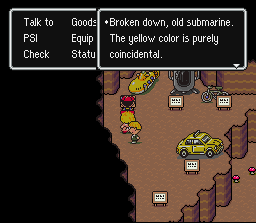
It's a living, breathing, organic world where you can call Mach Pizza and wait at the bus stop. Concerts are attended (actually, they're woven into the storyline!) and you can experiment with what condiments go on what foods. You can ride a bike and ring its bell if only for the shortest of times (or can you?). Is that a treehouse hidden in the forests of Onett? What are those two conspicuous dots lying in the Dusty Dunes Desert, and what happens if I interact with them? Who is Nico, the little girl who sings and dances in Magicant, Ness's realm of memories? What's the deal with that tiny, inaccessible house outside the stretches of Twoson?
Itoi's toy chest comparison hits the mark; indeed, EarthBound may very well be an electronic toy chest. Not in the "build-your-world" context of Minecraft and Little Big Planet, mind, but a metaphorical one; alongside its bright colors, the game's oblique projection tilts the perspective just enough to present it as a diorama, with the characters as dolls and figures you want to pick up and play with. EarthBound's character sprites are hardly as detailed as, say, Chrono Trigger, but as mentioned before, they stay just minimalized enough for players to come up with their own personalized details. (Think about it: how many different interpretations of Ness have you seen in the game's countless troves of fan art?)
One of my favorite examples involves the lone NPC you see above. You see that guy with the blond hair? Try reading his shirt. Okay, you can't, but note how it's just legible enough to make out the famous "I Heart" brand of shirts. What does he love? We don't know, but boy can we have fun filling in the blanks. (apparently Itoi loved the character as much as we did, as the NPC reappears in Mother 3) There are other favorite designs, namely how the members of Tessie Watching Club always have binoculars glued to their faces and conspicuous Mr. T lookalikes (the best possibly being a resident of Twoson, who, after a kidnapping incident is resolved, claims he'll be "careful" not to kidnap anyone. It's not nearly as suspect as it sounds, but that it's said so straight-laced always has me howling).
So while EarthBound's graphics are hardly a looker by SNES standards, they remain timeless via the player's own projection. Just take how it treats the game's sole visual stunner: the psychedelic battle backgrounds. Pulsing and fluttering around like a music visualizer, these fluctuating abstractions steal the show of the admittedly simple battle encounters. EarthBound's battle system isn't the deepest you'll come across, and you can't even see your party, but that's okay. After all, you're the star; how the kids fend off aliens with baseball bats and frying pans and bazookas and the hexagonal chaos that are PSI attacks is entirely up to your imagination.
Take an old perception of mine as some food for thought: are you fighting in the streets of Onett, or are you zapped into dimensions host to those zany 3D backgrounds? Back when I was a kid, I perceived it as the latter, and mentally framed all the battles as such. Was I taking the presentation literally as-is, or did I take inspiration from the whole "crime-fighting kids who keep their occupation secret" cartoon trope? Regardless, even now I occasionally get caught up in that little theory, and now maybe you can, too.
But if we must praise the battle system from a "game" perspective, there is no other nominee but the rolling HP meter. Whereas enemy damage is immediately applied to your characters' HP in other RPGs, any attacks here slowly dwindle down number-by-number as according to how much was inflicted. Even if you're dealt mortal damage, a serving of Hamburgers or casting a PSI LifeUp will save yourself before the ticker reaches zero. EarthBound keeps its battle just interesting enough to keep the player invested, but it doesn't go for flashiness lest it overrides its purpose of immersion.
Needless to say, EarthBound was far ahead of its time for a 1994 video game, and so much of this has to do with the excellent, excellent writing. That Mr. Itoi is, first and foremost, a copywriter/essayist should speak for itself on how different it's going to be, but consider how he's considered to be one of Japan's most eccentric. Hardcore Gaming 101's review elaborates on how the Japanese kana for the original Mother 2 projects what can be best described as a free-flowing script that, despite the childish inclinations from that sector of the Japanese language, never comes across as patronizing.
All woefully difficult to conserve in translation, you understand, and yet Mother 2's transition into EarthBound results in what's NOA's first legitimately great localization. I'm not exaggerating here: just read up on Clyde Mandelin's super comprehensive Mother 2 vs. EarthBound comparison, and you'll realize how any mistranslations that slipped by are a drop in the bucket to how perfectly it captures Itoi's tone. Bear in mind this is from the mid-90's; granted, we'd just started to figure out this "localization" business (no more "Dodongo dislike smoke!" for us Nintendo fans), but that the localizers felt the words "crap" and "sexy" were needed to flesh out Itoi's world just proves EarthBound's localization is a real gift. (Bear in mind not only had NOA been enforcing a strict "kid's only" set of depiction guidelines at the time, but the former word only just recently became standard for Fire Emblem games, while the latter remains exclusive to good ol' EB)
And what a gift the writing itself is. It's a masterful blend of wit, parody, casual speak, and occasional sincerity. Helpful one moment and sudden (but clever!) Beatles reference the next. It'll break the fourth wall, but only in ways that'll serve the game's world and the player's connection. There are two entire dungeons dedicated to gloriously parodying RPG tropes. It's not outright manic, but it's the logic behind an earlier point: you want to explore everything the game has to offer. For example, you discover early on that while not every building is accessible, you'll still receive an answer should you knock on the door. How many houses can I enter, you might wonder, and so you're encouraged to find out what lies in them. If you can't, you're at least rewarded with funny dialogue.
The NPC dialogues are really the winner here. I could elaborate on any number of them, but I particularly enjoy the ones who betray conventions. The first woman you meet in Twoson who introduces the town, for one; I dare not spoil the punchline, but I can confirm the conversation will induce more philosophical ponderings on NPCs you never thought possible. Anyone invoking wordplay (namely the Happy-Happyist Cult, who desire to paint the world blue) is a riot, and I also appreciate the wordplay behind the towns ("Twoson--we got this name because we weren't first").
Of course, the best of the best are everyone's favorite part of the game: the Mr. Saturns, a race of tiny aliens fond of ribbons, help Ness engage in introspective coffee trips, and are, at one point, held captive by sentient piles of barf. Oh, and they speak in broken English, with their font as a mess of foreign-styled scribbles (apparently inspired by the handwriting of Itoi's daughter). This results in beautiful dialogue like in screenshot above. Basically, if they don't make you at least crack a grin, you don't have a soul.
Anyone could make a case for EarthBound's quirky, innovative writing being the best part of the game, but you could just as easily do the same for its quirky, innovative score. For the sake of context, I consider the Super Nintendo to be home to the greatest soundtracks in gaming history, be it the orchestral flair of Kirby Super Star and Chrono Trigger, the rock of Star Fox, the chill ambiance of the Donkey Kong Country games, and Super Mario RPG's repertoire of xylophones, pianos and whistles remaining the very best of Yoko Shimomura. As opposed to the limited channels of NES chiptunes and the N64's weak MIDI instrumentation, the balance of synth in SNES music is almost magic in how there's no compromises in producing truly rich scores. There's a homely, warming nostalgia to it all, and you could swear early examples like Super Mario World and SimCity were scored around this very purpose.
Maybe it's how the composers built upon Itoi's love of Lennon and based the soundtrack around how much he sang about love. Maybe it's Keiichi Suzuki's non-game music background or Hirokazu Tanaka's unique approach to producing music (perhaps he took inspiration from the "living creature" sound of Metroid?). Whatever it is, it expertly plays into the game's themes. Take the concept of Ness's home: no matter how far you've gone in your journey, no matter how many countries you've travelled, you're always welcomed home with a serving of your favorite homemade food, courtesy of Mom. Even with the fate of the world on his shoulders, Ness is still, after all, a young boy.
And all the while, a slow arrangement of the Pollyanna overworld theme from the first Mother plays. If I'm forced to choose a favorite song, it would be this. It is a Lazy Sunday and a tearful homecoming all in one, topped off with what can only be described as a heavenly choir. It always, without fail, makes me feel safe and loved, makes me reflect whether I'm playing the game or simply looking it up on YouTube.
We could spot similar themes in Eight Melodies, which plays throughout the game in various forms. It echoes in toy-box form whenever a new melody is gathered at a "Your Sanctuary", and again as a whole in the game's most heartwarming scene: Ness visiting his baby-self in monochrome. It's echoed again in the Sound Stone item; a deeper introspective that gradually morphs with the more melodies you gather. But up until all are collected, it stops after your last melody and thumps with perhaps the most unique sampling: an instrumental take on Lennon's Give Peace a Chance.
Of course, EarthBound doesn't always get all mushy. Let's not forget it is a weird, weird beast, and we learn that the moment we reach the naming screen. We're greeted with the game's first instance of ear-catching dissonance, consisting of a Monty Python's Flying Circus sampling before diving into a pop beat. It's a beat so infectious that I tend to stick around far longer than I should, staring at each character's animations as I file through their lists of default names.
Actually, EarthBound doesn't just stick to samplings; at times, it pays full-blown tributes, including one of my favorite pieces above. The theme of the Sky Runner machine is undoubtedly derived from The Who's Won't Get Fooled Again, (or, at the very least, its intro) and fans had long since speculated EarthBound took so long to reach the Virtual Console due to music licensing/infringement issues, with this song at the top of the list. If that's the case, then I dub it a necessary evil that we had to wait so long, because I cannot imagine anything more perfect than the technopop launch buildup and the steady, pronounced percussion of the actual flight.
Obviously, EarthBound's music has its roots (and rightfully so!) in the Western sphere. Its parody of American culture comes alive best in Twoson, a laid-back tune I actually once wrote about. All the numbered-town tunes with their own brand of American nostalgia, but I particularly enjoy this one in how it's the sort of the tune that'd accompany a country drive. I'm also fond of the theme for the town's Chaos Theater, undoubtedly one of the game's top atmospheric tracks (just listen to all the little clinks!).
There are so, so many more I could elaborate upon---the snowy nostalgia of Winters and the Snow Wood Boarding School, the latter of which is another atmospheric winner through its borrowing of of Mother's Snowman theme. The tribal, jubilant walk of The Lost Underworld. My favorite of the psychedelic battle themes, which is reserved for mini-boss fights. The climatic fusion of 8-bit marches, rock guitars and haunting ambience for the masterpiece that is the final boss battle. The heartwrenching duo of Because I Love You and Smiles And Tears for their respective ending setpieces. There are many others.
But I fear I've shared too much already, and I haven't even discussed what I love most about the game.
The reason why EarthBound resonated so much with its fans is because while it's a fantastical sci-fi experience following the tale of four children, it's all framed within very human circumstances.Just ask the guy who grew up without a father and was comforted by how Ness communicated with his absent father through telephone (which is the game's method of saving). *Or the gay man who had anti-gay rallies take place on his street, and could only find solace in Jeff's friend: Tony, a homosexual child who dreams of taking walks with his bespectacled roommate.
*This story
was shared on a Starmen.net forum post nearly a decade ago. I've since
been unable to find it, but the tale's stuck with me as a prime example
of EarthBound's immersion.
And take me. The other factor that prevented EarthBound from falling into the American abyss--the one hooked me into the game--was that Ness was included in the roster for the Nintendo 64's crossover fighter Super Smash Bros. The character fascinated me all the way up through the GameCube's Melee:
here was a young boy who sauntered into a Nintendo all-star fray as
if he was on the same level as Mario or Donkey Kong, and all he had to
show for it was his brand of psionic powers. That was rad.
What
was even radder was how his source game ticked off every box that 4th
Grade me identified with. It was weird not just for the sake of being
weird, but was entirely self-aware (NPCs commonly mention the game's
title) and ripped on RPG tropes (the aforementioned Pencil Statue). I was out-of-touch and
awkward and the game's "neglected" status became an identifiable symbol,
a treasure hidden within the flood of "I rented Enter the Matrix over the weekend" during Circle Time.
Oh, and I also liked random humor. The likes of Invader Zim and Ed, Edd n' Eddy warped my young mind with their mall security zombies and buttered toast, and soon a new outlet of humor was born and eventually expressed through the likes of Games in the Basement and writings/drawings revolving around Kung Fu Animal Forces and Zombie Men. And now for the first in my favorite medium, I had a refuge in a game that hosted Mr. Saturns, peanut-cheese bars, and trout-flavored yogurt. Even if others didn't accept me, I was vindicated through this one game alone.
Of course, I've grown to further appreciate the game's satire as I've gotten older, but the way it's transformed the mundane into the hysterical is just phenomenal. Here's an example I've grown to recognize as one of my favorites: after collecting the first of the Eight Melodies, Ness is accosted by Onett's police (who, just so you know, are going for the world record in road-blocking) for trespassing in a restricted area, and is told to report the station. There, the chief explains that while he's aware Ness wishes to travel to Twoson, the roads shall remain blocked unless he completes a certain test. Leading him down to an isolated room, he turns to Ness and asks if he can "get past five of my best men..."
At the time, I took this at face-value. So Ness had to take on some policemen now, okay. I'd already put a stop to the biggest, baddest gang in town and took down a giant ant, and it's not like I wasn't already running over police in Grand Theft Auto: Vice City. How was fighting cops any different than stomping on Goombas? It wasn't until I was replaying it in college when I realized this guy legitimately pitted a little boy against trained policemen. Cops that chose to battle with karate chops rather than firearms, mind, but it was enough to send me into hysterics (that it was already home to some of the game's best quotes was icing on the cake).
And even still, the best examples of EarthBound's humor are those rare moments when it blends weird with the genuinely heartfelt; case in point, the Camera Man. Every so often, stepping on an unassuming spot will trigger a trumpeting fanfare as a bearded man spirals down the sky and, after announcing his profession, will snap a picture of Ness's party. He'll claim the picture will bring back the greatest of memories and, just as quickly as he came, spins back into the heavens.
That this seemingly pointless event occurs again and again throughout the game tricks you into thinking it's just one of EarthBound's gleeful methods of screwing with the player. And maybe it kind of is; I'll admit I actually hated him as a kid for interrupting my game. But right after the character roll call at the end, you realize his purpose when he pulls up a camera stand: as the credits roll, those very same photographs scroll by as Smiles and Tears instills the warmest of smiles or renders you a sobbing mess.
The very fondest of my video game memories lie within EarthBound. I was only ten and was just discovering internet forums and sprite comics and the history of a company I'd been busy worshiping for the past four years. The passion surrounding EarthBound struck me the hardest, what with the achievements of Starmen.net and their forums of teens and young adults endlessly discussing their love for the game. Naturally, a ten year old can't quite mingle with a size gap that big; my topics were frequently locked and my entries for the Apple of Enlightenment contests were nothing sort of embarrassing (I'll leave to you to guess which one is mine). But it was how I was part of a beloved secret--a masterpiece forgotten by society--that mattered most.
That, and how I learned the word "nostalgia". Imagine it: a ten year old knowing the word nostalgia! It's true. The Starmen.net hippies I idolized used the word to describe their memories of EarthBound and how Super Smash Bros. Melee glorified Nintendo history and I wanted in on whatever they were talking about. Was it the way the towns of Onett and Twoson recalled memories of a youth I didn't have, or how I imagined kids back in 1995 waking up in the languid hours of the morning and rushing downstairs to play EarthBound, or how I felt when I listened to Melee's arrangement of Pollyanna?
Whatever it was, it was the greatest feeling in the world; my most cherished secret of all. And now it's fourteen years later and I'm still playing EarthBound. It's a game that has grown up with me, gradually building upon what I adored about it as a child alongside all the trials and tribulations of being a young adult. It's a game all about nostalgia and making memories, and now I can mine that very same nostalgia I once sought to discover. The irony continues to blow my mind; I can't think of anything else like it.
EarthBound is not a game of excitement or thrills, the most common reasons people play games. In that sense, I often don't recommend as a game
game. But for games that require any sort of investment, or introduce
any sort of theme or message, or push the boundaries of what exactly is defined as a video game, it is, with the very possible exception of its own sequel, the very best video game not just
under Nintendo's banner, but the best video game you can play, on any console. EarthBound is a game that will grow the more you play it, and I eagerly anticipate to see what I'll discover next time I visit its world: where I can be a kid and an adult all in one. Say fuzzy pickles!
I haven't talked about the Star Fox series too much on this blog, have I? Not to my memory, no. I suppose it'd only make sense to initiate its Leave Luck to Heaven introduction via the first game.
The debate of Star Fox vs Star Fox 64 will surely last until the end of time, but the former is unanimously favored in one area: its soundtrack. Hajime Hirasawa's SNES score is wonderfully suited for a space-shooting 3D thriller, entertaining mixes of the rock and orchestral variety. The latter in particular is a highlighted standout, what with it contrasting the endless grandeur of space with a cast of anthropomorphic space fighters. Despite this, I've always relished in the powerful emotions it instills into me as the player, such as the heart-pounding tension of narrowly dodging the crossfire of an galactic armada and the hard-won victory following a difficult boss battle, soaring off into the distance with my trusted wingmates.
Sector Y is particularly notable for refusing to align with the battle-ready/victory fanfares of its orchestral brethren, instead opting for a soothing space waltz. An odd choice for an action-heavy game, but it succeeds with flying colors. For starters, it's a beautiful complement to the stage's vague ocean theme, with lead Fox McCloud shooting up space-bound amoebas, eels, whales and the like. It recalls similar themes used for other games' underwater levels (Hello, Super Mario Bros.!), and with the level's black expanse of space stretching out for what seems like forever, it may as well just be another underwater level.
But gosh, it's just such a gorgeous song regardless! What astounds me most about the song is how it masterfully touches upon areas not explored anywhere else in the rail-shooting realm of Star Fox. It's as soft as a lullaby, yet grand as an orchestral hall. This does not delve into the philosophical (why is the leader of Star Fox shooting down whales?), but the dreamy hypnosis it induces on the player is so palpable, so distinct that it can't be merely shrugged off. Take me, for instance: the high-score driven gameplay gradually but surely slips away as I'm whisked away into a fantastical wormhole, its brilliant colors morphing together into gentle vibrational shapes not unlike that of the Windows Media Player visualizer.
Sector Y is optimal for that moment of Zen we so desperately seek from the daily turmoil of our working lives, and I suppose that's why I often turn to it for an escape. Donkey Kong Country's Aquatic Ambience is also a stellar choice, but there's denying that it can instill some serious gloominess; in the case of Sector Y, the song is more on the netural side, so I can count on it for not letting me slide down the slippery slope of depression (nor being uplifted by the false promises of more uplifting songs; it merely refocuses me). The compounding stress of schoolwork and working on my personal projects such as this lovely blog are no match for this zoned-out waltz, and for that I'm grateful to it.
It's a shame Mr. Hirasawa never worked on any future Nintendo projects following Star Fox, as I would've loved to see his fantastic sense of genre into more classic video games. However, I suppose that is why this particular soundtrack is so unique and treasured, for there truly is nothing quite like it.
Final Thoughts: Man, I should write about Star Fox one of these days. It'd be fun to rip apart Star Fox Adventures.
--
Hmm...three Biweekly Music Wednesdays in a row. I think I hear Kirby calling me.
Not even a week after Kirby Super Star's release in North America in September 1996, the Nintendo 64 launched with the revolution that was Super Mario 64. While not the first of its kind (that is, a 3-D game), it was certainly what turned people's eyes around to the endless possibilities of the new genres. No longer were developers shackled to the confines of two-dimensional space, as the awe-inspiring scope of Bob-omb Battlefield proved that game direction could be taken as far as the imagination allowed it. Companies quickly shifted gears in their development processes, whether it be direct knock-offs of Mario 64 or reconstructing obscure genres (such as Metal Gear Solid's take on stealth). Stragglers such as Klonoa and Mega Man attempted to prove 2-D gaming still had its place, but the public's captivation said otherwise.
With this in mind, it immediately strikes the retrospective game historian as being rather odd that Nintendo would continue bothering with the already-archaic 2D-focused Super Nintendo. Do not misinterpret me: I am not with any shortage of love for Nintendo's greatest home console, but why focus on an ancient console when your current one is struggling to gain a successful foothold? It's possible they assumed the two systems would be joint successes such as how the NES/SNES were previously, but with third-parties rapidly jumping ship to a more compatible contender (the disc-based Sony Playstation), it would seem rather obvious the N64 would need all the support it could get.
But as still remains the case today, debating the origins of Nintendo's infamous stubbornness will yield not answers but instead endless headaches, so we may as well accept and analyze the cards we were dealt. From a purely Japanese perspective, the aging Super Famicom was still quite healthy. Game distribution remained active through online (the expensive Satellaview add-on) and mail order (The Nintendo Power service; not to be confused with the American magazine of the same name), the most notable games including a Mario-themed Excitebike title, a Kirby spin-off, and a notoriously difficult Fire Emblem. I cannot speak for Japan on their opinion for what seemed to be a rather inconvenient method of acquiring games (although said inconvenience and the failure of Famicom Stories: The Forest of Beginnings to bear potential financial fruit may be satisfactory hints alone), but regardless it stands in rather stark contrast to the bare lineup of American SNES titles; in particular, the circumstances surrounding Kirby's Dream Land 3 stump me. This is not to slight the game's quality, but I absolutely cannot imagine this being released in the same year (1997) when the N64 set the standards for the home console shooter via the instant popularity of Goldeneye 007, when the Zelda faithful were salivating over every shred of detail surrounding the upcoming Ocarina of Time, and--most damningly of all--within the very same month where Diddy Kong Racing was set to break the then-world record of being the fastest selling game ever released. As expected, despite sharing the name of the popular Dream Land Game Boy games, the game was forgotten as quickly as it came.
It's due to this obscurity (among several other factors I'll discuss shortly) that Dream Land 3 was branded as something of a "black sheep" within the Kirby family tree--not something I entirely agree with, mind you, but it's not so surprising as to why it received that unfortunate label. First and foremost: the "crayon" graphics, while certainly ambitious in its own right, instantly divided players in a manner akin to the much more infamous Yoshi's Story; in other words, one either adored Dream Land 3's unique charm or found it not only too childish but also rather alien to the previous Kirby aesthetics they had grown accustomed to. I can understand these opinions (though sadly I still struggle comprehending anyone who despises the similar Kirby's Epic Yarn), for the game is not without its problems but it is this very alien nature that draws me to it.
-----
One reason why Kirby's Dream Land 3 struggles to maintain a positive public identity is that of its successful predecessor: Kirby Super Star. The mechanically ambitious 1996 title was designed around the ideal of constructing the grandest Kirby game yet on 16-bit hardware and had satisfied all its fans on that front, so to develop a title with a lesser focus on gameplay renders it rather off-putting to more than a few people. Given that I had played the two games within the relatively same time period at a young age (beyond their years of release, at that), I found no difficulty in separately enjoying the games on their own; in particular, the graphical direction of Dream Land 3 was more than enough to hook me. Now that I'm a young adult can see their differences, and my research of the series points to one very obvious culprit: the change of director.
As established within my Dream Land 2 editorial, Shinichi Shimomura is by no means a Masahiro Sakurai. How he got away with the bizarre juxtaposition of the two worst introductory worlds ever crafted within the 2D platforming genre and a gradual ascension into a near-masterpiece is beyond me, and during my venture within the Dream Collection I was dreading the same mistake would pervade his later two games. While Dream Land 3 isn't nearly as bad as its Game Boy brother in this regard, there is a definite tedium within its early stages that's obviously not present within Sakurai's Kirby titles. But if the SNES title truly has anything over Dream Land 2, it is its possession of the single ambition that matches Kirby Super Star: its aesthetics.
Utilizing the very same SA-1 graphical chip that lent Super Star its graphical prowess, Dream Land 3 makes use of what's apparently dubbed "pseudo high-resolution", cleverly building upon the dithering effect (a graphical technique that pushes systems beyond primary color boundaries by "blending" opposing colors) normally reserved for Sega Genesis games. By blending adjacent pixels, the normally bright colors that populated Kirby's world are faded into a style that cleverly mimics a unique mixture of pastel drawings and sketchy scribbles. The detail-strewn backgrounds and exuberant character animations of Super Star are nowhere to be seen: everything is kept simple.
As much as I adore Super Star's explosion of colors and usage of CGI, there is no denying Dream Land 3 held the crown for being the most visually distinctive Kirby game for thirteen years. What amazes me most about the game is that it yet another juxtaposition: it pushes the Super Nintendo to its limits with a creative graphical process, but what is ultimately presented is something so purposely, deliberately soft that it looks as easy as a child's daydream. One may instantly think of the similarly pastel-driven nature of Yoshi's Island, but the two games only share similar backgrounds; the lively, animated spritework of Yoshi's Island are independent of the immaculate detail found in the background/foreground, while Dream Land 3 applies its blend of crayon and pastel to everything on the screen (aside from several of the pick-ups, which take on a simple 8-bit look). Dream Land 3's aesthetics have more in common with an infant's Winnie the Pooh blanket--subdued colors, traces of pastel, and character designs that instantly appeal on being "cute" as opposed to the more stocky, expression-driven characters of the past.
This is not to downplay the cuteness found in Kirby's first four years, but those games (save Super Star) were no different than the deformed, ambiguous 8-bit sprites of yesteryear. With Dream Land 3 arriving in an era where an abundance of detail left little imagination to the player, there is a very obvious aesthetic direction into the realm of overt cuteness that was never present before in the series -- forget the artstyle, just look at the beadiness of Rick the Hamster's eyes (or any character, really) or the lovey-dovey nature of Kirby and Chuchu's parasol cruise! Of course, Dream Land 3's irrelevance rendered any irritation vastly inferior to the vast disappointment met with Yoshi's Story -- another ill-fated cutesy platformer that came out not long afterwards--but I still imagine some frustration with the game was met with older audiences (even I confess to having my limits: I object to the name "Love-Love Stick", granted to the weapon Kirby wields to battle the final boss. I mean, seriously?)
Any qualms with cuteness are, however, ultimately nitpicks, for I find Dream Land 3 to be quite a charming looker. The backgrounds in particular I find interesting: a good chunk of 'em are no more detailed than the settings found in toddlers' picture books, but others get away with some surprising artistic choices, such as exclusively using watercolors to depict the molten-rock laden underground...
...to the pale birch trees resting near a shore. I've always associated these trees with something akin to sickly depression--peeling bark, y'know--and yet their presence within Dream Land 3 feels completely natural thanks to the similarly light pastel.
Indeed, the aquatic Ripple Fields world is host to some of Dream Land 3's strongest designs: including the aforementioned birch trees, the game presents more foreign locales with realistic lakesides and islands dotting the distance. It's the closest the series has ever traversed outside the boundaries of fantasy, providing a taste of something more akin to Donkey Kong Country 3 than anything in a bubbly children's game. The only representatives of the imagination are a stunning ocean-scenic temple home to cascading waterfalls--the veteran Nintendo fan can't help but ponder how such a concept could work in Zelda--and a pair of muffin-shaped islands surrounded by puffy clouds. As powerful as the temple level is solely on the grounds that its design has yet to be mimicked in future titles, the puffy islands remain my personal favorite background piece solely due an incredibly minor detail of absolutely no significance to the game itself, and yet my nostalgia for it is fierce.
Check out that house. Players have witnessed a similar detail in Kirby Super Star, but that ended up being the location of the heavily abridged Castle Lololo. Here? We never get a chance to drop in, and yet my young imagination was held captive by it. Who lives there? Why did they choose to live in the middle of an ocean? Was it a homage to Muten-Roshi's island in Dragon Ball? It is only a speck in the distance, yet it is the only drop of character placed within Dream Land 3's background props. Super Star's backgrounds were so luscious and beautiful that I immediately dove into the reverie they produced, yet here I contemplated and imagined. It bears for me the same enticing mystery of Super Mario Sunshine's book, one where I can have an eternity to craft an answer; an answer that I can continue to compose and revise much as I please.
So while the background don't get quite as CGI-intensive as Super Star, there are still some impressive effects going on with the foreground. Nothing that usually affects the actual game (unfortunate, but we'll get to that particular problem later), but still nice to look at. By far the most impressive is the forest level at the end of Grass Land, where the tree bushes transparently cover the level.
Complementing the muted graphics is an equally muted sound direction. I state the word "muted" with some difficulty, as the soundtrack frequently shifts between soft lullabies and hyper-frantic marathons, yet I can't help but notice just how soft the sound effects are. The explosions and rumbles that proliferated throughout Super Star are now relegated to simple pops and snaps, further reducing the frantic nature found before. The Shotzo cannons that frequently plague players are the best example of this; it's not like their barrage of cannonballs detonated with fury before, and yet it's suddenly so distinct when they audibly fire with all the force of a pebble dropping to the ground. The way Dream Land 3 commits to this soft nature--sound and graphics and even the impact of Kirby and co.'s attacks--is no doubt the reason why the game is so divisive, yet you cannot deny its dedication to remain that way throughout. My personal take? It's not perfect--I care not for the cheerier songs of the soundtrack--but I love the overall execution.
This unusually soft sound direction is why I've always been awed by the powerful roar that accompanies the game's level select screen, which presents Kirby's home planet Pop Star in the reaches of space. It's something that should be completely at odds for the setting: like everything else in Dream Land 3, the pastel-inspired stars would be more at home with glow in the dark stars decorating a baby's ceiling (the limited movement also calls to mind that of crib mobiles) than the eternally cold abyss of space. I've actually always been a little creeped out by how the game can instantaneously traverse on the boundaries of darkness--whether it be this sound or the theme of the final level--before going back its kid-friendly them as if nothing happened (going back to the final boss again: did I mention the boss in question spills and attacks with a red substance that's alluded to being blood? Yeah.)
Jun Ishikawa takes the helm once again for the soundtrack, though shifts the music style in accordance to traditional Kirby flair and the unprecedented soft aesthetic. Often Ishikawa appeals to the latter to some level of success -- the stronger emphasis on softer, relaxing tones leaves little room for the catchy hyperactivity of the past (as opposed to the balance found in earlier titles), but the soundtrack here emphasis a different sort of pleasantness hardly echoed before in Kirby. The softer themes found in, for example, Adventure's Rainbow Resort and Dream Land 2's Cloudy Park were deliberately majestic in their heart-soothing melodies that they were bound to make an impact on the player, yet Ishikawa takes a different route with Dream Land 3.
The theme of Dream Land 3's opening level--which you could label as the main theme of the game--is optimal for explaining this. While there are clear inspirations from Dream Land's Green Greens theme, (particularly the beginning), it's more lax than the typical cheery flair of Kirby. A good chunk of Dream Land 3's songs produce a more atmospheric quality that fit rather well within its aesthetic brand of watercolors and pastel. Atmospheric game music typically suffers from the unfortunate side-effect of being readily forgotten soon after playing (looking at you, Skyrim); make no mistake, while Dream Land 3 has the same issue, there are some standouts within its soundtracks. This particular song has always been one of my favorites, calling to mind a child merrily running through a wide, open field of dandelions.
I've also always been fond of this Ripple Field theme which, you guessed it, plays in the level starring the aforementioned house. It possesses a sense of urgency not unlike the island portion of Super Star's Revenge of Meta Knight, yet I further appreciate its echo to Dream Land's Float Islands's permeated nostalgia. However, I associate this song less with Dream Land's gooey warmness and more with a fleeting reminiscence: chasing for a hint of memory down the beach, something to jar the memory. Searching, finding for answers to a life-changing mystery. The house, maybe?
With this emphasis on softness through both graphics and music, the series' trademark sense of hyperactivity is lost to a more deliberate tranquility. I take no issue with this languidness by itself; indeed, I adore the graphics and I like the music well enough, and I appreciate what they set out to do. It can't be said that any other platformer in its age exuded this much pleasantness--however alien, yet perfectly natural to the world of Kirby--and the way it instills peace into the player is to be commended.
The problem here is the effect on gameplay.
Back when I reviewed Kirby's Epic Yarn upon its
release over three years ago, I described it as something of a
"relaxation simulator", as the game's alluring yarn-inspired visuals send the player
into a blissful, nostalgic state. If that sounds familiar, it's because Dream Land 3 works the same way; unfortunately, it is only to a considerably lesser degree. Given the premises involved with Epic Yarn (Kirby's
transformation into yarn, the technological advancements relative to the time of
its release (gorgeous felt effects) and what was expected of the series
(Kirby's transformations),the Wii game had to innovate with foreground to prove its new aesthetic would provide a compelling game experience. Dream Land 3 isn’t required to do so and takes little risk to expand on its own identity, which admittedly would be fine if it didn't result in weaker platforming.
In fact, it can actually get downright lazy. The perfect example is found at the first level of Cloudy Park; take a gander at that screenshot above and note the barren, vastly uninteresting landscape and boring background that composes its beginning. It remains sterile throughout, only bothering to add in pointless dips in the landscape and a wholly uninteresting outdoor tunnel sequence. What makes it even worse is the level waits until the very end to utilize the world's "sky" theme (the transparency of the clouds in the picture above shift into solid versions, obscuring Kirby's location from the player), rendering the level a rather bad first impression for the new world.
So yes, it does have the same stage design problems as Dream Land 2, but doesn't start out as being nearly as brain dead. Unlike that game's gradual ascension into quality, Dream Land 3 suffers from uneven level design throughout and never lands on a consistent state until the late-game Iceberg world (which is great). We can be thankful it also never reaches a consistency of tedium, but for as much as the game commits to simplicity, one can't help but wish Dream Land 3 pushed the admirable effort found in its graphics fully across the board.
Unlike its Game Boy predecessor, however, I am quicker to forgive Dream Land 3 not entirely on the basis of its glorious art, but for expanding upon what was fun in the previous title: the partner system. Rick, Coo, and Kine all return to grant Kirby their power-siphoning prowess, complete with the same repertoire of powers found in Dream Land 2 that, while limited in number (particular when, again, compared to Super Star), are a blast to use. While they're still a blast to use, they find themselves outshone by three more newcomers: Nago the Cat, Pitch the Bird, and Chuchu the...Octopus? Squid? Blob?
As the three original partners still retain their Game Boy abilities, the Super Nintendo-powered feats of Kirby's new friends provide far more attractive choices. Rather than simply exuding Copy Abilities from their bodies, the newer trio instantly appeal on their colorful takes on old favorites, whether it be joyful playness(Kirby and Chuchu merry-go-round in an upside-down spinning parasol), comedic (Nago repeatedly slams the shit out of Stone Kirby, a personal favorite of mine despite its short range), or just plain cool (Kirby manually guides an electrified Pitch via remote control).
Dream Land 3 is also host to its own unique Copy Ability: Clean, in which Kirby sweeps up foes with a broom. Much like Parasol, its tongue-in-cheek nature makes for some great laughs, as used by itself or through Kirby's partners when they're mercilessly slaughtering Waddle Dees. Particular standouts include Nago (who utilizes Kirby as a washing rag and slides on the ground), Kine (who turns Kirby into a plunger just because), and Chuchu (who rides on Kirby transformed into a magic broom).
The only faulty newcomer in Kirby's camaderie is the CPU/2P-controlled counterpart Gooey, who I still struggle to make sense of. The character is a visually endearing counterpart to Kirby--what with the dopey countenance on his doughy round shape, yet I care not for the gameplay execution; single-player wise, anyway. He's useful for 2P play since he can mimic Kirby's Copy Abilities, but as a summoned CPU, he's an inconvenient burden that divides half of Kirby's health. This would be a fair trade-off if he wasn't constantly gobbling up everything in Kirby's path (thus stealing any potential Copy Abilities you'd want to obtain), and he can't even utilize Copy Abilities when in the control of the CPU. He was better left in Dream Land 2's bag.
Yet I still occasionally summon him for kicks, regardless. Part of why Dream Land 3's aesthetic ultimately charms me despite its mistakes is that I find the uncanny jolliness of its cast--whether it's the aforementioned merry-go-round parasol of Kirby/Chuchu and pretty much anything related to Nago or Kine--rather hysterical when contrasted to the game's bleaker scenery. Dream Land 3 can toss avalanches or giants boulders at me and I simply just don't give a shit about the danger presented because I'm waddling away inside the intestines of a fish while taking the form of a plunger.
Indeed, many of the powers granted to Kirby and pals never reach the heights of flashiness found in Super Star, but that's okay. Dream Land 3's slower pace works very well to the advantage of its graphical/sound themes in framing the game as an epic adventure but something more like a walk in the park. A dash along the beach. A trip to the sky. Another lazy Sunday afternoon. It's languid, but it's a soothing sort of languid that echoes the faint nostalgia within the deeper recesses of your brain. For me, I'm reminded of the blank, silent observations during my adventures in the outdoors, or the one family walk I had some fifteen years back.
It's why I'm so fond of the game's sub-quest regarding the collectible Heart Stars, which involve solving stage-specific tasks such as reuniting a toad family, retrieving a juggler's blocks, and helping an angel find her wings. The results are genuinely charming in the same manner of Zelda: The Minish Cap's Kinstones in establishing a connection during a chance encounter with a familiar face (Nintendo cameos such as running into Samus from Metroid) or expanding upon the game's cast (Rick the Hamster has a girlfriend?). Even from a pure gameplay perspective they can actually get rather difficult, and Dream Land 3 is at its strongest when the levels revolve around them. A personal favorite involves a cameo of the NES R.O.B peripheral, where you have to search and assemble its parts within a pyramid that's host to backgrounds straight out of Earthbound's battle sequences. You could always just ignore them, I suppose, but then you get the Bad Ending and those always make you feel guilty.
By itself, Dream Land 3 is merely an interesting experiment that's sole ambition revolves around its aesthetics, which even on their own accord have succeeded in turning off a fair number of Kirby fans. Much like Dream Land 2, I cannot ignore the flaws that could potentially break an earnest game, yet I cannot bring myself to take them too seriously. Whatever laziness it produces within its own aspiration is overriden by just how damn pleasant it is to play and even witness, and I am unable to resist its unique brand of watercolor placidity. An objective evaluation could settle for it being just another good Kirby romp, yet I'll admit my own bias in what it sets out to do elevates my opinion to Dream Land 3 achieving the barest minimum of greatness.