I wasn't as happy with this one as I liked; I mean, given that I had to do five reviews in one month, I guess there'd be at least one review not up to snuff, but Volume 91 set such a high standard that I'd like to model my manga reviews around it going forward.
I'm still quite proud of this one -- I knew from the beginning I simply had to discuss Otama's cheeks, and from there that spiraled into a 1000+ review complete with visual showcases. Needless to say, I set a standard here I'd like to follow.
Have I been making it obvious I don't like Whole Cake Island? Goodness, I almost feel as exhausted as I did back in the weekly serial. Reverie and Wano can't come soon enough!
Waaaaaay back when I first started this blog, I mentioned I may deviate from games to talk about how much I love One Piece, and now I finally can! Of course, I reviewed One Piece: Unlimited World Red a few years back, but that's not quite the same.
Anyway, expect The Promised Neverland and My Hero Academiathis week. I'm also planning to review Hiromu Arakawa's Silver Spoon at this month's end; so excited that's finally coming here!
Note: This review was originally published in 2014 for Gaming Grunts,
which went under some time ago. Having recently salvaged most of my
articles on there, I've decided to give them a new home here for
archival purposes. Please bear in mind they differ in structure from
this blog's reviews, and be sure to join me at the end for a bonus
reflection!
The Japanese mega-hit anime/manga One Piece once again lands on
Playstation 3, this time with the latest installment in the Unlimited
series. Unlike the pure brawling action of the Pirate Warriors series,
Unlimited World Red emphasizes the beloved adventuring of the source
material, featuring the Straw Hat pirate crew exploring distant lands
and collecting materials and crafts alongside combat. With new
characters designed by series creator Eiichiro Oda, Unlimited World
Red’s resume is off to a great start…but alas, some head scratching
flaws and downgrades render the game appealing only to hardcore One
Piece fans.
STORY
As if the World Government didn’t have enough on their hands, the
legendary pirate Redfield has resurfaced! He wastes no time in attacking
Marine forces, but why do his companions sport some familiar
faces? Meanwhile, the Straw Hat Pirates–the series
protagonists–accompany a tanuki named Pato to “the Island of Promises,”
but is the talking critter all that he seems?
Anyone who’s intimately familiar with the term “anime filler” should
know what to expect: nothing special. While Redfield and Pato fit in
with the Straw Hat crew just fine and–to their credit–have some
genuinely touching scenes by the game’s end, the story just can’t lift a
candle to Oda’s hard-hitting original themes. The after-school special
themes of “it’s never too late to give up” simply don’t gel with One
Piece and it even clumsily enforces plot twists just for the sake of
plot twists. For what it is, it’s still tolerable, but don’t expect to
be blown away.
GRAPHICS
With cel-shading being the go-to presentation for anime-based video
games, it’s no surprise Unlimited World Red heads down the same path.
The characters are true to Oda’s overly-cartoonish artstyle: full of
exaggerated body proportions, hilarious facial expressions and bright
colors everywhere. Any fan can tell it’s also a good sign when the
new Oda-designed characters fit right in.
But that’s just the characters. Developer Ganbarion has always
struggled with graphical presentation in just about every other area,
and Unlimited World Red is not exempt from this. Embarrassing Nintendo
64-levels of draw distance “pop-up” effects are a common sight, and it
wouldn’t be a stretch to say environmental textures and models would
feel right at home in the early PS2 era. If only the same care given to
character animation was shared across the board.
HUB Unlimited World Red introduces Transtown (before you ask, no, it’s
not home to the gender-ambiguous “okama” of the series), a budding port
town that serves as the game’s hub. In exchange for free lodging, the
Straw Hats are roped into a material-gathering scheme to help the town
expand. As the pirates discover gold and nab loot from their adventures,
they’re able to contribute their hard-earned materials for crafting new
tools, pay off construction for new facilities, and even contribute to
the local museum.
Home to disposable mini-games and infrequent music transitions,
completionists might still find some worth in Transtown. Of particular
note are with the numerous expedition/mission requests; with DLC thrown
into the mix, hunting treasure and tracking down familiar
outlaws can keep players busy. Having Luffy’s Gum-Gum Rocket as an
interactive quick-jump is also a fun–and much appreciated–touch.
ADVENTURING
By far the most disappointing aspect of the game is how Unlimited
World Red has stripped down the series’ core element: exploration.
Whereas in earlier games it was fun to get lost in exotic jungles and
caverns, areas are stripped down here to a more linear model.
Progression comes packaged with all the excitement of exploring your
nearest hallway, and so the novelty of revisiting fan-favorite locales
such as Alabasta and Marineford is rendered rather dull.
This isn’t so bad in the aforementioned mission requests since the
streamlined level design eases their progress, but it comes across
as cookie-cutter and lazy in the actual campaign. Even worse, those
interested in collecting materials and insects and the like will find
the process to be a laborious, tedious process, as it just consists of
revisiting the same flat planes over and over. So rarely does the game
apply any twists on level design (such as Skypiea’s maze-like jungle)
that it makes the player wonder why they even bothered.
Even the unique actions for each crew member feel superfluous; for
example, crew archaeologist Robin could once decipher hieroglyphics for
clues, yet the equivalent action here grants the player a coconut (wait,
what?).
COMBAT
“Clunky” is appropriate for describing Unlimited World Red’s combat.
Combat in earlier games ran smooth as butter, yet Unlimited World Red is
rather sluggish in comparison. Excluding the gauge-consuming special
moves, attacks barely feel like they’re landing on enemy characters and
it takes forever for many of ‘em to keel over.
It’s not totally throwaway, though. Fighting side-by-side with fellow
crew members provides for a somewhat engaging experience, and there are
some undeniably cool maneuvers characters can pull off; in particular,
fans should get a nice kick out of how Cyborg Franky’s carpenter skills
are put to use in the heat of battle, and witnessing Brook’s hypnotic
musician skills is always a delightful sight.
COLISEUM
Based off the current Dressrosa story arc in the original series, the
Straw Hats–along with fellow pirate Trafalgar Law–enter Donquixite
Doflamingo’s Coliseum tournament in hopes of winning whatever mystery
prize the warlord has in store. Anyone who’s familiar with the series
should know Doflamingo is not the type to hand over anything so easily,
and rumor has it he’s pulling some strings with his Marine contacts…
Unfortunately, while the Coliseum is a decent diversion via solo and
multiplayer, there just isn’t enough variety for the player to chew on.
Fights often boil down to one-on-one duels or fending off mobs, and
while the original story involves recent new characters, its
predictably struggles to maintain further interest. Its saving grace are
the unlockable promises of fan-favorite characters (including Ace,
Jimbei, and Crocodile), yet one can’t help but feel their potential is
wasted here.
SOUND
True to the anime, Unlimited World Red utilizes classical-style music
to express the romance of adventure. While there are a couple of
stellar tunes expressing the grandeur of The Grand Line’s imaginative
locations (such as the sand kingdom Alabasta and the floating
islands/jungles of Skypiea), much of the music comes across as overly
typical classicism or just simply misplaced. Fans who remember the
daunting government facility Enies Lobby will be perplexed as to why
its accompanying score would suit a walk in the park, and it’s a shame
how woefully inadequate the song for the ravaged Marineford is.
Thankfully, the immaculate, ever-present Japanese voice cast from the
anime step in for their roles. If you’ve watched the show in its native
language, you understand what they’re capable of, and therefore know
they’re practically perfect at what they do. Redfield and Pato are
provided some nice pipes as well, although in the end I wished I could
have seen their full potential in Oda’s hands.
Summary
Unlimited
World Adventure is a decent diversion for One Piece fans, yet its
half-baked features are too jarring to overlook. While fun can still be
mined from the title regardless, it's a shame the title is so stripped
down from what made the series fun. Only hardcore One Piece fans should
give it a look.
6/10
PROS
Great character animation; models are true to Oda’s art
Cool new characters
Transtown provides some fulfilling sidequest material
CONS
Focus on linearity renders general gameplay tedious
Combat feels clunky
Poor graphical presentation aside from character models
Coliseum feels throwaway
Uninspired, clumsy music score
Bonus Reflection: Honestly, I haven't touched this since I reviewed it. It's weird how Unlimited Adventure wasn't even that great, yet that they downgraded what was good about it in an Oda-involved game is really disappointing. I doubt another in-depth review courtesy of Worldly Weekend would differ much from what I've written down here (however, rumor has it another One Piece game might be hitting the column soon...)
By the way, the new Zou arc in the manga is just incredible. Those cat gags get me every time.
2015 marks the 10th anniversary of when I first began reading manga; you know, those silly backwards Japanese comic books you might've spotted at Borders before its untimely demise (may it and its holy smell rest in peace). As an undergraduate with an English major, the fact that manga has constituted the majority of my reading since '05 is rather embarrassing to admit, but as my precious comics got me through a brother's drug addiction, the gloomy terror of high school and recovering from reconstructive foot surgery, it's a medium I'm much thankful for. So much did I love manga that I treated my Dragon Ball volumes like they were the New Testaments, that the poems at the beginning of every Bleach volume were considered as the finest heights of literature (stop laughing), and even requested my parents for a massive bookshelf to house all my manga in.
Today, things are a tad different. Much as I still (still!) love Dragon Ball, its flaws are far easier to discern now. I don't read Naruto or Bleach anymore, having been crushingly disappointed by their future story directions. That bookcase still stands in my room, but I've gradually recognized its position renders my volumes vulnerable to sun damage (my poor Case Closed volumes!).
But I still love manga. Even if I'm less-than-pleased with Viz's translations, I still purchase their volumes for One Piece (my favorite manga for the past eight years) and Case Closed. I dearly wish that new volumes of SGT Frog will hit our shores and that Vinland Saga will survive in America. One of the reasons I'm taking Japanese courses this fall is to collect manga that remain unlocalized (Sket Dance), were dropped midway (Gintama), or have unsatisfactory changes (Shaman King).
If you haven't picked up on it by now, I love the shonen (young boy) manga genre; to be precise, those featured in the famous Weekly Shonen Jump magazine. I guess a guy my age (23) should be focusing on seinen (young adult) manga, but, well, I already read Yotsuba&! and Vinland Saga, so cut me some slack. Just goes to show I'll always be a big kid.
Anyway, so strong is my love for shonen manga that J-Stars Victory Vs.+ actually kickstarted my shonen marathon over the past year and the half, long before it even came out in Japan. I mean, I knew the game wasn't going to be that great (after all, it's by Spike Chunsoft, the king of phoned-in anime tie-ins), but I figured it was finally time to check out classics I missed (Rurouni Kenshin) or enigmas I didn't recognize from the game's roster (Medaka Box). Just for fun, here's a ranked list of what I've read as according to the blog's ratings (albeit on more of a subjective scale):
Masterpiece
Rurouni Kenshin Shaman King
Near-Masterpiece
Sket Dance
Kinnikuman
Really Great Jojo's Bizarre Adventure Parts 1/2 Rokudenashi Blues
Medaka Box Bobobo-bo Bo-bobo Slam Dunk
Sakigake!! Otokojuku
Great
Pyuu to Fuku! Jaguar
Yu Yu Hakusho
Toriko
Okay/Mediocre
Beelzebub
Pretty solid list, eh? There's some opinions that differ from the norm;for example, I did enjoy Yu Yu Hakusho, but I didn't think the storytelling quality was all that cohesive (and as opposed to the famed Dark Tournament, I hail the Chapter Black arc as the series's highpoint). Slam Dunk was pretty damn great, but as a sports manga, it never reached the highs of Eyeshield 21 for me. I probably love Bobobo and Shaman King more than I should, but I have a huge soft-spot for goofy-ass random humor (Bobobo, that is) and the way the latter subverts the typical "defeat the final bad guy in epic fight while protagonist achieves dream" trope is nothing less than brilliant and even heartwarming.
But opinions are opinions. One Piece, Dragon Ball, Eyeshield 21, Gintama and Rurouni Kenshin remain the five Weekly Shonen Jump kings for me, yet I wonder if anything else can join their ranks. Next up on the list is Fist of the North Star and the rest of Jojo, both of which I can't wait to start after I finish rereading Dragon Ball.
Wait, what was the point of this article again? Right, J-Stars Victory Vs.+. The whole reason why it fueled that marathon was because the game itself was inspired by Jump's 45th anniversary. And what better way to celebrate that with a video game featuring all the famous Jump manga heroes and villains beating the snot out of each other? You have the Jump heroes of yore (Dragon Ball's Goku, Rurouni Kenshin, Dr. Slump's Arale, Yu Yu Hakusho's Yusuke) culled together with the biggest heroes of the 2000s (Naruto, One Piece's Luffy, Bleach's Ichigo) and...well, a lot of new guys (Kuroko the basketball player, the enigmatic Koro-Sensei from Assassination Classroom, and the tsundere romance of Nisekoi's Chitoge)
Like any Spike-Chunsoft game, the catch with J-Stars Victory Vs.+ is it's only enjoyable on a "turn-your-brain-off" level. Is it bad? Well, so long as you dive in without any expectations for the battle system, then it's pretty fun as a mindless button masher. But aside from the shiny character models, it's evident from the get-go that Spike, once again, rushed the game out to market with minimal budget.
And it kinda stings here. I mean, this is supposed to be a celebration of Jump! That the game is mediocre isn't the problem; it's how one of the most famous, prestigious sources of Japanese entertainment gets this dream video game crossover and yet that doesn't really get its due here aside from the customary fanservice. Just look at the opening intro: yeah, the fight in Naruto's Hidden Leaf Village is kinda cool, but that it's preceded by all the PS2-quality models running around in the beginning already sets the stage for disappointment.
Then there's the matter of the story mode. Man, would you look at those talking stills! Yeah, I know this isn't the first anime game to do this (there's the wonderful Dragon Ball Z Budokai 3, for one), but what's with that insanely cheesy rock music blaring endlessly in the background? Why do the cameo characters from Rurouni Kenshin and Dr. Slump have such huge eyes? Why do the Nisekoi and Assassination Classroom character conversations lack backgrounds?
I got my answer after finishing one of the four "arcs", which starred the lovable Luffy, his brother Ace and the titular protagonist of Saint Seiya. It was a huge slog as it was, and it had a story or something, concluding with boring-ass ghost versions of the three heroes and the mysterious voice (which remained anonymous) showering them with sprites of chicken dinner. I went over to start Naruto's story only to quickly recognize I was following the same exact story beats, with the same exact quests, with the same exact scripted encounters. I imagine the remaining two arcs follow the same pattern, so I can only chalk all that up to good ol' laziness. And what a goddamn shame that is.
Oh, how silly, I haven't even discussed how the game actually plays yet. Like Spike's earlier efforts with Dragon Ball, J-Stars is a 3D arena fighter divided into team play. There's assists to be summoned, and directions for your AI partner to follow (they call each other by name, so if you've ever wanted to hear Vegeta say Kenshin's name, here ya go). As said before, it qualifies for a mindless pastime so long as you invest nothing into it. It's clunky, and it always devolves into button-mashing, but the attacks register enough oomph and there's enough destructible terrain to go around. The real enemy's the camera, which tends to flip and flop around on its own will and never has a firm grasp on your player character. Consequently, it's not difficult to lose track of the overall action (perhaps this is why the support characters feel so non-existent?).
And check out that roster. J-Stars clocks in at 59 characters, providing a decent representation of Jump's history. While it succeeds in balancing out the usual suspects (Dragon Ball, One Piece, Naruto) with some relatively minor hits (Hell Teacher Nube, Tottemo! Luckyman), that emphasizes so many newer properties is rather...yeah. Okay, having Nisekoi's Chitoge as an assist is pretty cute and playing as Koro-Sensei is pretty amazing, but when legends like Slam Dunk's Sakuragi are axed in favor of the hot new basketball series, you know there's a problem (let alone how this even seeps into older IPs like Jojo; you could argue the inclusion of Jonathan and Joseph is a fresh take as opposed to Jotaro and Dio--and it is--but there's no getting around that they're in there to advertise the recent anime adaptions of Part 1 and 2).
Granted, is it that big of a deal? Dividing roster space from 45 years of history is certainly no easy task, particularly in regards to series expected to have more than one character (Dragon Ball, One Piece, Yu Yu Hakusho...the big boys, really), so I guess I'm not surprised stuff like Shaman King just missed the boat. But even then there's questionable selections; for example, while the effort to represent One Piece's massive diversity in character is appreciated, is Boa Hancock really all-star material? On the other side of the spectrum, what should be an impeccable selection of villains (Freeza, Shishio, Younger Toguro) are marred by absolute shitstains like Naruto's Madara Uchiha. I mean, I'm not surprised Naruto has three playable characters, but that what's quite possibly the most boring villain in Jump history gets to join an all-star celebration leaves me more than a little salty (and considering how he ended up being steamrolled by an even more boring villain after the fact, it stings even more). At least I'm given the option to never unlock him or Bleach's Sosuke Aizen.
This isn't even considering potential licensing issues or the presence of Jump's more mediocre franchises (specifically, Katekyo Hitman Reborn! and Beelzebub), but I digress. What is impressive is that despite Spike never working with most of the properties before, they certainly did their homework. You know that one Dragon Ball/KochiKame crossover oneshot where Ryotsu arrests Freeza for parking violations? That's referenced in here. You remember that one fight from Sakigake!! Otokojuku where the opposing schools had all the non-combatants shoved into two cages, with one doomed to fall off the mountain should their representative lose in battle? That's a stage in here. You know how people love shitting on Yamcha from Dragon Ball? You'll get a kick out of Gintoki's death pose. Actually, you'll get huge laughs out of Gin and Bobobo in general.
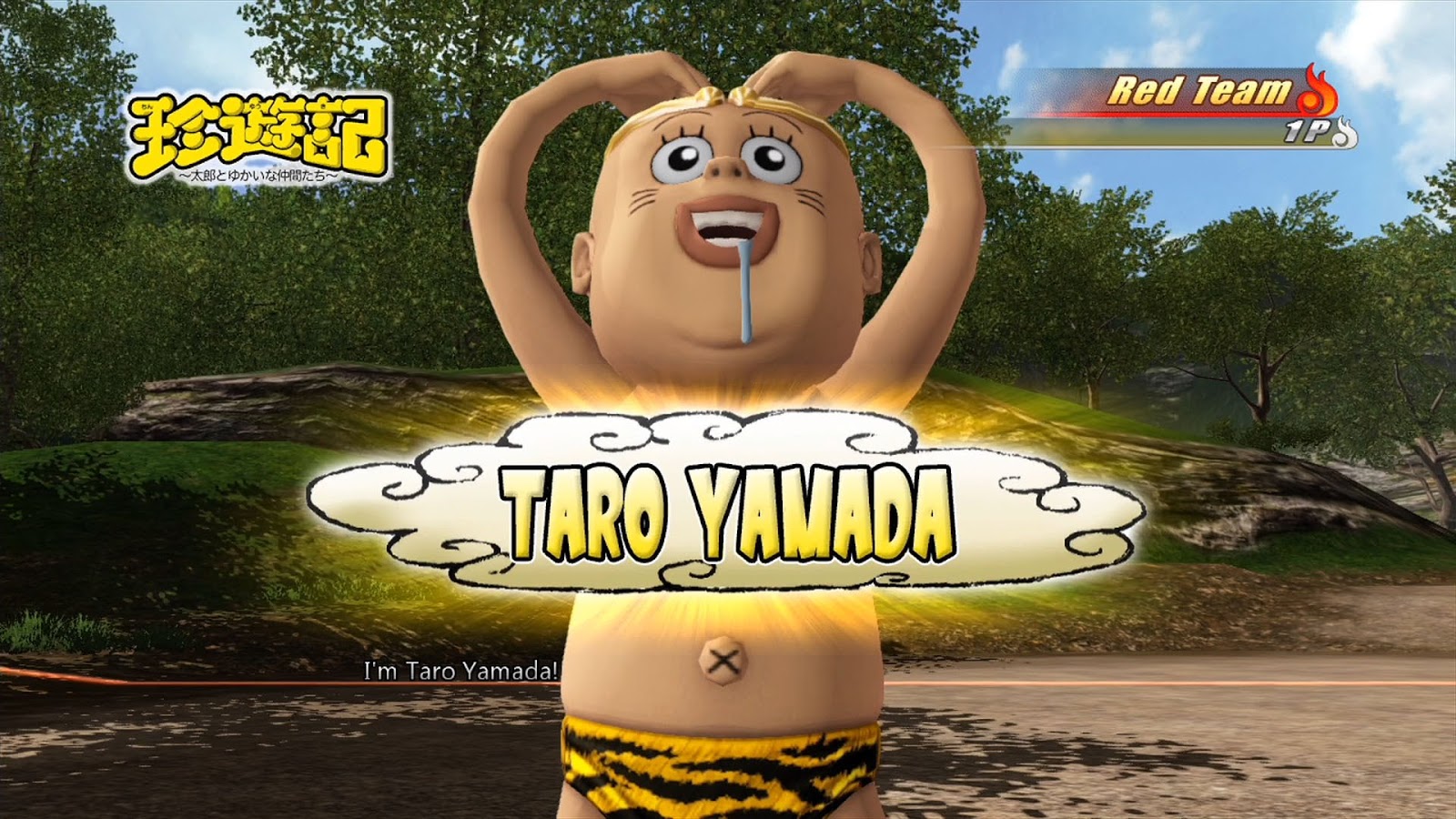
And this guy, too. The inclusion of Yamada Taro, the protagonist of Chinyuki: Taro To Yukaina Nakama Tachi, generally pissed off the English-speaking world for being gross and annoying. That it's near-impossible to find anything about the series on the English web likely didn't help, but from what I can gather he's an assassin cursed into the body of a baby/monkey hybrid after defecating on people's graves. Apparently the series got cancelled because it disturbed Jump's audience, and given how utterly bizarre his ultimate attack is (seriously, words do it no justice. Go look it up), I'm willing to believe in my new savior. Color me intrigued!
Oh, and the voices are all in Japanese with English subtitles. Given how a) publishing this game in America must've been a licensing nightmare unto itself and b) it's by and large the preferred language option by hardcore anime fans, which just so happen to be this game's audience, it's more than an acceptable compromise. Unfortunately, it's already been used as a springboard for people to hate on Goku's Japanese voice, who for for the uninitiated is performed by an old woman and American fans often mistake her performance as sounding like such. We'll discuss this in detail within a future Worldy Weekend, but as she's able to fluctuate between all three male members of the Son family (Goku, Gohan and Goten), these people are wrong and should feel bad.
But it's not like that'll matter for long, because the sloppy-ass localization courtesy of Namco-Bandai will immediately capture everyone's attention. Anyone familiar with the rush-jobs on the One Piece: Pirate Warriors series won't be surprised to see the same flood of grammatical errors and out-of-character dialogue. I'd be more lenient for the latter since I'm not expecting the average American localizer to know the quirks of every Saiki Kusuo no Psi-nan character, but apparently they still haven't gotten the hang of One Piece and Bleach characters they've worked with for years. You have Ichigo yelling "I am victorious!", Luffy possessing an expanded vocabulary ("specimen" comes to mind), and, my personal favorite, mistranslating the Skypiea island from One Piece as "Sky Pier".
Be it mistranslations ruining fun character dialogue (see if you can make any sense of the conversation between Goku and Gintoki, which was originally one of the best) or, you know, leaving over half the credits in Japanese, it's seriously shocking how little care and effort was put into this localization. Not even the series logos are translated or shifted to their American counterparts, and regardless of any rights issues involving that, when considering how roughly half of the game's cast are complete unknowns to even America's anime fanbase (let alone the general public), the character gallery alone can't settle English-speaking newcomers into this mess.
And that's what really sums J-Stars Victory Vs.+ up. For every labor of love it forges, it's all buried within a mess of design that fails to hook players for longer than a week. Be it how the fighting system lacks any sense of direction or cohesion (let alone a proper camera...), its gross excuse for a splitscreen UI in multiplayer, or the outright laziness of it's "story," it's a game completely undeserving of its brands, serving only quick laughs and things to smash. J-Stars Victory Vs.+ should not be anime game junk food, not when Shinpachi breaks the fourth wall within Gintoki's presence or when the the opening singers for Dragon Ball Z, One Piece, and Toriko collaborate to write the game's awesome theme. But it is, and that only its accompanying brands can't even salvage it into the depths of mediocrity is just, well, depressing.
Oh well, at least there's always Jump Ultimate Stars.
---
Man, to think I'd start out Worldly Weekend with two stinkers! The next game will be of much higher quality, I promise.